



How to Improve Poor Garden Soil: 9 Practical Ways to Build Healthier Soil
Looking for compost, topsoil or garden supplies?
Browse our full product range or get in touch for delivery across Glasgow and Scotland.
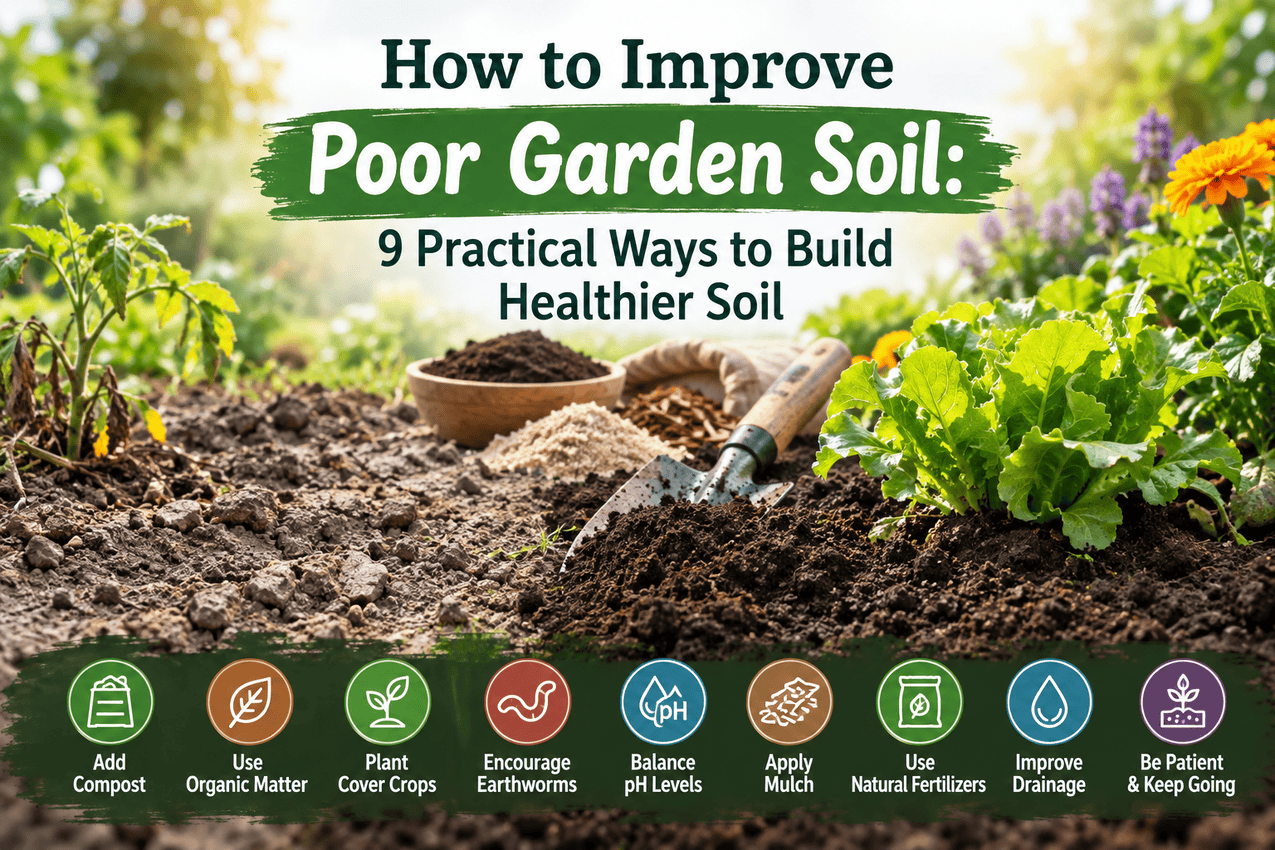
In many cases, the best way to improve poor garden soil is to add suitable organic matter, protect the soil surface, correct drainage or compaction problems, and only add nutrients when they're actually needed.
Whether you're dealing with heavy clay, dry sandy ground, compacted soil or a garden that simply doesn't seem to grow well, improving the soil is usually a gradual process rather than a one-off fix.
This guide explains how to identify poor soil, what to add to it and how to create better growing conditions for vegetables, flowers, shrubs and lawns.
Quick Answer: What Is the Best Way to Improve Garden Soil?
For most gardens, start with these steps:
Test your soil before making major changes.
Add mature organic matter such as organic compost.
Use well-rotted manure where additional organic matter and fertility are appropriate.
Avoid working soil when it is waterlogged.
Protect bare ground with compost or mulch.
Add topsoil when you actually need additional soil depth or volume.
Deal with drainage and compaction rather than simply adding fertiliser.
Use nutrients such as potash-potassium only where they're appropriate.
Keep improving the soil over time.
The important point is that poor soil isn't one single problem.
Before buying anything, work out what is actually wrong.
How Do I Know If My Garden Soil Is Poor?
Plants struggling to grow doesn't automatically mean the soil lacks fertiliser.
Poor garden performance can have several causes.
Look for signs such as:
Water sitting on the surface for long periods
Ground becoming extremely hard when dry
Soil that is sticky and difficult to work when wet
Very sandy soil that dries almost immediately
Heavy compaction
Very little visible organic matter
Poor root development
Repeatedly weak plant growth
Nutrient deficiencies
Unsuitable soil pH
Understanding the problem first prevents you from spending money on something the soil doesn't need.
For example, adding fertiliser won't solve serious compaction.
Similarly, adding topsoil isn't necessarily the solution when your existing soil simply needs more organic matter.
1. Test Your Soil Before Trying to Fix It
One of the most useful things you can do is find out what you're working with.
Start by looking at three things:
Soil texture
Take a small amount of moist soil and feel it between your fingers.
Very sticky soil that can easily be moulded may contain a high proportion of clay.
Soil that feels gritty and falls apart quickly is likely to contain more sand.
Balanced garden soil often falls somewhere between these extremes.
Drainage
After substantial rain, observe how long water remains on the ground.
Standing water may indicate poor drainage, compaction or naturally heavy soil.
Soil pH
Soil pH affects how available different nutrients are to plants.
Don't automatically add lime or other pH-changing materials without knowing your starting point.
If you haven't tested your soil before, read our complete guide to soil pH in Scottish gardens.
2. Add Organic Compost
For many gardens, adding mature organic matter is one of the most useful long-term soil improvements.
Organic compost can help improve:
Soil structure
Organic-matter content
Moisture retention
Workability
Growing conditions for roots
Biological activity within the soil
The benefit isn't simply about "feeding plants".
Organic matter changes the physical environment in which roots and soil organisms live.
That's why compost can be useful for both heavy and light soils, even though those soils have opposite problems.
How much compost should I add?
The amount depends on what you're doing.
For an existing bed in reasonable condition, a surface application of approximately 3–5cm is often sufficient for routine improvement.
At 5cm depth, you'll need approximately:
50 litres of compost per square metre.
So a 10m² bed would require roughly:
10 × 50L = 500 litres
For larger projects, use our compost quantity guide before ordering.
3. Improve Heavy Clay Soil With Organic Matter
Heavy clay soil gets a bad reputation, but clay isn't inherently poor.
Clay soils can hold considerable moisture and nutrients.
The difficulty is their physical structure.
Heavy ground may:
Become sticky when wet
Become hard when dry
Compact easily
Drain slowly
Be difficult to cultivate
The objective isn't necessarily to replace your clay soil.
Instead, focus on gradually improving its structure.
Regular additions of mature organic matter such as compost can make the ground easier to work over time.
Well-rotted manure can also be useful where additional fertility and organic matter are appropriate.
Don't work clay when it's soaking wet
This is particularly important in Scotland.
Repeatedly digging or walking over saturated clay can damage its structure further.
If the soil sticks heavily to your boots and tools, wait for better conditions.
4. Improve Sandy Soil With Compost
Sandy soil presents almost the opposite problem.
Water drains through it rapidly.
This can make sandy ground:
Quick to dry out
Lower in nutrient retention
More dependent on regular watering
Difficult during prolonged dry periods
Organic matter can help.
Adding mature compost increases the soil's organic content and can improve its ability to hold useful moisture.
Rather than attempting one enormous application, build the organic-matter content gradually.
Mulching the surface can also help reduce evaporation during dry periods.
5. Use Well-Rotted Manure Where More Fertility Is Needed
Compost isn't your only option.
Well-rotted manure is particularly useful for improving productive areas such as:
Vegetable gardens
Allotments
Established beds
Hungry crop areas
Depleted growing soil
The important words are well rotted.
Fresh manure and mature manure shouldn't be treated as the same product.
Well-rotted manure has undergone substantial decomposition and is much more suitable for general garden use.
Manure or compost: which should I choose?
Think about what you're trying to accomplish.
Choose compost for versatile general soil improvement.
Choose well-rotted manure where you're improving suitable productive beds and want additional organic matter and fertility.
Many gardeners use both at different points rather than treating them as competing products.
Read our complete guide to well-rotted manure if you're unsure whether manure is suitable for your project.
6. Protect Bare Soil With Mulch
Improving what's underneath the ground is only part of good soil management.
You should also think about its surface.
Bare soil is exposed to:
Heavy rainfall
Erosion
Weed growth
Moisture loss
Temperature fluctuations
Applying an appropriate mulch provides a protective surface layer.
Different materials are useful in different places.
Compost mulch
Mature compost can be spread over beds where you also want to add organic matter.
Woodchip mulch
Organic woodchip is particularly useful around:
Trees
Shrubs
Established perennial beds
Fruit-growing areas
Garden paths
Woodchip can help suppress weeds and reduce moisture evaporation while protecting the soil surface.
Don't pile it directly against plant stems or tree trunks.
For recommended depths and quantities, see our complete woodchip guide.
7. Don't Confuse Topsoil With Compost
This is one of the most common garden-material mistakes.
Topsoil and compost perform different jobs.
Topsoil provides soil structure, depth and volume.
Compost primarily provides organic matter and soil improvement.
You may need topsoil when:
Creating a new garden
Building new beds
Increasing soil depth
Levelling ground
Preparing areas for turf
Replacing missing or badly damaged soil
If you already have sufficient soil but it is low in organic matter, compost may be more appropriate.
If you're unsure which you need, read our beginner's guide to topsoil.
8. Fix Compaction Instead of Trying to Feed It Away
Compacted soil has too little pore space for healthy movement of air and water.
This can make it difficult for roots to penetrate the ground.
Common causes include:
Heavy foot traffic
Construction activity
Machinery
Working wet soil
Repeated cultivation
Walking over vegetable beds
Adding fertiliser doesn't remove compaction.
First, reduce whatever is causing the problem.
Avoid regularly walking across growing areas and consider creating permanent paths through vegetable gardens and allotments.
Organic matter can then form part of a longer-term soil-improvement programme.
Consider no-dig gardening
Repeated digging isn't the only way to improve soil.
No-dig gardening involves applying suitable organic matter to the surface and allowing natural soil processes to gradually incorporate it.
This can be particularly attractive for gardeners dealing with wet, heavy ground.
If you'd like to try it, see our beginner's guide to no-dig gardening in Scotland.
9. Only Add Fertiliser When Your Plants Need It
One of the easiest gardening mistakes is assuming:
Poor growth = more fertiliser needed.
That's not necessarily true.
Poor growth could result from:
Incorrect pH
Waterlogging
Drought
Compaction
Poor drainage
Root damage
Insufficient sunlight
Excess nutrients
Genuine nutrient deficiency
Adding more nutrients won't correct most of those problems.
Products such as potash-potassium have specific purposes.
Potassium is an essential plant nutrient and is particularly associated with important plant processes including flowering and fruit development.
But it should be used because additional potassium is appropriate — not simply because plants aren't growing as quickly as expected.
Diagnose first. Feed second.
How Do You Improve Soil in a Raised Bed?
Raised-bed soil gradually settles as organic material decomposes.
That doesn't mean the entire bed needs replacing every year.
For an existing raised bed:
Remove weeds and spent plants.
Check the existing soil level.
Add mature compost where organic matter is needed.
Add additional soil if significant volume has been lost.
Use well-rotted manure where appropriate for upcoming crops.
Avoid compacting the bed by walking on it.
For a completely new raised bed, don't automatically fill the entire structure with pure compost.
A mixture containing topsoil and organic matter provides a more suitable structural growing medium for many situations.
We have a separate step-by-step guide explaining how to build and fill a raised bed.
How Do You Improve Soil for a Vegetable Garden?
Vegetable gardens benefit greatly from good soil management because crops are planted and harvested repeatedly from the same growing area.
Start with:
1. Test the soil
Understand its texture and pH.
2. Add organic matter
Use mature compost as a general soil improver.
3. Use manure selectively
Well-rotted manure can be particularly useful for suitable hungry crops.
4. Rotate crops
Avoid repeatedly growing the same crop family in exactly the same place.
5. Protect the soil
Don't unnecessarily leave productive ground exposed for long periods.
6. Avoid compaction
Use defined paths rather than walking across growing beds.
Healthy vegetable soil is built over years rather than created by a single bag of fertiliser.
What Is the Best Soil for a New Garden?
If you're starting from scratch, first determine whether usable topsoil already exists.
New-build gardens deserve particular attention because construction can leave behind:
Compacted ground
Rubble
Poor-quality subsoil
Insufficient topsoil
Drainage problems
Where adequate growing soil is missing, bringing in quality topsoil may be necessary.
Organic compost can then be incorporated where appropriate to improve the growing environment.
The simple distinction is:
Need more actual soil? → Topsoil
Need to improve existing soil? → Compost
Need additional organic matter and fertility for suitable productive beds? → Well-rotted manure
What Is the Best Soil Mix for Raised Beds?
For most general-purpose raised beds, you need a combination of soil structure and organic matter rather than pure compost.
The RHS recommends a general raised-bed mixture based on topsoil, organic matter and sharp sand, with proportions adjusted according to what will be grown.
Kelvin Compost's detailed raised-bed soil guide also explains quantities and how to calculate the volume of your bed.
This matters because deep raised beds can require considerably more material than they appear to.
How Long Does It Take to Improve Poor Soil?
There isn't a universal timeframe.
Some improvements can be noticeable within one growing season, but building genuinely healthy soil is a longer process.
Think in terms of continuous soil management rather than a one-time repair.
Each year you can:
Add organic matter where required
Keep soil covered
Avoid unnecessary compaction
Rotate crops
Monitor pH
Correct genuine nutrient deficiencies
Reduce unnecessary disturbance
Over time, these relatively simple practices can make a substantial difference.
Frequently Asked Questions About Improving Garden Soil
What is the fastest way to improve poor garden soil?
Adding suitable mature organic matter is one of the most useful ways to improve many garden soils, but you should first identify whether the main problem is poor structure, compaction, drainage, pH or low organic matter.
What is the best thing to mix with garden soil?
For general soil improvement, mature organic compost is a versatile option. Well-rotted manure may be useful where additional organic matter and fertility are appropriate.
Can I put compost directly on top of soil?
Yes. Mature compost can be spread over the soil surface as organic mulch. It doesn't always need to be deeply dug in.
Is manure good for poor soil?
Well-rotted manure can improve suitable garden soil by contributing organic matter and nutrients. It is particularly useful for productive vegetable-growing areas and depleted beds.
Is topsoil good for improving poor soil?
Topsoil is most useful when additional soil depth or volume is required. If sufficient soil already exists but needs more organic matter, compost may be a more appropriate soil improver.
How can I improve clay soil?
Regularly adding mature organic matter can help improve the structure and workability of heavy clay soil. Avoid cultivating clay when it is saturated.
How can I improve sandy soil?
Adding organic matter can improve moisture and nutrient retention in light, free-draining soil. Mulching can also help reduce moisture loss.
Should I dig compost into my garden?
You can incorporate compost into the upper soil, but this isn't always necessary. No-dig methods apply mature organic matter to the surface and allow soil organisms and natural processes to integrate it gradually.
Can I use woodchip to improve soil?
Woodchip is particularly useful as a surface mulch around established plants, trees and shrubs. It shouldn't generally be treated as a direct substitute for compost or mixed in large quantities into the active growing layer.
How often should I add compost?
There isn't one schedule for every garden. Productive beds may benefit from regular additions of organic matter, while already fertile soil may require less. Judge applications according to soil condition and what you're growing.
Better Plants Start With Better Soil
It's tempting to focus entirely on what happens above ground.
But healthy plants depend on what is happening underneath them.
If your garden isn't performing well, don't immediately reach for fertiliser.
Look at the soil first.
Test its pH. Check its structure. Look at drainage. Consider compaction. Assess its organic-matter content.
Then choose the material that actually solves the problem.
Kelvin Compost supplies garden and landscaping materials across Glasgow, South Lanarkshire and surrounding areas of Scotland, including:
Whether you're improving a small vegetable bed, restoring tired garden soil or ordering material for a larger landscaping project, choosing the right product starts with understanding what your soil actually needs.
Need help choosing the right material?
Call Kelvin Compost on +44 7561 251350
Email info@kelvincompost.co.uk
Or browse the Kelvin Compost range for compost, soil, manure and mulch delivered across Glasgow and surrounding areas.
Need Garden Supplies Delivered in Glasgow?
Organic compost, topsoil, manure and more across Scotland