




Soil pH in Scottish Gardens | How to Test It & Fix It
Looking for compost, topsoil or garden supplies?
Browse our full product range or get in touch for delivery across Glasgow and Scotland.
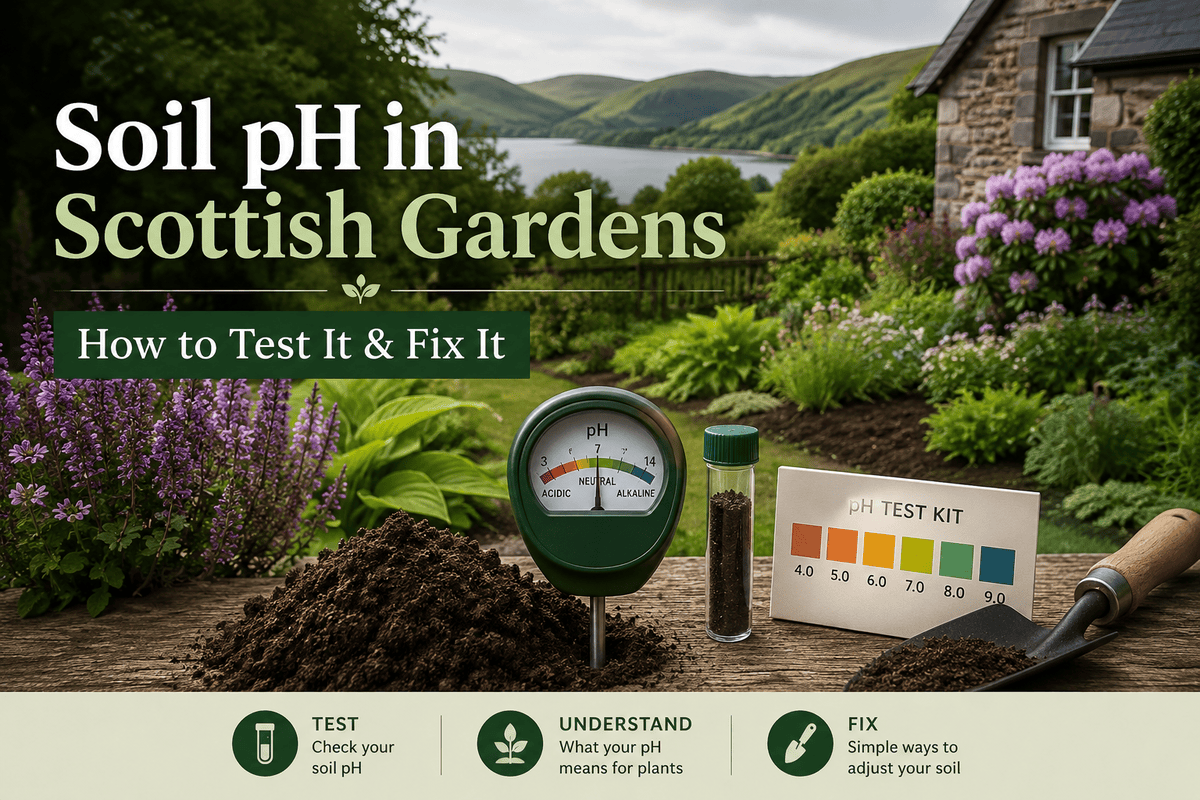
Short answer: aim for around pH 6.5 for a general garden — that's where nutrient availability, worm activity and soil bacteria all peak. Scottish soils naturally drift acidic because our rainfall leaches calcium out of the ground, and nearly half of samples tested through Scotland's Soil & Nutrient Network farms come back too low. Test with a £10 kit before you do anything, because liming without testing does more harm than guessing usually does.
Soil pH is the most useful number in gardening and the most commonly ignored. If your brassicas keep failing, your fruit disappoints, or you've been adding fertiliser for years with nothing to show for it, this is very often why — the nutrients are in the soil, but the pH is locking them away.
What pH actually measures
The pH scale runs from 0 to 14. Below 7 is acid, 7 is neutral, above 7 is alkaline. It's a logarithmic scale, which matters more than most gardeners realise: pH 5 is ten times more acidic than pH 6, and a hundred times more acidic than pH 7. A change of "one point" is a large change.
The RHS bands it like this:
| pH range | Description | What it means for you |
|---|---|---|
| 3.0–5.0 | Very acid | Most crops struggle; phosphates locked up below 5.1 |
| 5.1–6.0 | Acid | Ideal for ericaceous plants — rhododendrons, blueberries, camellias |
| 6.1–7.0 | Moderately acid | Nutrient availability at its highest; worm and bacterial activity optimum |
| 7.1–8.0 | Alkaline | Iron and manganese become less available; ericaceous plants fail |
pH 6.5 is the best general-purpose target for a mixed garden or vegetable plot. It suits nearly everything except deliberate lime-haters.
Why Scottish soil goes acidic
This isn't bad luck or bad gardening. It's geology and weather.
Rain is mildly acidic, and it dissolves calcium and magnesium out of the soil and carries them away in drainage water.
The more rain, the faster this happens — which is why the west of Scotland acidifies more quickly than drier parts of the UK. Growing crops removes more calcium every harvest, and some nitrogen fertilisers accelerate the process further.
Scottish soils span roughly pH 4 — very acid, where most crops fail — to about pH 8 on ground naturally rich in calcium or magnesium. The low end is common: Scotland's Farm Advisory Service reports that nearly half of soil samples from its Soil & Nutrient Network farms show low pH. If commercial farms who monitor this are running acidic, the average unfed Glasgow back garden very likely is too.
There's a local wrinkle worth knowing. Old urban gardens and allotments in Glasgow sometimes sit on made ground containing builders' rubble, mortar and ash — all of which are limey. It's entirely possible to have one alkaline corner and one acidic corner on the same plot. Which is the whole argument for testing more than one spot.
How to test properly
A DIY kit from a garden centre costs a few pounds and is accurate enough for every decision in this article. The technique matters more than the kit.
Take multiple samples. One test tells you about one trowel of soil. Take five or six samples from different parts of each area you care about — the vegetable beds, the lawn, the borders — and test them separately, or mix each area's samples together into one composite sample per area.
Sample from the root zone, not the surface. Scrape away the top few centimetres of mulch and leaf litter and take soil from around 10–15cm down. Surface material tells you about your mulch, not your soil.
Avoid odd spots. Don't sample right next to a wall or path — mortar leaches lime and will give you a false alkaline reading. Skip the compost heap's footprint and the bonfire site.
Use rainwater or distilled water, not tap water, which in hard-water areas is alkaline enough to skew a reading.
Test every 4–5 years. That's the recommended interval for monitoring drift, and pH changes slowly enough that testing annually is a waste of kits. Do test again a year after liming, though, to see whether it worked.
When to send it to a lab. If you're planting an orchard, converting a large area, or your DIY kit gives results that make no sense against what's growing, a laboratory analysis is worth the money — it gives you nutrient levels and organic matter content alongside pH.
What different plants want
| Plants | Preferred pH |
|---|---|
| Blueberries, rhododendrons, azaleas, camellias, heathers | 4.5–6.0 (ericaceous) |
| Potatoes | 5.0–6.0 — higher pH increases scab risk |
| Most vegetables, soft fruit, general borders | 6.0–7.0 |
| Brassicas (cabbage, kale, sprouts, cauliflower) | 6.5–7.5 — higher pH helps suppress clubroot |
| Lawns | 5.5–7.0 |
| Clematis, lilac, many Mediterranean herbs | Tolerate alkaline soil well |
Note the conflict in that table: potatoes want it acidic, brassicas want it limed. Since these two usually follow each other in a rotation, the traditional approach is to lime after the potatoes and before the brassicas — not the other way round.
Raising pH: how much lime, exactly
If your test says you're below about 6.0 and you're growing vegetables, liming is worth doing. Rates depend on your soil type and how far you need to move — clay needs the most because it resists change, sand needs the least.
Application rates in grams per square metre, to reach roughly pH 6.5:
| Current pH | Clay soil | Loam soil | Sandy soil |
|---|---|---|---|
| 6.0 | 600 g/m² | 500 g/m² | 400 g/m² |
| 5.5 | 1,000 g/m² | 800 g/m² | 700 g/m² |
| 5.0 | 1,400 g/m² | 1,200 g/m² | 1,000 g/m² |
| 4.5 | 1,800 g/m² | 1,500 g/m² | 1,300 g/m² |
Worked example: a 20m² vegetable bed on loam testing at pH 6.0 needs 20 × 500g = 10kg of lime. A 125m² allotment half plot on clay at pH 5.5 needs 125 × 1,000g = 125kg — which is a serious quantity, and a good reason to lime a third of the plot at a time.
Which lime to use
Lime is compared by Neutralising Value (NV) — the higher the number, the more acid it neutralises per kilo.
| Type | NV | Notes |
|---|---|---|
| Ground limestone | 50–55 | The standard garden choice — safe and steady |
| Ground chalk | 50–55 | Equivalent to limestone |
| Dolomite lime | 56 | Adds magnesium too — useful on magnesium-poor soil |
| Calcified seaweed | 44 | Weaker, more expensive, popular organically |
| Hydrated lime | 70 | Fast and strong, but caustic |
Ground limestone is the right default for almost every garden. Hydrated lime works faster but is irritating to skin and eyes — wear gloves and goggles if you use it, and don't use it around established plants.
How and when to apply it
- Apply in winter, before spring planting — traditionally just before digging for annual crops.
- If you're applying more than 0.5kg/m², work half into the soil and sprinkle the rest on the surface rather than dumping it all in one layer.
- Don't apply lime and manure at the same time. Lime reacts with nitrogen-rich material and drives off ammonia, wasting both. Separate them by a few months — manure in autumn, lime in late winter, or vice versa.
- Be patient around established plants. Lime moves down through soil slowly, and applied around existing trees, shrubs or perennials it can take years to have much effect.
- Retest the following year. Don't lime again on the assumption it didn't work.
The over-liming warning
You can overshoot, and it's much harder to fix than being too acidic. Above roughly pH 7.5, iron and manganese become progressively less available, and you get yellowing between the leaf veins on susceptible plants. Any ericaceous plant will simply decline.
Never lime without testing first. The habit of "giving the plot a dose of lime every winter" is how gardens end up alkaline and hard to correct.
Lowering pH: manage expectations
Making soil more acidic is genuinely difficult and rarely worth the effort at garden scale.
Elemental sulphur will do it slowly — soil bacteria convert it to sulphuric acid over months — but rates are large, results are gradual, and on limey soil or over chalk the ground simply reverts as more calcium weathers in.
The realistic options for lime-hating plants are to grow them in containers or raised beds filled with ericaceous compost, or to choose different plants. A blueberry in a large pot of ericaceous compost will outperform a blueberry fighting an alkaline border every time.
If your problem is that the water is alkaline, collect rainwater for ericaceous plants — over years, hard tap water alone will push a pot's pH up.
Where organic matter fits in
Compost doesn't set your pH — but it does something arguably more useful. Well-made compost is generally close to neutral, and organic matter buffers soil: it resists swings in either direction and holds nutrients in a form plants can reach.
That matters because the practical damage of wrong pH is nutrients being present but locked away. Raising organic matter improves nutrient availability and cation exchange capacity across a wide pH range, which is why a well-composted acidic soil often grows far better crops than a bare one at the same pH.
The two jobs are complementary, not alternatives:
- Lime corrects the pH.
- Compost and well-rotted manure build the buffer, the structure and the biology that keep it stable.
If you do only one of the two, do the compost — it improves a great many things at once. But on genuinely acidic Scottish ground, doing both is what turns an unproductive plot around.
For where soil improvement fits in the year, see our guide to when to add compost and manure in Scotland.
Frequently asked questions
What pH should my garden soil be? About pH 6.5 for a general garden. At pH 6.1–7.0 the availability of major nutrients is at its highest and earthworm and bacterial activity is optimum. Ericaceous plants such as rhododendrons and blueberries want pH 5.1–6.0 instead.
Is Scottish soil acidic? Generally yes. Rainfall leaches calcium and magnesium out of the soil, so high-rainfall areas acidify faster, and Scottish soils range from about pH 4 to pH 8. Scotland's Farm Advisory Service reports that nearly half of samples from its Soil & Nutrient Network farms show low pH.
How do I test my soil pH? Use a DIY kit from a garden centre. Take five or six samples from each area, from 10–15cm down rather than the surface, avoiding spots next to walls or paths where mortar leaches lime. Mix rainwater or distilled water with the sample, not tap water. Test every 4–5 years.
How much lime do I need per square metre? To reach about pH 6.5: on loam, 500 g/m² from pH 6.0, 800 from pH 5.5, 1,200 from pH 5.0 and 1,500 from pH 4.5. Clay needs roughly 20–25% more, sandy soil roughly 20% less. Always test before applying.
When should I apply lime? In winter, before spring planting. If applying more than 0.5 kg/m², work half in and sprinkle the rest on the surface. Do not apply lime and manure at the same time — separate them by a few months, as lime drives off nitrogen from fresh organic matter.
Can I add too much lime? Yes, and it is harder to reverse than acidity. Above about pH 7.5, iron and manganese become less available, causing yellowing between leaf veins, and ericaceous plants decline. Never lime routinely without testing.
Does compost change soil pH? Not substantially — well-made compost is generally close to neutral. What it does is buffer the soil against pH swings and improve nutrient availability, so a well-composted acidic soil usually grows better crops than a bare one at the same pH. Use lime to correct pH and compost to build resilience.
Why do my brassicas fail but my potatoes do well? That pattern often points to acidic soil. Potatoes prefer pH 5.0–6.0 and get more scab as pH rises, while brassicas prefer 6.5–7.5 and suffer more clubroot on acid ground. Lime after the potatoes and before the brassicas in your rotation.
How often should I test soil pH? Every 4–5 years for routine monitoring, since pH drifts slowly. Test again a year after liming to check the result, and test any new plot before you plant it.
Build the soil, not just the pH
Whatever your pH reading, organic matter is the foundation everything else sits on. We supply BSI PAS 100 certified organic compost, well-rotted manure, topsoil and woodchip across Glasgow, East Kilbride, South Lanarkshire and the Central Belt — in 850L bulk bags or 10 and 20 tonne loose loads, with HIAB delivery for tight access and depot uplift from Chapelton.
Browse our products · call 07561 251350 · email info@kelvincompost.co.uk · use code INTERNET for 5% off 850L sacks.
Kelvin Compost is the trading arm of ASAP (After School Activities Programme) — proceeds support local community projects.
Need Garden Supplies Delivered in Glasgow?
Organic compost, topsoil, manure and more across Scotland