




No-Dig Gardening in Scotland | Beginner's Guide
Looking for compost, topsoil or garden supplies?
Browse our full product range or get in touch for delivery across Glasgow and Scotland.
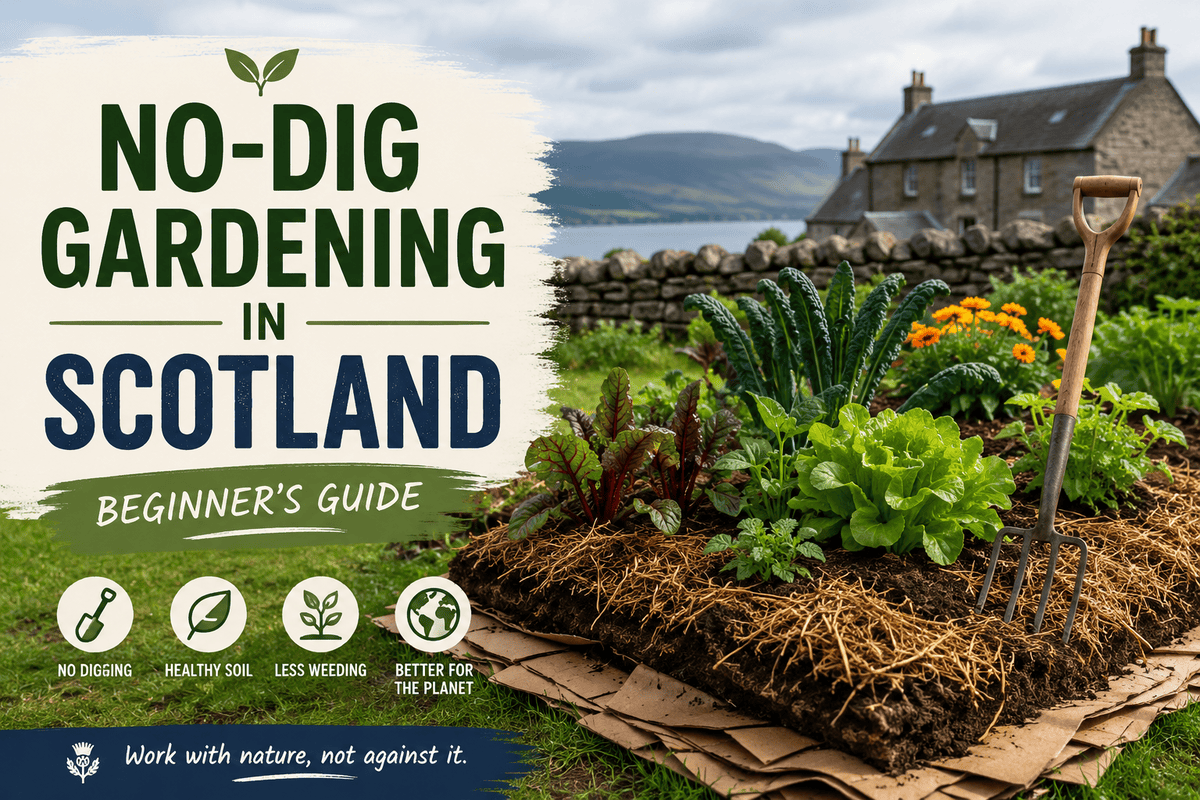
Short answer: no-dig means never turning your soil. You lay cardboard over the ground, cover it with 10–15cm of compost, and plant straight into that. Every following year you add just 2.5–5cm on top. It works particularly well in Scotland because our wet winters punish anyone who digs heavy soil — but the honest catch is that year one needs a lot of compost.
No-dig has gone from fringe idea to mainstream practice in about a decade, and it suits Scottish conditions better than it suits most of England. Here's how to start one properly in a Glasgow garden or a Lanarkshire allotment, what the evidence actually shows, and what it will cost you.
What no-dig actually is
The method is genuinely simple. Instead of digging or rotavating, you leave the soil structure completely alone and build fertility from the top down, exactly as it happens in a woodland.
- Cut down whatever is growing — don't strip the turf.
- Cover the ground with a light-excluding layer, usually a double thickness of plain cardboard.
- Spread compost on top of the cardboard.
- Plant directly into the compost.
- Top up with a thin layer of compost once a year, forever.
The cardboard kills the grass and annual weeds beneath it by excluding light, then rots away within a few months. Worms pull the compost down into the soil for you. Within a season the boundary between your compost layer and the soil below has largely disappeared.
What no-dig is not: it is not the same as raised beds — you can do no-dig on flat ground with no edging at all. It is not "no work". And it is not free.
Why it suits Scotland
Three things about the Scottish growing environment make no-dig more attractive here than it is further south.
Digging wet soil destroys it. The west of Scotland gets high winter rainfall, and much of the Central Belt sits on heavy clay — the Clyde Valley and the ground around East Kilbride particularly. Turning clay when it is wet smears and compacts it, and the damage takes years to undo. The traditional advice to "dig it over and leave it rough for the frost" was written for drier soils. No-dig removes the temptation entirely.
Bare soil doesn't survive a Scottish winter well. Uncovered ground gets capped and compacted by months of heavy rain, and nutrients leach away. A permanent compost mulch takes the impact instead.
A shorter season rewards earlier ground. Because a no-dig bed drains freely at the surface and doesn't need spring cultivation, it is workable and plantable earlier in the year than a bed waiting to be dug. In a climate where the growing season is already short, a fortnight matters.
The honest counterpoint: the wet west is also slug country, and a permanent organic mulch does give slugs cover. No-dig gardeners here generally report the problem settles down after the first year or two as beetles and other predators establish, but expect a difficult first spring and protect young transplants.
Does it actually produce more? The evidence
This is where most no-dig articles wave their hands. Here are real numbers.
Charles Dowding has run a side-by-side dig versus no-dig trial at Homeacres in Somerset since 2013. Two beds of 7.5m², identical crops planted on the same day, the same quantity of compost added to both — the only difference is that one bed is dug each year.
| Period | Dug bed | No-dig bed | Difference |
|---|---|---|---|
| 13-year total (2013–2025) | 1,218.80 kg | 1,374.77 kg | +12.8% |
| Yearly average | 93.75 kg | 105.75 kg | +12.8% |
| 2023 | 86.08 kg | 102.34 kg | +18.9% |
| 2024 | 88.54 kg | 99.45 kg | +12.3% |
| 2025 | 98.08 kg | 105.85 kg | +7.9% |
Read that honestly. It is one site, one gardener, one soil — the trial's own notes describe the results as "indications, not proof", and statistical analysis found the overall difference between dig and no-dig was not significant, though certain crops (kale, spinach, lettuce) did show a clear no-dig advantage. What it does demonstrate convincingly is that no-dig is not worse, which alone is a strong argument for a method that saves you a weekend of hard labour every year.
The RHS lists the better-established benefits: fewer annual weeds, better moisture retention, improved drainage from worm activity, preserved fungal networks, cleaner crops, and soil carbon kept in the ground rather than released by cultivation.
How to start a no-dig bed: step by step
Step 1 — Choose the size
Start smaller than you think. A 1.2m × 2.4m bed (4ft × 8ft) is the standard starter size, and it's enough to feed a household a meaningful amount. Paths between beds can be woodchip — it keeps them usable through a wet Scottish winter and costs a fraction of compost.
Step 2 — Cut, don't strip
Mow or strim whatever is there as short as you can. Leave the clippings — they're free organic matter. Do not lift the turf: that grass is about to become soil.
Step 3 — Lay the cardboard
Use plain brown cardboard. Remove all tape, staples and plastic labels, and glossy printed card. Overlap the sheets generously — at least 10–15cm — because weeds find every gap. A double layer over grass. In a dry spell, wet the cardboard; in most Scottish weather you can skip that step.
Step 4 — Spread the compost
Depth depends on what you're covering:
| Situation | Compost depth |
|---|---|
| Clean, already-cultivated ground | 5cm minimum |
| Ground with annual weeds | 7–12cm |
| Over grass or turf, with cardboard | 10–15cm |
| Annual top-up thereafter | 2.5–5cm |
Firm it down with your feet. It looks like a lot in year one and almost nothing in every year after.
Step 5 — Plant into it
You can plant the same day. Transplants do better than direct-sown seed in the first season, because the compost surface dries faster than soil. Put the plant's roots through the compost layer — they'll find the cardboard, and then the soil beneath it, within weeks.
Step 6 — Top up annually
About 2.5cm of compost a year on an established bed, ideally applied in autumn or late winter. That's it. No digging, ever.
Perennial weeds: the Scottish reality check
Cardboard and compost will beat grass, chickweed, annual meadow grass and most annuals comfortably. It will not beat established perennials on its own. If your plot has any of these, deal with them first:
- Couch grass — pushes through cardboard readily
- Bindweed — will find any gap and grow through 15cm of compost
- Ground elder — persistent and deep-rooted
- Mare's tail (horsetail) — very common on damp Scottish ground and near-impossible to smother
- Brambles and docks — need the crown physically removed
For serious perennial infestation, the accepted approach is to lay black polythene (not woven membrane, which lets light through) over the compost for a full growing season, cutting planting holes for a crop of squash or potatoes in the meantime. It's slower, but it works — where cardboard alone simply delays the problem to July. Brambles and dock crowns genuinely need a spade, and that's the one exception where every no-dig gardener digs.
What it costs: the part most guides skip
No-dig's real trade-off is that it converts labour into compost. You stop digging and start buying organic matter. Year one is the expensive year.
| Project | Compost needed | In 850L bulk bags |
|---|---|---|
| One 1.2 × 2.4m bed at 10cm | 0.29 m³ | About a third of a bag |
| One bed at 15cm over grass | 0.43 m³ | Half a bag |
| Three beds at 10cm | 0.86 m³ | One bag |
| Annual top-up, one bed at 2.5cm | 0.07 m³ | One bag does 11 beds |
| Full 10-rod allotment (253m²) converted at 10cm | 25.3 m³ | ≈30 bags, or a 20-tonne loose load |
| That same plot, annual top-up at 2.5cm | 6.3 m³ | ≈7 bags |
The shape of that table is the important part. Converting is expensive; maintaining is cheap. A full allotment plot needs a serious loose load to start, but under a quarter of that every year afterwards. Most people convert a bed or two per season rather than the whole plot at once, which spreads the cost and lets you learn the method on a small scale.
If you're working out quantities for your own plot, our guide to how much compost you need has the full coverage tables and conversions.
Compost quality matters more in no-dig than anywhere else
In a conventional bed, compost is an amendment mixed into a much larger volume of soil. In a no-dig bed, the compost is the growing medium — your seedlings' roots sit in it directly for their first few weeks.
That raises the stakes on two contaminants:
Weed seed. Uncertified compost that never reached a high enough temperature carries live weed seed. Spread 10cm of it and you have created a weed nursery on top of the cardboard you laid to stop weeds.
Herbicide residue. Aminopyralid and clopyralid are herbicides used on pasture that survive both the animal and the composting process in unmanaged manure. They devastate tomatoes, potatoes, beans and other sensitive crops — cupped, curled, fern-like leaves — and they can persist in the soil for a year or more. This is the single most common way a promising no-dig plot gets wrecked.
PAS 100 is the British Standards Institution specification for composted materials. It requires a controlled process that reaches a high enough temperature for long enough to kill weed seed and pathogens, plus screening and testing for contaminants and stability. For no-dig, that certification isn't a nice-to-have — it is the difference between a productive bed and a lost season.
All our organic compost is BSI PAS 100 certified, peat-free and chemical-free.
When to start in Scotland
You can start a no-dig bed at any time of year — that's one of the method's advantages. But there are better and worse windows here.
- Autumn (Sept–Nov) is the most popular. Beds are clearing, the ground is soft, and the cardboard has all winter to break down before spring planting. Note that the RHS suggests late winter over autumn for nitrogen-rich material like fresh manure, since winter rain can leach nitrogen away. Stable, well-made compost is much less prone to this, which is why autumn mulching with PAS 100 compost is standard no-dig practice.
- Late winter (Feb–Mar) is the RHS's preferred window and works very well if you missed autumn.
- Spring and summer are fine for starting new beds if you plant into them immediately.
- Mid-winter — avoid spreading on frozen or waterlogged ground. Wait for a dry spell.
For more on seasonal timing, see our guide to when to add compost and manure in Scotland.
A realistic first year
Autumn — Mow the area. Lay cardboard and 10–15cm of compost over one or two beds. Woodchip the paths. Do nothing else.
Late winter — Check for perennial weeds pushing through and pull them out as they appear; they're easy to remove from loose compost. Order compost for spring.
Spring — Plant transplants rather than direct-sown seed. Expect slugs; protect young plants. Resist the urge to fork anything over.
Summer — Weed by hand for the few minutes a week it takes. Notice how much less weeding there is than the plot next to yours.
Following autumn — Add 2.5cm of compost. Convert another bed or two. Repeat annually.
Frequently asked questions
What is no-dig gardening? No-dig gardening means growing without turning or cultivating the soil. You cover the ground with cardboard and 10–15cm of compost, plant directly into the compost, and add about 2.5cm more each year. Worms and soil life incorporate the organic matter instead of a spade.
How deep should compost be for a new no-dig bed
? 5cm on clean cultivated ground, 7–12cm where annual weeds are present, and 10–15cm over grass or turf with cardboard underneath. After the first year, an annual top-up of 2.5–5cm is enough.
Do I need cardboard for no-dig? Only when covering grass or weeds. On ground that is already clear and cultivated you can spread compost directly. Use plain brown cardboard with all tape, staples and glossy print removed, overlapped by at least 10–15cm.
Does no-dig produce a better harvest? Charles Dowding's 13-year side-by-side trial recorded 1,374.77kg from the no-dig bed against 1,218.80kg from the dug bed — about 12.8% more. It is a single-site trial, described by its author as indications rather than proof, and overall statistical significance was not established. The clearer, better-evidenced benefits are fewer annual weeds, better moisture retention and far less labour.
How much compost do I need to start no-dig? About 0.29m³ for a 1.2 × 2.4m bed at 10cm deep — roughly a third of an 850L bulk bag. One bag will start three beds. A full 10-rod allotment plot converted at 10cm needs around 25m³, or about 16 tonnes.
Is no-dig cheaper than digging? Not in the first year — converting a plot needs a significant quantity of bought-in compost. From the second year onward it becomes cheap, because annual top-ups are a quarter of the initial volume, and you save the labour and the tools.
Will no-dig get rid of couch grass and bindweed? Not on its own. Cardboard and compost beat grass and annual weeds, but established couch grass, bindweed, ground elder and mare's tail push straight through. For those, cover the compost with black polythene for a full growing season, or remove the roots first.
Can I start no-dig in autumn in Scotland? Yes — autumn is the most popular time. The ground is clear, the soil is still soft, and cardboard has all winter to break down. Use stable, well-made compost rather than fresh manure so nitrogen isn't leached by winter rain.
Do I need raised beds for no-dig? No. No-dig works perfectly well on flat ground with no edging. Sides make it tidier and stop compost washing onto paths, but they are optional and add cost.
What compost should I use for no-dig? Use a stable, screened, PAS 100 certified compost. Because your plants root directly into the compost layer, uncertified material carrying live weed seed or aminopyralid herbicide residue does far more damage in a no-dig bed than in a conventional one.
Starting a no-dig plot this autumn?
Tell us your bed sizes and we'll work out exactly what you need — bulk bags for a garden, or a loose load if you're converting a full allotment.
Browse our products · call 07561 251350 · email info@kelvincompost.co.uk
We deliver PAS 100 organic compost, well-rotted manure and woodchip across Glasgow, East Kilbride, South Lanarkshire and the Central Belt — in 850L bulk bags or 10 and 20 tonne loose loads, with HIAB delivery for tight access and depot uplift from Chapelton. Use code INTERNET for 5% off 850L sacks.
Kelvin Compost is the trading arm of ASAP (After School Activities Programme) — proceeds support local community projects.
Need Garden Supplies Delivered in Glasgow?
Organic compost, topsoil, manure and more across Scotland