




Woodchip Guide: Types, Uses, Prices and How to Buy in Bulk (2026)
Looking for compost, topsoil or garden supplies?
Browse our full product range or get in touch for delivery across Glasgow and Scotland.
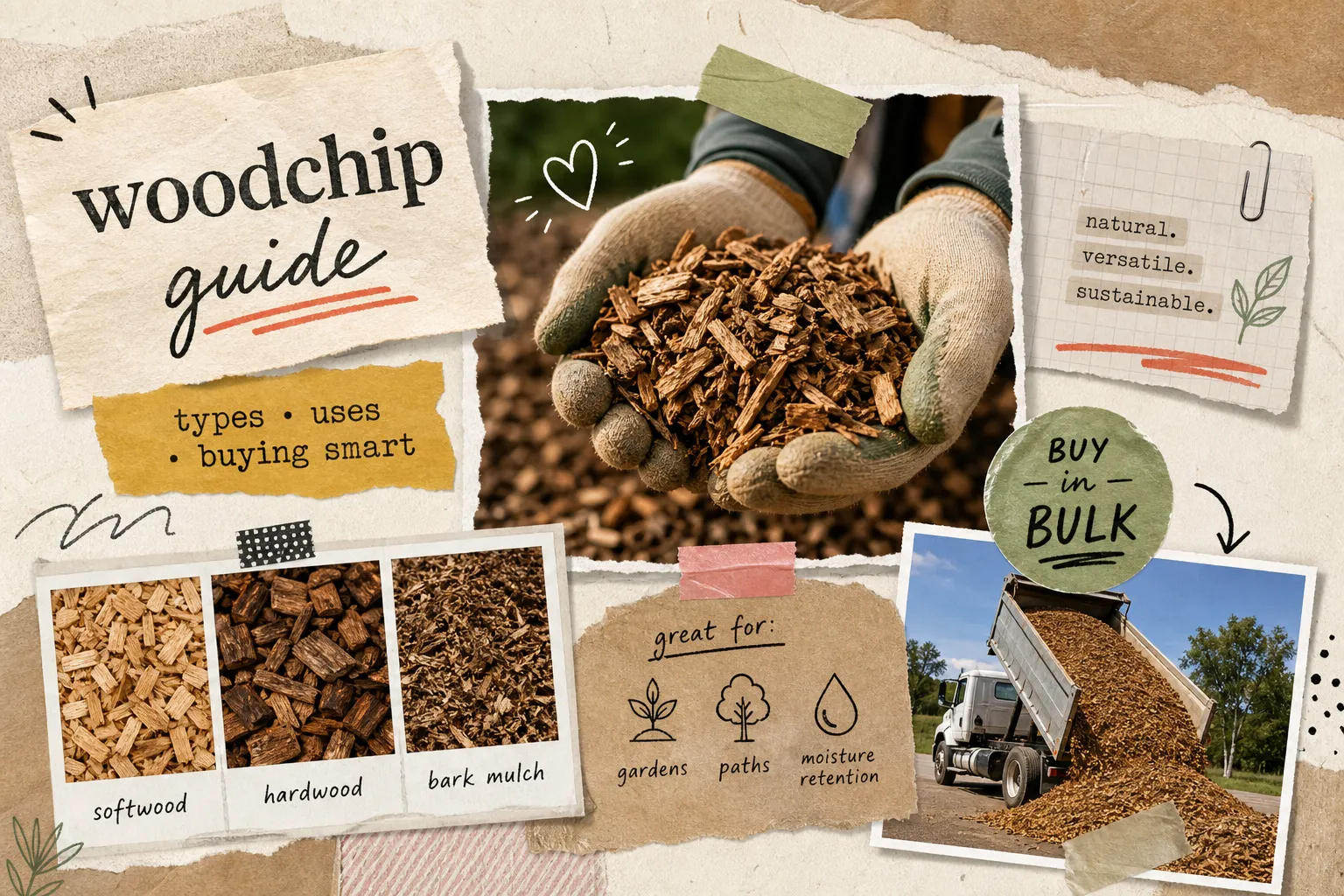
Quick answer: Bulk woodchip in the UK costs roughly £50–£65 per cubic metre for loose loads, or £70–£125 per bulk bag delivered, depending on grade and distance. For allotment paths, use 7.5–10 cm of coarse chip; for garden beds, use 5–7.5 cm. Always keep chip clear of plant stems and add a 10–25% buffer for settling.
Walk into any garden centre and you'll find woodchip sitting quietly beside the compost bags, rarely given a second glance. In my experience running Kelvin Compost from South Lanarkshire, bulk wood chippings have become one of the most requested products from allotment holders and home gardeners across Glasgow, and once people see what the material actually does, they tend to come back for it every season. By the end of this guide, you'll know exactly which grade to order, how much you need, what it should cost in 2026, and how to lay it properly the first time.
Key Takeaways
- Woodchip does three jobs: weed suppression, path surfacing, and long-term soil conditioning — most buyers only use it for one.
- Grade matters more than price: coarse arborist chip suits paths and bulk mulching; fine bark mulch suits ornamental beds.
- Loose bulk loads cost less per cubic metre than bagged chip once you need more than roughly 2–3 cubic metres.
- Always leave a 5–8 cm gap between chip and plant stems to prevent rot.
- Look for FSC or PEFC certification if the order needs to meet council or community-funding procurement rules.
What Is Woodchip Used For in a Garden or Allotment?
Most people think woodchip mulch is only for surfacing paths between raised beds. That's one use, and a good one, but it's far from the only job this material does well. In practice, wood chippings serve several distinct functions, and understanding all of them changes how you plan your growing space.
Does woodchip suppress weeds and retain moisture?
Yes. A 5 to 10 cm layer of woodchip mulch blocks light from reaching weed seeds without smothering established perennials or shrubs beneath. Weed suppression is a significant seasonal benefit on allotment beds in the Scottish climate — you spend less time on your knees in March and April if chip has been laid properly the previous autumn. Moisture retention matters too, though the wetter Scottish climate means the material stays damp naturally; the bigger gain here is consistently fewer weeds rather than conserving rainfall.
Can woodchip be used to surface paths?
Wood chippings make practical, low-cost path surfacing between raised beds. A 7.5 to 10 cm layer handles foot traffic well, stays firm enough for a loaded wheelbarrow, and decomposes slowly over time, feeding the soil beneath as it breaks down. Coarser chip grades perform better here than fine material, which shifts underfoot and doesn't hold its depth as reliably.
Does woodchip improve soil quality over time?
As woodchip breaks down at the edges of beds over several seasons, it contributes organic matter to the top layer of soil. This matters particularly in heavy clay soils, common in many Glasgow and Lanarkshire gardens, where anything that improves drainage and soil structure is worth using. One important note: fresh chip should always sit on the surface. Dig chip into the soil and it draws nitrogen from the soil as it decomposes, which works against you. Left on top, it builds structure gradually without interfering with your crops. Recent research on woodchip decomposition and nitrogen effects explores how decomposition stages influence soil nutrient dynamics and is worth a look if you plan heavy, repeated applications.
Woodchip Grades and Types Explained
Not all woodchip is the same product. Buying the wrong grade for your job wastes money and often produces disappointing results. Here are the main categories a garden buyer in the UK will encounter.
| Type | Particle size | Best use | Decomposition time | Relative cost |
|---|---|---|---|---|
| Arborist chip (raw) | Mixed, chunky, irregular | Paths, large-area mulching, soil building | Up to 5 years | Lowest |
| Bark mulch (processed) | Uniform, screened | Ornamental beds, borders | Around 2 years | Mid–high |
| Coarse landscaping chip | 20–50 mm | Allotment paths, under trees/shrubs | 3–5 years | Low–mid |
| Fine screened chip | Under 15 mm | Decorative borders, neat finishes | 1–2 years | Higher |
| Playgrade woodchip | Certified, uniform | Children's play areas only | N/A (safety product) | Highest |
Note: exact size ranges vary between suppliers, so always confirm grading specifications when ordering.
Arborist chip vs bark mulch — what's the difference?
Arborist chip is raw, freshly processed material from tree surgery work. It includes bark, heartwood and sometimes leaf matter, making it chunky, irregular and full of biological activity. It decomposes more slowly than bark mulch, up to five years versus two, allows water to penetrate freely without forming a mat, and actively feeds soil microbes as it breaks down. Bark mulch is a processed, screened product made predominantly from bark. It looks tidier, suppresses weeds more effectively over the short term, and suits ornamental beds where appearance matters. They are different products despite being sold side by side, and the distinction matters for both performance and price. The RHS also publishes practical guidance on using woody waste as mulch, which helps explain appropriate uses for each material.
Coarse vs fine woodchip — which should I buy?
Coarse landscaping woodchips, typically pieces between 20 and 50 mm, are the workhorse grade. They suit allotment paths, general mulching under trees and shrubs, and ground cover over large areas. Fine screened chip, under 15 mm, is lighter and more decorative, better suited to ornamental borders where you want a neater finish. For functional use in food-growing areas or working paths, coarse chip lasts longer, suppresses weeds more effectively, and costs less per cubic metre.
Important safety note: never substitute playground chip
Playgrade woodchip used in children's play areas is a separate, safety-certified product tested to specific British Standards for impact absorption. It should never be substituted with standard landscaping chip, regardless of how similar it looks — standard chip has not been tested for fall-impact safety and does not meet the same certification requirements.
How Much Woodchip Do I Need? (Coverage Calculator)
Most people either wildly over-order or fall short halfway through the job. Getting the calculation right before you phone a woodchip supplier saves time, money, and the frustration of running out mid-project.
Recommended depths by application
| Application | Recommended depth |
|---|---|
| General garden bed mulch | 5–7.5 cm |
| Allotment paths / working areas | 7.5–10 cm |
| Neglected ground (bindweed, couch grass) | 10–15 cm |
Expect some settling in the first few weeks; standard guidance suggests adding around 10% extra for settled ground, and up to 20–25% for uneven or heavily compacted areas. Your initial application should always be on the generous side.
How do I calculate woodchip volume in cubic metres?
- Multiply length by width to get your area in square metres.
- Multiply that figure by the depth in metres (not centimetres).
- The result is your required volume in cubic metres.
Worked example: a 10 m × 4 m allotment path at 10 cm depth = 10 × 4 × 0.1 = 4 cubic metres. That is the number to give your supplier when ordering.
Allowing for settling and wastage
Add 10 to 15% to your calculated volume to account for settling and edge wastage. For uneven ground or previously neglected plots, increase that buffer to 20 to 25%. Always round up to the nearest whole bulk bag or cubic metre rather than down. Running short mid-project and waiting for a second delivery is more disruptive than having a small surplus, which you can always use elsewhere on the plot.
Woodchip Prices UK 2026: What It Actually Costs
Pricing has shifted over the past couple of years, and it pays to know what realistic numbers look like before you start comparing quotes.
Bulk woodchip in the UK currently ranges from approximately £50 to £65 per cubic metre for loose loads, depending on grade, supplier, and distance from the depot. Bulk bags, typically 850 to 1,000 litres, tend to cost between £70 and £125 per bag including delivery for many national suppliers. Delivery from distant suppliers adds up quickly: expect anywhere from £24 to £95 on top of the product cost depending on mileage. For large allotments or community gardens needing several cubic metres, loose loads almost always offer better value per cubic metre than individual bags. For wider context on price trends and UK wood production, see the latest timber price indices and UK wood production statistics.
Bulk bags vs loose loads: which is better value?
Bulk bags suit smaller projects, tight-access plots, and one-off applications where you need flexibility over timing. Loose loads deliver higher volume for lower cost per cubic metre, but they require space to receive a tipped delivery and the ability to move material promptly. Kelvin Compost offers both formats, with HIAB crane-assisted delivery available for restricted-access sites, particularly useful for allotment plots that standard vehicles struggle to reach through narrow gates or across rough ground. Contact us to confirm which delivery format suits your site before ordering.
Why sourcing woodchip locally matters
For Glasgow and Lanarkshire gardeners, sourcing wood chippings locally cuts delivery cost sharply and often means fresher material. Kelvin Compost, based in South Lanarkshire, supplies bulk woodchip across the Glasgow region and offers local delivery to East Kilbride and surrounding areas — check current delivery rates and coverage when you get in touch, as pricing and zones are reviewed regularly. For allotment committees or community growing projects ordering in volume, tonne loads are available on request. Arborist chip in particular is best applied while it still retains some moisture, so shorter supply chains make a genuine practical difference.
When Is the Best Time of Year to Apply Woodchip?
Late autumn (October–November) is generally the best window for allotment paths and bed mulching in Scotland. Applying before winter lets the chip settle and start suppressing early weed germination before spring growth begins. A second good window is early spring (March), once the worst frosts have passed but before weed seedlings establish — this suits gardeners topping up beds ahead of the growing season. Avoid applying thick layers directly over dormant bulbs, as this can delay emergence.
Environmental Benefits of Using Woodchip
Beyond weed control, woodchip mulch supports garden biodiversity and reduces waste sent to landfill or incineration. Arborist chip is typically a byproduct of routine tree surgery and highway maintenance work — using it locally keeps that material in productive use rather than being transported long distances for disposal. As it breaks down, it also feeds fungal networks and soil organisms that support healthy plant root systems, particularly valuable in the compacted, clay-heavy soils common across Central Scotland.
How to Install Woodchip Mulch Properly
Buying the right grade and quantity is only half the job — poor installation undermines the performance of even the best material. The steps below apply whether you're mulching ornamental beds or surfacing a working path.
- Clear the ground. Remove existing perennial weeds before laying chip, particularly bindweed, couch grass and dock.
- Lay a weed barrier. On paths or beds with heavy weed pressure, lay two to three overlapping layers of cardboard directly on cleared soil before applying chip. This decomposes naturally over six to twelve months, feeding the soil as it breaks down.
- Add edging. Physical edging, such as timber boards or metal path edging, prevents chip migrating onto growing beds and reduces how often you need to replenish.
- Apply to the correct depth for your application (see table above).
- Leave a gap around stems. Maintain a 5 to 8 cm gap between the chip and the base of plant stems or tree trunks. Burying stems in woodchip encourages rot, and it's a common mistake that damages otherwise healthy plants.
- Inspect annually and top up. Once the layer drops below the recommended depth — roughly 7.5–10 cm for paths or 5 cm for beds — replenish it. In a typical Scottish climate, allotment paths need replenishing every one to two years, and ornamental bed mulch every twelve to eighteen months.
For practical advice on mulching and wood chips, extension literature such as the University of Illinois guidance on mulching and wood chips offers useful, hands-on tips.
Sustainability Checks Before You Order
It's worth taking two minutes to ask the right questions before you commit to a bulk woodchip supplier. The answers will affect both the environmental value of your purchase and, increasingly, whether the material qualifies for community or public funding schemes.
What does FSC or PEFC certification mean for woodchip?
When buying woodchip from a commercial supplier, look for FSC (Forest Stewardship Council) or PEFC (Programme for the Endorsement of Forest Certification) certification. These labels confirm that the raw timber originates from responsibly managed forests with verified chain-of-custody tracking. Not all suppliers carry these accreditations, and a local or regional claim is not a substitute for certification unless it can be verified. For community growing projects, schools, or local authority schemes, certification is increasingly required as a condition of procurement or project funding, so confirm this before placing a large order.
Does local sourcing make a real difference?
Woodchip sourced from local arboricultural operations or regional depots carries a lower transport footprint than material shipped long distances. Shorter supply chains also mean fresher chip with better moisture content for mulching applications — ask suppliers where their chip originates and whether it is processed locally. For Scottish gardeners, supporting regional suppliers who source and process within West Scotland keeps both quality and carbon costs lower, and keeps money circulating in the local growing community.
Frequently Asked Questions
How much does a cubic metre of woodchip cost in the UK? Loose bulk woodchip typically costs £50–£65 per cubic metre in 2026, before delivery. Bagged woodchip costs more per cubic metre but suits smaller or harder-to-access projects.
How deep should woodchip mulch be on garden beds? 5 to 7.5 cm is the standard recommended depth for ornamental and vegetable beds. Paths and heavily weeded ground need more — up to 15 cm initially.
Can I put woodchip directly on soil without a weed barrier? Yes, but for beds or paths with existing perennial weeds, laying cardboard underneath first significantly improves weed suppression and is worth the extra step.
Does fresh woodchip rob the soil of nitrogen? Only if it's dug into the soil. Left as a surface mulch, fresh woodchip does not meaningfully deplete soil nitrogen available to plant roots — the nitrogen drawdown happens at the chip-to-soil interface, not throughout the root zone.
How often does woodchip need replacing? Allotment paths typically need topping up every one to two years; ornamental bed mulch every twelve to eighteen months, depending on rainfall and decomposition rate.
Is arborist chip safe to use around vegetables? Yes, when used as a surface mulch on paths or between rows, kept clear of stems. It should not be used as growing medium or dug directly into vegetable beds.
Ready to Order? Here's Where to Start
Wood chippings are among the most cost-effective materials you can put on an allotment or garden, and yet they're consistently underused. The key decisions are straightforward once you work through them: choose the right grade for your specific job, calculate your volume honestly with a settling buffer built in, and buy in bulk rather than by the bag whenever volume allows.
For gardeners and allotment holders across Glasgow, Lanarkshire, and the West Coast of Scotland, Kelvin Compost supplies bulk woodchip with flexible delivery formats and HIAB capability for hard-to-reach plots. Bulk tonne loads are available for larger community or commercial projects, and local delivery covers East Kilbride and the surrounding area, making it a practical alternative to paying a national supplier's delivery premium for equivalent material.
Get in touch with Kelvin Compost to discuss your project, confirm the right grade, and arrange delivery. Give us a call and we'll sort the right quantity and format for your plot.
Written by the Kelvin Compost team, based in South Lanarkshire and supplying bulk woodchip, compost and landscaping materials across Glasgow and the surrounding area since [insert founding year]. This guide is updated periodically to reflect current UK pricing and supply conditions.
Need Garden Supplies Delivered in Glasgow?
Organic compost, topsoil, manure and more across Scotland