




How to Build & Fill a Raised Bed | Soil Mix & Volumes
Looking for compost, topsoil or garden supplies?
Browse our full product range or get in touch for delivery across Glasgow and Scotland.
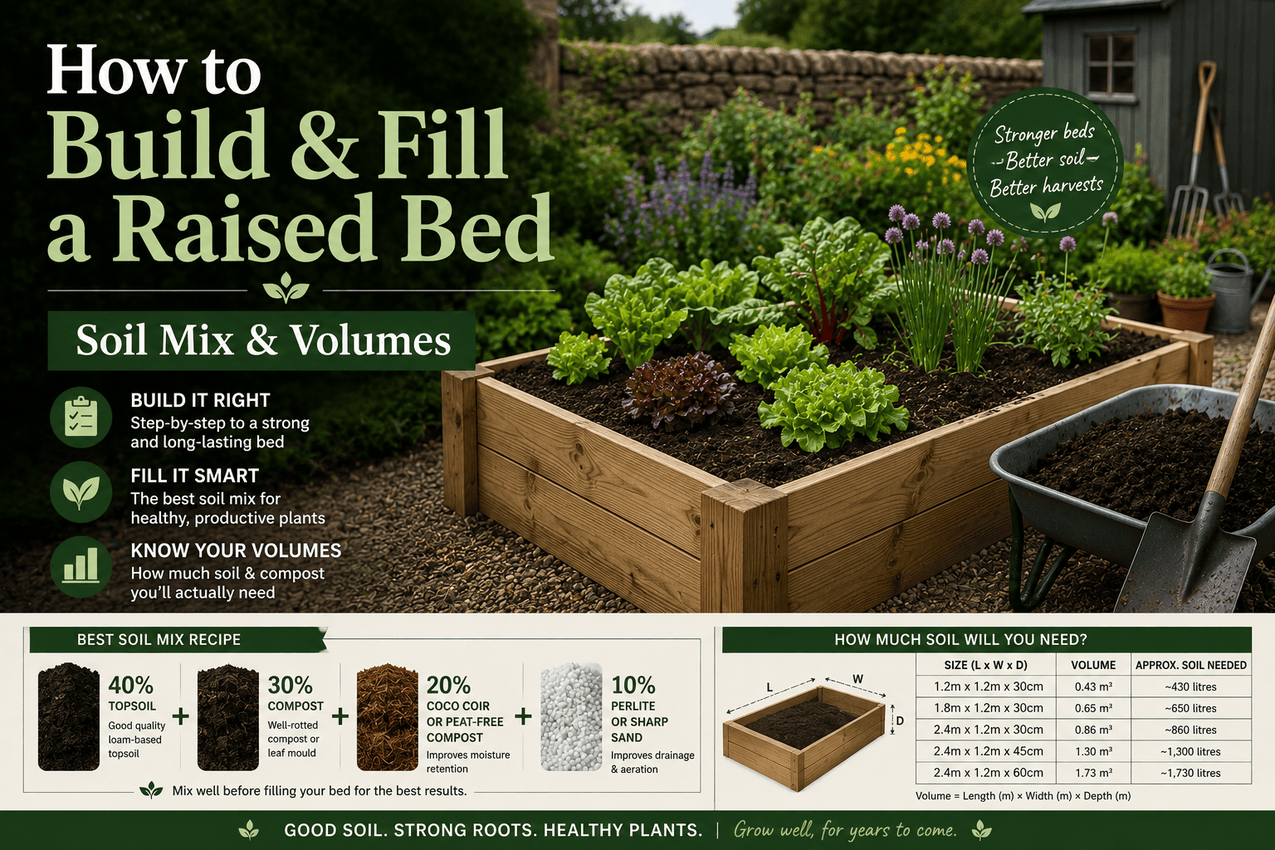
Short answer: build it no wider than 1.2m so you can reach the middle, and at least 30cm deep — 45cm or more if you want fruit bushes or root vegetables. Fill it with roughly 7 parts topsoil, 3 parts compost or well-rotted manure and 2 parts sharp sand. A standard 8ft × 4ft bed at 30cm deep takes 0.86m³ — almost exactly one 850L bulk bag.
The most expensive raised bed mistake is filling it entirely with compost. It costs far more than it needs to, slumps by a quarter within a year, and is too rich for many crops. Here's what actually goes in one, and how much.
Getting the dimensions right
Width: 1.2m maximum, or 1.5m at an absolute push. The whole point of a raised bed is that you never stand on the soil — so you must be able to reach the middle from either side. A bed you have to climb into is just an expensive border.
If it's against a wall or fence, halve that: 60–75cm, because you can only reach from one side.
Length: whatever suits your space. Length costs you nothing in access.
Depth depends on what you're growing:
| Depth | Suitable for |
|---|---|
| 15cm | Salad leaves only, and only on decent soil beneath |
| 30cm | Salad leaves, strawberries, dwarf bulbs, most annual vegetables |
| 45cm+ | Root vegetables, fruit bushes, shrubs, small trees — and the standard on poor or compacted ground |
| 50cm+ | Needs special base preparation, and is worth it only for accessibility or on hard standing |
A note on depth. If your bed sits on decent soil, the roots don't stop at the bottom of the timber — they carry on down, and 30cm of good bed over reasonable ground behaves much deeper than it looks. If it sits on compacted builder's subsoil, concrete or paving, the bed is all the soil there is, and you need the full 45cm.
Path width: at least 45cm between beds for a wheelbarrow, or 1m for wheelchair access.
Materials: what to build it from
Pressure-treated softwood sleepers or boards are the practical default — durable, widely available and inexpensive relative to the alternatives. Modern pressure treatment is considered suitable for growing food.
Do not use old railway sleepers treated with creosote. They're no longer permitted for domestic use because of the skin-contact risk, and they can leach into soil.
Untreated timber works and is the purist's choice, but it rots faster in a Scottish climate. If you use it, line the inside faces with old compost bags to slow moisture reaching the wood — line the sides only, never the base.
Other options: stone, engineering brick, paving slabs on edge, or recycled plastic boards. Recycled plastic costs more up front and effectively never needs replacing, which on a wet west-of-Scotland site is a reasonable trade.
Corner posts matter more than people expect. A long bed full of wet soil pushes outward hard. Use stakes at the corners and at 1m intervals along any side over 2m, driven into the ground.
Preparing the ground underneath
Do not line the base with plastic or weed membrane. It stops worms and drainage — the two things that make a raised bed work. This is the most common build mistake.
On grass or weeds: lay a double layer of plain cardboard across the base. It kills the grass beneath by excluding light, then rots away and lets roots and worms through. Same principle as no-dig.
On compacted ground: fork the base over before filling, breaking the surface so roots and water can pass into the soil below. Don't dig it out — just break the pan.
On paving, concrete or a hard surface: drill drainage holes through the sides near the base, add a coarse layer at the bottom, and build to at least 45cm. A sealed box of soil on concrete waterlogs.
Perennial weeds first. Couch grass, bindweed, ground elder and mare's tail will come up through cardboard and through the bed. Deal with them before you build, not after.
What to fill it with
Here's the mix, and here's why it isn't just compost.
The RHS ratio: 7 parts topsoil, 3 parts organic matter, 2 parts sharp sand.
That works out at roughly 58% topsoil, 25% compost or well-rotted manure, 17% sharp sand.
| Component | Why it's in there |
|---|---|
| Topsoil (58%) | Bulk, mineral content, structure and stability. It's the body of the bed and it doesn't decompose away |
| Compost / manure (25%) | Fertility, moisture retention, biology. This is the part that feeds |
| Sharp sand (17%) | Drainage and structure — matters especially in wet western Scotland |
Variations:
- Alpines, bulbs, Mediterranean herbs: double the sand.
- On a hard surface (paving, concrete): 7 parts topsoil, 3 organic matter, 4 sand — drainage becomes critical when water can't escape downward.
- Heavy clay topsoil: lean toward more sand and more compost.
Why not just fill it with compost?
Three reasons, and all three cost you money.
- It slumps. Organic matter decomposes and loses volume. A bed filled with pure compost can drop by a quarter or more in the first year, and you'll be buying again next spring.
- It's expensive. You're paying for fertility where you mostly need volume. Topsoil does the bulk job at a similar price and doesn't disappear.
- It's too rich for some crops. Carrots fork in over-rich soil. Mediterranean herbs sulk. Many crops crop better in a balanced medium than in neat compost.
The opposite mistake — filling with pure topsoil — gives you a bed that's stable but lifeless and prone to capping. The mix exists because both extremes are worse.
The shortcut: our Topsoil Mix is already a soil, sand and compost blend, so you can fill a bed from one product rather than buying three and mixing them in a barrow. For a single bed that's usually the easier and cheaper route; for several beds, buying the three components separately gives you more control.
How much do you need? Volumes by bed size
| Bed size | At 30cm deep | At 45cm deep |
|---|---|---|
| 1.2 × 1.2m (4×4ft) | 0.43 m³ — half a bag | 0.65 m³ — ¾ of a bag |
| 1.8 × 0.9m (6×3ft) | 0.49 m³ — ~½ a bag | 0.73 m³ — ~⅞ of a bag |
| 2.4 × 1.2m (8×4ft) | 0.86 m³ — one 850L bag | 1.30 m³ — 1½ bags |
| 3.0 × 1.2m (10×4ft) | 1.08 m³ — 1¼ bags | 1.62 m³ — ~2 bags |
Bags are 850L = 0.85m³.
The mix broken down — a standard 8ft × 4ft bed at 30cm
Total needed: 0.86 m³
| Component | Volume |
|---|---|
| Topsoil or loam | 0.50 m³ (500 litres) |
| Compost or well-rotted manure | 0.22 m³ (215 litres) |
| Sharp sand | 0.14 m³ (145 litres) |
Four beds — the usual back-garden project
Four 8ft × 4ft beds at 30cm need 3.46 m³ — about 4 bulk bags. At 45cm, 5.18 m³, about 6 bags. That's the point at which it's worth asking us for a quote rather than ordering bag by bag.
The formula for any size: length (m) × width (m) × depth (m) = cubic metres. Divide by 0.85 for bulk bags. Full tables are in our how much compost do I need guide.
Filling it properly
- Fill to about 5cm below the rim, not to the top. You need the freeboard for mulching and watering.
- Firm it as you go, gently — tread it down in layers rather than tipping it all in loose.
- Mix the components rather than layering them. Layers of distinct material create boundaries that roots and water struggle to cross. A tarpaulin on the lawn and a fork is the easiest mixing method.
- Let it settle for about two weeks before planting, if you can. It will drop.
- Water it thoroughly once filled — dry-filled beds have air pockets that collapse later.
Building the volume cheaply on a deep bed
If you're building a 45cm+ bed and the cost of filling it is off-putting, you can fill the bottom third with bulkier material — woody prunings, turf stacked upside down, cardboard, part-rotted material — and put the proper mix in the top 30cm.
Be honest with yourself about the trade-off: that base layer will decompose and the bed will sink substantially over two or three years. It's a legitimate technique for a deep bed where the top 30cm is what matters, and a bad idea if you were planning to grow carrots down there.
Aftercare: it will sink
Every raised bed drops. Organic matter decomposes, and material settles.
Expect to lose something like 15–25% of the depth in the first year, less thereafter. On an 8ft × 4ft bed at 30cm that's roughly 170 litres to replace — about a fifth of a bulk bag per bed, per year.
Top up annually with 2.5–5cm of compost on the surface each autumn. Don't dig it in; let worms take it down. That single habit maintains the bed indefinitely and is far cheaper than refilling.
For timing, see our guide to when to add compost and manure in Scotland.
Six mistakes worth avoiding
- Lining the base with plastic. Kills drainage and blocks worms.
- Building it too wide. If you can't reach the middle, you'll compact the soil you built the bed to protect.
- Filling with pure compost. Expensive, slumps badly, too rich for some crops.
- Measuring the outside of the timber. Sleepers are often 10–20cm thick. On a small bed, external measurements can overstate the volume by a quarter.
- Not settling before planting. Plant into unsettled fill and your seedlings sink with it.
- Ignoring perennial weeds under the bed. Bindweed will find its way up through 45cm of new soil.
Frequently asked questions
What should I fill a raised bed with? A mix of roughly 7 parts topsoil, 3 parts compost or well-rotted manure, and 2 parts sharp sand — about 58% topsoil, 25% organic matter and 17% sand. Topsoil provides bulk and structure, compost provides fertility, and sand provides drainage. Don't fill it with pure compost.
How much soil do I need for a raised bed? Multiply length × width × depth in metres. A 2.4 × 1.2m bed at 30cm deep needs 0.86m³ — almost exactly one 850L bulk bag. At 45cm it needs 1.3m³, about one and a half bags.
How deep should a raised bed be? 30cm is enough for salad leaves, strawberries and most annual vegetables. Root vegetables, fruit bushes and shrubs need 45cm or more, and 45cm is also the sensible minimum on compacted ground or a hard surface.
How wide should a raised bed be? No more than 1.2m, so you can reach the centre from either side without standing on the soil. Against a wall or fence, 60–75cm, since you can only reach from one side.
Can I fill a raised bed with just compost? You can, but it's a poor idea. Pure compost is expensive for the volume, slumps by a quarter or more in the first year as it decomposes, and is too rich for crops like carrots and Mediterranean herbs. Topsoil should be the majority of the fill.
Should I line a raised bed? Line the inside faces of untreated timber to slow rot, but never line the base with plastic or membrane — it blocks drainage and stops worms entering. On grass, put plain cardboard on the base instead; it kills the grass and then rots away.
What timber is best for raised beds? Pressure-treated softwood sleepers or boards are the practical default and are considered suitable for growing food. Avoid old creosote-treated railway sleepers, which are no longer permitted for domestic use. Untreated timber works but rots faster in a wet climate.
Do raised beds need drainage holes? Only on a hard surface. A bed on soil drains into the ground beneath, provided you haven't lined the base. On paving or concrete, drill holes through the sides near the base and build to at least 45cm.
Why has my raised bed sunk? Organic matter decomposes and the fill settles — a drop of 15–25% in the first year is normal, and more if you filled with pure compost or used a bulky base layer. Top up annually with 2.5–5cm of compost on the surface rather than refilling.
How much does it cost to fill a raised bed? By volume, not by bag. A standard 8ft × 4ft bed at 30cm takes 0.86m³, which is one 850L bulk bag. Four such beds take about four bags — the point where a quote for a larger quantity is worth asking for.
Building beds this autumn?
Autumn is the right time — build and fill now, let everything settle over winter, and plant into a stable bed in spring. Tell us your bed sizes and we'll work out the quantities.
Top Soil · Loam Soil · Topsoil Mix · Organic Compost · Well Rotted Manure · Horticultural Sand
Call 07561 251350 · email info@kelvincompost.co.uk · use code INTERNET for 5% off 850L sacks.
We deliver across Glasgow, East Kilbride, South Lanarkshire and the Central Belt — 850L bulk bags or 10 and 20 tonne loose loads, with HIAB delivery for gardens with no vehicle access.
Kelvin Compost is the trading arm of ASAP (After School Activities Programme) — proceeds support local community projects.
Need Garden Supplies Delivered in Glasgow?
Organic compost, topsoil, manure and more across Scotland