




New-Build Garden Soil Problems? How to Fix Poor Soil & Clay
Looking for compost, topsoil or garden supplies?
Browse our full product range or get in touch for delivery across Glasgow and Scotland.
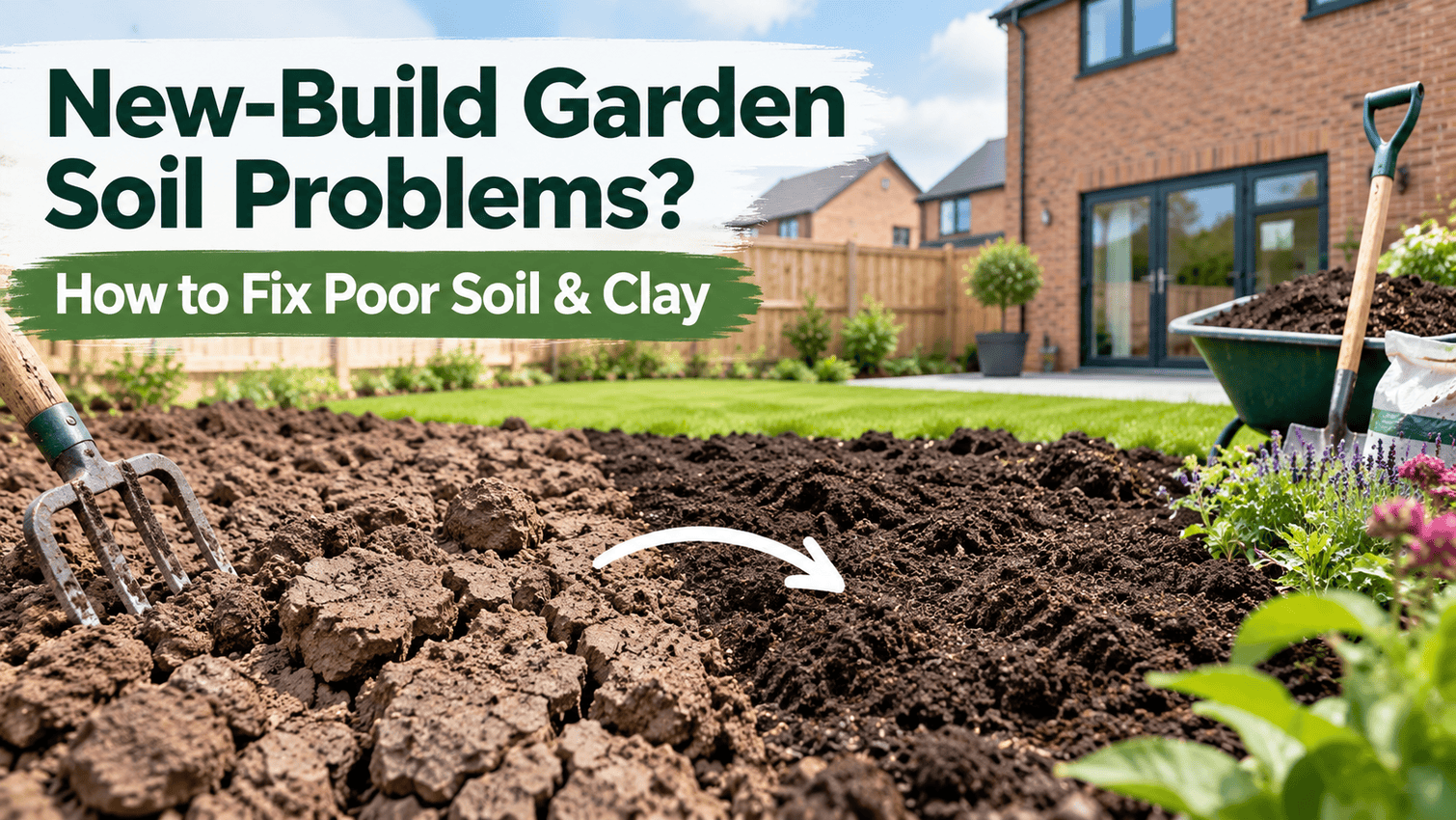
How to Improve a New-Build Garden: Fix Poor Soil, Clay & Compaction
Moving into a new-build home is exciting — until you start digging the garden.
Many homeowners discover that the ground beneath a new lawn or thin layer of topsoil is heavily compacted, contains clay or subsoil, drains poorly, or simply doesn't provide the conditions needed for healthy plants.
So, how do you improve the soil in a new-build garden?
The best approach is to first identify whether the main problem is compaction, drainage, insufficient topsoil or low organic matter. Compacted ground should be loosened before simply covering it. Where additional growing depth is needed, quality topsoil can be added, while organic compost can improve soil structure and organic-matter content.
For many new-build gardens, the solution is not one single product but a combination of proper ground preparation, topsoil and organic matter.
This guide explains exactly how to assess and improve poor new-build garden soil, particularly for homes around Glasgow, East Kilbride, South Lanarkshire and Central Scotland.
Why Is the Soil in My New-Build Garden So Poor?
During house construction, soil can be repeatedly travelled over by heavy machinery.
The original topsoil may also be disturbed, removed or mixed with deeper layers of subsoil.
As a result, a finished garden can sometimes contain:
Heavily compacted ground
Thin topsoil
Dense clay
Rubble or construction debris
Poor drainage
Uneven ground
Low levels of organic matter
Areas where grass struggles to establish
Soil that becomes sticky in winter and hard in summer
A garden can look finished when turf is first installed, while problems underneath only become obvious later.
You may notice puddles after rain, patchy grass, plants that fail to establish or soil that's extremely difficult to dig.
The important thing is to identify why the garden is struggling before adding more material.
What Are the Signs of Compacted Soil?
Compacted soil has very little open pore space between soil particles.
This can make it difficult for:
Water to move through the soil
Air to reach plant roots
Roots to penetrate deeper
Soil organisms to function effectively
Common warning signs include:
Water sitting on the lawn
If puddles remain for long periods after rainfall, poor infiltration or drainage may be involved.
Very hard ground
If pushing a garden fork into the ground requires considerable force, compaction may be part of the problem.
Shallow plant roots
Plants may struggle to establish deeper root systems where a dense layer exists beneath the surface.
Thin or patchy grass
A lawn can struggle where roots have only a shallow layer of usable soil.
Soil that behaves like concrete when dry
Heavy compacted clay can become extremely hard during dry periods.
Sticky soil after rain
Very wet clay soil can become difficult to work and easily damaged by cultivation.
How Do I Test the Soil in a New-Build Garden?
You don't need expensive equipment to carry out an initial assessment.
Start by digging several small inspection holes around the garden.
Don't test only one location.
New-build ground can vary considerably over a relatively small area.
Look at:
How deep the usable dark topsoil is
What lies underneath it
Whether the lower soil is compacted
Whether you find rubble
How wet the soil is
Whether roots are penetrating deeply
Soil colour and texture
If the first 5–10cm looks reasonable but you immediately reach dense compacted clay underneath, adding another small layer of soil to the surface may not address the real problem.
Should I Just Put New Topsoil Over Poor Soil?
Sometimes — but not always.
Adding topsoil is useful when your garden genuinely lacks sufficient good-quality growing soil.
However, putting quality topsoil directly over severely compacted ground can leave the underlying problem in place.
Plant roots may grow well through the new layer and then struggle when they reach the compacted soil underneath.
Water movement can also remain poor.
A better approach is often:
Remove construction debris.
Identify heavily compacted areas.
Loosen the underlying soil where appropriate.
Improve the transition between existing soil and new material.
Add quality topsoil where additional depth is required.
Add organic matter where soil improvement is needed.
Kelvin Compost supplies Topsoil for new lawns, borders, raised beds and general garden landscaping.
Topsoil or Compost for a New-Build Garden?
This is one of the most important decisions.
Topsoil and compost perform different jobs.
| Material | Main purpose |
|---|---|
| Topsoil | Adds soil depth, structure and growing volume |
| Organic compost | Adds organic matter and improves existing soil |
| Well-rotted manure | Adds organic matter and nutrients where appropriate |
| Woodchip | Surface mulch for suitable planting areas |
Use topsoil when:
Existing soil is too shallow
You need substantial additional growing depth
You're creating new beds
You're preparing a new lawn
You're levelling suitable areas
Much of the original topsoil is missing
Use compost when:
There is already enough soil
The soil is low in organic matter
You want to improve structure
You're preparing productive beds
You're improving clay or tired soil
In many new-build gardens, topsoil and compost work best together.
You can browse Kelvin Compost's Topsoil and Organic Compost if your project requires both structure and organic matter.
How Can I Improve Compacted New-Build Soil?
The first objective is to deal with the compaction rather than simply hiding it.
Step 1: Remove rubble and debris
Check for:
Bricks
Concrete
Plastic
Large stones
Building waste
Metal
Other construction material
A few stones are normal in garden soil, but significant construction waste can interfere with cultivation and drainage.
Step 2: Loosen compacted ground
Where practical, compacted soil can be loosened with a garden fork or suitable landscaping equipment.
The goal isn't necessarily to completely invert every layer.
You're trying to create pathways through which water, air and roots can move.
For larger or severely compacted sites, mechanical cultivation or professional landscaping may be more appropriate.
Step 3: Add organic matter
Once suitable ground has been opened up, mature organic matter can help improve soil structure.
Kelvin Compost's Organic Compost can be used for general garden soil improvement.
Step 4: Add topsoil where needed
If usable soil depth is insufficient, add suitable quality Topsoil.
Step 5: Allow the soil to settle
Newly added soil may settle after rainfall and cultivation.
Check final levels before planting permanent features.
How Do I Improve Clay Soil in a New-Build Garden?
Clay itself isn't necessarily bad soil.
Clay can retain both moisture and nutrients very effectively.
Problems occur when clay becomes:
Severely compacted
Waterlogged
Poorly structured
Difficult to cultivate
The best long-term approach is usually to improve its structure gradually.
Adding mature organic matter can help create a more workable soil over time.
Good options include:
Suitable well-rotted organic matter
Well-rotted manure where appropriate
Avoid expecting one application to permanently transform heavy clay.
Soil improvement is usually cumulative.
Regular additions of suitable organic matter can make a substantial difference over several growing seasons.
Should I Add Sand to Heavy Clay Soil?
Be careful.
Many gardeners assume that adding some sand automatically improves clay drainage.
In reality, casually mixing a small amount of sand into heavy clay doesn't necessarily solve structural problems and can sometimes produce an undesirable dense mixture.
For most home gardens, focus first on:
Reducing compaction
Adding organic matter
Improving drainage where genuinely required
Creating adequate soil depth
If you have a serious drainage problem, identify the cause rather than relying on a bag of sand as a universal fix.
How Do I Improve Drainage in a New-Build Garden?
Drainage problems require careful diagnosis.
Waterlogging may result from:
Compacted soil
Heavy clay
A low point in the garden
Poor grading
Surface runoff
An impermeable layer underground
Inadequate drainage infrastructure
Start by observing the garden after prolonged rainfall.
Ask:
Where does the water collect?
How long does it remain?
Is the whole garden wet or only one area?
Does water move toward or away from the house?
If the problem is severe or water is affecting the property, seek appropriate professional drainage advice.
Simply adding topsoil to the surface may raise the level without correcting the underlying drainage problem.
Can Compost Improve New-Build Clay Soil?
Yes, organic compost can be useful for improving soil structure and adding organic matter.
For clay soil, mature compost can help create conditions that are easier for gardeners and plant roots to work with over time.
For very poor ground, don't treat compost as a thin cosmetic layer.
Combine organic-matter additions with proper ground preparation.
Kelvin Compost supplies peat-free Organic Compost for soil improvement, raised beds, vegetable gardens and landscaping projects.
How Much Compost Should I Add to Poor Soil?
The quantity depends on the condition of the soil and the purpose of the area.
For example, if you want to apply a 5cm layer of material over 10m²:
10m × 0.05m = 0.5m³
That's approximately:
500 litres.
For 20m² at the same depth:
20 × 0.05 = 1m³
That's approximately:
1,000 litres.
Use the general formula:
Area in m² × depth in metres = cubic metres
Then:
1 cubic metre = 1,000 litres
Our How Much Compost Do I Need? guide provides more detailed examples.
How Much Topsoil Does a New-Build Garden Need?
Again, calculate it by volume.
Suppose your garden measures:
8m × 5m = 40m²
If you need an additional 10cm of soil:
40 × 0.10 = 4m³
That's approximately:
4,000 litres of topsoil.
For a larger garden, quantities rise quickly:
| Garden area | 5cm depth | 10cm depth | 20cm depth |
|---|---|---|---|
| 10m² | 500L | 1,000L | 2,000L |
| 20m² | 1,000L | 2,000L | 4,000L |
| 30m² | 1,500L | 3,000L | 6,000L |
| 40m² | 2,000L | 4,000L | 8,000L |
| 50m² | 2,500L | 5,000L | 10,000L |
This is why bulk materials can be more practical than purchasing dozens of small garden-centre bags.
For more information, read our beginner's guide to garden topsoil.
How Do I Prepare a New-Build Garden for a Lawn?
A successful lawn depends heavily on what lies underneath it.
Don't focus only on the turf.
Before laying a new lawn:
1. Clear debris
Remove construction waste, significant stones and unwanted material.
2. Assess compaction
Make sure roots will have usable soil below the immediate surface.
3. Correct major drainage issues
A new lawn won't solve waterlogging.
4. Add topsoil where required
Where the garden lacks sufficient growing soil, add suitable Topsoil.
5. Level carefully
Create the required final level before laying turf or sowing seed.
6. Establish the grass properly
Newly laid turf and seed require appropriate watering while roots establish.
If you already have a lawn that's thin or struggling, read our guide to compost and soil for lawns.
What If My New-Build Lawn Is Already Laid?
You may not need to remove everything immediately.
First identify the severity of the problem.
For relatively minor compaction, lawn aeration and suitable top dressing may help.
For more serious problems involving extremely shallow soil, severe waterlogging or buried construction waste, more substantial work may eventually be required.
Signs that deserve investigation include:
Grass repeatedly dying in the same places
Persistent standing water
Extremely hard soil
Very shallow roots
Major uneven settlement
Don't continually apply lawn products while ignoring a structural soil problem underneath.
How Can I Create Flower Beds in a New-Build Garden?
Creating beds gives you an opportunity to improve the soil properly before planting.
Start by deciding where the bed will go.
Then:
Remove turf if necessary.
Remove construction debris.
Loosen compacted ground.
Add quality topsoil if more growing depth is needed.
Incorporate suitable organic matter.
Allow the soil to settle.
Plant according to the light, drainage and soil conditions.
Combining Topsoil with Organic Compost is often more appropriate than using either material alone when building a completely new planting area.
Are Raised Beds Good for New-Build Gardens?
Raised beds can be an excellent option, particularly where native ground is difficult to cultivate.
They allow you to create a controlled growing medium above existing ground.
Raised beds are useful for:
Vegetables
Herbs
Flowers
Small fruit
Gardens with difficult soil
Areas where additional growing depth is desirable
However, don't automatically fill a deep raised bed entirely with compost.
Topsoil usually provides structural volume, while compost contributes organic matter.
Read our complete guide to building and filling raised beds before calculating your order.
Should I Use Manure in a New-Build Garden?
It depends on what you'll grow.
Well-rotted manure can be useful for suitable productive areas such as vegetable beds where additional organic matter and fertility are required.
It isn't a replacement for missing topsoil.
Think of the materials this way:
Topsoil → soil volume
Compost → general organic-matter improvement
Well-rotted manure → organic matter plus fertility where appropriate
For a newly created vegetable plot, a combination may be useful depending on the existing soil and intended crops.
Can Woodchip Help a New-Build Garden?
Yes, particularly after you've established planting areas.
Organic Woodchips can be useful as surface mulch around:
Trees
Shrubs
Established perennial plants
Hedges
Paths
Between raised beds
Woodchip can help cover bare soil, suppress some weeds and reduce moisture loss.
Avoid digging large amounts of fresh woodchip directly into productive garden soil.
Use it primarily as a surface mulch.
Read our woodchip guide for more information.
Should I Test the pH of a New-Build Garden?
It can be worthwhile, particularly before making substantial soil amendments.
Soil pH affects how available various nutrients are to plants.
Don't apply lime or other pH-changing products simply because somebody says Scottish soil is acidic.
Test first.
Different areas of the same garden can also differ, especially where soil has been moved during construction.
Our soil pH guide for Scottish gardens explains how to test and interpret your results.
A Simple New-Build Garden Improvement Plan
If you're overwhelmed by where to start, use this order.
Step 1 — Inspect
Dig several test holes and look at what is actually underneath your lawn or beds.
Step 2 — Identify the main problem
Is it:
Compaction?
Drainage?
Insufficient topsoil?
Clay?
Rubble?
Low organic matter?
Step 3 — Fix structural problems
Deal with serious drainage, rubble and compaction before spending heavily on soil products.
Step 4 — Add topsoil if needed
Use topsoil where you genuinely require additional soil depth.
Step 5 — Add organic matter
Use compost to improve suitable existing soil.
Step 6 — Create planting areas
Prepare lawns, borders, raised beds and vegetable areas according to their individual requirements.
Step 7 — Mulch
Once plants are established, use suitable surface mulch where beneficial.
Step 8 — Keep improving
Good soil develops over time.
Continue adding appropriate organic matter rather than expecting one application to permanently solve every problem.
Common New-Build Garden Mistakes to Avoid
Mistake 1: Covering compacted soil without loosening it
Adding beautiful topsoil above an impermeable compacted layer doesn't necessarily correct the underlying problem.
Mistake 2: Filling everything with compost
Compost is a soil improver, not a universal replacement for topsoil.
Mistake 3: Assuming all wet soil needs more topsoil
Persistent waterlogging needs diagnosis.
Mistake 4: Working clay while it is saturated
Cultivating very wet clay can damage soil structure.
Mistake 5: Adding fertiliser before diagnosing the problem
Poor plant growth doesn't automatically mean nutrient deficiency.
Mistake 6: Buying materials before calculating quantities
Measure the area and required depth first.
Mistake 7: Expecting instant results
Compacted and structurally poor soil often improves progressively over several seasons.
New-Build Garden Soil: Frequently Asked Questions
Why is my new-build garden so waterlogged?
Common causes include soil compaction, heavy clay, poor grading and inadequate drainage. Identify the cause before simply adding extra topsoil or compost.
Can I put topsoil directly over clay?
You can add topsoil where additional growing depth is required, but severely compacted clay should ideally be addressed first so roots and water aren't restricted by the layer underneath.
What is the best soil for a new-build garden?
There isn't one universal product. New planting areas commonly need quality topsoil for structure and mature compost for organic matter.
How can I improve hard soil in my new-build garden?
Start by assessing compaction. Loosen suitable compacted ground, remove debris and incorporate mature organic matter where appropriate.
Will compost improve clay soil?
Adding mature organic matter can help improve heavy soil structure and workability over time.
Do I need to remove all the clay?
Usually not. Clay can form perfectly productive garden soil when its structure, organic-matter content and drainage are appropriately managed.
Should I use topsoil or compost before laying turf?
If you're lacking adequate growing-soil depth, topsoil is generally the important structural material. Compost may be used appropriately to improve existing soil, but it doesn't substitute for substantial missing topsoil.
Can raised beds solve poor new-build soil?
Raised beds can create a controlled growing environment above difficult ground, making them particularly useful for vegetables and other productive planting.
How much soil do I need for my new-build garden?
Multiply the area in square metres by the required depth in metres. For example, 30m² at 10cm deep requires approximately 3m³, or 3,000 litres.
Improving a New-Build Garden in Glasgow or South Lanarkshire
A poor new-build garden isn't something you have to live with permanently.
The key is to work from the ground up.
Don't simply cover problems.
Identify compaction.
Check drainage.
Remove construction debris.
Make sure you have enough usable topsoil.
Then improve the soil with appropriate organic matter.
Kelvin Compost supplies garden and landscaping materials across Glasgow, East Kilbride, South Lanarkshire and surrounding areas of Scotland, including:
Whether you're preparing a lawn, creating borders, building raised beds or completely renovating the garden of a new home, ordering the right material begins with understanding what your soil actually needs.
Need Soil or Compost for a New-Build Garden?
Measure the area you're improving and note the approximate depth you need.
Then contact Kelvin Compost for help choosing the appropriate garden material.
Call: +44 7561 251350
Email: info@kelvincompost.co.uk
Need Garden Supplies Delivered in Glasgow?
Organic compost, topsoil, manure and more across Scotland