



Bulk Compost Delivery in Glasgow: What to Buy, How Much You Need & How to Order
Looking for compost, topsoil or garden supplies?
Browse our full product range or get in touch for delivery across Glasgow and Scotland.
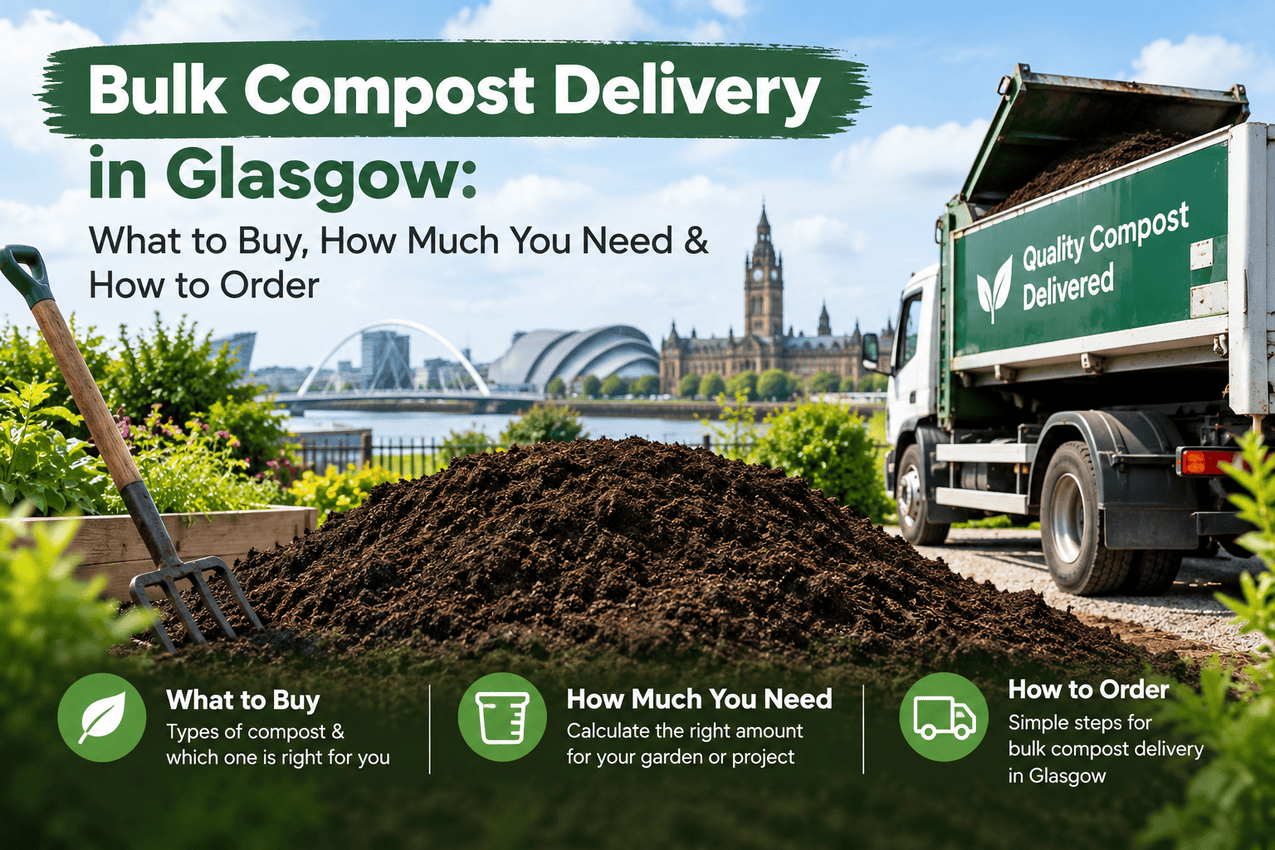
Bulk compost delivery provides a practical way to order larger quantities of compost directly to your property or project. Instead of transporting dozens of individual bags, you can calculate approximately how much material you need and order it in a suitable bulk quantity.
For gardeners and landscapers around Glasgow, the bigger questions are usually: Which compost should I buy? How much do I need? Is a bulk bag enough? And do I actually need compost, topsoil or manure?
This guide answers each of those questions.
What Is Bulk Compost?
Bulk compost simply means compost supplied in substantially larger quantities than the small bags typically purchased from garden centres.
Kelvin Compost supplies Organic Compost in approximately 850-litre bulk bags, providing a convenient option for larger gardening and landscaping projects.
Bulk compost can be particularly useful for:
Vegetable gardens
Allotments
Raised beds
Flower beds
Garden borders
Soil improvement
Mulching
Landscaping projects
Community gardens
Larger growing areas
Before ordering, however, it's important to understand what compost actually does.
What Is Organic Compost Used For?
Organic compost is primarily a soil improver.
It adds decomposed organic material to existing soil, helping support soil structure, moisture management and healthy growing conditions.
Compost is particularly useful where garden soil has become:
Low in organic matter
Difficult to work
Compacted
Tired after repeated growing
Quick to dry
Structurally poor
It can be incorporated into existing soil or applied as an organic surface mulch depending on the project.
Kelvin Compost supplies peat-free, chemical-free organic compost produced to BSI PAS 100 standards.
Why Buy Compost in Bulk?
For a couple of containers or a small flower bed, small bags may be perfectly adequate.
Bulk delivery becomes more attractive when the project requires hundreds of litres.
Imagine you need approximately 850 litres of compost.
Using 40-litre garden-centre bags would require more than:
21 individual bags.
Using 50-litre bags would still require:
17 individual bags.
An 850-litre bulk bag consolidates that volume into a single delivery.
Bulk compost can reduce:
Repeated journeys to garden centres
Loading individual bags into a vehicle
Unloading dozens of small bags
Plastic packaging from numerous small bags
The risk of running out halfway through a larger project
For allotments, raised beds and landscaping jobs, this can make the project much easier to organise.
How Much Compost Do I Need?
The easiest way to calculate compost requirements is:
Length × Width × Depth = Volume
Make sure all measurements are in metres.
For example, imagine a bed measuring:
5m long × 2m wide
The total area is:
5 × 2 = 10m²
If you want to apply compost at a depth of 5cm, convert 5cm to metres:
5cm = 0.05m
Then calculate:
10 × 0.05 = 0.5m³
One cubic metre contains 1,000 litres.
Therefore:
0.5m³ = approximately 500 litres
For this example, one 850-litre bulk bag would provide sufficient material with compost remaining for another area.
Quick Compost Quantity Table
| Garden area | 3cm depth | 5cm depth | 10cm depth |
|---|---|---|---|
| 5m² | 150L | 250L | 500L |
| 10m² | 300L | 500L | 1,000L |
| 15m² | 450L | 750L | 1,500L |
| 20m² | 600L | 1,000L | 2,000L |
| 25m² | 750L | 1,250L | 2,500L |
| 50m² | 1,500L | 2,500L | 5,000L |
Remember that these figures calculate volume, not a recommended application rate for every situation.
The appropriate depth depends on what you're trying to accomplish.
For a more detailed calculation, read our guide to calculating how much compost you need.
Is an 850-Litre Bulk Bag Enough?
It depends entirely on the area and application depth.
An 850-litre bulk bag contains approximately 0.85m³ of material by volume.
At different theoretical depths, 850 litres would cover approximately:
| Application depth | Approximate coverage |
|---|---|
| 2cm | 42.5m² |
| 3cm | 28.3m² |
| 5cm | 17m² |
| 10cm | 8.5m² |
So if you're applying a 5cm layer across a 10m² bed, an 850-litre bag should comfortably cover the area.
But if you're trying to fill a deep raised bed from empty, the same bag can disappear surprisingly quickly.
Always calculate your volume before ordering.
Can I Fill Raised Beds With Compost?
Compost is extremely useful in raised beds, but you don't normally need to fill a deep raised bed entirely with pure compost.
A raised bed needs both:
Soil structure + organic matter
For many general-purpose raised beds, that means combining suitable Topsoil with Organic Compost.
Topsoil provides the bulk growing medium.
Compost adds organic matter.
Depending on what you're growing, well-rotted Manure may also be incorporated where appropriate.
If you're building new beds, read our complete raised-bed soil and volume guide before ordering.
Compost or Topsoil: Which Should I Order?
This is one of the most important distinctions when buying garden materials.
If you need to improve existing soil, consider compost.
If you need additional soil depth, structure or volume, consider topsoil.
For example:
Choose compost for:
Improving established beds
Adding organic matter
Vegetable plots
Allotments
Mulching
Improving tired garden soil
Choose topsoil for:
Creating new beds
Levelling ground
Preparing new lawn areas
Increasing soil depth
Filling substantial areas
Landscaping projects
Many projects require both.
A new raised bed, for example, may need topsoil for volume and compost for organic matter.
If you're still unsure, see our complete beginner's guide to topsoil.
Compost or Manure: Which Is Better?
Again, they perform related but different jobs.
Organic Compost is a versatile general soil improver.
Well-Rotted Manure can be particularly useful where additional organic matter and fertility are desirable, including suitable vegetable-growing areas.
You might choose manure for:
Vegetable plots
Allotments
Hungry crops
Established productive beds
Depleted garden soil
You might choose compost for:
General soil improvement
Raised beds
Borders
Vegetable gardens
Mulching
Improving soil structure
Neither product is automatically "better".
The right choice depends on the soil and what you intend to grow.
Can Compost Help Clay Soil?
Yes.
Adding mature organic matter can be particularly useful for heavy garden soil.
Clay soil can hold valuable nutrients and moisture, but its physical structure may make it:
Sticky when wet
Hard when dry
Difficult to cultivate
Slow draining
Vulnerable to compaction
Regular additions of organic matter can gradually improve soil structure and workability.
Don't expect a single application to completely transform heavy ground.
Building healthier soil is an ongoing process.
Can Compost Help Sandy Soil?
Organic matter is also useful for light, sandy soil — but for almost the opposite reason.
Sandy soil tends to drain rapidly.
As a result, it can struggle to retain useful moisture and nutrients.
Adding mature compost increases organic matter and can improve moisture retention.
This is why compost is useful across a wide range of soil types.
Can Compost Be Used as Mulch?
Yes.
Mature compost can be spread across the soil surface as an organic mulch.
This approach can:
Add organic matter
Cover bare soil
Help retain moisture
Support soil improvement
Reduce some weed growth
You don't always have to dig compost deeply into the ground.
In no-dig gardening systems, suitable organic material is deliberately applied to the surface and natural soil processes gradually integrate it.
If you're interested in this approach, read our beginner's guide to no-dig gardening in Scotland.
Compost or Woodchip for Mulching?
Both can be used as mulch, but they aren't interchangeable.
Compost is particularly useful where you want to add organic matter directly to productive soil.
Organic Woodchips are especially useful for surface mulching around:
Trees
Shrubs
Established perennial planting
Paths
Fruit-growing areas
Woodchip can help suppress weeds and reduce moisture loss while covering the soil surface.
Avoid mixing large quantities of fresh woodchip directly into productive soil.
For more information, see our woodchip types, uses and bulk-buying guide.
When Is the Best Time to Add Compost?
Compost can be useful at several points throughout the gardening year.
Spring
Add compost while preparing beds before the main growing season.
During the growing season
Compost can be used as suitable surface mulch around established plants.
Autumn and winter
Beds can be improved and covered with organic matter when appropriate.
The exact timing should reflect your soil, weather and what you're growing rather than following a rigid calendar.
Where Can I Buy Bulk Compost in Glasgow?
Kelvin Compost supplies peat-free organic compost in approximately 850-litre bulk bags for gardens, allotments, community projects and landscaping requirements.
Delivery is available across Glasgow, South Lanarkshire and surrounding areas, subject to delivery location.
Kelvin Compost also supplies:
This makes it possible to order different materials for projects that require more than one type of soil improver or growing medium.
Frequently Asked Questions About Bulk Compost
How much is in a Kelvin Compost bulk bag?
Kelvin Compost's standard bulk compost bag is approximately 850 litres, or 0.85 cubic metres by volume.
How many square metres will 850 litres of compost cover?
It depends on depth. Theoretically, 850 litres covers approximately 28.3m² at 3cm deep, 17m² at 5cm deep or 8.5m² at 10cm deep.
Is bulk compost cheaper than buying small bags?
The answer depends on current product prices, bag sizes and delivery costs. For larger projects, bulk delivery can be much more convenient because it avoids purchasing and transporting numerous individual bags.
Is bulk compost good for raised beds?
Yes, organic compost can be an important component of raised-bed soil. For deep beds, however, it is generally better combined with suitable soil/topsoil rather than using compost as the entire growing medium.
Can I use compost for vegetables?
Yes. Mature organic compost can add valuable organic matter to vegetable-growing soil and is widely used in vegetable gardens, raised beds and allotments.
What's the difference between compost and topsoil?
Topsoil provides soil structure and volume. Compost is primarily used to add organic matter and improve existing soil. Many gardening projects benefit from using both.
Can I have compost delivered in Glasgow?
Yes. Kelvin Compost supplies bulk organic compost to customers across Glasgow, South Lanarkshire and surrounding areas, subject to delivery availability.
Do you deliver manure and topsoil too?
Yes. Kelvin Compost also supplies topsoil, well-rotted manure, organic woodchips and other garden soil products.
Order Bulk Compost for Your Garden
Whether you're improving a vegetable plot, preparing raised beds, restoring tired soil or working on a larger landscaping project, buying the right amount of compost makes the job considerably easier.
Before ordering:
Measure your area.
Decide how deep the material needs to be.
Calculate the required volume.
And most importantly, make sure compost is actually the right product for the job.
If you need organic matter, choose compost.
If you need additional soil depth, consider topsoil.
If you're preparing suitable productive ground and want additional organic matter and fertility, consider well-rotted manure.
Kelvin Compost supplies bulk garden materials across Glasgow, South Lanarkshire and surrounding areas of Scotland.
Need help working out how much to order?
Call Kelvin Compost: +44 7561 251350
Email: info@kelvincompost.co.uk
Or browse our Organic Compost, Topsoil, Manure and Organic Woodchip products to find the right material for your project.
Need Garden Supplies Delivered in Glasgow?
Organic compost, topsoil, manure and more across Scotland