



Topsoil Delivery Glasgow: How Much Do You Need?
Looking for compost, topsoil or garden supplies?
Browse our full product range or get in touch for delivery across Glasgow and Scotland.
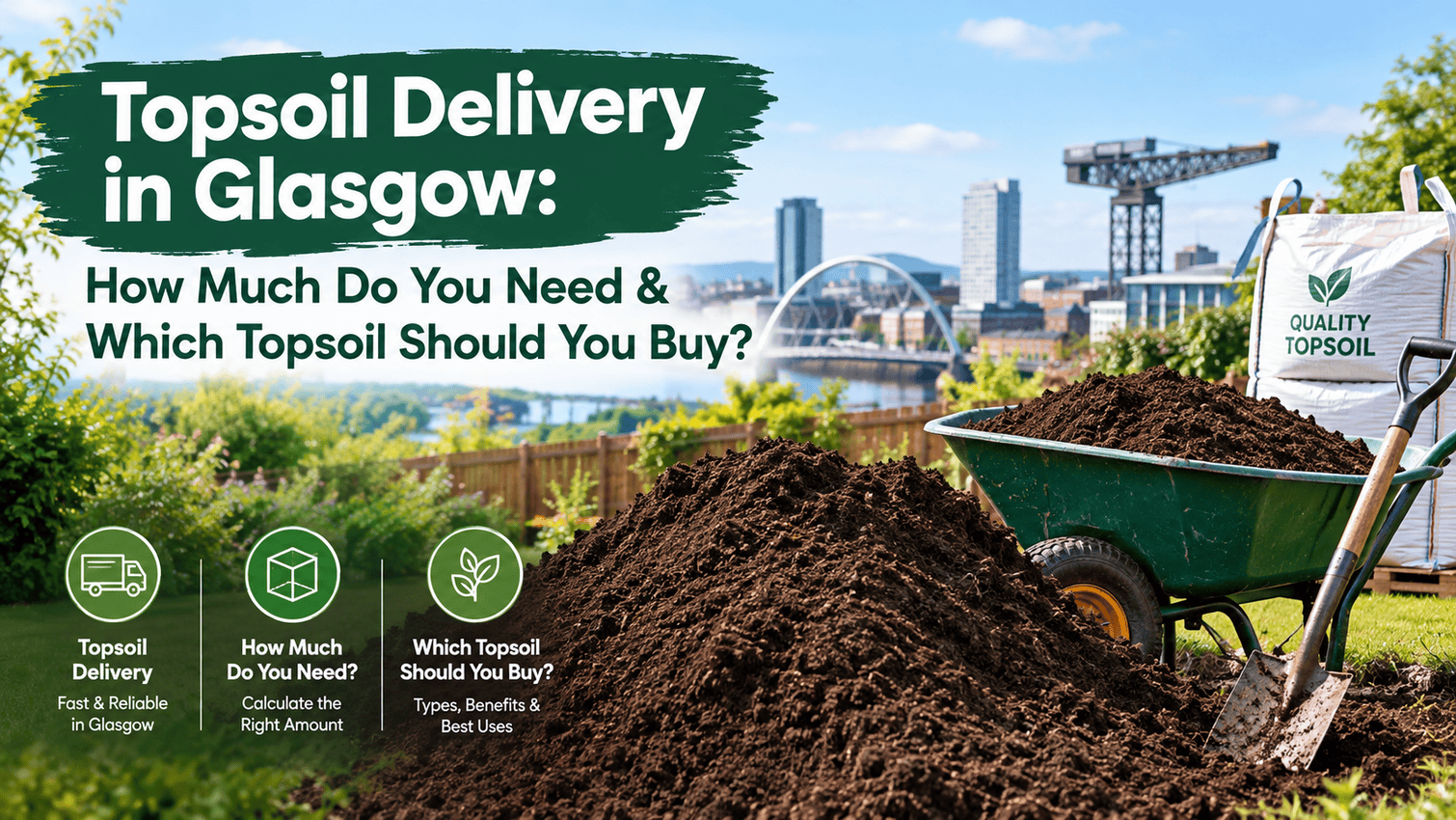
Whether you're laying a new lawn, filling raised beds, creating borders or levelling a garden, choosing the right amount of topsoil can make a significant difference to the success and cost of your project.
But how much topsoil do you actually need?
The simplest method is to measure the area in square metres and multiply it by the required soil depth. For example, a 10m² area filled to a depth of 10cm requires approximately 1 cubic metre (1,000 litres) of topsoil.
Before ordering topsoil in Glasgow, however, you should also consider what you're using it for, the condition of the existing ground and whether you actually need topsoil, compost or a combination of both.
This guide explains everything you need to know before ordering topsoil for your garden or landscaping project.
What Is Topsoil?
Topsoil is the upper layer of soil where much of a plant's root growth and biological activity takes place.
It normally contains mineral particles including sand, silt and clay, together with varying amounts of organic matter.
Good garden topsoil provides a physical growing medium in which plants can establish roots and access water, air and nutrients.
This makes topsoil useful for projects where you need additional:
Soil depth
Growing medium
Ground coverage
Garden levelling
Lawn preparation
Raised-bed volume
Kelvin Compost supplies Topsoil for gardening and landscaping projects across Glasgow, South Lanarkshire and surrounding areas.
What Is Topsoil Used For?
Topsoil has many applications around a garden.
Common uses include:
New lawns
Topsoil can create a suitable rooting layer before laying turf or sowing grass seed.
Raised beds
New raised beds often require considerable soil volume. Topsoil can provide the main structural growing medium, with organic compost incorporated to increase organic matter.
Flower beds and borders
Topsoil can be used when creating completely new planting areas or increasing soil depth in existing beds.
Garden levelling
Low areas can sometimes be corrected with appropriate soil before the garden is planted or landscaped.
Replacing missing soil
Construction, landscaping or previous garden work can leave areas without sufficient good-quality growing soil.
General landscaping
Larger landscaping projects frequently require substantial quantities of soil to establish new growing areas.
Topsoil vs Compost: What's the Difference?
This is one of the most common questions when buying garden materials.
Topsoil provides soil structure and volume. Compost primarily adds organic matter and improves existing soil.
Think of it this way:
Need more actual soil? → Topsoil
Already have enough soil but want to improve it? → Compost
For example, imagine you're filling a new raised bed that is 40cm deep.
Filling the entire bed with pure compost usually isn't necessary. A suitable soil-based growing medium containing topsoil and organic matter is generally more appropriate.
On the other hand, if your existing vegetable bed already contains plenty of soil but has become tired and low in organic matter, adding organic compost may be more useful than bringing in additional topsoil.
For more detail, read our complete beginner's guide to topsoil.
How Much Topsoil Do I Need?
Calculating topsoil is easier than it first appears.
Use this formula:
Length × Width × Depth = Volume
All measurements should be converted to metres.
Example
Suppose you're preparing a garden area measuring:
5m long × 4m wide
The total area is:
5 × 4 = 20m²
You want 10cm of topsoil.
Convert 10cm to metres:
10cm = 0.10m
Then:
20 × 0.10 = 2m³
Therefore, you need approximately:
2 cubic metres of topsoil.
Because one cubic metre equals 1,000 litres, that's approximately:
2,000 litres by volume.
Topsoil Quantity Table
Here's a quick reference:
| Area | 5cm depth | 10cm depth | 15cm depth | 20cm depth |
|---|---|---|---|---|
| 5m² | 250L | 500L | 750L | 1,000L |
| 10m² | 500L | 1,000L | 1,500L | 2,000L |
| 15m² | 750L | 1,500L | 2,250L | 3,000L |
| 20m² | 1,000L | 2,000L | 3,000L | 4,000L |
| 25m² | 1,250L | 2,500L | 3,750L | 5,000L |
| 50m² | 2,500L | 5,000L | 7,500L | 10,000L |
These figures calculate volume only. The appropriate soil depth depends on the project.
How Deep Should Topsoil Be?
There isn't one correct topsoil depth for every garden.
It depends on what you're creating.
Topsoil for lawns
When preparing a lawn, you need enough suitable soil to provide a healthy rooting environment.
The existing ground matters considerably.
If good-quality soil is already present, you may only need additional material for levelling or improvement.
Where the existing ground is poor, compacted or largely subsoil, more substantial preparation may be necessary.
Topsoil for flower beds
Flowers, shrubs and other ornamental plants need sufficient rooting depth.
Rather than focusing only on the new topsoil layer, consider the total usable soil depth, including suitable existing soil underneath.
Topsoil for raised beds
Raised beds can require surprisingly large quantities of material.
For example:
2m × 1m × 0.4m = 0.8m³
That's approximately:
800 litres
And that's for just one relatively small raised bed.
Four identical beds would theoretically require:
3,200 litres of material if filled completely from empty.
That's why measuring before ordering is so important.
For a detailed calculation, see our raised-bed soil mix and volume guide.
What Is the Best Topsoil for Raised Beds?
Raised beds need a growing medium that provides both physical structure and organic matter.
Rather than thinking about one perfect product, think about what plants need from the complete growing medium.
A practical raised-bed mix may include:
Quality topsoil
Mature organic compost
Well-rotted manure where appropriate
Topsoil provides structure.
Compost contributes organic matter.
Well-rotted manure may be useful where additional organic matter and fertility suit the crops being grown.
The exact mixture should depend on what you intend to plant.
Is Topsoil Good for Vegetable Gardens?
Yes, particularly when creating new vegetable-growing areas that lack sufficient suitable soil.
But vegetables also benefit from organic matter.
If your vegetable garden already contains adequate topsoil, repeatedly adding more soil isn't necessarily the best way to improve it.
Instead, consider adding mature compost or suitable well-rotted manure.
For existing poor soil, read our guide on how to improve poor garden soil.
Can I Mix Topsoil and Compost?
Yes. Topsoil and compost are commonly combined because they perform complementary roles.
Topsoil supplies the mineral soil structure.
Compost supplies decomposed organic material.
This combination can be useful for:
Raised beds
New vegetable beds
Flower borders
Planting areas
General garden improvement
The correct proportion depends on the quality of the topsoil, existing ground and intended plants.
Avoid assuming that more compost is automatically better.
Plants need a stable growing medium as well as organic matter.
Should I Add Manure to Topsoil?
Well-rotted manure can be incorporated where additional organic matter and fertility are appropriate.
This can be particularly useful when preparing suitable vegetable-growing areas for hungry crops.
However, manure isn't required in every garden.
Some plants prefer less fertile conditions, while certain root vegetables may perform poorly in ground that has been heavily manured immediately before sowing.
If you're unsure, read our guide to well-rotted manure for gardens and allotments.
How Do I Prepare the Ground Before Adding Topsoil?
Don't simply dump new topsoil over badly compacted ground and expect the underlying problem to disappear.
Start by examining what's underneath.
1. Remove debris
Clear:
Large stones
Building waste
Plastic
Rubble
Problem weeds
Unwanted roots
2. Check drainage
If water regularly remains on the surface, investigate the cause.
Adding a thin layer of topsoil won't solve serious drainage problems.
3. Deal with compaction
Very compacted underlying ground can restrict drainage and root growth.
Appropriate preparation before adding topsoil can help prevent a sharp boundary between the new and existing layers.
4. Check the final level
Remember that adding topsoil raises the ground.
Consider:
Paths
Patios
Door thresholds
Drainage
Fences
Existing plants
Plan the final soil level before ordering.
Can You Put Topsoil Over Grass?
It depends on what you're trying to achieve.
A very thin soil application may sometimes be used as part of lawn top-dressing, but covering an existing lawn with a substantial depth of topsoil is a completely different project.
If you're replacing the lawn, properly preparing the existing ground is generally preferable to simply burying everything under a new layer.
If you're only correcting small uneven areas, much less material may be required.
Can You Put Topsoil Over Clay?
Yes, but simply covering heavy clay with new soil may not solve the underlying structural or drainage problem.
If roots eventually reach an extremely compacted clay layer, growth and drainage can still be affected.
Where appropriate, improve the existing ground and create a gradual transition between layers rather than producing an abrupt boundary.
Organic matter can also help improve heavy soil over time.
Our garden soil improvement guide explains this in more detail.
Is Topsoil Good for Laying Turf?
Good-quality soil is an important part of preparing ground for a new lawn.
Before laying turf:
Remove debris and weeds.
Address serious drainage problems.
Prepare and level the ground.
Add suitable topsoil where additional growing depth is required.
Firm and level the surface appropriately.
Lay turf according to good establishment practices.
Water appropriately while roots establish.
The objective isn't simply to create a visually flat surface.
You're creating the rooting environment that supports the lawn for years to come.
When Is the Best Time to Add Topsoil?
Topsoil can be used whenever ground conditions allow suitable preparation, but extremely wet or frozen conditions can make soil handling difficult.
For many garden projects, spring and autumn provide useful working periods.
However, the project itself matters more than the calendar.
If you're preparing a new lawn, raised bed or border, coordinate soil delivery with the rest of the landscaping work so material isn't unnecessarily moved multiple times.
Bulk Topsoil or Small Bags?
For small jobs, individual bags may be convenient.
For larger projects, bulk quantities can make much more sense.
Consider a 20m² area requiring 10cm of new soil:
20 × 0.10 = 2m³
That's approximately:
2,000 litres.
If you tried to buy that quantity using 40-litre bags:
2,000 ÷ 40 = 50 bags
That means transporting, unloading and opening approximately 50 individual bags.
Bulk delivery can therefore be much more practical for larger garden and landscaping projects.
How Much Topsoil Should I Order?
Calculate your theoretical volume first, but don't measure casually.
A small error across a large area can substantially change the quantity required.
Measure:
Length × Width × Required Depth
For irregular gardens, divide the area into smaller rectangles, calculate each separately and add the totals.
For example:
Area A: 5m × 3m = 15m²
Area B: 4m × 2m = 8m²
Total:
23m²
At 10cm depth:
23 × 0.10 = 2.3m³
You would therefore need approximately 2.3 cubic metres based on theoretical volume.
Real-world material requirements can vary because of settling, compaction and site conditions, so discuss your measurements with your supplier before ordering.
Where Can I Buy Topsoil in Glasgow?
Kelvin Compost supplies Topsoil for gardening and landscaping projects across Glasgow, South Lanarkshire and surrounding areas of Scotland.
Topsoil can be used for projects including:
New lawns
Raised beds
Borders
Vegetable gardens
Garden levelling
Landscaping
Increasing growing depth
Kelvin Compost also supplies complementary garden materials including Organic Compost, Well-Rotted Manure, Organic Woodchips and Potash-Potassium.
Frequently Asked Questions About Topsoil
How much topsoil do I need for 10 square metres?
At 5cm depth, 10m² requires approximately 500 litres. At 10cm depth, it requires approximately 1,000 litres, and at 20cm depth approximately 2,000 litres.
Is topsoil the same as compost?
No. Topsoil provides mineral soil, physical structure and growing volume. Compost is decomposed organic material primarily used to improve soil.
Can I use compost instead of topsoil?
Not usually where substantial soil depth or structural volume is required. Compost is better regarded as a soil improver rather than a direct replacement for topsoil.
Can I mix compost with topsoil?
Yes. Combining quality topsoil with mature compost can create a useful growing medium for raised beds, borders and other planting areas.
Is topsoil suitable for raised beds?
Yes. Topsoil can provide the main structural growing medium in raised beds and can be combined with organic compost where additional organic matter is required.
Is topsoil suitable for vegetables?
Yes, provided the soil is suitable for growing. Vegetable beds also benefit from appropriate organic matter, so compost or well-rotted manure may be incorporated depending on the crop and existing soil.
How much topsoil do I need for a lawn?
Measure the lawn area and multiply it by the additional soil depth required. For example, 50m² at 10cm depth requires approximately 5m³ of soil.
Do I need topsoil or compost for my garden?
If you need additional soil depth or volume, choose topsoil. If you already have sufficient soil and primarily want to increase organic matter, compost is usually more appropriate.
Can Kelvin Compost deliver topsoil in Glasgow?
Kelvin Compost supplies topsoil and other bulk garden materials across Glasgow, South Lanarkshire and surrounding areas, subject to delivery availability.
Order Topsoil for Your Garden or Landscaping Project
The most important thing to do before ordering topsoil is measure first.
Work out:
How large is the area?
How much additional depth do you need?
What will you grow there?
Does the project need topsoil, compost or both?
Getting those answers right can prevent both over-ordering and discovering halfway through the project that you don't have enough material.
Kelvin Compost supplies:
for gardens, allotments and landscaping projects across Glasgow, South Lanarkshire and surrounding areas of Scotland.
Need help working out how much topsoil you need?
Call Kelvin Compost on +44 7561 251350
Email info@kelvincompost.co.uk
Tell us the dimensions of your project and what you're planning to grow, and we can help you determine the most suitable material and quantity.
Need Garden Supplies Delivered in Glasgow?
Organic compost, topsoil, manure and more across Scotland