



Garden Soil Delivery Glasgow | Topsoil, Compost & Manure
Looking for compost, topsoil or garden supplies?
Browse our full product range or get in touch for delivery across Glasgow and Scotland.
Garden Soil Delivery Glasgow: Which Soil Should You Order?
Need garden soil delivered in Glasgow but aren't sure whether to order topsoil, compost, manure or a soil mix?
You're not alone.
One of the easiest ways to waste money on a garden project is to order the wrong material. Compost is excellent for improving existing soil, but it isn't always the best choice when you need substantial new soil depth. Topsoil is useful for lawns and new planting areas, but a vegetable bed may benefit from additional organic matter.
The quickest way to choose is:
Need to add soil depth? → Choose topsoil.
Need to improve existing garden soil? → Choose organic compost.
Preparing productive ground for hungry plants? → Consider well-rotted manure.
Building a raised bed? → Usually use a soil-based mix containing topsoil and organic matter.
Kelvin Compost supplies bulk garden materials for homes, allotments and landscaping projects across Glasgow, East Kilbride, South Lanarkshire and surrounding areas.
This guide will help you choose the right product and calculate approximately how much you need before placing an order.
Which Garden Soil Do I Need?
Start with the job rather than the product.
| Your project | Material to consider |
|---|---|
| Laying a new lawn | Topsoil |
| Filling a new raised bed | Topsoil + compost |
| Improving existing beds | Organic compost |
| Vegetable garden | Compost / topsoil depending on existing soil |
| Hungry vegetable crops | Well-rotted manure where appropriate |
| Creating a new flower border | Topsoil + compost |
| Levelling suitable garden ground | Topsoil |
| Improving tired soil | Organic compost |
| Mulching trees and shrubs | Woodchip |
| Allotment soil improvement | Compost or well-rotted manure |
| Adding substantial growing depth | Topsoil |
The important point is that garden soil products aren't interchangeable.
Let's look at each option.
When Should You Buy Topsoil?
Topsoil should generally be considered when you need actual soil volume or additional growing depth.
Kelvin Compost's Topsoil is suitable for projects such as:
New lawns
Raised beds
Flower beds
Garden borders
Landscaping
Increasing soil depth
Levelling appropriate areas
Creating new growing areas
Imagine you've removed an old patio and want to turn the area into a flower bed.
You don't simply need to improve existing soil.
You need to create a new usable soil layer.
That's a topsoil job.
Likewise, if a new-build garden contains only a shallow layer of usable soil over compacted subsoil, additional topsoil may be required after the underlying ground has been properly prepared.
Order topsoil when your problem is:
"I don't have enough soil."
If that's your project, browse Kelvin Compost Topsoil.
When Should You Buy Organic Compost?
Compost performs a different job.
Organic compost is primarily used to improve soil by adding organic matter.
If your garden already contains enough soil but that soil is tired, compacted, low in organic matter or difficult to work, Organic Compost may be the more appropriate purchase.
Kelvin Compost supplies peat-free organic compost produced to BSI PAS 100 standards.
Organic compost can be useful for:
Vegetable gardens
Established flower beds
Borders
Allotments
Raised beds
General soil improvement
Surface mulching
No-dig gardening
Order compost when your problem is:
"I have enough soil, but I need to improve it."
This distinction can save you from ordering the wrong bulk material.
When Should You Buy Well-Rotted Manure?
Well-Rotted Manure is particularly useful where you want to add organic matter and fertility to suitable productive soil.
It is commonly used for:
Vegetable plots
Allotments
Productive beds
Soil being prepared for hungry crops
Improving depleted growing areas
Crops with relatively high nutrient demands can benefit from fertile, organic-rich soil.
Examples include:
Courgettes
Pumpkins
Squashes
Brassicas
Sweetcorn
But manure isn't automatically the best product for every plant.
For example, heavily manured ground immediately before sowing isn't ideal for some root crops such as carrots and parsnips.
Order manure when your problem is:
"I want to improve productive soil and add fertility."
For a deeper explanation, read our well-rotted manure guide.
What Should I Order for a New Lawn?
For a new lawn, topsoil is generally the primary product where additional suitable soil depth is required.
A lawn needs a proper root zone.
Before laying turf or sowing seed, check:
Existing soil depth
Compaction
Drainage
Ground levels
Rubble or construction waste
Surface preparation
If you have only a thin layer of soil over compacted clay or subsoil, simply laying expensive turf over it won't solve the underlying problem.
Prepare the ground first.
Then add suitable Topsoil where additional growing depth is required.
If you're planning a new lawn, read our New Lawn in Scotland: Turf vs Seed & Topsoil Needed guide before ordering.
What Should I Order for Raised Beds?
This is another common buying mistake.
Don't automatically fill a deep raised bed entirely with compost.
A raised bed needs a stable soil-based growing medium.
For many general raised-bed projects, that means combining:
Topsoil + organic matter
The topsoil provides structural growing volume.
The compost contributes organic matter.
Well-rotted manure may also be useful in appropriate productive beds.
Example
Suppose your raised bed measures:
2m long × 1m wide × 0.4m deep
The total volume is:
2 × 1 × 0.4 = 0.8m³
That's approximately:
800 litres of material.
Now imagine you have four identical beds.
You need approximately:
3,200 litres
That's why calculating your requirements before ordering is so important.
Our raised-bed soil and volume guide explains the process in detail.
What Should I Order for a Vegetable Garden?
First ask:
Do I need more soil, or do I need to improve the soil I already have?
If you're creating a vegetable garden from scratch and don't have enough usable soil, start with suitable topsoil.
If you've already got good soil depth but want to increase organic matter, mature compost may be more appropriate.
For suitable beds being prepared for hungry crops, well-rotted manure may also be useful.
So a vegetable-garden order might contain:
New vegetable bed
Topsoil + Organic Compost
Existing tired vegetable bed
Organic Compost
Productive bed for hungry crops
Well-Rotted Manure or Compost, depending on the soil and crop
There isn't one universal "best soil for vegetables."
The correct material depends on what's already in the garden.
What Should I Order for an Allotment?
For an established allotment, you may already have plenty of actual soil.
That means ordering more topsoil every year may be unnecessary.
Instead, allotment holders often need organic matter.
Depending on the beds and crops, that may mean:
Woodchip can also be useful for allotment paths and selected mulching applications.
Kelvin Compost supplies Organic Woodchips in bulk quantities.
A practical allotment order might therefore combine:
Compost for beds + manure for selected productive areas + woodchip for paths.
Combining products into one planned delivery can be more convenient than discovering later that another material is needed.
What Should I Order for Poor Clay Soil?
Clay soil doesn't automatically need replacing.
Clay can retain considerable moisture and nutrients.
The difficulty is often structure and compaction.
If your clay soil already has adequate depth, adding more topsoil may not be the priority.
Instead, regular additions of mature organic matter such as Organic Compost can help improve soil structure and workability over time.
For productive areas, suitable well-rotted manure may also contribute organic matter.
However, if your garden suffers from persistent standing water, don't assume buying compost will solve everything.
Serious drainage problems need to be diagnosed separately.
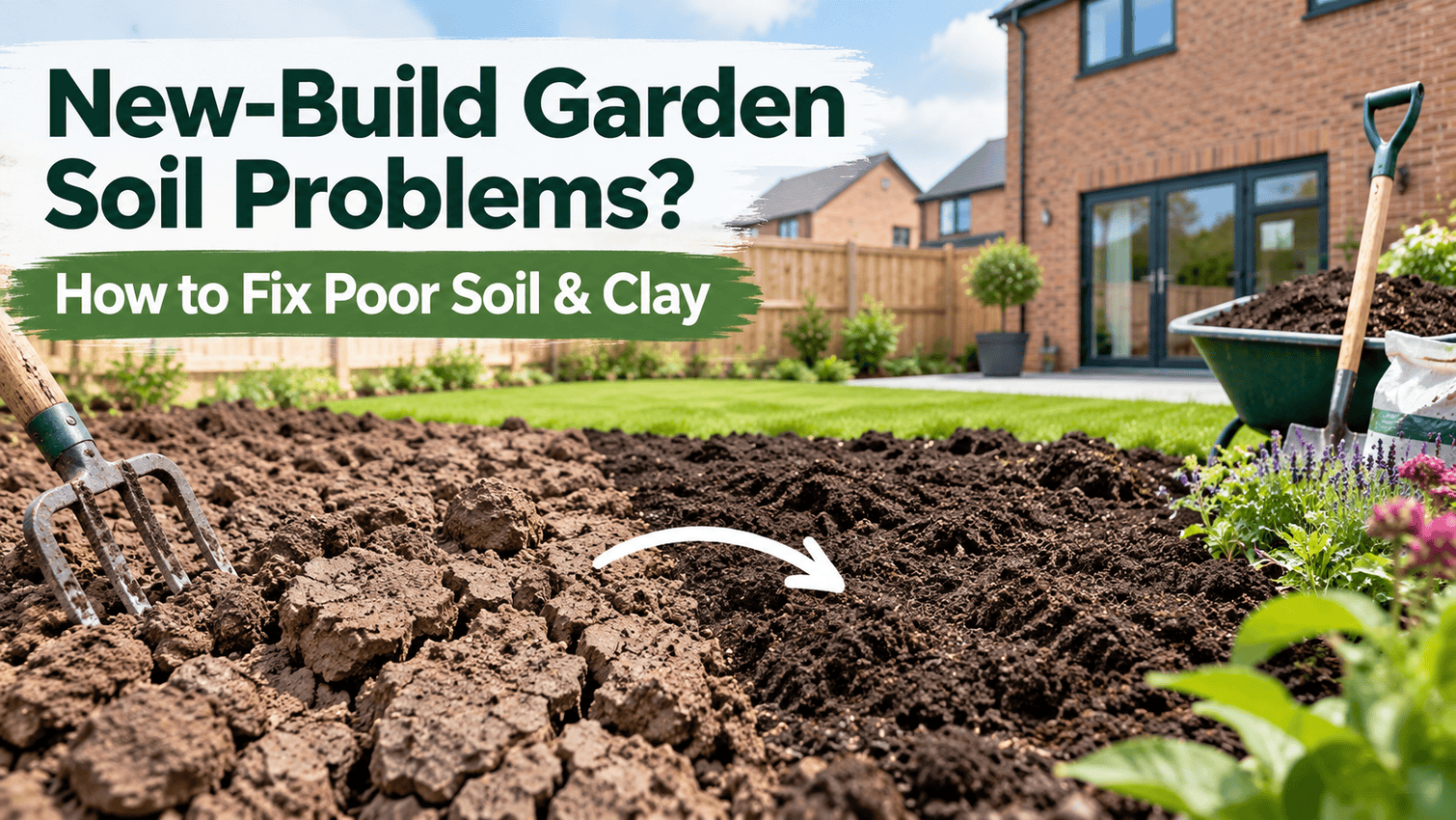
What Should I Order for a New-Build Garden?
New-build gardens can present several different problems:
Compaction
Shallow topsoil
Clay
Rubble
Poor drainage
Low organic matter
If there isn't enough usable soil, additional Topsoil may be required.
If sufficient soil is already present but its structure is poor, organic matter may be more useful.
Many new-build garden projects therefore use:
Topsoil + Organic Compost
rather than choosing one or the other.
But don't simply cover severe compaction with a new layer of material.
Prepare the underlying ground first.
How Much Garden Soil Do I Need?
Before ordering, measure the area.
Use this formula:
Length × Width × Depth = Volume
Measurements need to be in metres.
Example 1: Small flower bed
5m × 2m = 10m²
If you need 10cm of material:
10 × 0.10 = 1m³
That's approximately:
1,000 litres
Example 2: Larger garden
10m × 5m = 50m²
At 10cm:
50 × 0.10 = 5m³
That's approximately:
5,000 litres
Example 3: Raised bed
2.4m × 1.2m × 0.3m = 0.864m³
That's approximately:
864 litres
Measuring before you order helps avoid two expensive situations:
Ordering too little and needing another delivery
or
ordering far more than you can use.
Quick Garden Soil Calculator
| Area | 5cm depth | 10cm depth | 20cm depth |
|---|---|---|---|
| 5m² | 250L | 500L | 1,000L |
| 10m² | 500L | 1,000L | 2,000L |
| 20m² | 1,000L | 2,000L | 4,000L |
| 30m² | 1,500L | 3,000L | 6,000L |
| 40m² | 2,000L | 4,000L | 8,000L |
| 50m² | 2,500L | 5,000L | 10,000L |
| 100m² | 5,000L | 10,000L | 20,000L |
These are volume calculations rather than recommended application depths for every garden.
The correct depth depends on what you're building.
Is a Bulk Bag Better Than Small Garden-Centre Bags?
For small jobs, small bags are convenient.
For larger projects, the numbers quickly change.
Kelvin Compost supplies many garden materials in approximately 850-litre bulk bags.
Suppose your project requires 850 litres.
If you purchased 40-litre bags, you'd need more than:
21 bags
If you purchased 50-litre bags:
17 bags
For a larger landscaping project requiring several cubic metres, individual bags become even less practical.
Bulk delivery can reduce:
Trips to the garden centre
Loading and unloading
Individual plastic bags
The chance of running out halfway through a project
Can I Order More Than One Garden Material?
Yes — and for many projects, that's exactly what makes sense.
For example:
Raised-bed project
Topsoil + Organic Compost
Vegetable garden
Compost + Well-Rotted Manure
Garden renovation
Topsoil + Compost + Woodchip
Allotment
Compost + Manure + Woodchip
New lawn plus flower borders
Topsoil + Organic Compost
Think about the complete project before ordering rather than treating each area separately.
Bulk Bags or Loose Loads?
The appropriate format depends on project size.
Bulk bags are convenient for many domestic gardens because material remains contained in one place.
For substantially larger landscaping, farming, allotment or community projects, loose loads may make more sense.
Kelvin Compost can also supply 10 and 20 tonne loose loads for larger requirements.
Before ordering a large load, consider:
Vehicle access
Drop-off location
Gates
Overhead cables
Road access
Space for material
How quickly you can move it
Kelvin Compost also has a small HIAB option for suitable deliveries where access needs additional consideration.
Where Does Kelvin Compost Deliver?
Kelvin Compost supplies garden materials across Glasgow, East Kilbride, South Lanarkshire and surrounding areas of Scotland.
Products include:
Loam Soil
Topsoil & Compost Mix
Other soil-improvement products
Bulk bags are available for domestic and gardening projects, while larger loose-load options are available for substantial requirements.
Why Buy Garden Soil Locally?
Garden materials are heavy.
That makes the supplier's location and delivery options important.
Buying from a local supplier can make it easier to:
Discuss delivery access
Calculate quantities
Combine products
Arrange larger loads
Ask which material suits the project
Arrange collection where available
Kelvin Compost supplies individual gardeners as well as allotments, schools, community gardens, farms and landscaping projects.
Before You Order: 5 Things to Check
1. Measure your project
Know the approximate length, width and required depth.
2. Decide what you're actually trying to do
Are you:
Adding soil?
or
improving existing soil?
That determines whether topsoil or compost is likely to be the starting point.
3. Check access
Think about where the bulk bag or load can safely be delivered.
4. Calculate the entire project
If you also need manure or woodchip, planning the complete order may avoid another delivery.
5. Ask if you're unsure
If you don't know which product you need, explain the project before ordering.
It's much easier to choose the right material beforehand than move a bulk bag of the wrong material afterward.
Frequently Asked Questions About Garden Soil Delivery
Where can I buy garden soil in Glasgow?
Kelvin Compost supplies topsoil, organic compost, well-rotted manure, woodchip and other garden materials with delivery across Glasgow, South Lanarkshire and surrounding areas.
Do you deliver topsoil in Glasgow?
Yes. Kelvin Compost supplies bulk topsoil for lawns, raised beds, planting areas and landscaping projects.
Do you deliver compost in Glasgow?
Yes. Peat-free, BSI PAS 100 organic compost is available for soil improvement, vegetable gardens, allotments, raised beds and other suitable applications.
What is the best soil for filling raised beds?
Raised beds generally benefit from a soil-based growing medium containing topsoil and organic matter rather than being filled entirely with compost.
Should I buy topsoil or compost?
Buy topsoil when you need additional soil depth or volume. Buy compost when you already have sufficient soil but want to increase organic matter and improve it.
How much soil does an 850-litre bulk bag contain?
850 litres is approximately 0.85 cubic metres by volume.
How many bulk bags do I need?
Calculate your required volume in litres and divide by the volume supplied per bag. Allow for the specific mix and real-world requirements of your project.
Can I order compost and topsoil together?
Yes. Many garden projects require both products because topsoil provides growing volume while compost contributes organic matter.
Do you supply larger garden projects?
Yes. In addition to bulk bags, Kelvin Compost offers larger loose-load options for suitable projects.
Ready to Order Garden Soil in Glasgow?
Don't start by asking:
"Which product is cheapest?"
Start with:
"What does my garden actually need?"
If you need soil depth, consider Topsoil.
If you need to improve existing soil, consider Organic Compost.
If you're preparing suitable productive ground, consider Well-Rotted Manure.
And if you're working on several areas at once, you may need a combination.
Kelvin Compost supplies garden soil and bulk materials across Glasgow, East Kilbride, South Lanarkshire and surrounding areas, from individual bulk bags to larger loads.
Get the Right Material Delivered
Already know what you need?
Not sure how much to order?
Call Kelvin Compost: +44 7561 251350
Email: info@kelvincompost.co.uk
Tell us what you're building, the approximate dimensions and your delivery area so we can help you choose the right garden material for the job.
Need Garden Supplies Delivered in Glasgow?
Organic compost, topsoil, manure and more across Scotland