




How to Prepare an Allotment for Winter | Scotland Guide
Looking for compost, topsoil or garden supplies?
Browse our full product range or get in touch for delivery across Glasgow and Scotland.
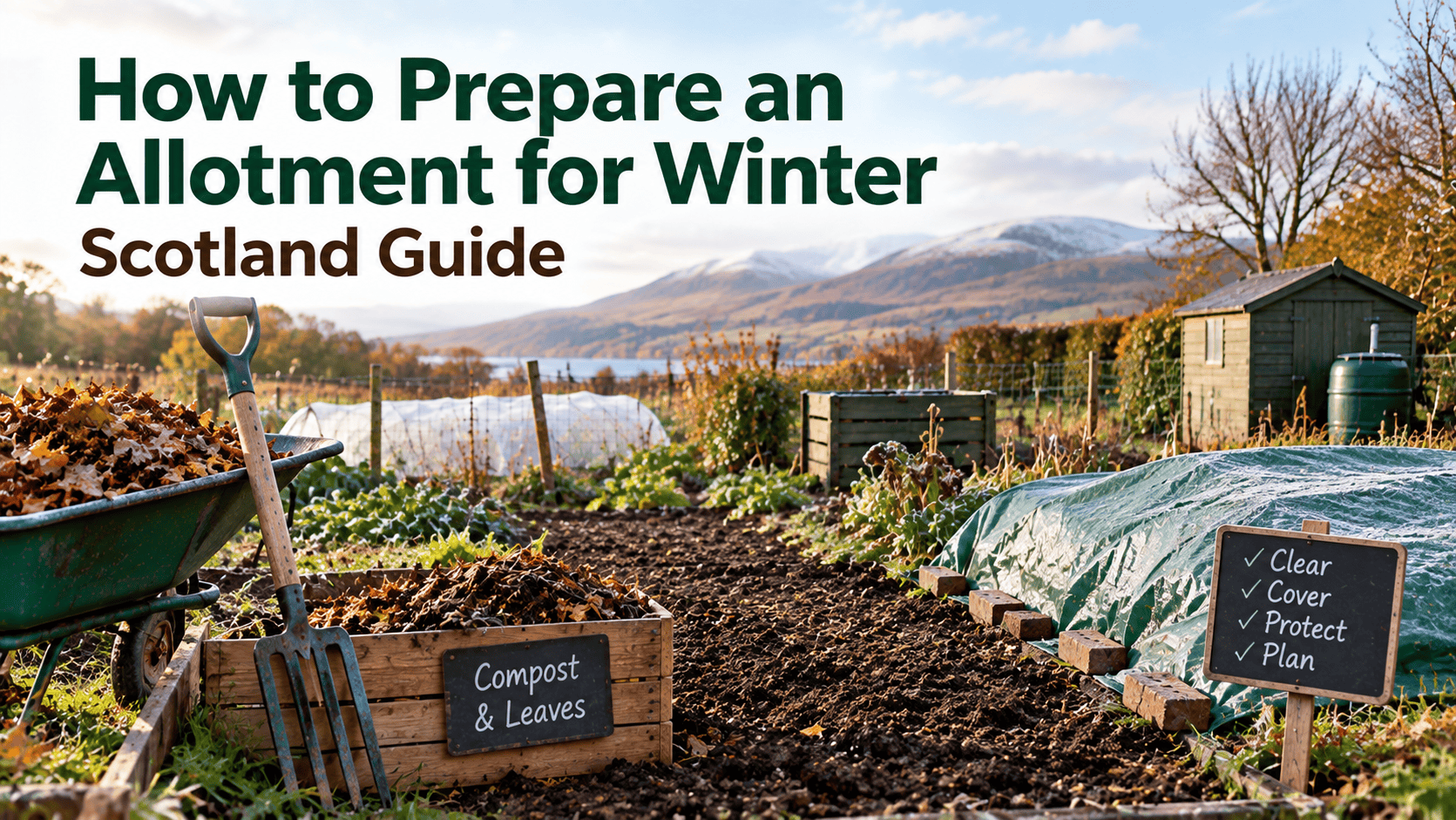
How to Prepare an Allotment for Winter in Scotland: Autumn Soil & Compost Guide
September and October are important months on a Scottish allotment.
Summer crops are finishing, beds are becoming empty and weeds are still growing — but what you do with the soil now can make next spring considerably easier.
You don't necessarily need to dig the entire allotment.
Instead, focus on:
Clear problem weeds → remove diseased crops → assess each bed → improve soil where appropriate → protect bare ground → plan where next year's crops will grow.
For some beds, that might mean organic compost.
For others, well-rotted manure may be more appropriate.
And for allotment paths and permanent fruit areas, woodchip can be extremely useful.
Here's how to prepare your allotment properly for the Scottish winter.
Quick Answer: What Should I Do to My Allotment in Autumn?
Start with these jobs:
Harvest remaining crops
Remove diseased plant material
Control perennial weeds
Avoid leaving unnecessary bare soil
Add organic matter where appropriate
Decide which beds actually need manure
Mulch suitable beds
Woodchip paths where required
Check raised beds
Avoid walking over wet growing areas
Plan next year's crop locations
Measure beds before ordering compost
You don't need to treat every bed identically.
Your potatoes, carrots, fruit bushes and paths all have different requirements.
Should You Dig an Allotment Over Before Winter?
Not necessarily.
Traditional allotment gardening often involved digging the whole plot during autumn.
That can still be useful in particular situations, especially where soil is compacted or you're establishing a neglected plot.
But annual deep digging isn't essential for every allotment.
If your soil is already productive and well structured, you may prefer a minimal-dig or no-dig approach.
Kelvin Compost has a separate guide to No-Dig Gardening in Scotland.
The most important rule is:
Don't cultivate saturated soil.
This is particularly important with heavy clay.
Walking and digging on very wet soil can damage its structure and contribute to compaction.
Start by Dividing Your Allotment Into Zones
Before spreading compost everywhere, make a simple plan.
Divide the plot into areas such as:
Vegetable beds
Where annual crops will grow.
Hungry-crop beds
Where you expect to grow crops such as courgettes, pumpkins, squash or sweetcorn.
Root-crop beds
Potential future areas for carrots, parsnips and similar crops.
Permanent fruit
Raspberries, currants, gooseberries and fruit trees.
Paths
Areas that need weed suppression and year-round access.
This immediately helps you decide where different materials belong.
Step 1: Clear Finished Crops
Once annual crops have finished, remove material that shouldn't remain on the bed.
Pay particular attention to:
Diseased leaves
Rotten fruit
Serious pest problems
Dead annual plants
Persistent weeds
Healthy plant material can often be composted.
Don't automatically strip every bed completely bare, though.
Healthy roots can sometimes remain in the soil to decompose naturally, particularly in a minimal-disturbance system.
Step 2: Deal With Perennial Weeds
Autumn is a good opportunity to regain control of weeds before next spring.
Watch for:
Couch grass
Bindweed
Docks
Dandelions
Ground elder
Creeping buttercup
Don't simply spread a thin layer of compost over severe perennial weeds and expect them to disappear.
Remove or properly suppress them before creating next year's growing beds.
This is especially important on a newly acquired or neglected allotment.
Step 3: Check the Soil
Take a handful of soil from several beds.
Ask:
Is it compacted?
Roots and water may struggle to move through badly compacted ground.
Is it heavy clay?
Clay can be productive, but avoid working it while saturated.
Is it sandy?
Sandy soil can drain rapidly and lose nutrients more easily.
Is it low in organic matter?
Adding suitable organic material may improve soil structure and water-holding capacity.
Does water stand on it?
Don't simply cover a serious drainage problem with compost.
Investigate why water isn't moving away.
Should You Add Compost to an Allotment in Autumn?
Organic compost can be useful for improving suitable allotment soil.
Kelvin Compost Organic Compost can add organic matter to:
Vegetable beds
Raised beds
No-dig beds
Established growing areas
Future planting areas
It can be spread over the surface as a mulch rather than necessarily being dug deeply into the ground.
For many established beds, around 2.5–5cm can be a practical soil-improvement layer, depending on existing conditions and your gardening system.
If you're creating a completely new no-dig bed, considerably more compost may initially be required.
How Much Compost Does an Allotment Need?
Measure rather than guess.
The formula is:
Length × Width × Depth = volume
Remember that depth must also be converted to metres.
Example: 10m² bed at 5cm
10 × 0.05 = 0.5m³
That's approximately:
500 litres.
20m² bed
At 5cm:
20 × 0.05 = 1m³
That's approximately:
1,000 litres.
50m² growing area
At 5cm:
50 × 0.05 = 2.5m³
That's approximately:
2,500 litres.
This is why bulk delivery can become much more practical on an allotment than transporting dozens of small bags.
Allotment Compost Calculator
| Growing area | 2.5cm layer | 5cm layer |
|---|---|---|
| 5m² | 125L | 250L |
| 10m² | 250L | 500L |
| 20m² | 500L | 1,000L |
| 30m² | 750L | 1,500L |
| 50m² | 1,250L | 2,500L |
| 75m² | 1,875L | 3,750L |
| 100m² | 2,500L | 5,000L |
These are volume calculations, not a recommendation to apply the same amount to every allotment.
Assess your soil first.
Should You Put Manure on an Allotment in Autumn?
Sometimes.
But don't manure the entire allotment simply because it's autumn.
Well-Rotted Manure is particularly useful where you want organic matter and fertility for suitable crops.
It can be valuable when preparing ground for hungry crops such as:
Pumpkins
Squashes
Courgettes
Sweetcorn
Brassicas
But think about next year's crop plan first.
Where Should You Avoid Freshly Manured Ground?
Root vegetables deserve special consideration.
Carrots and parsnips generally don't benefit from being planted into recently heavily manured soil.
Excessively rich or freshly manured conditions can contribute to forked or distorted roots.
That's why crop planning matters.
Instead of:
manure → entire allotment
think:
manure → specific future beds
This saves material and gives different crops the conditions they need.
Compost vs Manure for an Allotment
A simple way to think about them is:
Organic Compost
Useful for broad soil improvement and adding stable organic matter.
Consider it for:
General vegetable beds
Raised beds
No-dig beds
Soil structure
Surface mulching
Well-Rotted Manure
Useful where additional fertility and organic matter are appropriate.
Consider it for:
Hungry-crop beds
Established productive soil
Suitable fruit-growing areas
Particular soil-improvement projects
You may use both across an allotment — just not necessarily on the same bed at the same time.
What Should You Do With Empty Beds?
You have several options.
Option 1: Mulch with compost
Spread suitable organic matter over the surface.
Option 2: Grow green manure
Certain green-manure crops can cover otherwise bare ground and later be incorporated or cut down according to the system you're using.
Option 3: Leave suitable crop roots
Healthy roots can be left to decompose in some gardening systems.
Option 4: Cover temporarily
Where there is a particular weed-control or soil-management reason, an appropriate temporary cover may be useful.
The goal is to avoid neglecting the plot until March.
What About Allotment Paths?
Paths are often overlooked.
If paths become muddy during Glasgow's wet winter weather, they can make the whole allotment difficult to use.
Organic Woodchips can be useful for allotment paths.
They can help:
Suppress weeds
Reduce exposed muddy soil
Define growing beds
Create cleaner walking routes
Recycle organic woody material
For weed suppression, prepare the path first rather than simply throwing a very thin layer over established weeds.
How Much Woodchip Do I Need for Allotment Paths?
Suppose your combined paths measure:
25m long × 0.6m wide
Area:
15m²
At 7.5cm depth:
15 × 0.075 = 1.125m³
That's approximately:
1,125 litres of woodchip.
For 30m² of paths:
30 × 0.075 = 2.25m³
or approximately:
2,250 litres.
Measure the total path area before ordering.
Should You Mulch Around Fruit Bushes?
Yes, suitable organic mulch can be useful around established:
Raspberries
Blackcurrants
Redcurrants
Gooseberries
Fruit trees
It can help reduce weeds and conserve moisture.
Keep mulch away from direct contact with woody stems and trunks.
Depending on the plants and your objective, suitable compost or woodchip may be used.
What About Raised Beds?
Autumn is a good time to inspect raised beds.
Check whether:
Soil level has dropped
Timber needs repairing
Perennial weeds are present
Additional organic matter is required
Drainage is functioning properly
Organic materials naturally settle over time, so a bed that was full last spring may be noticeably lower by autumn.
Don't automatically refill the entire missing depth with compost if significant soil volume is required.
If you genuinely need additional soil, Topsoil may form part of the mix.
Don't Forget Your Compost Heap
Your home compost heap can keep working through autumn and winter, although decomposition slows as temperatures fall.
Continue adding a balanced mixture of:
greens, such as suitable fresh plant material,
and
browns, such as dry leaves and cardboard.
Avoid allowing an open heap to become completely saturated by winter rain.
Autumn leaves are also ideal for making leafmould separately.
Should You Rotavate an Allotment Every Autumn?
Not automatically.
Rotavators can be useful when initially tackling particular areas, but routine rotavation isn't necessary for every productive plot.
There are also disadvantages.
For example, rotavating through perennial weeds such as couch grass can chop roots into many pieces and potentially spread the problem.
Before using machinery, identify what is growing in the bed and why cultivation is necessary.
What If You Have Heavy Clay Soil?
Don't panic.
Clay can be productive because it retains water and nutrients well.
The challenge is managing its structure.
For heavy allotment soil:
Avoid walking over wet beds
Avoid cultivating saturated ground
Add organic matter where appropriate
Keep permanent paths
Consider raised beds where useful
Protect soil surfaces
Address genuine drainage problems separately
Organic matter improves soil gradually.
Don't expect one bulk bag to permanently transform years of compaction overnight.
What If You Have Sandy Soil?
Sandy soil behaves almost oppositely.
It generally:
Drains quickly
Warms quickly
Is easier to cultivate
Loses moisture more rapidly
Can lose nutrients more readily
Organic matter is particularly valuable for improving moisture and nutrient retention.
However, timing nutrient-rich applications closer to active plant growth may reduce unnecessary winter nutrient losses.
New Allotment? Don't Try to Fix Everything at Once
If you've just taken over an overgrown allotment, start small.
A sensible first year could be:
Autumn
Clear and prepare 2–4 manageable beds.
Winter
Plan crops and improve paths.
Spring
Plant the prepared beds.
Summer
Keep those areas productive and under control.
Following autumn
Expand into another section.
Trying to clear, dig, manure and plant an entire neglected plot in one weekend is a good way to make allotment gardening feel like punishment.
Build productive soil gradually.
Autumn Allotment Checklist
Before winter:
✓ Harvest remaining crops
✓ Remove diseased plants
✓ Control perennial weeds
✓ Avoid walking on saturated beds
✓ Add compost where required
✓ Manure only appropriate future beds
✓ Cover bare soil
✓ Mulch fruit bushes
✓ Woodchip paths
✓ Check raised-bed levels
✓ Start collecting autumn leaves
✓ Maintain the compost heap
✓ Decide next year's crop locations
✓ Measure before ordering bulk material
You'll thank yourself when spring arrives.
Buying Compost & Manure for Allotments in Glasgow
Kelvin Compost supplies garden and allotment materials across Glasgow, East Kilbride, South Lanarkshire and surrounding areas.
Improving vegetable beds?
Preparing suitable hungry-crop beds?
Improving allotment paths?
Need additional actual soil?
Bulk quantities can be particularly useful for allotments because even a modest plot can require thousands of litres of material.
Frequently Asked Questions
Should I put compost on my allotment in autumn?
Yes, compost can be used as an organic mulch and soil improver on suitable beds. The correct amount depends on your soil condition and gardening method.
Should I dig compost into the soil?
Not necessarily. Compost can be applied to the surface, particularly in no-dig or minimal-disturbance systems.
Should I manure my entire allotment?
Usually not. Plan where next year's crops will grow and apply manure where additional fertility is appropriate.
How much compost do I need for a 50m² allotment?
A 5cm layer across 50m² equals approximately 2.5m³ or 2,500 litres.
Is woodchip good for allotment paths?
Yes. Woodchip can be a practical material for suppressing weeds and reducing muddy exposed soil on paths.
Should allotment soil be left bare over winter?
Suitable mulch, cover crops or other soil-cover approaches can protect empty ground. The best option depends on the bed and next crop.
Should I dig clay soil in autumn?
Clay soil can be cultivated in autumn when conditions are suitable, but avoid digging it when wet and sticky.
Can I prepare an allotment in winter?
Yes. Many clearing, planning, mulching and infrastructure jobs can be done during winter whenever ground conditions allow.
Get Your Allotment Ready Before Winter
A productive spring allotment begins months earlier.
Don't simply abandon empty beds after the final harvest.
Assess each part of the plot and decide what it actually needs.
Organic Compost for general soil improvement.
Well-Rotted Manure for suitable fertile growing areas.
Woodchip for paths and suitable permanent planting.
Topsoil when you genuinely need additional soil volume.
Order Allotment Materials
Call Kelvin Compost: +44 7561 251350
Email: info@kelvincompost.co.uk
Before ordering, measure the total area of the beds or paths you want to cover. A simple measurement can prevent both under-ordering and paying for material you don't need.
Need Garden Supplies Delivered in Glasgow?
Organic compost, topsoil, manure and more across Scotland