




How to Create a Garden Border | Soil & Compost Guide Scotland
Looking for compost, topsoil or garden supplies?
Browse our full product range or get in touch for delivery across Glasgow and Scotland.
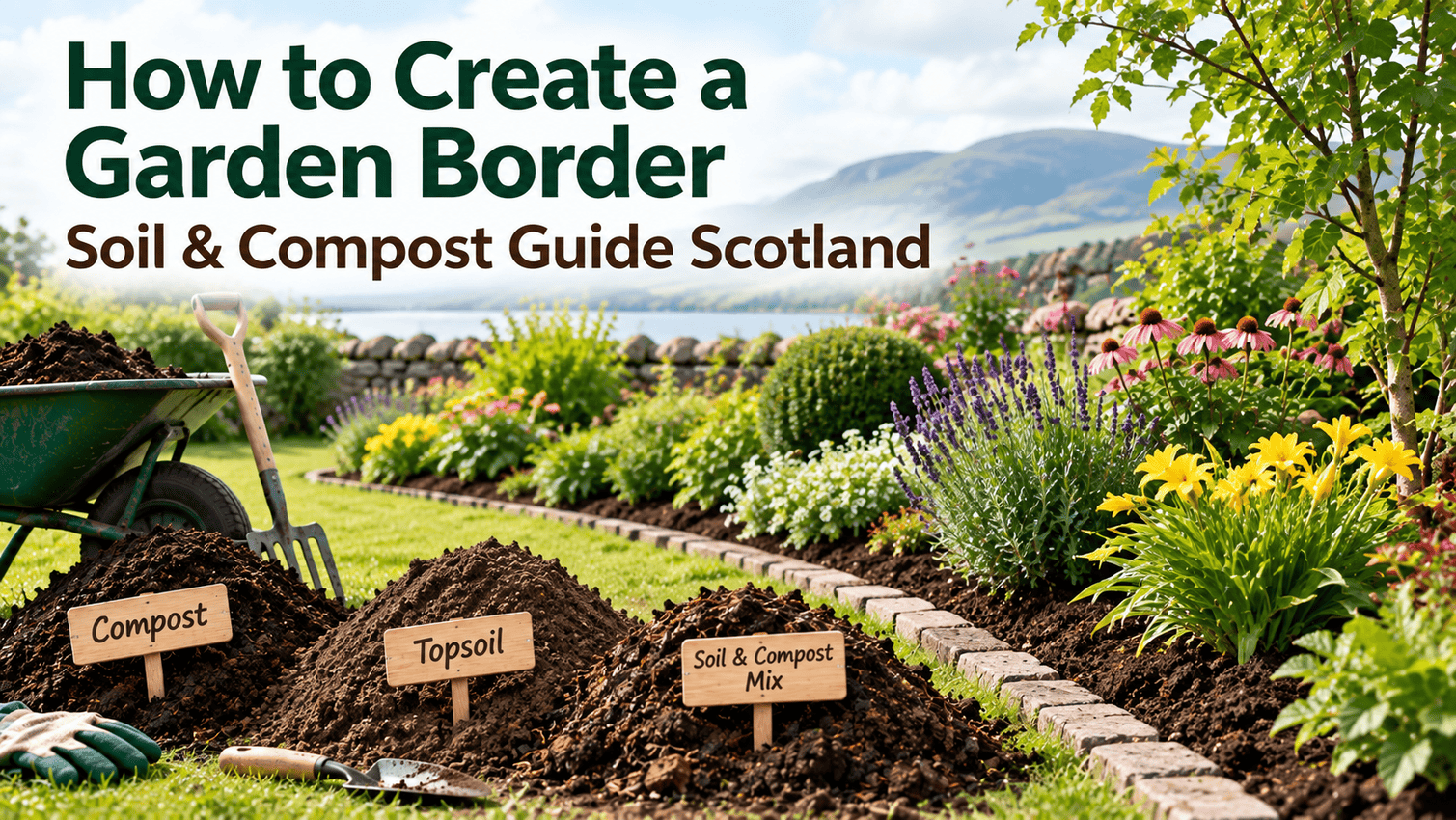
How to Create a New Garden Border: Soil, Compost & Planting Guide for Scotland
Want to turn an empty lawn, tired flower bed or unused corner of your garden into a new planting border?
Before buying dozens of plants, get the soil right.
A successful garden border starts below ground. If the soil is compacted, shallow, waterlogged or low in organic matter, expensive plants can struggle no matter how attractive they looked at the garden centre.
For most new borders, the process is:
Mark out the border → remove grass and weeds → assess the existing soil → relieve compaction where necessary → add organic matter → add topsoil only if additional soil is actually required → plant → water → mulch.
Depending on your garden, that could mean using organic compost, topsoil, well-rotted manure, woodchip — or a combination.
This guide explains how to prepare a new garden border properly and calculate how much material you need before ordering.
Quick Answer: What Soil Should I Use for a New Garden Border?
If you already have a reasonable depth of garden soil, you usually don't need to replace it.
Instead, improve it.
A simple starting point is:
| Garden condition | What to consider |
|---|---|
| Good existing soil | Compost/mulch as required |
| Poor soil low in organic matter | Organic compost |
| Heavy but workable clay | Organic compost |
| Light sandy soil | Organic compost |
| Shallow or missing topsoil | Topsoil |
| New raised border | Topsoil + organic matter |
| Tired established border | Compost or suitable well-rotted manure |
| Bare soil after planting | Compost or woodchip mulch |
| Waterlogged ground | Diagnose drainage first |
The most important distinction is:
Topsoil adds soil volume.
Compost improves suitable existing soil.
They aren't interchangeable.
Is Autumn a Good Time to Create a Garden Border in Scotland?
Yes.
Autumn can be an excellent time to establish a new border because the soil is often still relatively warm while temperatures are cooler than summer.
Many hardy perennials, shrubs and trees can establish roots during autumn before strong spring growth begins.
September is therefore a useful time to:
Mark out new borders
Remove turf
Clear perennial weeds
Improve the soil
Plant suitable hardy perennials and shrubs
Mulch newly planted areas
You can also prepare the soil in autumn and leave some planting until spring.
Avoid cultivating or planting when soil is severely waterlogged or frozen.
Step 1: Decide Where Your Border Will Go
Don't start digging immediately.
First consider what plants will eventually grow there.
Look at:
Sunlight
Shade
Drainage
Existing trees
Buildings and fences
Mature plant sizes
Access for maintenance
Views from the house
Existing garden paths
A south-facing border may experience very different conditions from a shaded border against a north-facing wall.
Your soil preparation matters, but the right plant still needs the right location.
Step 2: Mark Out the Shape
For curved borders, a garden hose is an easy way to experiment with the shape before cutting anything.
For straight borders, use string.
Don't make a border unnecessarily narrow.
A very narrow strip can make it difficult to create layers of plants.
A deeper border provides space for combinations such as:
taller shrubs at the back → medium perennials → lower plants toward the front.
Once you're happy with the layout, mark the final edge.
Step 3: Remove Turf and Perennial Weeds
If you're converting lawn into a traditional dug border, remove the turf and deal with persistent weeds before planting.
Pay particular attention to perennial weeds such as:
Couch grass
Bindweed
Ground elder
Docks
Dandelions
Don't simply cover serious perennial weeds with a thin layer of new soil and hope they disappear.
Removing them now is much easier than trying to extract their roots from around established plants later.
If you're using a no-dig method instead, the approach is different. Read our No-Dig Gardening in Scotland guide.
Step 4: Inspect the Existing Soil
Now dig a few test holes.
You're trying to answer several questions.
How deep is the usable soil?
If you have a reasonable depth of existing garden soil, you may not need additional topsoil.
If there's only a shallow layer over:
Rubble
Hardcore
Poor subsoil
Construction material
you may need more substantial preparation and additional Topsoil.
Is the soil compacted?
Compacted soil can restrict root growth and water movement.
This is especially common in:
New-build gardens
Areas previously used for paving
Construction sites
Frequently walked areas
Is it heavy clay?
Clay isn't automatically bad.
It can retain nutrients and moisture well.
The problem is often poor structure or compaction rather than the fact that clay is present.
Is it very sandy?
Sandy soil tends to drain rapidly and can struggle to retain moisture and nutrients.
Organic matter can be particularly valuable here.
Does water sit on the surface?
Don't ignore this.
Persistent standing water may indicate compaction, poor drainage, an impermeable layer or a high water table.
Fix the underlying problem before spending hundreds of pounds on plants.
Step 5: Do You Need to Dig the Border?
Not necessarily.
If your existing soil is already in reasonable condition and isn't compacted, intensive digging may be unnecessary.
However, if you're creating a traditional border on compacted ground, this is a useful opportunity to relieve that compaction.
Use a garden fork to loosen the soil.
Remove:
Large stones
Construction debris
Old roots
Persistent weed roots
You want workable soil that allows roots to spread.
Avoid aggressively cultivating saturated clay soil.
Working very wet soil can damage its structure.
Step 6: Add Organic Matter
This is where Organic Compost becomes useful.
Organic matter can help improve:
Soil structure
Moisture retention
Workability
Growing conditions
Biological activity
For a newly created border, a layer of approximately 5cm of organic matter is a useful general starting point.
For particularly sandy or heavy clay soils, a larger quantity may be appropriate.
You don't need to replace the entire border with compost.
The objective is to improve the soil you already have.
How Much Compost Does a New Border Need?
Use this simple calculation:
Length × Width × Depth = volume
Remember to use metres.
Example: 5m × 1.5m border
Area:
5 × 1.5 = 7.5m²
At a 5cm application:
7.5 × 0.05 = 0.375m³
That's approximately:
375 litres of compost.
Example: 10m × 2m border
Area:
20m²
At 5cm:
20 × 0.05 = 1m³
That's approximately:
1,000 litres.
At 10cm:
20 × 0.10 = 2m³
That's approximately:
2,000 litres.
For a large border, buying small garden-centre bags quickly becomes impractical.
Kelvin Compost supplies Organic Compost in approximately 850-litre bulk bags, making larger soil-improvement projects easier to plan.
Compost Calculator for Garden Borders
| Border area | Compost at 5cm | Compost at 7.5cm | Compost at 10cm |
|---|---|---|---|
| 5m² | 250L | 375L | 500L |
| 10m² | 500L | 750L | 1,000L |
| 15m² | 750L | 1,125L | 1,500L |
| 20m² | 1,000L | 1,500L | 2,000L |
| 25m² | 1,250L | 1,875L | 2,500L |
| 30m² | 1,500L | 2,250L | 3,000L |
| 50m² | 2,500L | 3,750L | 5,000L |
These are volume calculations, not a recommendation that every border requires a particular depth.
Assess your existing soil first.
Should I Use Topsoil in a New Flower Border?
Only when you actually need additional soil.
This is an important distinction because gardeners sometimes buy topsoil when they really need compost — or compost when they actually need additional soil volume.
Use Topsoil when:
Existing soil is too shallow
You're creating a raised border
Soil has been removed during landscaping
You're converting a previously paved area
You need substantial additional growing depth
You're establishing a new landscaped area with insufficient suitable soil
If you've already got 30cm or more of reasonable garden soil but it's tired and low in organic matter, adding another layer of topsoil may not address the real problem.
Organic compost may be the more useful purchase.
Topsoil vs Compost for Borders
Here's the simplest way to remember the difference:
Topsoil
Think:
"I need more soil."
Use it for:
Adding depth
Creating new growing areas
Raised borders
Replacing missing soil
Landscaping
Organic Compost
Think:
"I need to improve my soil."
Use it for:
Adding organic matter
Improving structure
Helping moisture retention
Improving tired beds
Mulching suitable established areas
Many new garden projects need both.
For example, if you're turning an old paved section into a deep planting bed, you may need:
Topsoil for volume + compost for organic matter.
Should You Use Manure in a Flower Border?
Well-Rotted Manure can be a useful source of organic matter for suitable beds and borders.
It can be particularly useful around hungry plants and in depleted soil.
However, don't assume every ornamental plant needs highly fertile soil.
Some plants naturally prefer relatively lean conditions.
If you're planting a mixed ornamental border, know what you're growing before adding large amounts of manure.
For general soil improvement, good-quality compost can often be the more versatile starting point.
Step 7: Level the Soil Before Planting
Once you've prepared and improved the soil:
Remove remaining stones and debris.
Break down large clods.
Rake the surface.
Fill obvious hollows.
Check your final soil level.
Remember that loose soil and organic material can settle.
Don't build soil up against:
House walls
Damp-proof courses
Fence bases
Tree trunks
Existing shrub stems
Now the border is ready for plants.
Step 8: Position Plants Before Digging Holes
Don't immediately plant the first pot.
Place all your plants on top of the prepared border first.
Then stand back.
Look at them from:
The house
The patio
The garden path
Upstairs windows
Check the mature size of each plant.
That small shrub in a 3-litre pot may eventually become 1.5 metres wide.
Proper spacing now prevents an overcrowded border later.
Step 9: Plant at the Correct Depth
For most container-grown perennials and shrubs, plant at approximately the same depth they were growing in the pot.
Avoid burying woody stems.
For shrubs, identify where the roots begin spreading from the base.
Backfill gently with the surrounding soil.
Firm enough to eliminate large air pockets without compacting the soil excessively.
Then water thoroughly.
Step 10: Mulch the Finished Border
After planting and watering, mulch the soil surface.
This is one of the easiest ways to improve the finished border.
Organic mulch can:
Suppress weeds
Reduce evaporation
Protect the soil surface
Add organic matter as it decomposes
Improve the finished appearance
For many borders, aim for approximately:
5–7.5cm of mulch
depending on the material and situation.
You can use suitable organic compost as mulch.
Alternatively, Organic Woodchips can be particularly useful around:
Shrubs
Trees
Larger established perennials
Ornamental planting
Paths around beds
Don't pile mulch directly against plant stems or crowns.
Leave a small clear area around them.
How Much Woodchip Do I Need for a Border?
Use exactly the same volume calculation.
Suppose your border is:
10m × 2m = 20m²
At 5cm:
20 × 0.05 = 1m³
That's approximately:
1,000 litres of woodchip.
At 7.5cm:
20 × 0.075 = 1.5m³
That's approximately:
1,500 litres.
Kelvin Compost supplies Organic Woodchips in bulk quantities for garden and landscaping projects.
Compost or Woodchip for Mulching?
Both can work, but they perform slightly different roles.
Compost mulch
Best when your priority includes:
Adding organic matter
Improving the soil
Mulching productive beds
Gradually feeding soil organisms
Woodchip mulch
Particularly useful when your priority includes:
Weed suppression
Moisture conservation
Shrub and tree planting
A longer-lasting surface covering
Garden paths
For an ornamental shrub border, woodchip can be an excellent finishing material.
For a productive or perennial border where soil improvement is the priority, compost may be preferable.
Some gardens use both in different areas.
How Much Material Does an 850-Litre Bulk Bag Cover?
This depends entirely on application depth.
An 850-litre bulk bag represents approximately:
0.85m³
At a 5cm layer:
0.85 ÷ 0.05 = approximately 17m²
At 7.5cm:
0.85 ÷ 0.075 = approximately 11.3m²
At 10cm:
0.85 ÷ 0.10 = approximately 8.5m²
So, approximately:
| Application depth | Approx. area from 850L |
|---|---|
| 5cm | 17m² |
| 7.5cm | 11.3m² |
| 10cm | 8.5m² |
Actual coverage varies because loose materials settle and surfaces are rarely perfectly level.
Measure before ordering.
Example: What Would I Order for a 20m² New Border?
Let's consider three scenarios.
Scenario 1: Good soil, low organic matter
You already have adequate soil depth.
You might need:
Organic Compost
At 5cm across 20m²:
approximately 1,000 litres.
Scenario 2: Shallow soil
You need an additional 15cm of soil depth.
Calculation:
20 × 0.15 = 3m³
That's approximately:
3,000 litres of topsoil
plus organic matter depending on the condition and intended planting.
Scenario 3: New shrub border with good existing soil
You improve the soil and then want a woodchip mulch.
At 7.5cm:
20 × 0.075 = 1.5m³
That's approximately:
1,500 litres of woodchip.
This is why it's worth measuring the project before placing an order.
What If My Border Has Heavy Clay Soil?
Don't automatically remove it.
Clay can be fertile and hold moisture well.
The problems usually arise when it is:
Compacted
Waterlogged
Structurally poor
Worked while saturated
For workable clay soil:
Remove perennial weeds.
Relieve severe compaction where necessary.
Add organic matter.
Avoid overworking wet soil.
Choose plants suited to your conditions.
Mulch the surface.
Organic Compost can be useful for increasing organic matter.
Don't assume adding a little sand will magically turn heavy clay into perfect loam.
What If My Border Is Waterlogged?
Don't hide the problem under new soil.
If water remains in your planting area for prolonged periods, investigate why.
Potential causes include:
Compacted soil
Heavy clay
Poor garden levels
Impermeable subsoil
Runoff from paving
High water table
Depending on the cause, you may need to:
Relieve compaction
Improve drainage
Create a raised border
Redirect surface water
Choose plants tolerant of wetter conditions
Compost can improve the structure of suitable soil, but it isn't a replacement for a drainage system.
Can I Make a Border on a New-Build Garden?
Yes, but inspect the ground carefully first.
New-build gardens can contain:
Compacted subsoil
Rubble
Shallow topsoil
Poor drainage
Construction debris
Don't simply spread 10cm of nice topsoil over badly compacted ground and start planting.
Prepare the underlying soil first.
If your entire garden has these problems, read our guide to improving new-build garden soil before starting the border.
What Should I Plant in a Scottish Garden Border?
Plant selection should reflect the conditions you actually have.
Consider:
Sun or shade
Soil moisture
Wind exposure
Soil pH
Mature plant size
Flowering period
Winter interest
Wildlife value
For year-round structure, combine different types of plants.
For example:
Shrubs provide structure.
Perennials provide seasonal colour.
Bulbs extend spring interest.
Ground-cover plants help fill gaps.
Rather than buying everything that happens to be flowering at the garden centre today, plan for different seasons.
A border that looks spectacular for two weeks in June and empty for the rest of the year isn't necessarily a successful design.
How Can I Make a Border Better for Pollinators?
Choose a range of plants that flower at different times.
Aim to provide flowers from early spring through autumn where your garden conditions allow.
Different flower shapes also support different insects.
Avoid thinking of a wildlife border as a single "wildlife plant."
Diversity is more useful.
Healthy soil, organic matter and sensible mulching also create a better environment for the wider soil ecosystem beneath your plants.
Common Garden Border Mistakes
1. Buying plants before preparing the ground
Prepare the soil first.
2. Filling the whole border with compost
Compost is primarily a soil improver, not necessarily a replacement for mineral soil.
3. Adding topsoil when you don't need additional soil
If soil depth is already adequate, organic matter may be what you actually need.
4. Ignoring perennial weeds
Deal with them before planting.
5. Planting too close together
Check mature sizes, not today's pot size.
6. Working saturated clay
Wait until conditions improve.
7. Ignoring drainage
New compost can't fix a serious drainage defect.
8. Leaving soil bare after planting
Appropriate mulch can reduce weeds and moisture loss.
9. Piling mulch against stems
Keep mulch clear of woody stems and perennial crowns.
10. Forgetting to water
Autumn in Scotland can be wet, but newly planted plants still need their rootballs checked and watered when necessary.
Buying Compost, Topsoil & Woodchip for a New Garden Border in Glasgow
The correct order depends on what you're starting with.
Existing soil needs improving?
Choose Organic Compost.
Need additional soil depth?
Choose Topsoil.
Need suitable well-rotted organic matter?
See Well-Rotted Manure.
Want to mulch around shrubs and established planting?
See Organic Woodchips.
Kelvin Compost supplies bulk garden materials for domestic gardens, allotments, community projects and landscaping requirements across Glasgow, East Kilbride, South Lanarkshire and surrounding areas.
For larger projects, bulk quantities can be considerably easier than transporting dozens of small bags.
Frequently Asked Questions
What is the best soil for a flower border?
Most garden borders need suitable mineral soil with good structure, adequate drainage and organic matter. If you already have sufficient soil, improve it with organic matter rather than replacing it unnecessarily.
Should I use topsoil or compost for a new border?
Use topsoil when you need additional soil depth or volume. Use compost when you have sufficient existing soil but want to add organic matter and improve its condition.
How much compost should I add to a new border?
A 5cm layer is a useful general starting point for many new borders. Very sandy or heavy clay soil may benefit from more organic matter. Five centimetres equals approximately 50 litres per square metre.
How much compost do I need for 20m²?
At a depth of 5cm, a 20m² area requires approximately 1m³, or 1,000 litres, of material.
How much area will an 850L bulk bag cover?
At 5cm deep, approximately 17m² by volume. At 7.5cm, approximately 11.3m².
Is September a good time to create a border?
Yes. Late summer and autumn are excellent times to prepare borders, and many hardy perennials and shrubs can be planted in autumn while the ground remains workable.
Can I use manure in a flower border?
Yes, well-rotted manure can be useful in suitable borders, but consider the requirements of the plants you're growing. Highly fertile conditions aren't appropriate for every ornamental species.
Should I put woodchip over compost?
It can be done where appropriate, but it isn't always necessary. Compost itself can act as organic mulch. Woodchip is particularly useful where you want a longer-lasting surface covering around shrubs, trees or paths.
Can I make a border directly over grass?
You can remove the turf and create a traditional border, or use a suitable no-dig approach with cardboard and a substantial layer of compost. The best method depends on what you're planting and the condition of the ground.
Do I need to dig compost into the soil?
Not always. Organic matter can be incorporated during preparation or applied as surface mulch depending on the gardening method and existing soil conditions.
Creating a New Garden Border This Autumn?
Don't start by buying plants.
Start with the soil.
Measure the border and inspect the ground.
If you need more actual soil, order Topsoil.
If you have enough soil but need to improve it, order Organic Compost.
If well-rotted organic matter is appropriate for the planting, consider Manure.
And if you want a practical surface mulch around shrubs and established planting, consider Organic Woodchips.
Order Your Garden Border Materials
Improve existing soil:
Shop Organic Compost
Add soil depth:
Shop Topsoil
Add well-rotted organic matter:
Shop Manure
Mulch the finished border:
Shop Organic Woodchips
Call Kelvin Compost: +44 7561 251350
Email: info@kelvincompost.co.uk
If you're unsure how much to order, measure the length and width of your border and decide approximately how deep you need the material. Those measurements make it much easier to calculate the right quantity before delivery.
Need Garden Supplies Delivered in Glasgow?
Organic compost, topsoil, manure and more across Scotland