




Worm Composting: How to Start a Wormery at Home
Looking for compost, topsoil or garden supplies?
Browse our full product range or get in touch for delivery across Glasgow and Scotland.
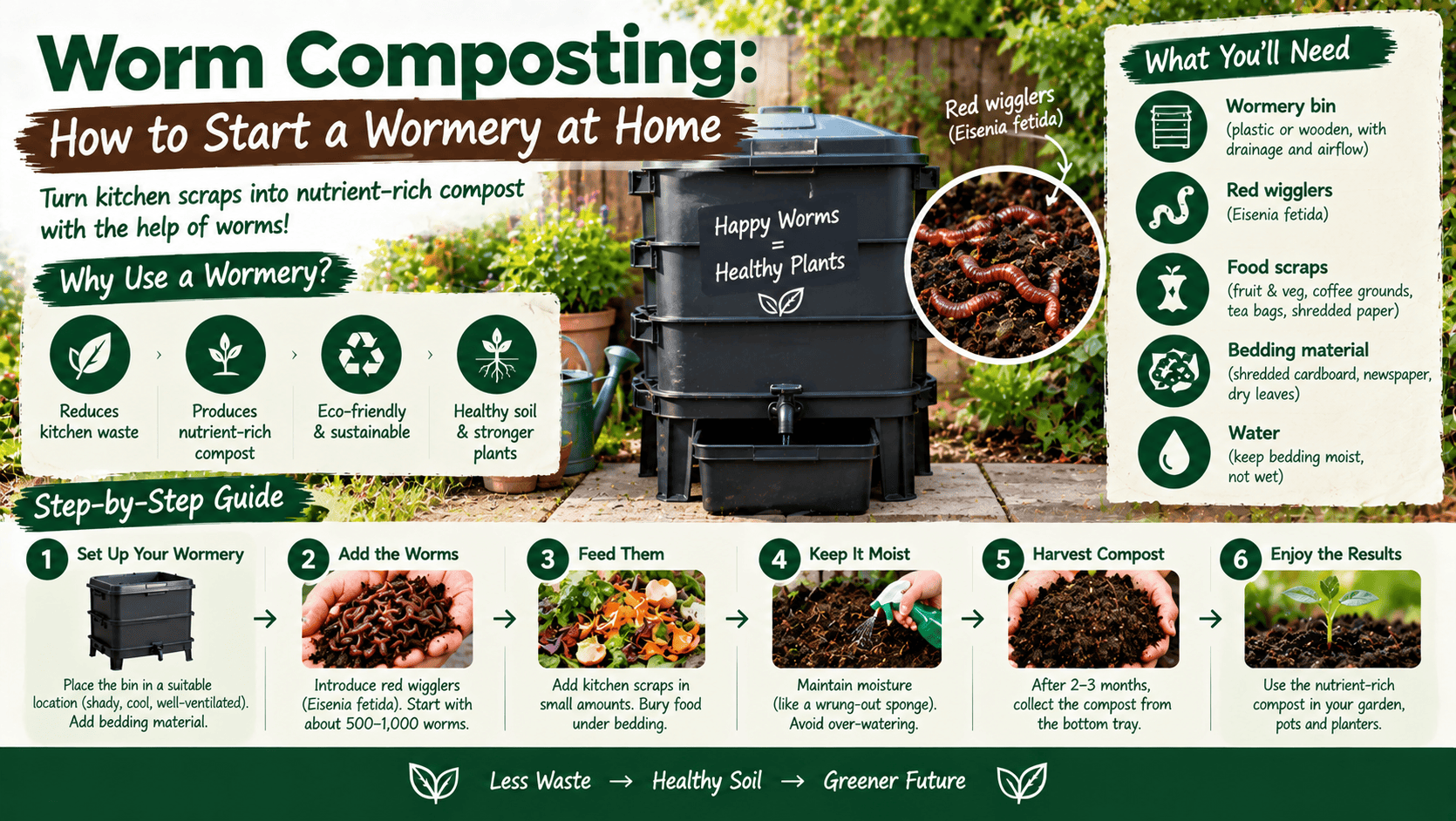
Worm Composting: How to Start a Wormery at Home
If you want to recycle vegetable peelings, coffee grounds and other kitchen waste but don't have enough space for a large compost heap, worm composting can be an excellent alternative.
A wormery uses specialist composting worms to process organic waste. Over time, the worms and microorganisms transform suitable kitchen scraps into a dark organic material commonly called worm compost, vermicompost or worm castings.
Many wormeries can also produce a liquid that can be collected and, when appropriately diluted, used as a liquid feed.
Worm composting is particularly attractive for people with:
Small gardens
Patios
Courtyards
Balconies
Limited garden waste
Large amounts of vegetable kitchen scraps
An interest in producing their own organic soil improver
However, a wormery isn't simply a normal compost bin with a handful of garden worms added.
The worms need suitable food, moisture, air and temperature. Feed them too quickly, let the wormery become waterlogged or expose it to extreme temperatures and the system can develop problems.
This complete beginner's guide explains how worm composting works, which worms you need, what worms can eat, what to avoid, where to put a wormery, how to harvest worm castings and how worm compost compares with ordinary garden compost.
Quick Answer: What Is Worm Composting?
Worm composting, also called vermicomposting, is the process of using specialist composting worms to break down suitable organic waste into nutrient-rich organic material.
A typical wormery contains:
Composting worms
Moist bedding
Kitchen and soft organic waste
Air
Drainage
A suitable temperature
The worms feed on decomposing organic matter while microorganisms also contribute to the process.
Eventually, the original waste is transformed into dark, crumbly worm compost.
The key to success is simple:
Feed little and often, keep conditions moist but not waterlogged, maintain airflow and protect the worms from temperature extremes.
What Is a Wormery?
A wormery is a container designed to provide suitable living and feeding conditions for composting worms.
Commercial wormeries often contain several trays.
Fresh waste goes into the upper active area. The worms move through the organic material while more processed compost gradually accumulates below.
Some systems also have a bottom reservoir where excess liquid collects.
You don't necessarily need a sophisticated multi-storey wormery, however.
The essential requirements are:
Darkness
Ventilation
Drainage
Moisture
Suitable bedding
Food
Appropriate composting worms
Get those conditions right and the worms do most of the work.
Is Worm Composting the Same as Normal Composting?
No.
Both processes transform organic waste, but they operate differently.
| Worm composting | Traditional composting |
|---|---|
| Uses specialist composting worms | Primarily relies on microorganisms |
| Excellent for kitchen scraps | Excellent for mixed garden waste |
| Works well at smaller scale | Can process large volumes |
| Needs relatively stable conditions | Larger heaps tolerate wider material types |
| Doesn't operate as a hot composting system | Active heaps can become hot |
| Produces worm castings | Produces garden compost |
| Limited woody material | Can handle more garden waste |
| Worm population must be protected | No managed worm population required |
The two methods don't need to compete.
A household with enough space can operate both a compost heap and a wormery.
Use the wormery for suitable kitchen waste and the main compost heap for larger quantities of garden material.
What Is Vermicompost?
Vermicompost is the organic material produced through worm composting.
You may also see terms such as:
Worm compost
Worm castings
Vermicast
Worm manure
The finished material contains processed organic matter and can be used as a soil conditioner or as an ingredient in appropriate growing-media mixtures.
It is generally used in smaller quantities than ordinary bulk garden compost.
That's an important distinction.
A wormery might produce a valuable concentrated material, but it isn't normally the practical way to generate several cubic metres of soil improver for a large garden.
Which Worms Do You Need for a Wormery?
One of the most common beginner mistakes is assuming you can dig up ordinary earthworms from the lawn and put them into a wormery.
A dedicated wormery uses composting worms adapted to living in decomposing organic matter.
Common species include:
Eisenia fetida
Eisenia andrei
Dendrobaena veneta
They may be sold under names such as:
Tiger worms
Brandling worms
Red worms
Composting worms
These worms naturally thrive in environments rich in decaying organic matter.
They are different from many of the larger earthworms living deeper in garden soil.
Can You Use Ordinary Garden Earthworms?
Don't deliberately collect random earthworms from your lawn for a wormery.
Different earthworm species occupy different ecological niches.
Some live in permanent soil burrows and are not suited to the concentrated organic environment inside a worm bin.
Buy or obtain worms specifically intended for composting.
How Does a Wormery Work?
A wormery is essentially a managed ecosystem.
You provide suitable organic waste.
Microorganisms begin decomposing it.
Composting worms consume the decomposing material and associated microorganisms.
Their activity further processes the organic matter.
Eventually, the material becomes a dark, fine compost.
For the system to remain healthy, four conditions are particularly important:
Food
The worms need suitable organic material.
Moisture
Worms require a moist environment.
Oxygen
A wormery is an aerobic composting system.
Temperature
Extreme heat and cold can reduce activity or kill worms.
You are therefore managing the environment, rather than simply feeding worms.
Where Should You Put a Wormery?
Choose a location protected from temperature extremes.
Possible locations include:
A sheltered garden area
Shed
Garage
Covered patio
Utility area
Sheltered balcony
The best location changes with climate and season.
In Scotland, winter cold deserves particular attention.
A wormery sitting completely exposed through prolonged frost may become too cold.
Likewise, placing a dark plastic wormery in intense direct summer sunshine can cause overheating.
Think:
Sheltered and stable rather than exposed.
What Temperature Do Composting Worms Prefer?
Composting worms are most active under relatively mild conditions.
The RHS identifies roughly 18–25°C as an ideal activity range and notes that activity declines noticeably below around 10°C and above 30°C.
You don't need to maintain exactly 21°C.
The practical lesson is simply:
Avoid extremes.
During a cold Scottish winter, consider moving a vulnerable wormery into:
A shed
Garage
Greenhouse where appropriate
Other frost-protected sheltered location
During hot weather, keep it away from intense direct sunlight.
How to Start a Wormery Step by Step
Step 1: Choose the wormery
You can purchase a purpose-built system or use a suitable DIY design.
Whatever you choose needs:
Ventilation
Drainage
A lid
Sufficient surface area
Protection from weather
A way to harvest finished material
Don't use a completely sealed container.
Worms need oxygen.
Step 2: Add bedding
The worms need somewhere moist and comfortable to establish before being overloaded with food.
Suitable bedding may include materials such as:
Mature compost
Coir
Shredded damp cardboard
Suitable mixtures supplied with the wormery
The bedding should be moist rather than saturated.
The RHS recommends establishing a layer of moist bedding before introducing worms.
Step 3: Add the composting worms
Place the worms onto the prepared bedding.
Allow them to settle into their new environment.
Don't immediately bury them under a huge quantity of food.
Step 4: Add a small amount of food
Start slowly.
A new worm population cannot process unlimited waste.
Add a relatively small amount of suitable material and wait for the worms to begin processing it.
Step 5: Increase feeding gradually
As the wormery becomes established, you will learn how quickly your worm population processes food.
Only add more when the previous material is being consumed.
This is one of the most important rules of worm composting.
Feed according to the worms' capacity—not according to how much kitchen waste you want to dispose of.
What Can Worms Eat?
Composting worms can process a wide range of soft organic material.
Suitable foods commonly include:
Vegetable peelings
Fruit scraps
Coffee grounds
Tea leaves
Small amounts of suitable paper
Shredded cardboard
Cooked vegetables without unsuitable sauces or fats
Soft garden material
Small quantities of crushed eggshell
Variety is useful.
A wormery fed a mixture of suitable foods is generally easier to manage than one constantly receiving large quantities of a single ingredient.
Should You Chop Food Before Putting It in a Wormery?
It can help.
A whole vegetable takes longer to break down than the same vegetable chopped into smaller pieces.
Smaller pieces create more surface area for microorganisms and worms to work on.
You don't need to turn every carrot peeling into confetti.
But chopping large scraps can accelerate processing.
This is particularly useful when:
Starting a new wormery
Temperatures are cooler
Food is accumulating
You want faster decomposition
What Should You Not Put in a Wormery?
A wormery is not a general-purpose food waste bin.
Some foods can cause odours, attract pests or create unsuitable conditions.
Meat
Avoid meat scraps.
Fish
Avoid fish and fish waste.
Bones
Bones are inappropriate for a normal wormery.
Dairy products
Avoid cheese, milk products and similar waste.
Oils and fats
Greasy and oily foods can create problems.
Large amounts of citrus
Small quantities may sometimes be tolerated, but large amounts can create acidic conditions.
Large quantities of onions and garlic
These are generally best limited.
Salty processed food
A wormery is designed around suitable organic scraps, not highly processed leftovers.
Large woody garden waste
Wormeries aren't efficient wood-processing systems.
Put substantial woody prunings into an appropriate garden composting or mulching system instead.
Can Worms Eat Coffee Grounds?
Yes, coffee grounds can be included.
But don't turn the wormery into a coffee-ground bin.
Coffee grounds should form part of a varied diet.
Mix them with other suitable food and bedding materials.
If you produce unusually large quantities of coffee grounds, distribute them between different composting systems rather than overwhelming the wormery.
Can Worms Eat Tea Bags?
Tea itself can be compostable, but modern tea bags vary.
Some contain plastic or other synthetic components.
Check whether your tea bags are genuinely suitable for home composting.
Loose tea leaves avoid this issue entirely.
Can Worms Eat Eggshells?
Small amounts of finely crushed eggshell can be added.
Eggshells break down slowly, so crushing them helps.
Don't expect whole shell pieces to disappear quickly.
Can Worms Eat Banana Peels?
Yes.
Banana skins can be added as part of a varied worm diet.
Cutting thick skins into smaller pieces can speed decomposition.
As with all food, avoid adding huge quantities at once.
Can Worms Eat Citrus Fruit?
This requires moderation.
Large amounts of citrus can create conditions that composting worms dislike.
If your household produces substantial quantities of orange, lemon or grapefruit peel, don't send all of it into the wormery.
Use another suitable waste route for the excess.
How Much Should You Feed Composting Worms?
There isn't a perfect household formula.
The correct feeding rate depends on:
Number of worms
Temperature
Food type
Wormery size
Moisture
How established the system is
The simplest method is observation.
If food disappears steadily:
Continue feeding at approximately that rate.
If uneaten food is accumulating:
Stop adding more.
Allow the worms to catch up.
If the wormery smells:
You've probably created unsuitable conditions—often through overfeeding or excessive moisture.
A healthy wormery should not smell strongly unpleasant.
How Often Should You Feed a Wormery?
Small amounts added regularly are generally better than dumping a week's worth of waste into the system all at once.
You might feed several times per week, but the correct frequency depends on how quickly food is being processed.
Don't feed by calendar alone.
Look inside.
The worms tell you what the system can handle.
Does a Wormery Need Water?
Sometimes—but be careful.
Kitchen waste already contains considerable moisture.
A covered wormery may therefore need very little additional water.
The bedding should remain damp.
If it becomes genuinely dry, add moisture gradually.
If liquid is pooling and the material is saturated, adding water will make the problem worse.
Moist is good. Waterlogged is not.
Why Is My Wormery Too Wet?
Excess moisture is one of the most common wormery problems.
Possible causes include:
Too much wet food
Poor drainage
Rain entering the bin
Insufficient absorbent bedding
Blocked drainage holes
If the wormery becomes waterlogged, oxygen levels fall.
Worms require oxygen, so prolonged saturation can become dangerous.
How to fix it
Try:
Stop feeding temporarily.
Drain excess liquid.
Add shredded cardboard or paper.
Gently improve airflow.
Check drainage.
Protect the bin from rain.
Don't aggressively stir the entire wormery as though you're turning a hot compost pile.
Work gently.
Why Does My Wormery Smell?
A well-managed wormery should have an earthy organic smell rather than a strong rotten odour.
Bad smells commonly indicate:
Overfeeding
Rotting uneaten food
Excessive moisture
Poor airflow
Unsuitable foods
Start by removing obvious excess food.
Then check moisture and drainage.
Add dry absorbent bedding if necessary.
Most smell problems are management problems rather than evidence that worm composting itself is inherently smelly.
Why Are There Flies in My Wormery?
Small flies can be attracted to exposed food.
They may be annoying even when they aren't harmful to the worms.
To reduce the problem:
Don't overfeed.
Bury fresh food slightly within the active material.
Cover food with damp cardboard or paper.
Keep the lid properly fitted.
Remove excessive rotting food.
Avoid spraying insecticides into the wormery.
You could harm the worms and other organisms that make the system work.
Why Are My Worms Trying to Escape?
A few worms exploring isn't necessarily a crisis.
Large numbers repeatedly attempting to leave may indicate poor conditions.
Check:
Moisture
Temperature
Acidity
Ventilation
Food
Drainage
Ask yourself what changed recently.
Did you add a huge amount of citrus?
Did the wormery become flooded?
Has it become extremely hot?
Did you suddenly add lots of food?
Correct the environmental problem rather than trying to physically force the worms to stay.
Can a Wormery Get Too Cold?
Yes.
Worm activity declines as temperatures fall.
In Scotland, this becomes particularly relevant through late autumn and winter.
A sheltered location can help protect the wormery.
If severe cold is expected, consider moving a portable system somewhere more protected.
The worms don't need tropical conditions.
They do need protection from extremes.
Can a Wormery Get Too Hot?
Yes.
This can be just as dangerous.
A dark plastic wormery sitting in strong direct summer sun can heat rapidly.
Position it somewhere protected from intense sunshine.
If the wormery feels unusually hot, investigate immediately.
Does Worm Composting Work in Winter?
Yes, but processing generally slows in colder conditions.
Worms remain more active when the wormery is protected from extreme cold.
The RHS recommends sheltering wormeries during colder weather and notes that a shed, garage or well-sheltered garden location can help protect them through winter.
For Scottish households, this makes location particularly important.
An exposed corner of the garden may work in summer but be unsuitable in January.
Can You Keep a Wormery Indoors?
Potentially.
Small wormeries can be kept in places such as:
Utility rooms
Garages
Sheds
Suitable indoor service areas
But remember that a badly managed wormery can develop odours or flies.
For most households, a sheltered outdoor or semi-outdoor location is more convenient.
If keeping one indoors, management becomes especially important.
What Are Worm Castings?
Worm castings are the processed material produced as composting worms digest organic matter.
In a mature wormery, the finished material is typically:
Dark
Fine
Crumbly
Organic-rich
Earthy-smelling
Worm castings can be used as a soil conditioner and as one ingredient in appropriate growing mixtures.
Because the material can be relatively rich, you generally don't need to fill an entire raised bed with pure worm castings.
Think of them as a valuable amendment, not bulk topsoil.
How Long Does a Wormery Take to Produce Compost?
Don't expect instant results.
How quickly material is processed depends on:
Worm population
Temperature
Feeding rate
Food particle size
Moisture
Wormery design
Overall conditions
The RHS notes that established wormeries may commonly take roughly 8–12 months to fill sufficiently for emptying, although actual processing rates vary.
A new wormery also needs time for the worm population and biological system to establish.
Patience is part of the process.
How Do You Harvest Worm Compost?
The method depends on your wormery.
Stacking wormeries
These make harvesting relatively straightforward.
Worms move toward fresher food in upper trays, allowing mature material in a lower tray to be removed.
Single-bin wormeries
You need to separate the worms from finished compost.
One approach is to encourage the worms toward an area containing fresh food before harvesting mature material elsewhere.
Another method is to remove the active upper layer containing most worms and use it to restart the system.
Always return composting worms to suitable conditions.
What Is Wormery Liquid?
Some wormeries collect liquid in their base.
This liquid is sometimes marketed or described as worm tea, although terminology can become confusing because deliberately brewed compost teas are different products.
If your system produces collected wormery liquid, follow the wormery manufacturer's instructions before using it.
The RHS recommends diluting wormery liquid at approximately one part liquid to ten parts water, while noting that its nutrient composition varies.
Don't assume stronger is better.
Is Wormery Liquid the Same as Worm Castings?
No.
They're two different outputs.
Worm castings
The solid processed organic material.
Wormery liquid
Liquid draining from the system.
The solid material is generally used as an organic soil conditioner or growing-media component.
The liquid may be diluted and used as a plant feed where appropriate.
How Do You Use Worm Castings in the Garden?
There are several possible uses.
Add them to garden soil
Small quantities can be incorporated into suitable soil.
Use around established plants
They can be applied appropriately around plants as an organic amendment.
Add to growing-media mixtures
Worm compost can form one component of a suitable homemade growing mix.
Don't assume pure worm castings should replace a properly formulated potting medium.
Add to vegetable beds
They can contribute organic matter and nutrients.
Again, use them as an amendment rather than assuming more is always better.
Can You Use Worm Castings for Houseplants?
Worm compost can be incorporated into appropriate houseplant growing mixtures.
Because drainage, aeration and structure matter in containers, don't simply replace all potting medium with dense worm compost.
Use it as one component of a suitable mix.
Can You Put Worm Castings on a Lawn?
Small quantities of organic material can be used in appropriate lawn-management situations, but worm compost is generally too valuable and limited in volume to be the most practical material for covering a large lawn.
For substantial lawn levelling or renovation, appropriate topsoil or top-dressing materials are usually more practical.
Use each material for the job it suits best.
Worm Castings vs Compost: Which Is Better?
Neither is universally better.
They serve somewhat different purposes.
| Worm castings | Garden compost |
|---|---|
| Produced by wormery | Produced in compost heap/bin |
| Fine organic amendment | General soil improver |
| Usually produced in small amounts | Can be produced in larger volume |
| Excellent for kitchen-waste recycling | Handles more garden waste |
| Useful in growing mixes | Excellent for beds and mulching |
| Not practical for filling large areas | More practical for bulk soil improvement |
If you have a 100m² garden requiring a substantial layer of organic matter, a household wormery isn't going to produce enough material quickly.
That's where conventional composting or bulk organic compost becomes much more practical.
Worm Composting vs a Compost Bin
This is one of the most useful decisions for beginners.
Choose a wormery if:
You have limited space.
Most of your compostable waste comes from the kitchen.
You want to experiment with vermicomposting.
You don't generate huge quantities of garden waste.
Choose a conventional compost bin if:
You have a lawn.
You generate lots of garden cuttings.
You have autumn leaves and annual plants.
You need to process greater volume.
You have enough outdoor space.
Use both if:
You generate both kitchen scraps and substantial garden waste.
That can be an excellent system.
Worm Compost vs Manure
Despite the term "worm manure" sometimes being used, worm castings and traditional animal manure are not the same thing.
Worm castings result from worms processing organic material.
Well-rotted manure generally comes from livestock manure and bedding that has decomposed.
For a large vegetable garden, well-rotted manure can provide substantial bulk organic matter and fertility where appropriate.
Worm castings are normally produced and used at a much smaller scale.
Worm Compost vs Topsoil
These materials have completely different jobs.
Topsoil is soil.
Worm compost is an organic amendment.
If you're creating a new garden bed that needs 20cm of additional growing depth, filling it with worm castings would make little sense.
You would normally need suitable soil, potentially combined with appropriate organic matter.
A useful rule is:
Need more soil volume? → Topsoil
Need concentrated home-produced organic amendment? → Worm compost
Worm Compost vs Bulk Organic Compost
This comparison is particularly important for larger gardens.
Imagine you have a 30m² vegetable area and want to apply 5cm of organic material.
The volume calculation is:
30m² × 0.05m = 1.5m³
That's approximately:
1,500 litres
A domestic wormery is not designed to produce 1,500 litres of finished material on demand.
Bulk organic compost is far more practical at that scale.
Worm composting therefore works best as part of a broader soil-management system rather than as a complete replacement for bulk organic matter.
How Much Compost Does a Garden Actually Need?
Use this simple formula:
Area × application depth = volume
For example:
10m² × 0.05m = 0.5m³
0.5m³ = approximately 500 litres.
| Area | At 2.5cm | At 5cm |
|---|---|---|
| 5m² | 125L | 250L |
| 10m² | 250L | 500L |
| 20m² | 500L | 1,000L |
| 30m² | 750L | 1,500L |
| 50m² | 1,250L | 2,500L |
| 100m² | 2,500L | 5,000L |
These figures demonstrate why home-produced worm compost and bulk compost solve different problems.
A wormery is excellent for producing small quantities of valuable organic amendment.
Bulk compost is the practical option when you need large quantities of organic matter.
Can You Add Worms to a Normal Compost Heap?
Worms often naturally colonise suitable cooler parts of mature compost heaps.
You don't normally need to purchase composting worms and deliberately add them to an ordinary garden heap.
A conventional compost pile may also heat significantly during active decomposition, while wormeries are designed specifically around conditions suitable for the worms.
Allow each system to work as intended.
Can You Put Worms Directly Into Garden Soil?
Garden soil already contains naturally occurring earthworm populations where conditions suit them.
Composting worms are adapted to rich decomposing organic environments and aren't a substitute for the earthworm communities naturally occupying soil.
Rather than buying composting worms for your borders, focus on creating healthy soil conditions by:
Adding appropriate organic matter
Avoiding unnecessary disturbance
Maintaining suitable moisture
Avoiding waterlogging
Protecting the soil surface
Earthworms will generally colonise suitable garden environments naturally.
Do Worms Improve Garden Soil?
Earthworms play important roles in healthy soil ecosystems.
Different species behave differently, but collectively earthworms can:
Consume decaying organic matter
Move material through soil
Create channels
Contribute to nutrient cycling
Influence soil structure
The goal shouldn't be simply to maximise worm numbers.
Instead, create soil conditions that support a healthy biological community.
Organic matter is an important part of that strategy.
How to Keep a Wormery Healthy Through Autumn and Winter in Scotland
October is a good time to think about winter protection.
As temperatures fall around Glasgow and across the Central Belt, an exposed wormery will become less active.
Use this checklist:
Move it somewhere sheltered
A shed or protected area can reduce exposure to frost.
Keep the lid on
Scottish winter rainfall can quickly turn an uncovered wormery into a waterlogged system.
Check drainage
Make sure liquid isn't accumulating excessively.
Feed less if processing slows
Don't continue adding food at summer rates if the worms aren't consuming it.
Keep bedding available
Shredded cardboard can help absorb excess moisture and maintain structure.
Don't panic when activity slows
Lower temperatures naturally reduce worm activity.
The goal through winter is to keep the system healthy, not force maximum production.
Common Worm Composting Mistakes
1. Using the wrong worms
Use specialist composting worms rather than random garden earthworms.
2. Overfeeding
Probably the most common beginner error.
Only add food at a rate the worms can process.
3. Letting the wormery become waterlogged
Maintain drainage and protect it from excessive rainfall.
4. Allowing it to overheat
Keep it out of intense direct summer sun.
5. Letting it freeze
Provide winter protection in colder conditions.
6. Adding unsuitable food
Avoid meat, fish, dairy, oils and excessive quantities of problematic foods.
7. Expecting instant compost
Wormeries need time to establish.
8. Treating wormery liquid as an undiluted fertiliser
Follow appropriate dilution guidance.
9. Assuming worm compost replaces topsoil
It doesn't.
10. Expecting a small wormery to supply an entire large garden
Use it for what it does best: recycling suitable kitchen waste into a valuable organic amendment.
A Simple Wormery Routine for Beginners
You don't need to inspect your worms every hour.
A simple routine works well.
Every few days
Check whether the previous food is being consumed.
Add a small amount if appropriate.
Weekly
Look at:
Moisture
Smell
Food accumulation
Worm activity
Drainage
Seasonally
Adjust feeding according to temperature.
Protect the wormery from summer heat and winter cold.
When mature material accumulates
Harvest the finished compost according to your wormery design.
Then return the active worms and bedding to continue the cycle.
Is a Wormery Worth It?
For many households, yes.
A wormery can be particularly worthwhile if you:
Want to reduce vegetable kitchen waste.
Don't have space for a large compost heap.
Enjoy producing your own soil amendments.
Have a small garden or allotment.
Want another composting method alongside a conventional bin.
But understand its limitations.
A wormery isn't designed to process every type of household waste.
It won't consume unlimited food.
And it won't produce tonnes of compost for a landscaping project.
Its strength is small-scale, controlled recycling of suitable organic waste.
What If You Need More Compost Than Your Wormery Produces?
This is normal.
Suppose your wormery produces enough castings for pots and selected vegetable beds.
That's useful.
But if you then decide to improve:
A 50m² vegetable plot
Several large raised beds
A new garden border
An allotment
A school garden
A community growing space
the volume requirement can quickly reach hundreds or thousands of litres.
Continue using your wormery.
Use its castings where they provide the greatest value.
Then supplement them with appropriate bulk organic matter where necessary.
Kelvin Compost supplies organic compost, topsoil, well-rotted manure and organic woodchip for larger garden projects across Glasgow, East Kilbride, South Lanarkshire and surrounding areas.
Frequently Asked Questions About Worm Composting
What is worm composting?
Worm composting uses specialist composting worms to process suitable organic waste into worm compost or vermicompost.
What worms should I use for composting?
Use specialist composting species such as tiger or brandling worms rather than collecting ordinary soil-dwelling earthworms.
What can I feed composting worms?
Suitable foods include many fruit and vegetable scraps, coffee grounds, tea leaves and small quantities of suitable soft organic material.
What shouldn't worms eat?
Avoid meat, fish, bones, dairy products, fats and oils. Limit foods such as citrus and members of the onion family.
Can worms eat cardboard?
Small amounts of shredded plain cardboard can provide useful bedding and carbon-rich material.
Can worms eat coffee grounds?
Yes, as part of a varied diet.
How often should I feed my worms?
Feed according to how quickly existing food is being consumed rather than following a rigid schedule.
Why does my wormery smell?
Overfeeding, excess moisture, poor drainage or unsuitable food are common causes.
Why are there flies in my wormery?
Exposed or excessive food can attract small flies. Bury food lightly and avoid overfeeding.
Can a wormery stay outside in winter?
It can in suitable sheltered conditions, but colder areas may require additional protection or relocation to a shed or garage.
Does worm composting work in Scotland?
Yes. Temperature management and protection from excessive winter rain and frost are particularly important.
How long does worm composting take?
Processing speed varies according to temperature, worm population, feeding and system design. Establishing useful quantities takes time rather than weeks.
What are worm castings?
They are processed organic material produced by worms feeding within the wormery.
Can I use worm castings directly in my garden?
They can be used as an organic soil conditioner or as part of suitable growing-media mixtures.
Is worm compost the same as normal compost?
No. Worm compost is produced through vermicomposting and is usually generated in much smaller quantities than conventional garden compost.
Is worm compost better than manure?
They have different properties and uses. Neither is universally better.
Can a wormery replace my compost bin?
For small quantities of kitchen waste, possibly. If you generate substantial garden waste, a conventional compost heap or bin is still useful.
Do I need both a wormery and a compost bin?
Not necessarily, but the combination works well for households producing both kitchen scraps and larger amounts of garden waste.
Start Small and Let the Worms Do the Work
Worm composting doesn't need to be complicated.
Start with the correct worms.
Give them suitable bedding.
Add small amounts of appropriate food.
Keep their environment moist but not waterlogged.
Protect them from excessive heat and cold.
And most importantly:
Don't overfeed them.
Once established, a wormery can quietly turn everyday kitchen scraps into useful organic material throughout the year.
For a small garden, that may provide much of the concentrated organic amendment you need.
For larger projects, use your worm compost where it provides the most benefit and supplement it with bulk soil-improvement materials when necessary.
Improving a Larger Garden?
Kelvin Compost supplies garden materials across Glasgow, East Kilbride, South Lanarkshire and surrounding areas.
Organic Compost — for adding mature organic matter to suitable garden soil.
Topsoil — when you need additional soil depth or volume.
Well-Rotted Manure — for suitable productive beds requiring organic matter and fertility.
Organic Woodchips — for appropriate mulching and path applications.
Call: +44 7561 251350
Email: info@kelvincompost.co.uk
Need Garden Supplies Delivered in Glasgow?
Organic compost, topsoil, manure and more across Scotland