


Why Is My Garden Soil Turning Green? UK Guide
Looking for compost, topsoil or garden supplies?
Browse our full product range or get in touch for delivery across Glasgow and Scotland.
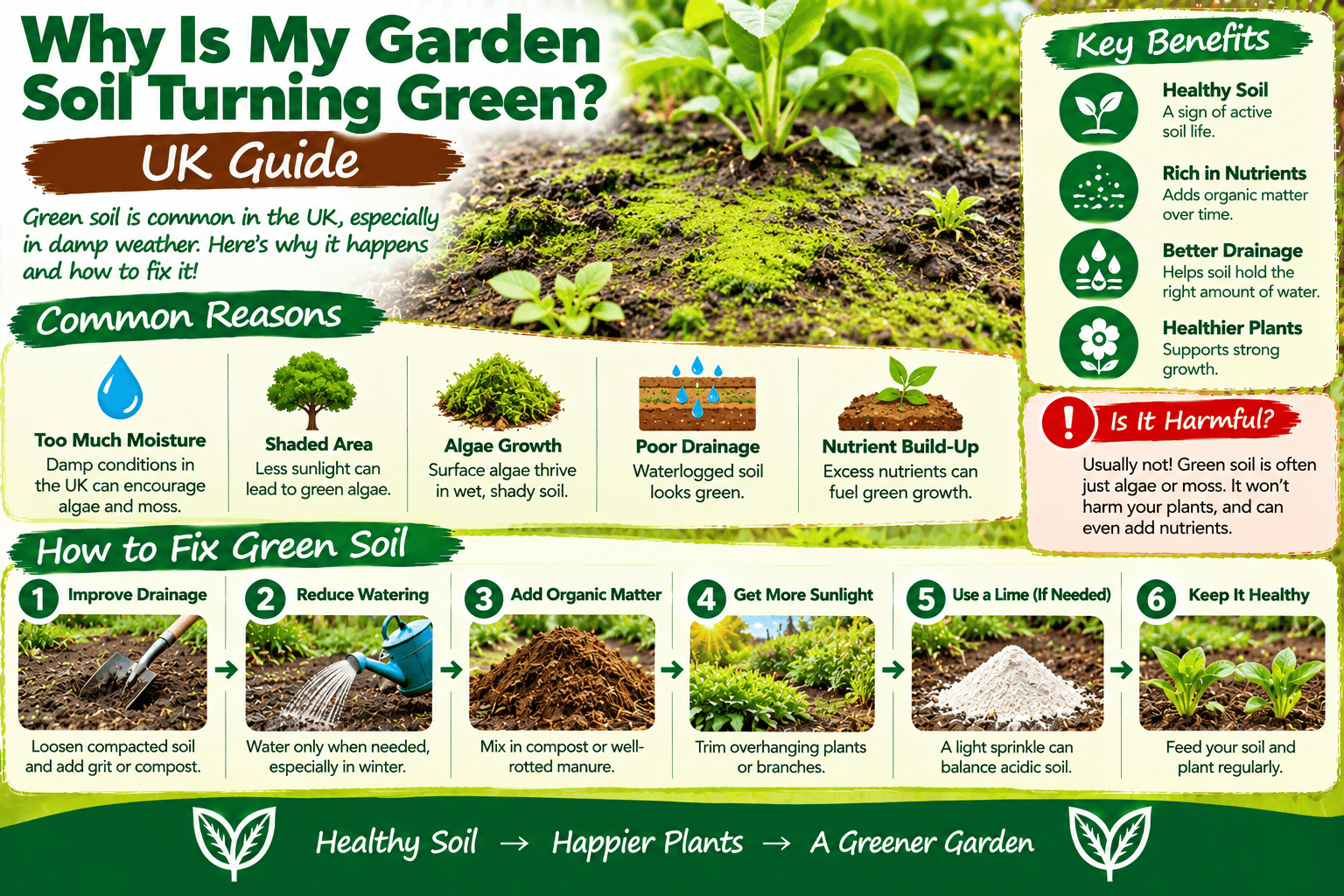
Why Is My Garden Soil Turning Green? Causes, Algae, Moss & How to Fix It
You walk into your garden after several days of rain and notice something unusual.
The soil has started turning green.
Perhaps there's a thin green film covering your vegetable bed. Maybe the surface of your compost looks green, or a slippery, jelly-like substance has appeared on the ground.
Is it mould? Is your soil going bad? Could it harm your plants?
Green soil is often caused by algae, moss or liverworts growing on the surface. These organisms commonly appear where moisture, shade and suitable conditions allow them to establish.
In many cases, the green growth itself is not a serious problem. However, persistent wetness, poor drainage or compaction may need attention.
For gardeners in Glasgow, East Kilbride, South Lanarkshire and across Scotland, this can be particularly noticeable during wet autumn and winter weather.
This guide explains why soil turns green, how to identify the likely cause, when to remove it and how to prevent the problem from returning.
Quick Answer: Why Is My Garden Soil Green?
Garden soil usually develops a green surface when algae, moss or liverworts grow in damp conditions.
Common contributing factors include:
Frequent rainfall.
Overwatering.
Poor drainage.
Compacted soil.
Shaded garden areas.
Limited air movement.
Persistently moist potting compost.
Bare soil exposed to light.
Old or compacted growing media.
A green coating does not automatically mean your soil is contaminated or unsuitable for plants.
The important question is whether the growth is simply covering the surface or whether the underlying soil conditions are affecting plant health.
1. What Is the Green Stuff Growing on My Soil?
Not every green growth is the same.
Three common possibilities are algae, moss and liverworts.
Green algae
Algae often appear as a thin green coating over damp soil.
The layer may look smooth or slightly slimy when wet and become dry or powdery as moisture decreases.
Algae do not have true roots, stems or leaves.
Moss
Moss usually has a more textured appearance.
It may form small green cushions, tufts or spreading mats.
Many mosses favour moist, shaded areas, although different species tolerate different conditions.
Liverworts
Liverworts may form flattened, overlapping green growths that spread across the soil surface.
They are particularly common in damp growing conditions.
Some produce distinctive reproductive structures.
How can you tell the difference?
| Appearance | Possible cause | Typical conditions |
|---|---|---|
| Thin green film | Algae | Moist exposed soil |
| Soft green cushion | Moss | Damp, often shaded ground |
| Flat overlapping green plates | Liverwort | Moist, compacted soil |
| Greenish jelly after rain | Possibly Nostoc | Wet ground or hard surfaces |
| Fuzzy or thread-like growth | Could be fungal growth | Depends on material and organism |
Appearance alone may not establish a precise identification.
2. Why Does Soil Turn Green After Rain?
Rain creates favourable moisture conditions for many surface-growing organisms.
When the soil remains damp for several days, algae and other growths may become more noticeable.
This is especially common where the ground receives little direct sunlight.
The rain doesn't necessarily introduce the organisms.
They may already be present and simply begin growing more visibly when conditions become favourable.
In Glasgow and western Scotland, prolonged wet periods can allow green surface growth to persist.
3. Is Green Algae on Garden Soil Harmful?
Usually, a small amount of algae on outdoor soil is not a major problem.
Algae are normal components of many environments.
However, a dense layer may indicate that the soil surface is staying wet for long periods.
In seed trays, algae can sometimes interfere with the establishment of delicate seedlings.
On established garden borders, the main concern may be the underlying moisture or drainage condition rather than the algae itself.
4. Does Green Soil Mean the Garden Is Waterlogged?
Not necessarily.
A damp soil surface can support algae without the entire root zone being waterlogged.
However, persistent green growth may be one clue that the ground remains wet.
Check for additional symptoms:
Water standing after rainfall.
Soil that remains saturated for long periods.
Plants wilting despite wet conditions.
Soft or muddy ground.
Poor root growth.
An unpleasant smell from saturated soil.
If these symptoms occur, investigate drainage separately.
Adding more soil or compost without addressing the underlying problem may not solve it.
5. Why Is My Compost Turning Green?
Compost can develop green surface growth when it remains moist and exposed to light.
This is particularly noticeable in seed trays, plant pots and growing containers.
The green coating may be algae rather than mould.
A small amount does not automatically mean the compost has spoiled.
However, the condition of the growing medium matters.
Ask:
Is the compost constantly saturated?
Does the container drain properly?
Is the material compacted?
Are seedlings struggling?
Does the compost have an unusual smell?
Is the material suitable for the intended plants?
For seed trays, persistent surface algae may indicate that watering or growing conditions need adjustment.
6. Is Green Mould the Same as Green Algae?
No.
Algae and mould are different organisms.
Algae photosynthesise and commonly form green surface films.
Moulds are fungi and often appear fuzzy, powdery or thread-like.
Colour alone is not enough to identify a particular organism.
If you're unsure what is growing, avoid handling or disturbing unknown material unnecessarily.
For ordinary outdoor garden soil, focus first on moisture, drainage and plant condition.
7. Why Is There Green Slime on My Garden Soil?
A greenish, jelly-like growth that becomes especially noticeable after rain may be Nostoc.
Nostoc is a type of cyanobacterium.
It may appear as a gelatinous mass when wet and become darker or crust-like when dry.
It can occur on compacted soil, gravel and other surfaces.
Nostoc is sometimes mistaken for algae or fungus.
The appropriate response usually involves assessing drainage, surface conditions and whether the growth creates a slipping hazard.
Avoid assuming that every green jelly-like substance is Nostoc without identification.
8. Why Is My Raised Bed Soil Turning Green?
Raised beds can develop green surface growth when moisture remains high.
Possible contributing factors include:
Frequent watering.
Heavy rainfall.
Poor drainage.
Shading.
Compacted growing medium.
Bare soil between crops.
A raised bed isn't automatically well drained simply because it is elevated.
The underlying ground, bed construction and growing medium all influence drainage.
If vegetables appear healthy and the green growth is limited, immediate treatment may not be necessary.
If seedlings are struggling or the growing medium remains saturated, investigate further.
9. Is Green Soil Dangerous for Vegetables?
A green surface coating does not automatically make vegetables unsafe.
Algae, moss and liverworts can occur in ordinary garden soil.
However, plants growing in persistently saturated soil may experience poor root conditions.
For vegetable beds, check whether crops are developing normally.
If plants are yellowing, wilting or failing to grow, investigate soil moisture, drainage, nutrients and other possible causes.
Wash harvested vegetables appropriately.
Do not assume that an unidentified green growth is edible.
10. Can Green Algae Stop Seeds From Growing?
Dense surface growth can interfere with the establishment of some seedlings.
This is particularly relevant to fine seeds grown in trays or small containers.
A surface layer may make it more difficult for delicate shoots to emerge.
To reduce the problem:
Avoid overwatering.
Ensure containers have drainage holes.
Use a suitable seed-growing medium.
Improve growing conditions where possible.
Follow seed-specific advice on surface coverings.
Avoid allowing trays to remain constantly saturated.
Do not scrape aggressively around emerging seedlings.
11. Why Is Green Moss Growing on Bare Soil?
Moss can colonise bare garden soil where conditions suit it.
Shade, moisture and limited competition from other plants may contribute.
However, moss does not always indicate acidic soil.
Different moss species tolerate different soil conditions.
If moss is growing in a garden border without harming other plants, removal may be unnecessary.
In some locations, moss can provide useful ground cover and help protect exposed soil.
12. Is Green Soil a Sign of Poor Drainage?
It can be, but it isn't proof.
Look at the wider garden.
Does water remain on the surface for days?
Does the soil smell unpleasant?
Are plants struggling?
Are paths or borders becoming muddy?
If so, poor drainage may be contributing.
For heavy Scottish clay soils, compaction and soil structure can also affect how quickly water moves through the ground.
Address these problems before adding unnecessary amendments.
13. How to Remove Green Algae From Garden Soil
If the growth is unwanted, non-chemical methods are often sufficient.
Step 1: Identify the likely growth
Determine whether it resembles algae, moss or liverwort.
Step 2: Check moisture
Avoid unnecessary watering if the soil is already wet.
Step 3: Improve drainage where needed
Investigate persistent waterlogging and compaction.
Step 4: Remove unwanted surface growth
Where appropriate, lightly remove algae or moss from bare soil.
Avoid disturbing roots or delicate seedlings.
Step 5: Improve light and airflow
If practical, reduce excessive shading without damaging established plants.
Step 6: Maintain suitable soil conditions
Avoid repeatedly working saturated soil.
Step 7: Monitor regrowth
If the underlying conditions remain unchanged, green growth may return.
The aim is not to sterilise outdoor soil.
14. How to Stop Soil Turning Green Again
Prevention depends on the cause.
Avoid excessive watering
Check actual soil moisture before irrigating.
Improve drainage
Persistent saturation may require drainage improvements.
Reduce compaction
Avoid walking on wet beds and lawns.
Improve airflow
Suitable plant spacing and pruning can help some areas dry more readily.
Manage bare soil
Appropriate planting or mulching may reduce exposed surfaces where green growth establishes.
Use suitable growing media
For pots and seed trays, avoid old, compacted or poorly draining compost.
These measures can reduce unwanted growth, but they won't eliminate algae or moss from every garden.
15. Can You Use Vinegar or Bleach to Kill Green Algae on Soil?
Avoid using household cleaning products on garden soil.
Bleach, vinegar, salt and similar substances can damage plants and soil organisms.
They may also create environmental problems.
For ordinary algae, moss and liverwort on soil, improving growing conditions and using appropriate physical removal methods is generally preferable.
Don't apply a patio-cleaning product to vegetable beds or plant roots.
16. Does Adding Compost Stop Green Algae?
Not automatically.
Mature organic compost can contribute organic matter to suitable garden soil.
Over time, appropriate organic-matter management may help improve some soil properties.
However, compost is not an algae treatment.
If the soil is already saturated, adding compost without addressing drainage may not solve the problem.
Compost itself can also support surface growth when kept persistently moist.
Use organic compost because the soil needs improvement, not simply because its surface has turned green.
For suitable soil-improvement projects, explore Kelvin Compost's organic compost.
17. Can New Topsoil Turn Green?
Yes.
Green surface growth can appear on newly placed topsoil when conditions are moist and suitable.
This doesn't automatically mean the topsoil is poor quality.
Algae and moss spores are widespread.
However, if the new soil remains saturated or forms a compacted surface, investigate its installation and drainage.
If a project requires additional suitable soil depth, Kelvin Compost's topsoil may be relevant.
Don't assume that placing fresh topsoil over a drainage problem will fix it.
18. Can Woodchip Help With Green Soil?
Suitable woodchip mulch can cover exposed soil and help manage moisture and weed growth in some garden settings.
However, woodchip isn't a universal treatment for algae.
Mulch should not be piled against trunks, stems or plant crowns.
Deep layers can remain wet, particularly in shaded areas.
For appropriate garden mulching projects, Kelvin Compost supplies woodchip.
Use a depth suitable for the location and purpose.
19. How Much Woodchip Do You Need for a Garden Border?
If you're planning to mulch an appropriate border, calculate the material volume.
Use:
Area (m²) × depth (m) = volume (m³)
For example, a 15m² border with a 5cm woodchip layer requires:
15 × 0.05 = 0.75m³
That's approximately 750 litres.
| Border area | 5cm woodchip layer |
|---|---|
| 5m² | 250L |
| 10m² | 500L |
| 15m² | 750L |
| 20m² | 1,000L |
| 30m² | 1,500L |
| 50m² | 2,500L |
These are volume calculations, not recommendations to mulch every green-soil problem.
Choose the correct treatment for the underlying conditions.
20. Why Is My Plant Pot Soil Turning Green?
A green layer on the surface of potting compost often indicates persistent moisture and light exposure.
Check whether the pot drains properly.
Avoid allowing the container to stand in water for long periods unless the plant specifically requires those conditions.
If the growing medium has become compacted or unsuitable, repotting may be necessary.
Choose a growing medium appropriate for the plant.
Bulk garden soil improvers should not automatically be used as substitutes for container compost.
21. Why Is My Greenhouse Soil Turning Green?
Greenhouses can provide moist, sheltered conditions where algae and liverworts establish.
Seed trays, benches and growing containers may develop green surface growth.
To reduce unwanted growth:
Avoid excessive watering.
Improve ventilation where appropriate.
Keep growing areas clean.
Ensure drainage is adequate.
Avoid overcrowding containers.
Use suitable seed compost.
Pay particular attention to delicate seedlings.
22. Green Soil in New-Build Gardens
Some new-build gardens contain compacted subsoil, disturbed ground or shallow growing layers.
If the surface remains wet, algae and moss may become noticeable.
Before ordering additional topsoil:
Check the existing soil depth.
Assess compaction.
Look for construction debris.
Investigate drainage.
Identify whether the growing layer is suitable.
Calculate any additional material needed.
If there are serious construction-related defects, consult the developer or an appropriate professional.
23. Green Soil in Glasgow, East Kilbride and South Lanarkshire
Gardens across Glasgow and surrounding areas experience different soil and drainage conditions.
Some contain clay-rich ground that stays wet during prolonged rainfall.
Others have shaded borders, compacted lawns or raised beds with unsuitable growing media.
During November and the winter months, green algae and moss may become more noticeable.
The most useful approach is to identify what is growing and why.
If the green layer is harmless and plants are healthy, removal may be unnecessary.
If the soil remains waterlogged or plants are failing, investigate the underlying problem.
For garden improvements requiring appropriate organic matter, mulch or additional topsoil, Kelvin Compost supplies materials across Glasgow, East Kilbride, South Lanarkshire and surrounding areas.
24. When Should Green Growth on Soil Concern You?
Pay closer attention when:
Seedlings cannot emerge. Dense surface growth may be interfering with germination.
Containers remain saturated. Poor drainage may be affecting roots.
Plants are dying. Investigate soil and plant-health problems rather than assuming algae is responsible.
Paths become slippery. Green growth on hard surfaces can create a slipping hazard.
The soil smells unpleasant. Persistent saturation and poor aeration may need attention.
An unidentified substance appears. Don't assume every green growth is harmless algae without considering its characteristics and context.
Frequently Asked Questions About Green Garden Soil
Why is my garden soil suddenly turning green?
Moist conditions may have encouraged algae, moss or liverworts to grow on the surface.
Is green soil bad for plants?
Not necessarily. Small amounts of surface growth may be harmless, but persistent saturation can affect plant roots.
What is the green slime on my soil?
It may be algae or an organism such as Nostoc. Identification depends on its appearance and characteristics.
Is green algae on soil dangerous?
Ordinary surface algae is not automatically dangerous, but dense growth may interfere with delicate seedlings.
Why is my compost turning green?
Moisture, light and suitable growing conditions can allow algae to develop.
Is green mould on soil harmful?
Green growth isn't always mould. Identify the organism and assess plant condition before deciding whether treatment is needed.
Can I still grow vegetables in green soil?
Yes, if the soil is otherwise suitable and the crops are healthy. Investigate persistent waterlogging or poor growth.
Does green soil mean poor drainage?
It can indicate persistent moisture, but green growth alone doesn't prove a drainage problem.
How do I remove algae from soil naturally?
Appropriate physical removal, moisture management and drainage improvements are often sufficient.
Will vinegar kill green algae on soil?
Vinegar may damage plants and soil organisms. Avoid using it as a homemade garden-soil treatment.
Does compost prevent algae?
No. Compost is a soil improver, not a specific algae treatment.
Can I cover green soil with woodchip?
Suitable mulch may be appropriate for some borders, but it won't correct underlying waterlogging.
Why is my raised bed turning green?
Moisture, shade and surface conditions may be encouraging algae, moss or liverworts.
Why is my plant pot soil green?
The growing medium may be staying damp for prolonged periods. Check watering and drainage.
Does green algae mean my soil is healthy?
Not necessarily. It indicates suitable conditions for algae but doesn't establish overall soil health.
Will green algae disappear in summer?
It may decline as conditions become drier, although growth can return when moisture becomes favourable.
Should I remove moss from garden borders?
Not always. Moss can be a useful part of the garden ecosystem unless it interferes with your planting plans.
Can green soil affect grass seed?
Dense surface growth and unsuitable moisture conditions may interfere with seed establishment.
Final Thoughts: Green Soil Is Usually a Symptom, Not the Main Problem
Discovering green soil in your garden can be surprising.
But in many cases, the explanation is straightforward.
Moisture, shade and suitable conditions have allowed algae, moss or liverworts to establish.
These organisms are common in gardens and don't automatically mean the soil is unhealthy.
The important thing is to assess the growing conditions.
Check drainage.
Avoid unnecessary watering.
Protect soil structure.
Investigate plant-health problems separately.
And use compost, topsoil or mulch only where those materials are genuinely appropriate.
Healthy garden soil doesn't have to look perfectly clean. It needs to provide suitable conditions for the plants you're growing.
Improving Garden Soil in Glasgow?
Kelvin Compost supplies garden materials for homeowners, allotments and landscaping projects across Glasgow, East Kilbride, South Lanarkshire and surrounding areas.
Explore our products:
Organic Compost — for adding mature organic matter to suitable garden soil.
Topsoil — for projects requiring additional suitable soil depth or volume.
Woodchip — for appropriate garden mulching and paths.
Manure — for suitable soil-fertility projects.
Call: +44 7561 251350
Email: info@kelvincompost.co.uk
Need Garden Supplies Delivered in Glasgow?
Organic compost, topsoil, manure and more across Scotland