



Why Is My Garden Soil So Hard? Causes & Fixes
Looking for compost, topsoil or garden supplies?
Browse our full product range or get in touch for delivery across Glasgow and Scotland.
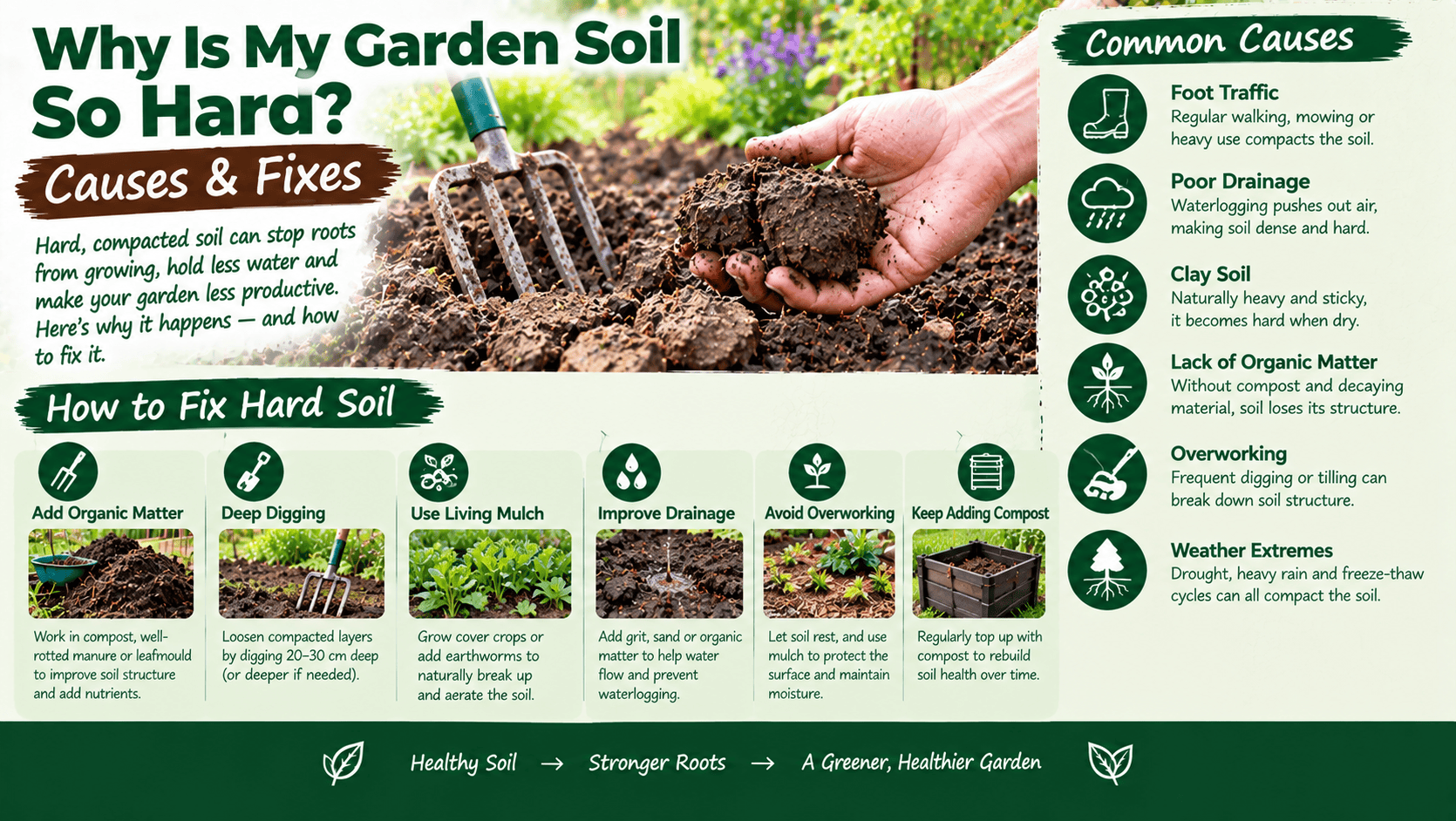
Why Is My Garden Soil So Hard? Causes, Fixes & How to Improve Compacted Soil
Have you ever tried digging your garden only to discover that the soil feels almost as hard as concrete?
Perhaps your spade struggles to penetrate the ground, rainwater sits on the surface, or your plants seem to grow slowly despite regular watering and feeding.
Hard garden soil is a common problem, particularly in areas with heavy clay, construction-disturbed ground or repeated foot traffic.
But hard soil doesn't always mean poor soil. Some soils naturally become firm when dry, while others have been compressed so tightly that water, air and plant roots struggle to move through them.
Understanding the difference is essential before trying to fix the problem.
This guide explains why garden soil becomes hard, how to identify compaction and the most effective ways to improve soil structure in gardens across Glasgow, Scotland and the wider UK.
Quick Answer: How Do You Soften Hard Garden Soil?
The best way to improve hard garden soil depends on what is causing it.
If the soil is compacted, reducing foot traffic, relieving compaction when conditions are suitable and adding organic matter can help restore a healthier structure.
If heavy clay becomes hard during dry weather, applying mature compost as a surface mulch, maintaining plant cover and avoiding cultivation when the soil is saturated can improve its condition over time.
The most important rule is to identify the cause before adding more soil or fertiliser.
Fertiliser alone won't fix compacted ground, and spreading new topsoil over a severely compressed layer may simply hide the underlying problem.
1. Why Does Garden Soil Become Hard?
Garden soil becomes hard for several reasons.
Some are related to its natural texture, while others result from how the ground has been used or managed.
The most common causes include:
Soil compaction from repeated walking or machinery.
Heavy clay drying and becoming firm.
Construction activity.
Low organic matter.
Poor soil structure.
Repeated cultivation under unsuitable conditions.
Surface crusting after rainfall.
Lack of vegetation or protective mulch.
These problems can occur individually or together.
For example, a new-build garden may contain naturally clay-rich soil that has also been compressed by construction machinery.
Adding compost may help improve the soil over time, but severe compaction may first require appropriate physical remediation
.
2. What Is Soil Compaction?
Soil compaction occurs when soil particles are pressed closer together, reducing the space between them.
Healthy soil contains pores that allow water, oxygen and roots to move through the ground.
When these spaces are reduced, plants may struggle.
Compacted soil can cause:
Restricted root development.
Poor water infiltration.
Surface runoff.
Reduced aeration.
Slow plant growth.
Waterlogging.
Difficulty digging.
The severity depends on the soil type, moisture conditions and depth of compaction.
3. How Can You Tell If Your Soil Is Compacted?
You don't need specialist equipment to perform an initial inspection.
Look for several warning signs.
A spade is difficult to push into the ground
If digging is unusually difficult, compaction may be present.
However, dry clay can also become very hard without necessarily having the same underlying problem.
Rainwater sits on the surface
Poor infiltration can indicate compacted ground, although drainage and soil texture may also contribute.
Plants develop shallow roots
Roots may struggle to penetrate dense soil layers.
Grass becomes thin in frequently used areas
Foot traffic can gradually compress lawn soil.
Water runs off instead of soaking in
Surface sealing or compaction may contribute to runoff.
The soil forms hard layers
An inspection hole may reveal a dense layer beneath the surface.
No single sign proves compaction. Look at the overall soil profile.
4. Is Hard Soil Always Compacted?
No.
This distinction is important.
Clay-rich soil can become extremely firm when dry.
When it becomes wet, it may turn sticky and difficult to cultivate.
That behaviour is partly related to its natural texture.
Compaction, meanwhile, involves a reduction in pore space caused by pressure or unsuitable soil management.
A garden can have:
Naturally firm clay soil.
Compacted sandy soil.
Compacted clay soil.
Dry soil that is temporarily difficult to dig.
The correct treatment depends on which situation you're dealing with.
5. Why Is Clay Soil So Hard?
Clay contains very small mineral particles.
These particles influence how soil holds water and behaves under different moisture conditions.
When clay-rich soil dries, it can become hard and sometimes develop cracks.
When saturated, it may become sticky and vulnerable to structural damage if worked aggressively.
This is why digging wet clay can make the problem worse.
The aim isn't necessarily to remove clay.
Clay soils can be productive when their structure is managed properly.
The goal is to create conditions that allow roots, water and air to move through the soil.
6. Why Is My Garden Soil Hard After Rain?
If your soil remains hard or develops a sealed surface after rain, several factors may be involved.
These include:
Surface crusting.
Poor aggregation.
Compaction.
Bare soil exposed to heavy rainfall.
Fine soil particles settling into surface pores.
A crust can make seedling emergence difficult and reduce infiltration.
Maintaining organic matter and protecting the surface with suitable mulch or vegetation can help reduce repeated crusting.
However, persistent standing water requires further investigation.
7. Why Is Soil Hard in New-Build Gardens?
New-build gardens can experience soil problems following construction.
Heavy machinery, repeated vehicle movement and the storage of building materials may compress the ground.
Some gardens also contain:
Disturbed soil layers.
Buried rubble.
Shallow topsoil.
Compacted subsoil.
Poor drainage.
Uneven soil quality.
A newly laid lawn can initially look attractive while concealing a dense layer underneath.
Over time, this can affect drainage and rooting.
Before ordering more topsoil, investigate what lies beneath the existing surface.
8. Can Compost Soften Hard Soil?
Mature compost can help improve soil structure over time, particularly where the soil would benefit from additional organic matter.
Organic matter can support soil aggregation, biological activity and moisture management.
In clay-rich soils, it can contribute to a more workable structure.
In sandy soils, it can help improve moisture retention.
However, compost is not an instant cure for severe compaction.
If the soil has been compressed into a dense layer by machinery, adding compost to the surface may not be enough to restore the deeper soil profile.
The best approach may involve addressing the compaction first and then using organic matter to support longer-term improvement.
9. How Much Compost Should You Add to Hard Soil?
The appropriate quantity depends on the soil's condition and the purpose of the application.
For general soil improvement, a surface layer of approximately 2.5–5cm of mature compost can be a practical starting point in suitable situations.
This is not a universal requirement.
Existing organic matter, crop requirements and the compost's characteristics should influence the amount used.
Compost Quantity Calculator
| Garden area | 2.5cm compost layer | 5cm compost layer |
|---|---|---|
| 5m² | 125 litres | 250 litres |
| 10m² | 250 litres | 500 litres |
| 20m² | 500 litres | 1,000 litres |
| 30m² | 750 litres | 1,500 litres |
| 50m² | 1,250 litres | 2,500 litres |
| 100m² | 2,500 litres | 5,000 litres |
Use the formula:
Area (m²) × depth (m) × 1,000 = litres required
For example:
20m² × 0.05m × 1,000 = 1,000 litres
If you already have suitable soil depth, adding organic matter may be more useful than importing extra topsoil.
10. Should You Dig Compost Into Hard Soil?
It depends on the condition of the soil.
For a new planting area with suitable moisture conditions, incorporating mature compost into the upper soil may be appropriate.
However, avoid digging when the soil is saturated.
Wet clay is especially vulnerable to structural damage.
In established beds, applying compost to the surface can be a useful alternative.
Soil organisms and natural processes gradually incorporate organic matter.
This approach is commonly associated with no-dig gardening.
11. Can No-Dig Gardening Improve Hard Soil?
No-dig gardening can help protect and gradually improve soil structure by reducing repeated disturbance.
The basic approach involves:
Minimising unnecessary digging.
Applying suitable organic matter to the surface.
Keeping soil covered where practical.
Allowing soil organisms and roots to contribute to structure.
Avoiding walking on growing beds.
Over time, this can support a more stable soil environment.
However, severe construction compaction may require targeted remediation before a no-dig system becomes fully effective.
No-dig is a management approach, not a guarantee that every compacted site will recover without intervention.
12. Should You Add Sand to Hard Clay Soil?
Adding small amounts of sand to heavy clay is generally not a reliable way to improve garden soil.
Meaningful changes to soil texture can require very large quantities of correctly graded material.
Small additions may provide little benefit and can produce an undesirable mixture.
For many domestic gardens, improving soil structure through suitable organic matter and good soil management is more practical.
Where specialist drainage or engineered growing media are needed, obtain appropriate advice rather than experimenting with arbitrary sand-to-clay ratios.
13. Can Gypsum Break Up Hard Clay?
Gypsum is sometimes promoted as a universal solution for clay soil.
But its effectiveness depends on soil chemistry.
It can be useful in certain soil conditions, particularly where excess sodium affects soil structure.
It is not automatically beneficial for ordinary clay-rich garden soil.
Before applying gypsum, establish whether the soil has a problem that gypsum can actually address.
Adding amendments without understanding the soil can waste money.
14. Does Adding Topsoil Fix Hard Ground?
Not necessarily.
Topsoil provides additional soil volume, but it doesn't automatically remove compaction underneath.
For example, placing 15cm of good-quality topsoil over a severely compacted layer may create a better-looking surface.
However, roots and water can still encounter the dense underlying material.
If the existing ground is compacted, address that issue before establishing the final growing layer where appropriate.
Use topsoil when you genuinely need additional soil depth or replacement soil.
Use compost when suitable existing soil needs more organic matter.
15. How Do You Loosen Compacted Garden Soil?
The best approach depends on how deeply the ground is compacted.
For light surface compaction
Reduce foot traffic, protect the soil and consider appropriate organic matter.
For moderate compaction
Careful loosening may be beneficial when the soil is moist enough to work without smearing.
For severe deep compaction
Targeted mechanical loosening or professional ground preparation may be necessary.
Avoid attempting major soil work while the ground is saturated.
In some cases, aggressive cultivation can damage the soil further.
16. Can a Garden Fork Help?
A garden fork can be useful for gently loosening some compacted soils.
Insert the fork into workable ground and carefully lift or rock it to create openings.
The objective is to reduce compaction without unnecessarily destroying the soil's structure.
Do not force the fork into extremely dry, hard ground or saturated clay.
If the soil is too difficult to work, wait for more suitable conditions.
17. Can Earthworms Improve Hard Soil?
Earthworms contribute to soil health by creating channels and processing organic material.
Their activity can support:
Soil aeration.
Water movement.
Organic matter incorporation.
Soil aggregation.
However, earthworms need suitable conditions.
Severely compacted, contaminated or persistently waterlogged ground may not support healthy populations.
Adding organic matter and reducing unnecessary disturbance can help create a more favourable environment for soil life.
18. Should You Mulch Hard Garden Soil?
Mulching can help protect the soil surface.
Suitable organic mulches can:
Reduce moisture loss.
Moderate temperature fluctuations.
Limit weed growth.
Protect against rainfall impact.
Add organic matter as they decompose.
For planting beds, mature compost may be used as an organic surface application.
Woodchip can also be useful around established shrubs and trees where appropriate.
Avoid piling mulch against plant stems or tree trunks.
19. Can Woodchip Help Improve Hard Soil?
Woodchip is particularly useful as a surface mulch.
It can help protect soil from drying, suppress weeds and support gradual organic matter cycling.
As the material decomposes, it contributes to the organic layer.
However, woodchip shouldn't be treated as an instant solution for deep soil compaction.
For most garden applications, apply it on the surface rather than mixing large amounts of fresh woodchip directly into the root zone.
20. How Do You Improve Hard Soil for a Vegetable Garden?
Vegetable-growing areas benefit from a workable soil profile with appropriate structure, drainage and organic matter.
A practical approach is:
Step 1: Inspect the soil
Check for compaction, stones, drainage problems and existing soil depth.
Step 2: Avoid working saturated ground
Wait until the soil is sufficiently workable.
Step 3: Address serious compaction
Use appropriate methods based on its severity.
Step 4: Add suitable organic matter
Mature compost or appropriate well-rotted manure may help improve the soil.
Step 5: Protect the surface
Use suitable mulch or living ground cover.
Step 6: Keep feet off growing beds
Create paths so the cultivated area isn't repeatedly compressed.
Step 7: Monitor improvement
Soil structure often improves gradually rather than overnight.
21. How Do You Fix Hard Soil Under a Lawn?
Lawns are vulnerable to compaction from repeated foot traffic.
Signs may include:
Thin grass.
Poor infiltration.
Standing water.
Hard ground.
Reduced root growth.
Where compaction is present, suitable lawn aeration may help.
However, the method should match the soil and conditions.
Core aeration can remove small plugs of soil and help relieve some types of compaction.
Severely compacted ground may require more substantial renovation.
Avoid working a lawn when the soil is waterlogged.
22. Is Aerating a Lawn Enough?
Sometimes.
For relatively mild compaction, aeration can improve conditions.
But aeration alone won't necessarily solve:
Severe subsoil compaction.
Poor site drainage.
Buried construction debris.
Inappropriate ground levels.
Persistent waterlogging.
If problems continue after normal lawn care, investigate the underlying soil.
23. Can Plants Help Break Up Hard Soil?
Plant roots can contribute to soil structure.
Different root systems create channels and interact with soil organisms.
Cover crops and green manures may help protect bare ground and support soil improvement over time.
However, roots alone may not penetrate extremely dense layers.
For severe compaction, physical remediation may be needed before planting a soil-improving crop.
24. Best Green Manures for Improving Soil Structure
Several green manure crops can support soil management.
Examples include:
Field beans.
Rye.
Vetches.
Phacelia.
Other suitable cover crops.
The best choice depends on:
Season.
Soil conditions.
Available growing time.
Crop rotation.
Intended follow-on planting.
Avoid sowing into severely waterlogged or unsuitable soil.
Green manure is most effective as part of a wider soil-management approach.
25. Why Does My Soil Become Hard Again?
Sometimes gardeners loosen the ground successfully, only to find that it becomes hard again.
Possible reasons include:
Continued foot traffic.
Working soil when wet.
Low organic matter.
Bare soil exposed to weather.
Repeated heavy machinery use.
Poor drainage.
Natural clay shrinkage during dry weather.
A long-term solution requires changing the conditions that caused the problem.
If you loosen compacted soil and then repeatedly walk over it, the improvement may not last.
26. How Long Does It Take to Improve Hard Soil?
There is no universal timetable.
Light surface compaction may improve relatively quickly with appropriate management.
More serious structural problems can take considerably longer.
Organic matter, plant roots and soil organisms contribute to gradual improvement, but the rate depends on soil conditions and management.
Deep construction compaction may not resolve through surface compost applications alone.
The key is to combine immediate remediation, where necessary, with long-term soil care.
27. Improving Hard Soil in Glasgow and Scotland
Gardens across Glasgow, East Kilbride, South Lanarkshire and surrounding areas can experience a range of soil conditions.
Some contain clay-rich ground.
Others have disturbed or compacted soil following landscaping or construction.
Periods of heavy rainfall can also make soil management difficult.
For Scottish gardeners, one of the most important practical rules is:
Avoid digging or heavily cultivating soil when it is saturated.
Working wet soil can damage its structure, particularly where clay content is high.
Instead, plan major soil preparation for suitable conditions and use organic matter and surface protection to support longer-term improvement.
28. Common Mistakes When Trying to Soften Hard Soil
Adding fertiliser instead of fixing structure
Fertiliser doesn't automatically relieve compaction.
Digging wet clay
This can damage soil structure.
Adding a thin layer of topsoil over severe compaction
The underlying problem remains.
Using sand without understanding the soil
Small quantities may not deliver the intended improvement.
Applying gypsum without a soil-based reason
It isn't a universal clay treatment.
Walking on newly improved beds
This can recreate compaction.
Leaving soil bare
Bare soil can be more vulnerable to surface crusting and erosion.
Expecting compost to work overnight
Organic matter supports gradual improvement.
Ignoring drainage
Persistent waterlogging may require more than soil amendments.
29. Hard Soil Improvement Checklist
Before starting work:
Identify whether the soil is dry, clay-rich or compacted.
Dig inspection holes in several locations.
Check for buried rubble or dense layers.
Observe drainage after rainfall.
Avoid digging saturated soil.
Relieve serious compaction where appropriate.
Add suitable organic matter if needed.
Protect the surface with mulch or vegetation.
Reduce foot traffic over planting areas.
Reassess soil conditions over time.
Frequently Asked Questions
Why is my garden soil so hard?
Hard soil can result from compaction, clay-rich texture, drying, poor structure or construction disturbance.
How can I soften hard soil naturally?
Reduce unnecessary compaction, add suitable organic matter, maintain soil cover and encourage healthy biological activity.
Will compost soften hard soil?
Mature compost can help improve soil structure over time, but severe compaction may need additional treatment.
Is hard soil always clay?
No. Sandy, silty and other soils can also become compacted.
Should I dig hard soil when it's wet?
Avoid digging saturated soil, particularly clay-rich ground, because this can damage its structure.
Can I put topsoil over hard soil?
You can add topsoil where more soil depth is needed, but it won't automatically resolve underlying compaction.
Does sand loosen clay soil?
Small additions of sand generally aren't a reliable solution for heavy clay garden soil.
Does gypsum soften clay?
Only under certain soil-chemistry conditions. It isn't a universal treatment.
Can worms loosen hard soil?
Earthworms contribute to soil structure, but they need suitable conditions and cannot necessarily correct severe compaction.
What is the best compost for hard soil?
Choose mature compost suitable for soil improvement. The appropriate product and application rate depend on the existing soil.
Can woodchip improve hard soil?
Woodchip mulch can protect the surface and contribute organic matter over time, but it won't immediately relieve deep compaction.
How do I fix hard soil under grass?
Assess compaction and drainage. Suitable lawn aeration may help mild problems, while severe issues may require more substantial renovation.
Why is my soil hard even after watering?
The soil may be compacted, naturally clay-rich or affected by a dense underlying layer.
How long does it take to improve compacted soil?
It depends on severity. Some improvements occur relatively quickly, while structural recovery can take much longer.
Is hard soil bad for plants?
Hard soil can restrict roots, water movement and aeration, but its effect depends on the cause and severity.
Final Thoughts: Improve the Soil, Not Just the Surface
Hard garden soil can be frustrating, but the right solution begins with understanding why the ground is difficult to work.
If the problem is dry clay, improving moisture management and protecting soil structure may help.
If the problem is compaction, reducing pressure and relieving dense layers may be necessary.
If the soil lacks organic matter, mature compost can contribute to long-term improvement.
And if the garden genuinely lacks sufficient soil depth, suitable topsoil may be required.
The best results come from treating the cause rather than simply covering the problem.
Need Compost or Topsoil for Soil Improvement in Glasgow?
Kelvin Compost supplies organic compost, topsoil, well-rotted manure and woodchip for garden, allotment and landscaping projects across Glasgow, East Kilbride, South Lanarkshire and surrounding areas.
Explore our products:
Organic Compost: https://www.kelvincompost.co.uk/product/organic-compost
Well-Rotted Manure: https://www.kelvincompost.co.uk/product/manure
Call: +44 7561 251350
Email: info@kelvincompost.co.uk
Need Garden Supplies Delivered in Glasgow?
Organic compost, topsoil, manure and more across Scotland