


Why Is My Garden Always Wet? 10 Causes & Fixes
Looking for compost, topsoil or garden supplies?
Browse our full product range or get in touch for delivery across Glasgow and Scotland.
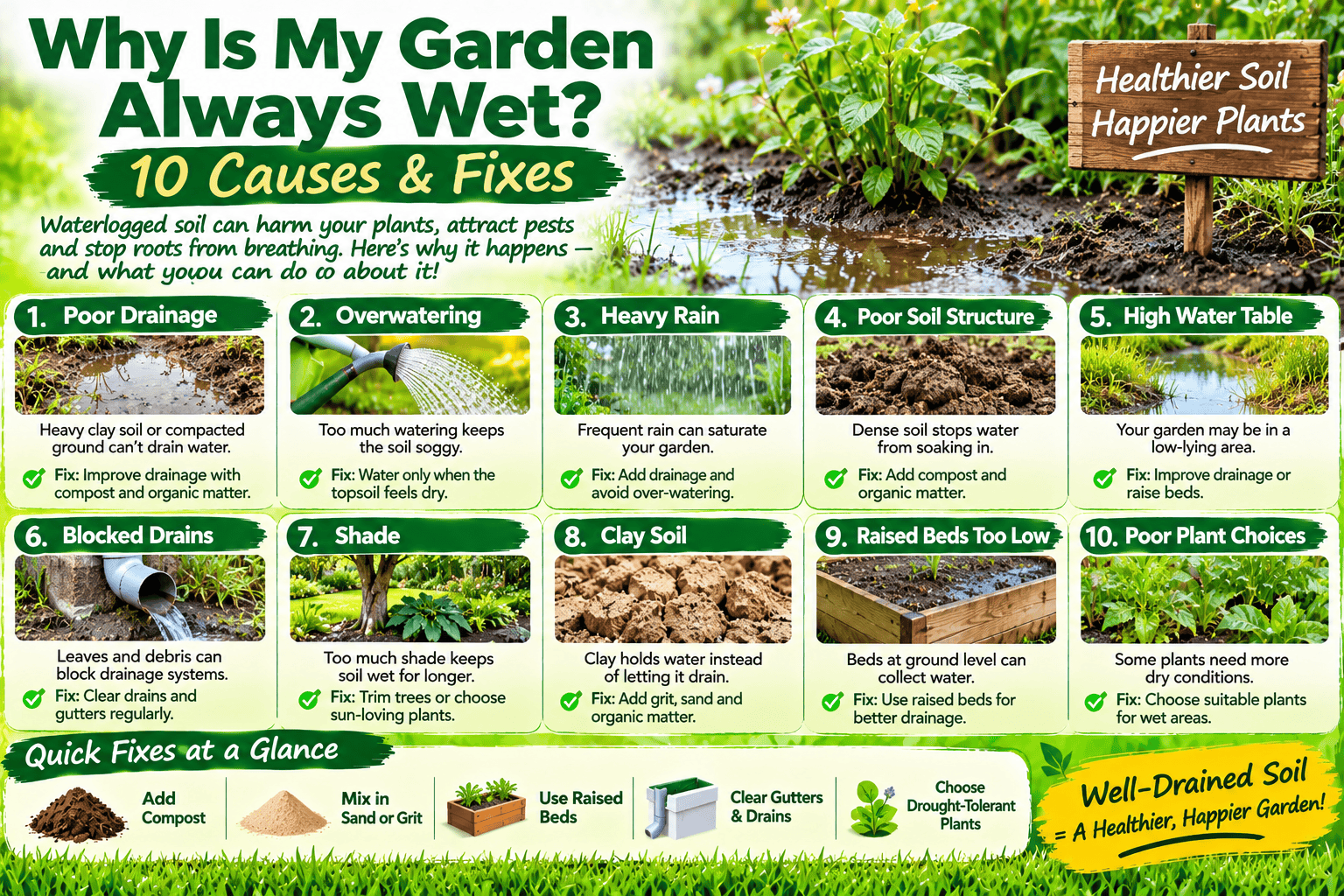
Why Is My Garden Always Wet? 10 Causes of Waterlogged Soil & How to Fix It
You look outside after a few days of rain and notice that your garden still hasn't dried out.
The lawn feels soft and muddy. Water sits on the soil surface. Your flower beds remain wet, and some plants are starting to turn yellow.
Perhaps the problem has been happening for years. Or maybe you've recently moved into a new-build property and discovered that your garden becomes waterlogged every winter.
A garden that stays wet is often affected by poor drainage, compacted soil, clay-rich ground, unsuitable landscaping or excessive water entering the area.
The correct solution depends on why the water is accumulating.
For homeowners in Glasgow, East Kilbride, South Lanarkshire and across Scotland, prolonged rainfall can make drainage problems particularly noticeable.
This guide explains the most common causes of waterlogged gardens, how to identify the problem and what you can do to improve growing conditions.
Quick Answer: How Do You Fix a Waterlogged Garden?
If your garden remains wet after rainfall:
Check where water collects.
Identify whether the soil is compacted or clay-rich.
Look for runoff from roofs, patios and neighbouring areas.
Avoid walking or digging on saturated ground.
Check whether existing drains are functioning.
Consider appropriate drainage improvements.
Improve soil structure where suitable.
Use raised beds for plants that need better-drained growing conditions.
Avoid simply covering the problem with more topsoil.
Seek professional advice for persistent flooding or serious drainage defects.
Adding compost or topsoil alone will not fix every waterlogged garden. First identify where the water is coming from and why it cannot drain away.
1. Heavy Clay Soil
Clay-rich soil is a common reason gardens remain wet.
Clay particles are very fine and can hold substantial amounts of water.
Clay soil can be productive, but when its structure is poor or it becomes compacted, water movement may be restricted.
Signs of heavy clay soil
Sticky soil when wet.
Very firm ground when dry.
Slow drainage.
Surface puddles.
Difficulty digging.
Soil that clings to boots and tools.
How to improve it
Avoid working clay soil when saturated.
Where appropriate, mature organic matter can contribute to improved soil structure over time.
However, severe drainage problems may require additional measures.
For suitable soil-improvement projects, explore Kelvin Compost's organic compost.
2. Compacted Garden Soil
Soil compaction occurs when soil particles are pressed closer together.
This reduces pore spaces through which air and water normally move.
Compaction may result from:
Heavy foot traffic.
Construction machinery.
Repeated wheelbarrow use.
Working wet soil.
Poor landscaping preparation.
How to identify compaction
Look for hard layers beneath the surface, slow drainage and poor root growth.
How to fix it
Reduce traffic over affected areas.
Where appropriate, relieve compaction when the soil is workable.
Avoid repeatedly digging or walking on saturated ground.
Severe compaction may require professional remediation.
3. Poor Drainage in New-Build Gardens
New-build gardens can develop drainage problems because of construction activity.
Heavy machinery may compact the ground before topsoil is installed.
Some properties may also have shallow growing layers, unsuitable fill or buried debris.
Common warning signs
Water pooling across the lawn.
Very shallow topsoil.
Compacted subsoil.
Buried rubble.
Poorly prepared ground.
Uneven drainage.
What should you do?
Document the problem.
Check the property documentation and any applicable developer obligations.
If the garden is newly completed, raise concerns with the developer.
For serious problems, seek a qualified drainage or landscaping assessment before paying for major remedial work.
4. Water Running Into the Garden From Other Areas
Sometimes the soil isn't the main problem.
Water may be entering the garden from:
A sloping driveway.
A patio.
Roof downpipes.
Neighbouring higher ground.
Poorly directed surface drainage.
An overflowing water feature.
How to investigate
Observe where water travels during rainfall.
Check whether downpipes discharge into appropriate drainage systems.
Look for runoff crossing hard surfaces and entering planting beds.
Don't redirect water onto neighbouring property or into an unsuitable drainage system.
Drainage changes may require professional advice or approval.
5. Blocked or Damaged Drains
A blocked drainage system can cause persistent wet areas.
Potential issues include:
Blocked surface drains.
Damaged underground pipes.
Poorly maintained channels.
Silt accumulation.
Inadequate drainage capacity.
What to do
Check accessible surface drains safely.
Avoid attempting hazardous excavation.
If you suspect a damaged underground pipe, consult an appropriate professional.
Don't assume that adding more topsoil will solve a drainage-system failure.
6. A High Water Table
In some locations, groundwater may remain close to the surface.
This can make gardens persistently wet.
Signs may include prolonged saturation even when there is no obvious surface runoff.
However, a high water table cannot be confirmed simply by looking at puddles.
A professional assessment may be necessary.
Where groundwater is the main issue, ordinary soil amendments may have limited effect.
7. Incorrect Garden Levels
Poor landscaping levels can direct water towards the wrong areas.
For example, a lawn may slope towards a house or contain a low point where water collects.
How to identify the issue
Look at the garden after rainfall.
Notice where puddles form and whether the ground slopes towards buildings.
How to fix it
Minor surface-level problems may sometimes be corrected through appropriate landscaping.
However, changing ground levels can affect drainage, boundary conditions and building damp protection.
For significant work, obtain professional advice.
8. Excessive Watering
Not every wet garden is caused by rain.
Automatic irrigation systems or frequent watering can keep soil saturated.
Signs
Wet ground during otherwise dry weather.
Watering continuing after rainfall.
Constantly damp raised beds.
Plants wilting despite wet soil.
How to fix it
Adjust irrigation to actual soil moisture and plant requirements.
Check timers, emitters and possible leaks.
Avoid watering simply because a fixed schedule says it is time.
9. Poor Soil Structure
Soil structure affects how water enters, moves through and drains from the ground.
Poorly structured soil may become dense, crusted or difficult for roots to penetrate.
Possible causes
Compaction.
Repeated working when wet.
Loss of soil structure.
Inappropriate soil handling.
Unsuitable imported material.
How to improve it
Protect the soil from unnecessary disturbance.
Maintain suitable organic matter.
Avoid repeated traffic over planting beds.
Use appropriate soil-management methods for the existing soil type.
Improvement may take several growing seasons.
10. Inadequate Drainage Beneath Raised Beds
Raised beds can improve growing conditions, but they aren't automatically well drained.
If a raised bed sits on compacted ground, water may struggle to move into the underlying soil.
Poorly designed containers or lined beds can also retain excessive water.
How to fix it
Check the bed construction and drainage.
Ensure the growing medium is appropriate.
Avoid filling raised beds entirely with compost or manure.
Where additional suitable soil depth is needed, Kelvin Compost's topsoil may be relevant.
How to Tell If Your Garden Is Waterlogged
A wet soil surface doesn't always mean the root zone is waterlogged.
Look for several indicators.
Standing water
Water remains visible after rainfall.
Persistent mud
The ground stays soft and muddy for prolonged periods.
Yellowing plants
Roots may struggle when soil remains saturated.
Poor growth
Plants may develop weak root systems.
Unpleasant soil smells
Saturated soil with insufficient oxygen may develop unpleasant odours.
Surface algae or moss
These can occur in persistently moist conditions, although they don't prove waterlogging.
If several symptoms occur together, investigate drainage.
How Long Should Water Stay on a Lawn After Rain?
There is no single drainage time that applies to every lawn.
The answer depends on rainfall intensity, soil type, slope and underlying conditions.
Temporary puddles after very heavy rain may not indicate a permanent problem.
However, repeated standing water that persists well after surrounding ground has drained deserves investigation.
Compare affected areas with the rest of the garden.
Can Compost Improve Waterlogged Soil?
Mature organic compost can improve some soil properties over time.
In suitable soils, organic matter can support aggregation, biological activity and soil structure.
However, compost is not an instant drainage system.
If the ground is severely compacted, has a high water table or receives excessive runoff, additional measures may be needed.
Do not spread compost onto saturated ground expecting it to absorb and remove all the water.
Use compost where soil improvement is appropriate.
Can Topsoil Fix a Waterlogged Garden?
Sometimes additional suitable topsoil is needed for landscaping or planting projects.
However, placing new topsoil directly over poorly drained ground can create problems.
Water may collect at the boundary between soil layers.
The underlying compaction or drainage defect may remain.
Before adding topsoil:
Assess the existing ground.
Identify drainage problems.
Check soil depth.
Address severe compaction.
Select suitable material.
Prepare the ground appropriately.
For suitable projects, explore Kelvin Compost's topsoil.
Should You Add Sand to Wet Clay Soil?
Adding sand to clay soil is not a universal drainage solution.
The outcome depends on the soil and the type and proportion of sand.
Inappropriate mixtures may fail to improve drainage.
Avoid adding sand without understanding the existing soil conditions.
For persistent drainage problems, professional assessment may be more effective.
Can Woodchip Help With a Muddy Garden?
Woodchip may be useful for suitable paths and mulched areas.
It can provide a surface layer that reduces direct contact with muddy soil.
However, it doesn't fix the underlying drainage problem.
A path built over persistently saturated ground may require proper construction and drainage preparation.
For appropriate landscaping applications, explore Kelvin Compost's woodchip.
How Much Woodchip Do You Need for a Garden Path?
Calculate the material volume using:
Area (m²) × depth (m) = volume (m³)
For example, a 12m² path with a 7.5cm woodchip layer requires:
12 × 0.075 = 0.9m³
That's approximately 900 litres.
| Path area | 5cm layer | 7.5cm layer |
|---|---|---|
| 5m² | 250L | 375L |
| 10m² | 500L | 750L |
| 15m² | 750L | 1,125L |
| 20m² | 1,000L | 1,500L |
| 30m² | 1,500L | 2,250L |
These are volume calculations, not universal path-construction recommendations.
How to Fix a Waterlogged Lawn
The correct solution depends on the cause.
Step 1: Identify where water collects
Observe the lawn during and after rainfall.
Step 2: Check soil conditions
Assess compaction, texture and drainage.
Step 3: Reduce traffic
Avoid walking on saturated grass.
Step 4: Investigate drainage
Look for runoff, blocked drains and low areas.
Step 5: Address compaction where appropriate
Use suitable lawn-aeration or remediation methods when ground conditions allow.
Step 6: Repair damaged grass
Once drainage is improved, repair affected areas using suitable lawn preparation.
Step 7: Monitor future rainfall
Check whether the changes have improved conditions.
How to Improve Drainage in Clay Soil
Clay soil can be productive, but it needs appropriate management.
Avoid working it when wet.
Reduce unnecessary compaction.
Maintain suitable organic matter.
Consider whether surface runoff or an underlying drainage problem is contributing.
Where severe waterlogging persists, soil amendments alone may not be enough.
Should You Install a French Drain?
A French drain is a drainage system that typically uses a gravel-filled trench and may include a perforated pipe.
It can help manage water in suitable situations.
However, it needs a suitable design and a lawful, effective discharge destination.
Installing a trench without understanding where the water will go may simply move the problem elsewhere.
Professional advice is sensible for significant drainage work.
Are Soakaways Suitable for Every Garden?
No.
A soakaway relies on water infiltrating into the surrounding ground.
If the soil has very poor infiltration or groundwater is too high, a soakaway may not function effectively.
Site assessment and appropriate infiltration testing may be necessary.
Local rules and building considerations may also apply.
Can Raised Beds Help in a Wet Garden?
Raised beds can provide an improved growing environment for some plants.
They may allow greater control over growing-medium depth and composition.
However, raised beds still need suitable drainage.
They should not be treated as a complete solution for flooding or major ground-drainage defects.
What Plants Grow in Wet Soil?
Some plants tolerate consistently moist conditions better than others.
Examples that may suit certain damp garden locations include:
Astilbe.
Ligularia.
Iris sibirica.
Rodgersia.
Some moisture-loving ferns.
Suitability depends on the amount of moisture, light, soil conditions and local climate.
A plant that tolerates damp soil may not tolerate permanent flooding.
Choose plants according to the actual conditions.
Waterlogged Gardens in Glasgow and Scotland
Glasgow and western Scotland can experience prolonged periods of rainfall, particularly during autumn and winter.
For some gardens, this highlights existing drainage and compaction problems.
New-build properties, clay-rich ground and poorly prepared lawns may be particularly affected.
Before spending money on landscaping materials, identify the underlying cause.
For appropriate projects, Kelvin Compost supplies organic compost, topsoil and woodchip across Glasgow, East Kilbride, South Lanarkshire and surrounding areas.
Common Mistakes When Fixing a Wet Garden
Adding topsoil without addressing drainage
The underlying problem may remain.
Digging saturated clay soil
This can damage soil structure.
Installing drainage without an outlet
Water needs a suitable destination.
Using sand as a universal fix
It may not improve the soil.
Ignoring roof runoff
Water entering from another area may be the main cause.
Walking on wet lawns
This can increase compaction and damage grass.
Assuming every wet garden needs a French drain
The correct solution depends on the site.
Expecting compost to remove standing water
Compost is a soil amendment, not a drainage system.
Frequently Asked Questions About Waterlogged Gardens
Why is my garden always wet?
Possible causes include poor drainage, clay-rich soil, compaction, runoff and high groundwater.
How do I fix a waterlogged garden?
Identify the cause, correct drainage problems and improve soil management where appropriate.
Why is my lawn always muddy?
Poor drainage, compaction, heavy soil and repeated traffic may contribute.
Can compost improve drainage?
Suitable mature compost may improve some soil properties over time, but won't solve every drainage problem.
Will adding topsoil fix waterlogging?
Not necessarily. The underlying ground must be assessed first.
Is clay soil bad for drainage?
Clay-rich soil can drain slowly, particularly when compacted, but not every clay soil is severely waterlogged.
Can I put sand on a muddy lawn?
Adding sand without understanding the soil may not solve the problem.
Does woodchip stop mud?
Woodchip can provide a suitable surface for some paths but doesn't correct the underlying drainage.
What is a French drain?
A gravel-filled drainage trench, sometimes containing a perforated pipe, designed to collect and direct water.
Do I need a soakaway?
Only if site conditions and applicable requirements make it suitable.
Can raised beds help waterlogged soil?
They can improve growing conditions for some plants but still require drainage.
Why is my new-build garden flooded?
Possible causes include compaction, poor landscaping levels and inadequate drainage.
Should I dig wet soil?
Avoid digging saturated soil because it can damage soil structure.
Can waterlogging kill plants?
Yes. Prolonged saturation can restrict oxygen around roots and damage susceptible plants.
Why are my plants yellow in wet soil?
Poor root function caused by waterlogging may be one explanation.
How do I stop water pooling in my garden?
Identify whether the cause is runoff, compaction, soil conditions or drainage infrastructure.
What plants tolerate wet soil?
Some astilbes, irises and other moisture-loving species can tolerate damp conditions, depending on the site.
How can I improve drainage in a Glasgow garden?
Start with soil and drainage assessment, then choose appropriate improvements for the site.
Final Thoughts: Fix the Drainage Problem Before Adding More Soil
A garden that remains wet can be frustrating.
But the solution isn't always to add more topsoil, dig deeper or install a drain immediately.
Start by identifying where the water is coming from.
Check the soil.
Look for compaction.
Investigate runoff.
And consider whether the garden has an underlying drainage defect.
Once the cause is understood, you can choose a solution that improves the garden rather than simply covering up the problem.
Need Topsoil, Compost or Woodchip in Glasgow?
Kelvin Compost supplies garden materials for homeowners, allotments and landscaping projects across Glasgow, East Kilbride, South Lanarkshire and surrounding areas.
Explore our products:
Topsoil — for appropriate landscaping and planting projects.
Organic Compost — for suitable soil improvement.
Woodchip — for appropriate paths and garden mulching.
Manure — for suitable soil-fertility projects.
Phone: +44 7561 251350
Email: info@kelvincompost.co.uk
Need Garden Supplies Delivered in Glasgow?
Organic compost, topsoil, manure and more across Scotland