



Why Does Topsoil Smell Bad? Causes & Warning Signs
Looking for compost, topsoil or garden supplies?
Browse our full product range or get in touch for delivery across Glasgow and Scotland.
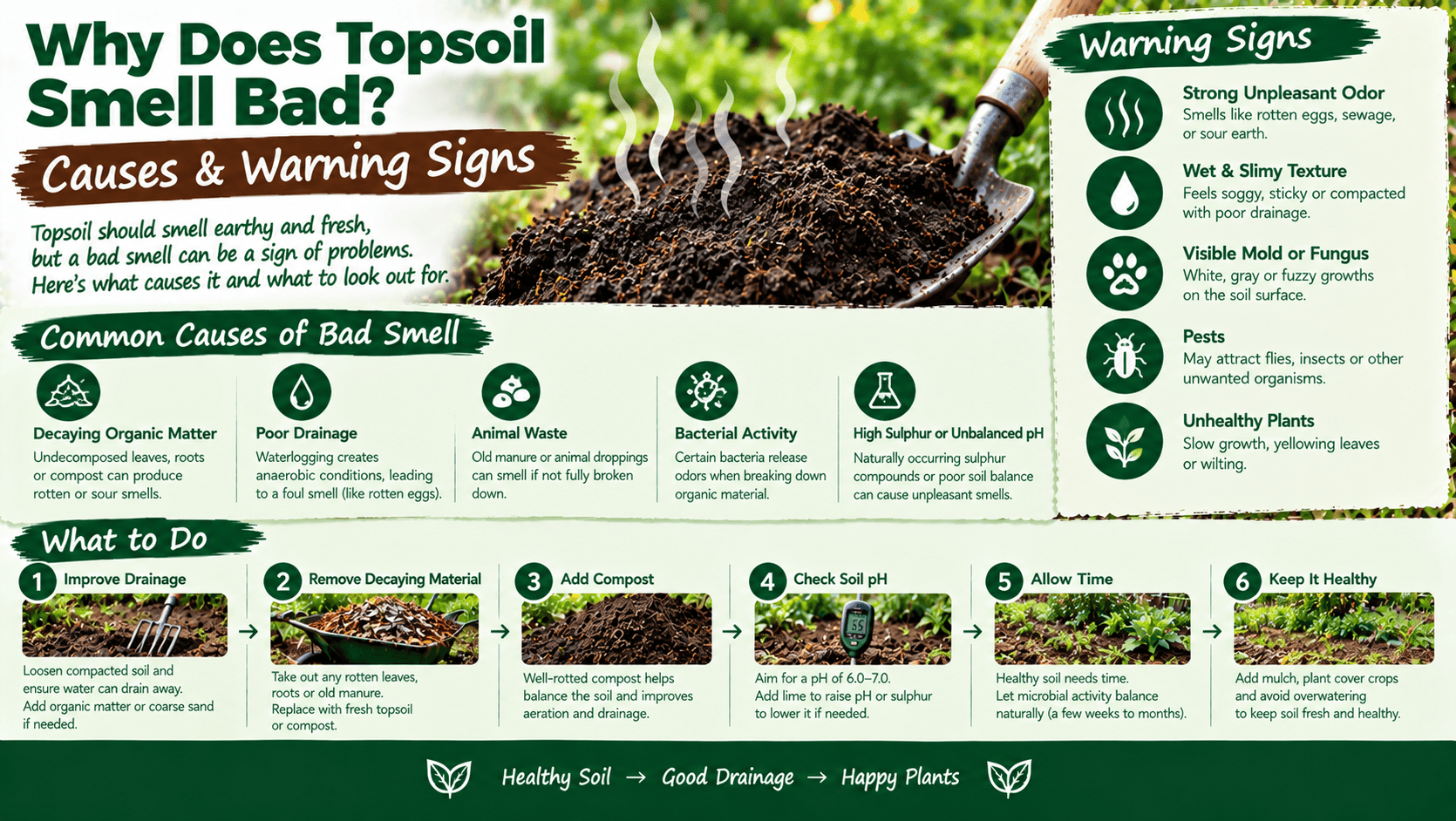
Why Does Topsoil Smell Bad? What Different Soil Smells Mean
You've ordered topsoil for your garden, and the delivery has finally arrived.
The soil looks fine. There aren't any obvious pieces of rubbish, and the texture seems suitable for the job.
But when you open the bag or start spreading it, you notice an unusual smell.
Maybe it's slightly earthy. Perhaps it's sour, musty or even similar to rotten eggs.
Naturally, you wonder whether the topsoil is safe to use.
Healthy topsoil usually has a mild, earthy smell. A strong rotten-egg, sewage-like, chemical or fuel-like odour can indicate a problem that deserves investigation before the soil is spread.
Not every unusual smell means the soil is contaminated. Sometimes stored soil develops unpleasant odours because it has remained too wet and poorly aerated.
However, smell alone cannot confirm whether soil is safe.
This guide explains what different topsoil smells may mean, when to be concerned and what to check before using newly delivered soil.
What Should Good Topsoil Smell Like?
Good garden topsoil commonly has a natural, earthy smell.
You might notice this after rainfall or when digging into a healthy garden bed.
That familiar smell is associated partly with compounds produced by soil microorganisms.
However, soil smells vary depending on moisture, organic matter and biological activity.
Some perfectly usable mineral soils have very little noticeable odour.
Others smell more strongly earthy when wet.
The important distinction is between a normal soil smell and an unusually strong or offensive odour.
Why Does My New Topsoil Smell Bad?
There are several possible explanations.
| Smell | Possible explanation | Recommended response |
|---|---|---|
| Mild and earthy | Normal soil biological activity | Usually not concerning by itself |
| Musty | Moist storage or biological activity | Inspect moisture, texture and storage conditions |
| Sour | Poor aeration or decomposition under wet conditions | Investigate before use |
| Rotten eggs | Possible anaerobic conditions and sulphur compounds | Stop spreading and contact supplier |
| Sewage-like | Potentially unsuitable or contaminated material | Do not use until investigated |
| Fuel or chemical smell | Possible contamination | Stop handling and seek appropriate assessment |
These are possible explanations, not diagnoses.
A soil sample may require testing to establish whether it is suitable for a particular use.
Why Does Topsoil Smell Like Rotten Eggs?
A rotten-egg smell can occur when oxygen becomes limited and certain microorganisms produce sulphur-containing gases, including hydrogen sulphide.
This can happen in very wet, poorly aerated organic material.
For example, soil stored in a saturated pile or container may develop low-oxygen conditions.
But a strong rotten-egg smell shouldn't simply be dismissed as normal.
If newly delivered topsoil has this odour:
Stop spreading it.
Avoid deliberately inhaling gases from the material.
Keep people and pets away from suspicious material.
Photograph the delivery and record the circumstances.
Contact the supplier.
Arrange appropriate assessment if contamination is suspected.
Do not assume that leaving the material outside will make every potential problem disappear.
Why Does Topsoil Smell Sour?
A sour smell can sometimes develop when wet organic material decomposes under poorly aerated conditions.
If the soil has been stored for a long period without adequate drainage, oxygen availability may become limited.
However, a sour smell doesn't establish the exact cause.
Check whether the material is:
Excessively wet.
Sticky or compacted.
Containing large quantities of undecomposed organic material.
Showing unusual discolouration.
Producing an unusually strong odour.
If the smell is pronounced or persistent, ask the supplier for more information before using it.
Can Topsoil Smell Bad Because It Was Stored in a Bulk Bag?
t can.
Bulk bags are convenient for transporting and storing garden materials, but the condition of the material matters.
If topsoil becomes saturated and remains poorly aerated, its smell may change.
This doesn't mean every bagged product will develop a problem.
Nor does it mean that every unpleasant-smelling bag can be made suitable simply by opening it.
When a delivery smells unusual, inspect the material and establish the cause before spreading it around the garden.
Is Smelly Topsoil Safe for Vegetable Gardens?
Don't judge safety by smell alone.
Vegetable-growing soil should come from an appropriate source and be suitable for food-growing applications.
Some contaminants are odourless.
Others may create noticeable smells.
If the topsoil has a strong chemical, fuel, sewage-like or otherwise suspicious odour, don't use it for vegetables until its suitability has been established.
Ask the supplier about the material's source and relevant testing.
Does Dark Topsoil Mean It Is Healthy?
No.
Dark colour can be associated with organic matter, but it isn't proof of quality.
Similarly, a pleasant earthy smell doesn't guarantee that soil is free from contamination.
When evaluating imported topsoil, consider:
Source.
Texture.
Structure.
Organic matter.
Intended use.
Relevant test information.
Visible debris.
Unusual odours.
A single characteristic should never determine the entire assessment.
Can Compost Make Topsoil Smell Stronger?
Yes, the organic material within a soil or soil blend can influence its smell.
Mature compost generally has an earthy odour.
Poorly decomposed or waterlogged organic material can smell considerably less pleasant.
If you're buying a blended growing medium, ask what materials it contains and whether they are appropriate for your intended use.
Remember that compost and topsoil serve different purposes.
Topsoil provides mineral soil volume, while mature compost is primarily used to add organic matter and improve suitable existing soil.
Should You Spread Smelly Topsoil and Wait for the Smell to Disappear?
Not automatically.
If the material has a mild, unfamiliar earthy smell, it may be perfectly normal.
But a strong, offensive or chemical odour deserves investigation.
Spreading potentially unsuitable material across a lawn or vegetable garden can make later removal difficult and expensive.
It is much easier to address a questionable delivery before it has been distributed throughout the site.
What Should You Ask Your Topsoil Supplier?
If you notice an unusual smell, ask:
Where did the topsoil originate?
How was it stored?
Is it screened?
Has it been blended with organic material?
Is it suitable for my intended application?
Is relevant test information available?
What could explain the odour?
What should I do before using it?
Keep a record of the supplier's response and any supporting documents.
For projects where soil quality is particularly important, ask about relevant topsoil specifications, including BS 3882 where applicable.
How Should You Store Topsoil to Avoid Problems?
If you can't use your topsoil immediately, choose a suitable storage location.
Keep the material:
Away from fuel, chemicals and construction waste.
On a clean surface where practical.
Protected from excessive water accumulation.
Away from unnecessary vehicle traffic.
Separate from potentially contaminated materials.
Avoid allowing soil to remain saturated for extended periods.
If a strong or suspicious odour develops, investigate rather than simply mixing the material into the garden.
What If the Topsoil Already Has Been Spread?
If you have already spread the soil and then notice a concerning smell, stop further work.
Try to establish:
When the odour appeared.
Whether it is present throughout the area.
Whether it becomes stronger after rainfall.
Whether there is visible debris or staining.
Where the material came from.
Contact the supplier and seek appropriate assessment where contamination is suspected.
Avoid planting edible crops in questionable imported soil until its suitability is established.
Buying Topsoil in Glasgow: What Should You Check?
Gardeners in Glasgow, East Kilbride and South Lanarkshire may be buying topsoil for lawns, raised beds, landscaping or vegetable growing.
Before ordering, confirm that the material suits the job.
For example, topsoil for a new lawn should provide a suitable growing layer and be practical to level.
Topsoil for a vegetable garden should be appropriate for food growing.
If you're buying a substantial quantity, ask about source, specification and delivery arrangements before the material arrives.
Choosing suitable soil at the beginning is far easier than correcting problems after landscaping is complete.
Frequently Asked Questions
Should topsoil smell earthy?
A mild earthy smell is common in healthy garden soil, although some suitable soils have very little noticeable odour.
Why does my topsoil smell like rotten eggs?
It may indicate low-oxygen conditions and sulphur-containing gases, but the exact cause requires investigation.
Can wet topsoil smell bad?
Yes. Prolonged wet, poorly aerated conditions can contribute to unpleasant odours.
Does screened topsoil smell better?
Not necessarily. Screening removes oversized material but doesn't guarantee any particular smell or chemical quality.
Is smelly topsoil contaminated?
Not always. However, a strong or unusual smell can be a warning sign, and some contaminants cannot be detected by smell.
Can I use sour-smelling topsoil for vegetables?
Avoid using suspicious material for food growing until its suitability has been established.
Will the smell disappear if I leave topsoil outside?
Some odours may change as conditions change, but disappearance of a smell does not prove that soil is safe.
Can compost smell bad?
Compost can develop unpleasant odours under unsuitable decomposition or storage conditions, particularly when oxygen is limited.
What should I do if delivered topsoil smells like chemicals?
Stop using it, avoid unnecessary exposure and contact the supplier. Seek appropriate assessment if contamination is suspected.
Is dark topsoil always better?
No. Colour alone cannot establish soil quality, fertility or safety.
Final Thoughts: Don't Ignore an Unusual Soil Smell
Most gardeners recognise the pleasant, earthy smell of freshly dug soil.
But when imported topsoil has a strong or unfamiliar odour, it's worth finding out why.
A mild earthy smell is generally unsurprising.
A pronounced rotten-egg, sewage-like, fuel-like or chemical odour is different.
Don't rely on appearance or smell alone to decide whether topsoil is safe.
Ask about its source, intended use and relevant quality information.
And if you have concerns about a delivery, investigate before spreading it throughout your garden.
Need Topsoil for a Garden Project in Glasgow?
Kelvin Compost supplies topsoil and other garden materials for landscaping, lawns, borders and growing projects across Glasgow, East Kilbride, South Lanarkshire and surrounding areas.
Explore our topsoil product or contact us to discuss your requirements.
Phone: +44 7561 251350
Email: info@kelvincompost.co.uk
Need Garden Supplies Delivered in Glasgow?
Organic compost, topsoil, manure and more across Scotland