


Why Are My Plant Leaves Turning Yellow? 12 Causes
Looking for compost, topsoil or garden supplies?
Browse our full product range or get in touch for delivery across Glasgow and Scotland.
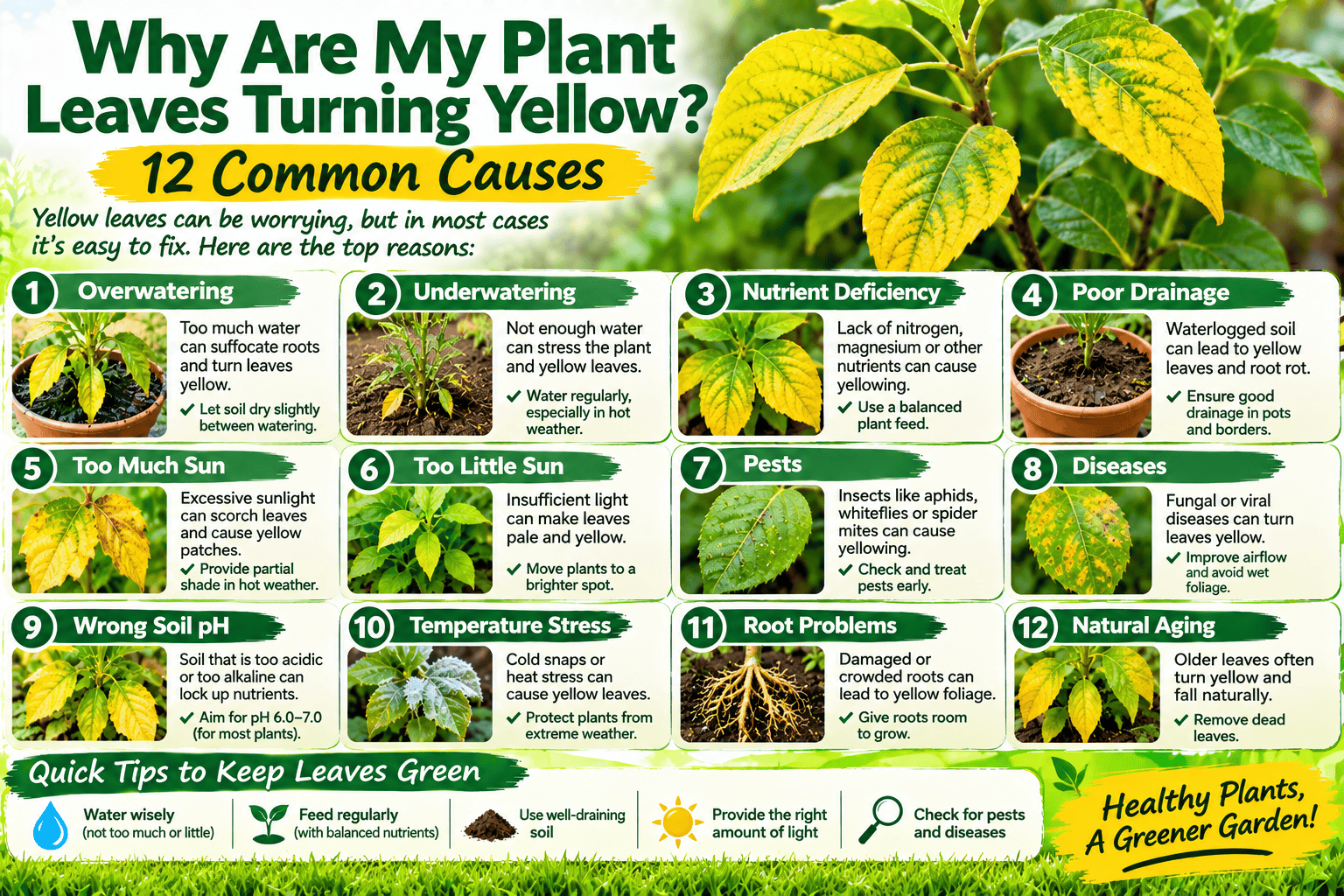
Why Are My Plant Leaves Turning Yellow? 12 Common Causes & How to Fix Them
You check your garden one morning and notice that a previously healthy plant has started developing yellow leaves.
Perhaps the lower leaves are turning yellow first. Maybe the entire plant looks pale, or the leaves are yellow but the veins remain green.
Does it need more water? Is the soil missing nutrients? Could the roots be rotting?
Yellow leaves, also called chlorosis, can result from overwatering, underwatering, nutrient deficiencies, unsuitable soil conditions, pests, diseases or natural ageing.
The correct treatment depends on which leaves are affected, how quickly the symptoms developed and the growing conditions.
For gardeners in Glasgow, East Kilbride, South Lanarkshire and across Scotland, prolonged rainfall, heavy soils and seasonal temperature changes can contribute to some of these problems.
This guide explains 12 common reasons why plant leaves turn yellow, how to recognise the likely cause and what you can do to help your plants recover.
Quick Answer: Why Are My Plant Leaves Turning Yellow?
The most common possibilities include:
Overwatering.
Underwatering.
Poor drainage.
Nitrogen deficiency.
Iron deficiency.
Magnesium deficiency.
Insufficient sunlight.
Excessive sunlight or heat stress.
Cold temperatures or frost.
Pests.
Plant diseases.
Natural leaf ageing.
Don't immediately add fertiliser when leaves turn yellow. Nutrient deficiency is only one possible cause, and unnecessary feeding can make some problems worse.
Start by checking soil moisture, drainage and the pattern of yellowing.
1. Overwatering: One of the Most Common Causes of Yellow Leaves
Plants need water, but their roots also need oxygen.
When growing media remain saturated for too long, roots may struggle to function properly.
This can cause leaves to yellow.
Signs of overwatering
Yellowing leaves.
Soil that remains wet for prolonged periods.
Wilting despite wet soil.
Soft or unhealthy roots.
Poor plant growth.
Leaf drop.
Not every plant has the same water requirements.
Some tolerate wet conditions better than others.
How to fix it
Check the soil before watering again.
For container plants, ensure drainage holes are clear and excess water can escape.
For outdoor gardens, investigate persistent waterlogging.
Avoid applying more water simply because the leaves look unhealthy.
2. Underwatering: Why Dry Soil Causes Yellow Leaves
A lack of water can also cause yellowing.
When plants cannot absorb sufficient moisture, they may shed older leaves or show signs of stress.
Signs of underwatering
Dry growing medium.
Wilting.
Yellow or brown leaf edges.
Dry, crispy leaves.
Slow growth.
How to fix it
Water according to the plant's requirements.
For very dry container compost, water may run down the sides without adequately moistening the root ball.
Check whether the growing medium is actually absorbing water.
Avoid switching from severe drought to permanently saturated conditions.
3. Poor Drainage and Waterlogged Soil
Waterlogging is particularly relevant to gardens experiencing prolonged rainfall.
In Glasgow and western Scotland, some garden soils remain wet for extended periods during autumn and winter.
When soil pores remain filled with water, oxygen availability around roots can decline.
This may lead to yellowing, poor growth and root damage.
How to identify poor drainage
Look for:
Standing water after rain.
Persistently muddy ground.
Plants wilting in wet soil.
Unpleasant smells from saturated soil.
Poor root development.
How to improve it
Investigate compaction, ground levels and drainage.
Avoid digging saturated clay soil.
Suitable organic-matter management may help improve some soil properties over time, but compost is not an instant solution for severe waterlogging.
For appropriate soil-improvement projects, explore Kelvin Compost's organic compost.
4. Nitrogen Deficiency: Yellow Lower Leaves
Nitrogen is an essential nutrient for plant growth.
It plays an important role in chlorophyll production and the development of healthy foliage.
When nitrogen is insufficient, older leaves may become pale or yellow.
This occurs because nitrogen is mobile within plants and can be redistributed towards newer growth.
Common signs
Older leaves yellowing first.
Generally pale foliage.
Reduced growth.
Weak development.
How to fix it
Check whether nitrogen deficiency is genuinely likely.
Consider soil fertility, previous feeding and the plant's requirements.
Where appropriate, use a suitable fertiliser according to its instructions.
Mature compost and well-rotted manure can contribute nutrients, but their nutrient contents vary.
Don't assume every yellow lower leaf indicates nitrogen deficiency.
5. Iron Deficiency: Yellow Leaves With Green Veins
Iron deficiency can cause a distinctive pattern called interveinal chlorosis.
The leaf tissue becomes yellow while the veins remain greener.
Symptoms often appear on younger leaves first.
Why it happens
Sometimes iron is present in the soil but unavailable to the plant because of unsuitable pH or other growing conditions.
This can affect acid-loving plants such as rhododendrons and some other ornamentals.
How to fix it
Identify the plant and check whether the soil pH is suitable.
A soil test may help.
Use an appropriate treatment only when the diagnosis is supported.
Important: Adding ordinary compost or manure does not automatically correct iron availability problems.
6. Magnesium Deficiency: Yellowing Between Leaf Veins
Magnesium is part of the chlorophyll molecule.
When plants lack available magnesium, yellowing may develop between the veins.
Symptoms commonly appear on older leaves first because magnesium is mobile within plants.
Common signs
Yellow areas between green veins.
Older leaves affected first.
Poor growth in more severe cases.
How to fix it
Confirm the likely cause before applying magnesium products.
Other problems, including root damage and nutrient imbalance, can produce similar symptoms.
Soil or plant-tissue testing may be useful for persistent cases.
Avoid routinely adding Epsom salts without evidence of deficiency.
7. Insufficient Sunlight
Plants need suitable light for photosynthesis.
When a sun-loving plant receives too little light, it may produce pale foliage and weak growth.
Signs
Pale or yellow leaves.
Long, weak stems.
Slow growth.
Reduced flowering.
Leaves dropping in shaded areas.
How to fix it
Check the light requirements of the plant.
Where possible, move container plants to a suitable location.
For established garden plants, consider whether nearby trees or structures have increased shading.
Not every plant needs full sun, so avoid moving shade-loving species into harsh sunlight.
8. Too Much Sunlight or Heat Stress
Excessive sunlight can also damage plants.
Leaves may develop yellow, pale or scorched patches.
This is particularly relevant when plants accustomed to shade are suddenly moved into strong direct sunlight.
How to fix it
Provide light conditions appropriate to the species.
Acclimatise plants gradually when moving them outdoors.
Maintain suitable watering without keeping roots permanently saturated.
9. Cold Weather and Frost Damage
Cold temperatures can cause yellowing, browning and leaf drop.
Some tender plants are especially vulnerable.
In Scotland, sudden temperature changes during autumn and spring may affect plants that have not fully acclimatised.
Signs of cold damage
Yellow or brown patches.
Blackened or damaged foliage.
Wilting after frost.
Sudden leaf drop.
Damaged young shoots.
How to fix it
Protect vulnerable plants when frost is forecast.
Move suitable containers to sheltered locations.
Use appropriate horticultural fleece where needed.
Avoid cutting away all damaged growth immediately if further frost is expected and the plant's pruning requirements suggest waiting.
10. Pests That Cause Yellow Leaves
Some insects and mites feed on plant sap or damage foliage.
This can cause yellow spots, mottling or general decline.
Potential pests include:
Aphids.
Spider mites.
Whitefly.
Scale insects.
Thrips.
How to identify pest damage
Inspect both sides of the leaves.
Look for insects, webbing, sticky deposits, distorted growth or unusual markings.
How to fix it
Identify the pest before choosing a treatment.
For mild infestations, suitable physical removal or other non-chemical methods may be enough.
Use plant-protection products only when appropriate and according to their labels.
11. Plant Diseases and Root Problems
Yellow leaves can be associated with plant diseases.
These include some fungal, bacterial and viral conditions.
However, yellowing alone does not identify a particular disease.
Warning signs
Distinctive spots or lesions.
Unusual leaf patterns.
Stem damage.
Rotting roots.
Rapid plant decline.
Symptoms spreading through multiple plants.
How to fix it
Identify the affected plant and examine the symptoms.
Improve growing conditions where appropriate.
Remove diseased material only when suitable for the condition.
Seek specialist guidance for serious or persistent problems.
Avoid applying fungicide without an appropriate diagnosis.
12. Natural Ageing: When Yellow Leaves Are Normal
Not every yellow leaf indicates a problem.
Plants naturally replace older foliage.
As leaves age, chlorophyll breaks down and yellow pigments may become more visible.
Some deciduous plants also turn yellow before shedding leaves in autumn.
Signs of normal ageing
Only a few older leaves are affected.
New growth remains healthy.
The plant continues developing normally.
Yellowing follows a seasonal pattern.
If the plant is otherwise healthy, treatment may not be necessary.
How to Diagnose Yellow Leaves by Their Pattern
The location and appearance of yellowing can help narrow down possible causes.
| Symptom | Possible causes |
|---|---|
| Older leaves yellow first | Nitrogen deficiency, natural ageing or other stress |
| Young leaves yellow with green veins | Iron availability problems |
| Older leaves yellow between veins | Magnesium deficiency or other nutrient issues |
| Yellow leaves and wet soil | Overwatering, waterlogging or root problems |
| Yellow leaves and dry soil | Underwatering or drought stress |
| Yellow spots or mottling | Pests, disease or environmental stress |
| Yellow leaves after frost | Cold damage |
| Yellowing across the entire plant | Several possible causes; investigate systematically |
These patterns are clues, not definitive diagnoses.
Why Are Tomato Plant Leaves Turning Yellow?
Tomato plants commonly develop yellow leaves when growing conditions are unsuitable.
Possible causes include:
Overwatering.
Underwatering.
Nutrient deficiency.
Root damage.
Poor drainage.
Pests.
Disease.
Natural ageing of older foliage.
Yellow lower leaves on tomatoes
Some older leaves naturally decline as plants grow.
However, widespread yellowing may indicate a problem.
Check moisture, drainage and plant health before applying fertiliser.
Yellow leaves with brown spots
Distinctive spotting may indicate disease or other damage.
Identify the symptoms before removing foliage or applying treatment.
Why Are Cucumber Leaves Turning Yellow?
Cucumbers need suitable warmth, moisture and nutrition.
Yellow leaves may result from:
Water stress.
Nutrient imbalance.
Cold conditions.
Root problems.
Pests.
Disease.
Cucumbers can be sensitive to low temperatures.
For Scottish gardeners, greenhouse conditions and seasonal timing may be particularly important.
Why Are Potato Leaves Turning Yellow?
Potato foliage can yellow for several reasons.
These include:
Natural maturity.
Water stress.
Nutrient problems.
Disease.
Poor growing conditions.
As potato plants mature, foliage naturally declines.
However, premature yellowing combined with dark lesions or rapid dieback may require investigation.
Don't assume that yellow potato leaves always mean the crop is ready to harvest.
Why Are Rose Leaves Turning Yellow?
Roses may develop yellow leaves due to:
Water stress.
Poor drainage.
Nutrient issues.
Pest activity.
Disease.
Seasonal changes.
Rose black spot, for example, can cause dark leaf lesions and yellowing.
However, not every yellow rose leaf is caused by black spot.
Check the full symptom pattern.
Why Are Houseplant Leaves Turning Yellow?
Houseplants frequently develop yellow leaves because of watering or light problems.
During winter, reduced daylight may slow growth and water use.
This can leave compost wet for longer than expected.
Check these factors
Is the compost too wet?
Is the pot draining?
Does the plant receive suitable light?
Has it recently been moved?
Are there pests?
Is it naturally shedding older leaves?
Avoid repotting or fertilising automatically without identifying the likely cause.
Can Poor Soil Cause Yellow Leaves?
Yes.
Poor soil conditions can restrict root development and nutrient availability.
Potential problems include:
Compaction.
Waterlogging.
Unsuitable pH.
Nutrient deficiency.
Nutrient excess.
Inadequate rooting depth.
However, soil appearance alone isn't enough to diagnose plant problems.
A soil test may be useful where yellowing persists across multiple plants.
Can Organic Compost Help Yellow Leaves?
Mature organic compost can improve some soil properties and contribute nutrients.
In suitable garden soils, it may support long-term plant growth.
However, compost is not a universal treatment for yellow leaves.
If the cause is overwatering, disease, unsuitable pH or frost damage, adding compost may not solve it.
Use compost when soil improvement is appropriate.
Kelvin Compost supplies organic compost for suitable outdoor gardening projects.
Can Manure Fix Yellow Leaves?
Suitable well-rotted manure can supply organic matter and nutrients.
However, nutrient content varies.
Excessive applications can create imbalances.
Fresh manure can also cause plant-health and food-safety problems.
If yellowing is caused by a genuine nutrient deficiency, use an appropriate nutrient-management approach rather than applying manure indiscriminately.
For suitable garden projects, explore Kelvin Compost's manure.
Can Topsoil Help Plants With Yellow Leaves?
Additional suitable topsoil may be useful where plants lack adequate growing depth.
However, topsoil isn't a direct treatment for chlorosis.
Adding soil over an established root system can create problems if it buries stems or alters drainage.
Investigate the cause before adding material.
For projects requiring additional suitable soil depth, explore Kelvin Compost's topsoil.
Can Woodchip Mulch Help Prevent Yellow Leaves?
Suitable woodchip mulch may help manage soil moisture fluctuations and protect the surface.
However, mulch won't correct every cause of yellowing.
Avoid piling woodchip against stems and trunks.
For appropriate garden mulching, Kelvin Compost supplies woodchip.
Yellow Leaves in Glasgow and Scottish Gardens
Gardeners in Glasgow, East Kilbride and South Lanarkshire may encounter yellowing associated with wet soil, cold conditions and seasonal changes.
During autumn and winter, some plants naturally lose leaves.
Others may struggle when soil remains saturated.
The most useful approach is to assess the plant and its environment.
Check moisture and drainage first.
Then consider light, temperature, pests and nutrients.
Don't apply fertiliser simply because a plant looks yellow.
How to Fix Yellow Leaves: A Step-by-Step Checklist
Step 1: Identify the plant
Different species have different requirements.
Step 2: Check which leaves are yellow
Older leaves, younger leaves and the entire plant can suggest different causes.
Step 3: Examine soil moisture
Check whether the root zone is dry, moist or saturated.
Step 4: Inspect drainage
Look for standing water or poorly draining containers.
Step 5: Check light and temperature
Consider recent changes in weather or location.
Step 6: Look for pests
Inspect leaves, stems and growing points.
Step 7: Consider nutrient availability
If other causes are unlikely, investigate soil fertility and pH.
Step 8: Apply a targeted solution
Correct the identified problem rather than treating every possibility at once.
Step 9: Monitor new growth
Damaged yellow leaves may not turn green again.
Healthy new growth is often a better indicator of recovery.
Common Mistakes When Treating Yellow Leaves
Adding fertiliser immediately
Yellowing does not always mean nutrient deficiency.
Watering more without checking the soil
Overwatering can produce symptoms similar to drought stress.
Ignoring drainage
Persistently saturated soil can damage roots.
Applying Epsom salts without evidence
Magnesium deficiency is only one possible cause.
Using pesticides without identifying pests
Unnecessary treatments may harm beneficial organisms.
Expecting damaged leaves to recover fully
Some yellow leaves won't regain their original colour.
Treating natural autumn leaf drop as disease
Seasonal yellowing may be normal.
Frequently Asked Questions About Yellow Plant Leaves
Why are my plant leaves turning yellow?
Possible causes include watering problems, nutrient deficiencies, unsuitable light, pests, diseases and natural ageing.
Should I remove yellow leaves?
Remove leaves when appropriate for the plant and condition. Avoid unnecessary pruning of healthy tissue.
Can yellow leaves turn green again?
Sometimes mild chlorosis can improve, but severely damaged leaves often remain yellow.
Does yellowing mean overwatering?
It can, particularly when soil remains saturated, but other causes are possible.
Can underwatering cause yellow leaves?
Yes. Water stress can cause yellowing and leaf drop.
What nutrient deficiency causes yellow leaves?
Nitrogen, iron and magnesium deficiencies can cause different yellowing patterns.
Do yellow leaves mean a plant is dying?
Not necessarily. Some yellowing is temporary or part of normal ageing.
Why are the bottom leaves turning yellow?
Possible causes include natural ageing, nitrogen deficiency and environmental stress.
Why are new leaves yellow but veins green?
Iron availability problems are one possibility.
Why are my tomato leaves yellow?
Watering, nutrients, pests, disease and natural ageing can all contribute.
Why are cucumber leaves yellow?
Possible causes include cold stress, water problems, nutrients and disease.
Why are my rose leaves turning yellow?
Check watering, drainage, pests and disease symptoms.
Can compost fix yellow leaves?
Only where suitable soil improvement addresses a contributing problem.
Is manure good for yellowing plants?
It can contribute nutrients where appropriate, but isn't a universal treatment.
Why do leaves turn yellow in autumn?
Many deciduous plants naturally break down chlorophyll before shedding leaves.
Why are my houseplant leaves yellow in winter?
Reduced light, slower growth and watering problems may contribute.
Can poor drainage turn leaves yellow?
Yes. Waterlogged soil can restrict root function.
How do I stop plant leaves turning yellow?
Identify the cause, correct the growing conditions and monitor new growth.
Final Thoughts: Find the Cause Before Treating Yellow Leaves
Yellow leaves are one of the most common signs that something has changed in a plant's growing conditions.
Sometimes the explanation is simple.
An older leaf is reaching the end of its life.
Other times, the plant may be struggling with excess water, poor drainage, unsuitable light or nutrient availability.
The most effective treatment starts with observation, not guesswork.
Check the soil.
Inspect the leaves.
Consider the weather.
And only add fertiliser or soil amendments when they're genuinely needed.
Need Garden Soil or Compost in Glasgow?
Kelvin Compost supplies garden materials for homeowners, allotments and landscaping projects across Glasgow, East Kilbride, South Lanarkshire and surrounding areas.
Explore our products:
Organic Compost — for suitable soil-improvement projects.
Topsoil — for projects requiring additional growing depth.
Manure — for appropriate soil-fertility management.
Woodchip — for suitable mulching applications.
Phone: +44 7561 251350
Email: info@kelvincompost.co.uk
Need Garden Supplies Delivered in Glasgow?
Organic compost, topsoil, manure and more across Scotland