




Why Are Mushrooms Growing in My Garden? Complete Guide
Looking for compost, topsoil or garden supplies?
Browse our full product range or get in touch for delivery across Glasgow and Scotland.
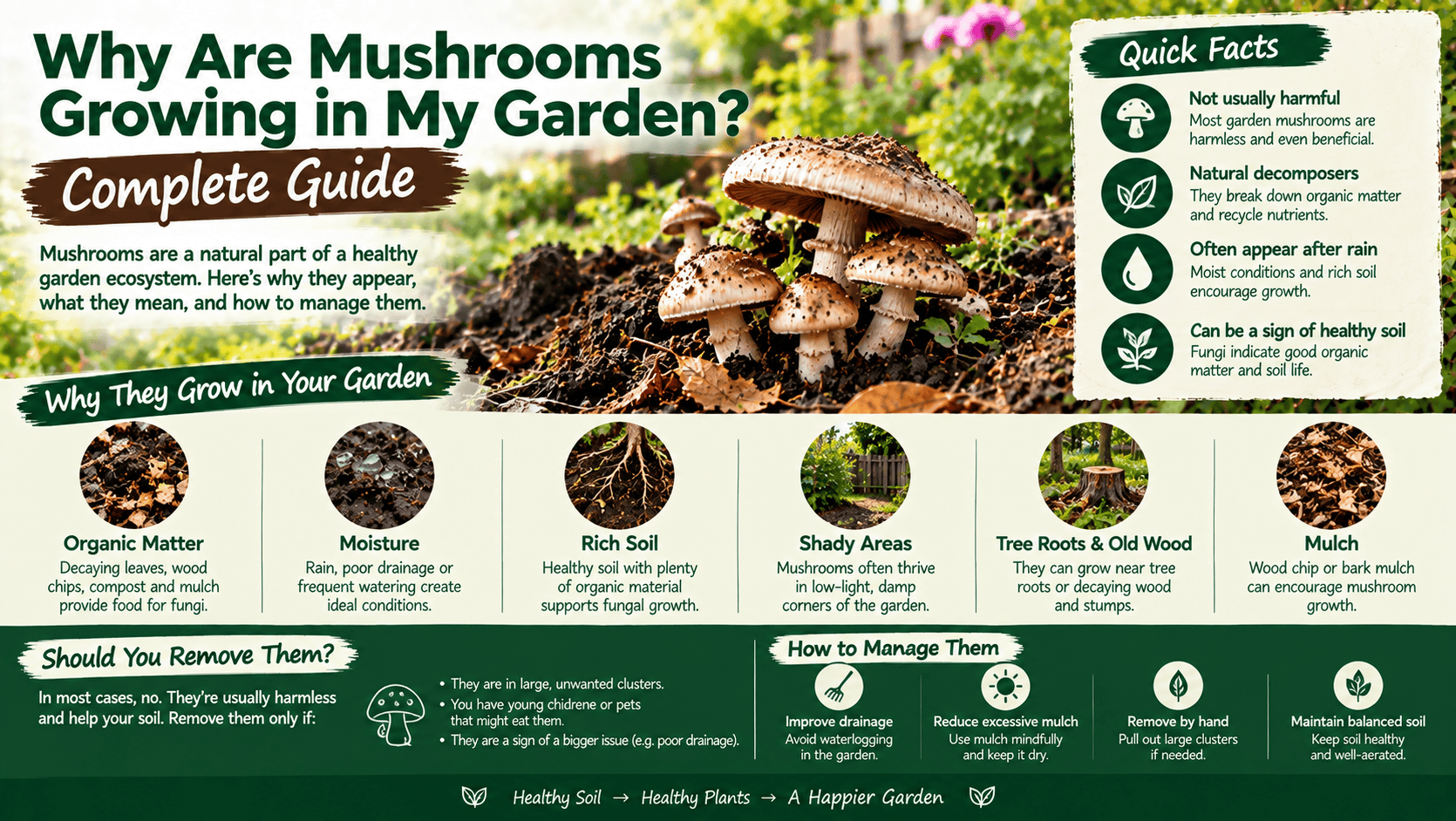
Why Are Mushrooms Growing in My Garden? A Guide to Fungi in Soil, Compost & Mulch
You walk into the garden one morning and suddenly there are mushrooms growing through the lawn, vegetable bed, compost, raised bed or woodchip mulch.
Should you remove them?
Do mushrooms mean your compost has gone bad?
Are they damaging your plants?
And why do they sometimes seem to appear overnight?
For most gardeners, mushrooms appearing in soil or organic mulch are not automatically a sign that something is wrong. Mushrooms are the visible fruiting bodies of fungi, and many fungi play an important role in breaking down dead organic material.
They are particularly likely to appear where there is plenty of moisture and organic matter — conditions commonly found in compost-rich beds, woodchip mulch and damp Scottish gardens.
However, mushrooms should never be eaten simply because they appeared in your garden. Identifying edible and poisonous fungi safely requires specialist knowledge.
This guide explains why mushrooms appear, whether they harm plants, what they mean for your soil and what you can do if you don't want them.
Quick Answer: Why Are Mushrooms Growing in My Garden?
Garden mushrooms usually appear because fungi already present in the soil or organic material have found suitable conditions for producing fruiting bodies.
Common factors include:
- Moist soil
- Recent rainfall
- Mild temperatures
- Decaying roots or wood
- Compost
- Woodchip or bark mulch
- Buried organic material
- Thatch in lawns
- Shaded areas
The mushrooms themselves are only a small visible part of the fungus.
A much larger network of fungal threads, known as mycelium, may already be growing through the soil, wood or other organic material.
In many situations, the fungus is simply decomposing dead material.
What Exactly Is a Mushroom?
What we commonly call a mushroom is usually a fruiting body produced by a fungus.
Think of an apple tree.
The apple isn't the whole tree; it is something produced by the tree.
A mushroom works somewhat similarly.
Most of the fungal organism can exist out of sight as microscopic threads called hyphae. Collectively, these form a network known as mycelium.
The mycelium may be growing through:
- Soil
- Compost
- Dead roots
- Woodchip
- Fallen leaves
- Tree stumps
- Buried timber
- Other decaying organic matter
When temperature and moisture become favourable, the fungus may produce visible mushrooms.
That is why mushrooms can apparently appear extremely quickly after rain.
The fungus often wasn't created overnight.
It was already there.
Does Having Mushrooms Mean My Soil Is Healthy?
Not necessarily — but mushrooms don't automatically indicate unhealthy soil either.
Their presence usually tells you that:
- Fungi are present.
- Conditions are moist enough for fruiting.
- There may be organic material available for decomposition.
Fungi are normal components of soil ecosystems.
Many species help break down dead organic matter, recycling nutrients through the ecosystem.
Other fungi form beneficial relationships with living plants.
However, some fungi can also cause plant diseases.
So the statement:
“Mushrooms always mean healthy soil”
is too simplistic.
A better interpretation is:
Mushrooms usually indicate fungal activity and suitable fruiting conditions. The significance depends on the fungus and what it is growing on.
Why Do Mushrooms Appear After Rain?
Moisture is a major factor.
Fungi require suitable moisture conditions, and periods of rainfall can create exactly the environment needed for fruiting bodies to develop.
This is why gardeners often notice mushrooms:
- After prolonged rain
- During mild autumn weather
- In shaded damp areas
- After watering
- In irrigated lawns
- In moist mulch
For gardens around Glasgow and across western Scotland, wet autumn conditions can make mushrooms particularly noticeable.
The rainfall didn't necessarily introduce the fungus.
It may simply have provided the conditions that triggered visible mushrooms.
Why Do Mushrooms Grow So Quickly?
Mushrooms can appear surprisingly fast because much of the organism already exists before you see them.
The underground or internal mycelial network may have been developing for weeks, months or even years.
When conditions become favourable, the fungus produces fruiting bodies.
So what appears to be:
“A mushroom suddenly grew overnight.”
is really closer to:
“An established fungus produced a visible fruiting body.”
Why Are Mushrooms Growing in My Compost?
Compost contains decomposing organic matter.
That makes fungal activity completely unsurprising.
Fungi are among the organisms involved in breaking down organic materials.
Mushrooms can therefore appear:
- In a compost heap
- On mature compost
- In compost spread over a bed
- Around partially decomposed woody material
Their presence does not automatically mean the compost is ruined.
Should You Remove Mushrooms From Compost?
Usually there is no need to panic.
If mushrooms appear on a compost heap, you can generally continue managing the compost normally.
Consider:
- Is the compost excessively wet?
- Is there sufficient airflow?
- Is decomposition progressing?
- Does it smell earthy or unpleasant?
- Is there a large amount of woody material?
If the compost is waterlogged and anaerobic, address the moisture and aeration problem.
But the mushrooms themselves aren't necessarily the problem.
Are Mushrooms in Compost Dangerous?
The sensible rule is simple:
Do not eat unidentified mushrooms.
A mushroom growing in compost is not automatically edible simply because the compost is organic or because it resembles something sold in a supermarket.
Some poisonous species can resemble edible fungi.
If children or pets use the garden and you are concerned that they may eat unknown mushrooms, removing the visible fruiting bodies can be a sensible precaution.
Wear gloves if appropriate, collect them and dispose of them safely.
Remember that removing mushrooms doesn't necessarily remove the fungus itself.
The mycelium may remain in the soil or organic material.
Why Are Mushrooms Growing in Woodchip?
This is particularly common.
Woodchip is organic material.
Fungi are major decomposers of woody material.
When woodchip is placed around:
- Trees
- Shrubs
- Hedges
- Paths
- Garden beds
fungi gradually colonise and help break it down.
You may notice:
- White fungal threads
- Mushrooms
- Other fungal fruiting structures
This can look alarming if you've never seen it before.
In many cases, it is simply part of natural decomposition.
Is White Fungus in Woodchip Bad?
White fungal growth through woodchip is often mycelium.
It can appear as:
- Fine white threads
- Cotton-like growth
- Pale patches binding chips together
In decomposing wood mulch, fungal colonisation is expected.
You don't generally need to sterilise outdoor woodchip.
In fact, decomposition is part of what makes organic mulch change over time.
However, if you see unusual growth directly associated with a sick tree or shrub, diagnose the plant problem separately rather than assuming every fungus is harmless.
Do Mushrooms Mean Woodchip Is Rotting?
Yes — in the sense that woodchip naturally decomposes.
But that isn't necessarily a defect.
Organic woodchip isn't supposed to remain unchanged forever.
Microorganisms and fungi gradually break it down.
Over time:
- Chips become smaller.
- Colour changes.
- Material decomposes.
- Organic matter becomes incorporated at the soil surface.
This is part of the natural life cycle of organic mulch.
You may eventually need to top up the mulch as its depth decreases.
Will Mushrooms in Woodchip Harm My Plants?
Usually, mushrooms produced by fungi decomposing dead wood are not attacking your living plants.
The fungus is using the woodchip as its food source.
That is different from a pathogenic fungus attacking living roots, stems or leaves.
If your plants look healthy and mushrooms are simply appearing through decomposing woodchip, there may be no plant-health problem at all.
If the plant itself shows symptoms such as:
- Dieback
- Rot
- Severe wilting
- Bark damage
- Root problems
then investigate those symptoms independently.
Why Are Mushrooms Growing in My Raised Bed?
Raised beds often contain plenty of organic material and are regularly watered.
That can create good conditions for fungi.
Possible sources include:
- Compost
- Woody material
- Old roots
- Mulch
- Organic matter within the soil mix
- Fungal spores naturally present in the environment
Mushrooms in a raised bed do not automatically mean your vegetables are in danger.
Can You Still Eat Vegetables From a Bed With Mushrooms?
The presence of unrelated mushrooms in the soil does not automatically make vegetables growing nearby unsafe.
However:
- Don't eat the mushrooms unless properly identified as edible.
- Wash harvested vegetables normally.
- Investigate separately if the crop itself shows signs of disease.
A mushroom next to a lettuce isn't necessarily infecting the lettuce.
Why Are Mushrooms Growing in My Vegetable Garden?
Vegetable gardens often receive regular additions of organic matter.
That may include:
- Compost
- Manure
- Mulches
- Crop residues
- Old plant roots
These materials support decomposer organisms.
Combined with moisture, they can encourage visible fungal fruiting.
Again, the key question isn't simply:
“Are mushrooms present?”
Ask instead:
“Are my crops healthy?”
If the plants are thriving, mushrooms may simply be part of the decomposition system around them.
Can Mushrooms Damage Vegetable Roots?
Some fungi are plant pathogens, but the presence of mushroom fruiting bodies does not automatically mean roots are being attacked.
Many garden fungi feed primarily on dead organic material.
Others form beneficial associations with plant roots.
If plants are showing symptoms, identify the cause rather than blaming nearby mushrooms automatically.
Why Are Mushrooms Growing in My Lawn?
Lawns frequently develop mushrooms.
The fungi may be feeding on:
- Dead grass material
- Thatch
- Old roots
- Buried wood
- Tree roots
- Organic matter in the soil
Wet weather can then trigger fruiting.
Mushrooms often disappear naturally as conditions become drier.
Are Lawn Mushrooms Bad for Grass?
The mushrooms themselves generally don't kill grass simply by emerging through it.
However, some fungal growth patterns can be associated with fairy rings.
These may create:
- Rings of mushrooms
- Darker green grass
- Occasionally stressed or dead grass
Fairy rings are a more specific lawn issue than isolated mushrooms after rain.
Don't assume every mushroom means you have a damaging fairy ring.
What Is a Fairy Ring?
A fairy ring occurs when certain fungi grow outward through the soil or turf, often forming a circular or arc-shaped pattern.
You may notice:
- A ring of mushrooms
- A ring of unusually green grass
- Dry or stressed grass in severe cases
The fungal colony expands outward over time.
Fairy rings can become difficult to manage because the fungus exists within the soil rather than only in the visible mushrooms.
Should You Remove Mushrooms From Your Lawn?
You can remove them if:
- You dislike their appearance.
- Children use the lawn.
- Pets may eat them.
- You want to reduce visible fruiting bodies.
You can mow them off or collect them.
But remember:
Removing the mushroom doesn't necessarily remove the fungus.
If conditions remain favourable, more fruiting bodies may appear.
Why Are Mushrooms Growing Around a Tree?
This deserves closer attention.
Mushrooms near trees can have very different meanings.
Some fungi form beneficial relationships with tree roots.
Some decompose dead roots or buried woody material.
Others can be associated with decay in living trees.
If mushrooms are growing directly from:
- A tree trunk
- Major roots
- The base of a mature tree
- A stump connected to a living tree
and the tree shows signs of decline, professional assessment may be sensible.
This is particularly important for large trees where structural failure could create a safety risk.
Don't attempt to diagnose a potentially hazardous tree from mushroom appearance alone.
Why Are Mushrooms Growing Where a Tree Was Removed?
This is extremely common.
Removing the visible tree does not remove every root underground.
Large roots may remain buried for years.
Wood-decaying fungi can continue breaking them down.
Mushrooms may therefore appear:
- Where the stump stood
- Along former root lines
- Several metres from the original trunk
They may continue appearing periodically until much of the buried woody material has decomposed.
Are Mushrooms Growing From Manure Normal?
Well-rotted manure contains decomposed organic material and may support fungal activity.
Fungi can colonise many organic materials.
Visible mushrooms do not necessarily mean the manure is unusable.
However, assess the material as a whole:
- Is it genuinely well rotted?
- Does it smell appropriately earthy rather than strongly fresh?
- Is its source suitable?
- Is it appropriate for the intended plants?
Mushrooms alone aren't a reliable quality test.
Can You Put Mushrooms in the Compost Bin?
Ordinary garden mushrooms can generally be added to a compost system.
However, there are exceptions.
If you're dealing with plant material known to be affected by a serious fungal disease, don't assume your domestic compost heap will reliably destroy the pathogen.
A cool household compost pile may not reach sufficient temperatures.
For random mushrooms collected from a lawn or mulch, composting the fruiting bodies is generally less concerning because the fungal organism is probably already present throughout the environment.
Do Mushroom Spores Spread Around the Garden?
Yes.
Fungi reproduce through spores, and these can travel through air, water, animals and movement of organic material.
But trying to create a completely fungus-free outdoor garden is neither realistic nor desirable.
Fungi are normal components of ecosystems.
The goal isn't to eliminate fungi.
The goal is to distinguish normal decomposition from genuine plant disease.
Should You Try to Kill Garden Fungi?
Usually not simply because you've seen mushrooms.
Before reaching for any treatment, ask:
- Are plants actually being damaged?
- Is the fungus merely decomposing dead material?
- Are mushrooms appearing temporarily after wet weather?
- Is there a genuine disease diagnosis?
- Is there a safety concern involving a mature tree?
Applying fungicide simply because mushrooms appear in mulch can be unnecessary and may affect non-target organisms.
Treat actual problems, not the existence of fungi itself.
How Do You Stop Mushrooms Growing in the Garden?
You may not be able to prevent them completely.
Fungal spores are widespread and organic material naturally supports fungi.
However, if mushrooms are becoming excessive, you can make conditions less favourable for fruiting.
1. Avoid overwatering
If soil remains constantly saturated because of irrigation, reduce watering where plants permit.
2. Improve drainage where necessary
Persistent waterlogging is a separate soil problem worth addressing.
3. Remove buried dead wood where practical
Old timber, roots and stumps can support wood-decaying fungi for years.
4. Avoid excessive mulch depth
More isn't always better.
Very deep, permanently wet mulch can remain damp for long periods.
5. Improve airflow
Dense, shaded areas can remain damp.
Appropriate pruning and spacing may improve airflow depending on the plants.
6. Remove visible mushrooms
This won't eliminate underground mycelium, but it removes the fruiting bodies.
Should You Remove Mushrooms From Mulch?
Usually, you don't have to.
If they are simply decomposing woodchip and causing no problem, you can leave them.
Remove them when:
- Children or pets might eat them.
- Their appearance bothers you.
- They're becoming slippery on a path.
- You need to investigate a potentially harmful fungus.
Otherwise, decomposition can continue naturally.
Are Garden Mushrooms Poisonous to Dogs?
Some mushrooms are toxic to dogs.
Because reliable mushroom identification can be difficult, don't assume a mushroom is safe for a pet.
If your dog is likely to eat unknown mushrooms, removing visible fruiting bodies is sensible.
If you believe a pet has eaten an unidentified mushroom, contact a veterinarian promptly and follow professional advice.
Do not rely on a general gardening article to determine whether a particular fungus is toxic.
Are Garden Mushrooms Safe for Children?
Unknown mushrooms should not be eaten.
If young children regularly play in an area where mushrooms appear, removing the visible mushrooms can reduce the chance of accidental ingestion.
Teach children not to eat unidentified plants or fungi from the garden.
Can You Eat Mushrooms Growing in Your Garden?
Do not eat a wild mushroom unless its identity and edibility have been established reliably by someone with appropriate expertise.
Photographs, colour and casual internet comparisons are not enough to make potentially life-critical identification decisions.
Edible and poisonous species can sometimes look similar.
The fact that:
- Insects are eating it,
- Animals have touched it,
- It smells pleasant,
- It grew in organic compost,
does not establish that it is safe for humans.
Mushrooms and Healthy Garden Soil
Mushrooms provide a useful reminder that soil is alive.
A garden bed isn't simply a container holding plant roots.
Healthy soil can contain:
- Bacteria
- Fungi
- Earthworms
- Arthropods
- Protozoa
- Plant roots
- Decaying organic material
These organisms interact in complex ways.
Adding suitable organic matter supports many of these biological processes.
That is one reason mature compost can be valuable for garden soil.
Does Compost Encourage Fungi?
Organic matter provides food for decomposer organisms, including fungi.
So yes, adding compost can contribute to an environment in which fungal activity occurs.
That is not inherently undesirable.
The goal of applying compost isn't to create sterile soil.
It is to add mature organic matter to a living soil system.
Is Fungal Growth a Sign That Compost Is Working?
Fungal decomposition is one part of composting.
In a compost heap, fungi are particularly important in breaking down tougher plant materials.
You may see fungal threads or fruiting bodies during different stages.
A successful compost heap also involves bacteria and numerous other organisms.
So fungal growth can be completely normal, but it isn't the only measure of whether your compost is working correctly.
Mushrooms vs Mould: What's the Difference?
Both mushrooms and moulds are fungi, but they look and behave differently.
A mushroom is a macroscopic fruiting body produced by certain fungi.
Mould commonly appears as fuzzy or powdery fungal growth over a surface.
In composting systems, various fungal forms can occur as organic material decomposes.
The mere presence of visible fungal growth isn't automatically a reason to throw the compost away.
What About Yellow Mushrooms in Plant Pots?
Mushrooms sometimes appear in houseplant pots and containers.
Moist organic growing media can support fungi.
The basic response is:
- Don't eat them.
- Remove them if children or pets may access them.
- Check whether you're overwatering.
- Make sure the container drains correctly.
- Judge the plant's health separately.
Mushrooms themselves may be temporary.
Constantly saturated potting medium, however, can cause genuine root problems.
Mushrooms in a New-Build Garden
New-build gardens can sometimes produce unexpected mushrooms because the ground may contain buried organic material.
Possible sources include:
- Old roots
- Timber fragments
- Landscaping material
- Turf organic matter
- Imported soil or compost
If mushrooms repeatedly appear in one precise area, buried wood can sometimes be the explanation.
More importantly, if the new-build garden is persistently wet, investigate drainage and compaction.
Mushrooms may be a symptom of damp conditions rather than the underlying problem.
Mushrooms in Clay Soil
Clay itself does not automatically create mushrooms.
But heavy clay can remain wet for long periods, particularly when compacted.
Combine:
moisture + organic matter + fungal mycelium + suitable temperature
and mushrooms may appear.
If your clay soil is genuinely waterlogged, don't focus exclusively on the mushrooms.
Address:
- Drainage
- Compaction
- Soil structure
- Surface runoff
- Organic matter management
Mushrooms may disappear as conditions change.
Mushrooms in Woodchip Paths
Woodchip paths are ideal environments for wood-decomposing fungi.
They contain:
- Woody food
- Moisture
- Shade near ground level
Seeing mushrooms in a woodchip path is therefore unsurprising.
As long as there is no specific plant-health or safety concern, the fungi can simply be part of the decomposition process.
Top the path up when the woodchip layer eventually becomes too thin.
How Deep Should Woodchip Mulch Be?
Depth depends on the purpose and location.
For many garden mulching applications, a layer in the region of several centimetres is more useful than a very thin scattering.
Avoid:
- Piling woodchip against tree trunks.
- Burying plant crowns.
- Creating deep wet mounds against stems.
Around woody plants, leave the immediate trunk or stem base clear.
This avoids creating constantly damp conditions directly against bark.
How Much Woodchip Do You Need?
You can calculate volume using:
Area × depth = volume
For example, a 20m² area with a 7.5cm layer:
20 × 0.075 = 1.5m³
That's approximately 1,500 litres.
Woodchip Volume Guide
| Area | 5cm depth | 7.5cm depth | 10cm depth |
|---|---|---|---|
| 5m² | 250L | 375L | 500L |
| 10m² | 500L | 750L | 1,000L |
| 20m² | 1,000L | 1,500L | 2,000L |
| 30m² | 1,500L | 2,250L | 3,000L |
| 50m² | 2,500L | 3,750L | 5,000L |
Use the depth appropriate to your actual application rather than automatically choosing the deepest option.
Should You Replace Woodchip When Fungi Appear?
Usually not.
Replacing perfectly functional mulch simply because mushrooms appeared can waste both material and effort.
Organic mulch is supposed to interact with decomposer organisms.
Replace or replenish it when:
- It has substantially decomposed.
- Coverage has become too thin.
- It has become contaminated.
- The landscaping requirement has changed.
Mushrooms alone don't mean all the woodchip needs to go in the bin.
When Should Garden Mushrooms Concern You?
Most casual garden mushrooms aren't an emergency.
Pay more attention when:
A mature tree appears unhealthy
Especially if large fungal fruiting bodies are emerging from its trunk, base or major roots.
A pet or child has eaten an unidentified mushroom
Seek appropriate medical or veterinary advice rather than attempting identification yourself.
Plants are dying
Investigate whether there is an actual root or stem disease.
Soil remains permanently saturated
Address the waterlogging problem.
Fungi repeatedly appear from structural timber
Investigate the timber rather than treating this purely as a gardening issue.
A Simple Garden Mushroom Checklist
When mushrooms appear, ask:
Where are they growing?
Soil, lawn, woodchip, tree, stump, compost or pot?
Has the weather been wet?
Recent rain often explains sudden fruiting.
Is there dead wood nearby?
Old roots and buried timber can support fungi for years.
Are the plants healthy?
Healthy plants plus mushrooms in mulch usually suggest a very different situation from dying plants plus fungi at the stem base.
Could children or pets eat them?
Remove visible mushrooms if necessary.
Is the soil waterlogged?
Fix the moisture problem rather than simply picking mushrooms.
Is a large tree involved?
Seek professional advice where structural safety may be affected.
Frequently Asked Questions About Garden Mushrooms
Why are mushrooms suddenly growing in my garden?
Moisture, temperature and available organic material may have created suitable conditions for an existing fungus to produce fruiting bodies.
Are mushrooms a sign of good soil?
They demonstrate fungal activity but don't, by themselves, prove that soil is either healthy or unhealthy.
Do mushrooms mean my compost is bad?
No. Fungi naturally participate in organic-matter decomposition.
Why are mushrooms growing in my woodchip?
Many fungi specialise in decomposing wood. Organic woodchip provides a suitable food source.
Should I remove mushrooms from woodchip?
Not usually unless they create a safety concern, children or pets may eat them, or you simply dislike their appearance.
Will mushrooms hurt my vegetables?
Mushrooms appearing near vegetables do not automatically indicate that the crop is being harmed. Monitor the plants themselves for symptoms.
Can I eat mushrooms from my garden?
Never eat an unidentified wild mushroom. Some poisonous fungi can resemble edible species.
Are garden mushrooms dangerous to dogs?
Some can be toxic. Prevent pets from eating unidentified mushrooms and contact a veterinarian if ingestion occurs.
Why do mushrooms grow after rain?
Moist conditions can trigger fungi already present in soil or organic material to produce fruiting bodies.
Why are mushrooms growing around an old tree stump?
Fungi may be decomposing the remaining stump and underground roots.
How do I permanently get rid of garden mushrooms?
Removing fruiting bodies doesn't necessarily remove underground mycelium. Reduce unnecessary moisture and remove buried dead wood where appropriate, but fungi are normal components of garden ecosystems.
Is white fungus in woodchip harmful?
White mycelium is commonly associated with wood decomposition and is not automatically harmful to plants.
Can mushrooms go into a compost bin?
Ordinary garden mushroom fruiting bodies can generally be composted, although known diseased plant material may require different handling.
Do mushrooms grow in well-rotted manure?
Fungal activity can occur in many decomposing organic materials. Mushrooms alone don't determine whether manure is suitable for use.
Does compost cause mushrooms?
Compost supplies organic material that can support fungi, but fungi and their spores are already widespread in the environment.
Should I use fungicide on garden mushrooms?
Usually not simply because mushrooms have appeared. Determine whether there is an actual plant disease before considering treatment.
Mushrooms Usually Tell You More About Decomposition Than Disaster
Finding mushrooms throughout your garden can look alarming.
But in many cases, they are simply the visible part of fungi doing one of their most important ecological jobs:
breaking down organic material.
Mushrooms in woodchip may be decomposing the mulch.
Mushrooms around an old stump may be decomposing buried roots.
Mushrooms in compost may be participating in the breakdown of organic material.
And mushrooms across a lawn after heavy rain may disappear almost as quickly as they arrived.
Instead of automatically trying to kill every fungus, identify the context.
Check moisture.
Look at plant health.
Consider whether dead wood is present.
Protect children and pets from unidentified mushrooms.
And remember that a productive garden is a biological ecosystem, not a sterile growing medium.
Building Healthier Garden Soil?
Kelvin Compost supplies bulk garden materials across Glasgow, East Kilbride, South Lanarkshire and surrounding areas.
Organic Compost — for adding mature organic matter to suitable existing soil.
Organic Woodchips — for suitable garden mulching and paths.
Topsoil — when your project requires additional soil depth or volume.
Well-Rotted Manure — for appropriate productive beds requiring organic matter and fertility.
Call: +44 7561 251350
Email: info@kelvincompost.co.uk
Need Garden Supplies Delivered in Glasgow?
Organic compost, topsoil, manure and more across Scotland