


When to Spread Manure on Your Garden: UK Guide
Looking for compost, topsoil or garden supplies?
Browse our full product range or get in touch for delivery across Glasgow and Scotland.
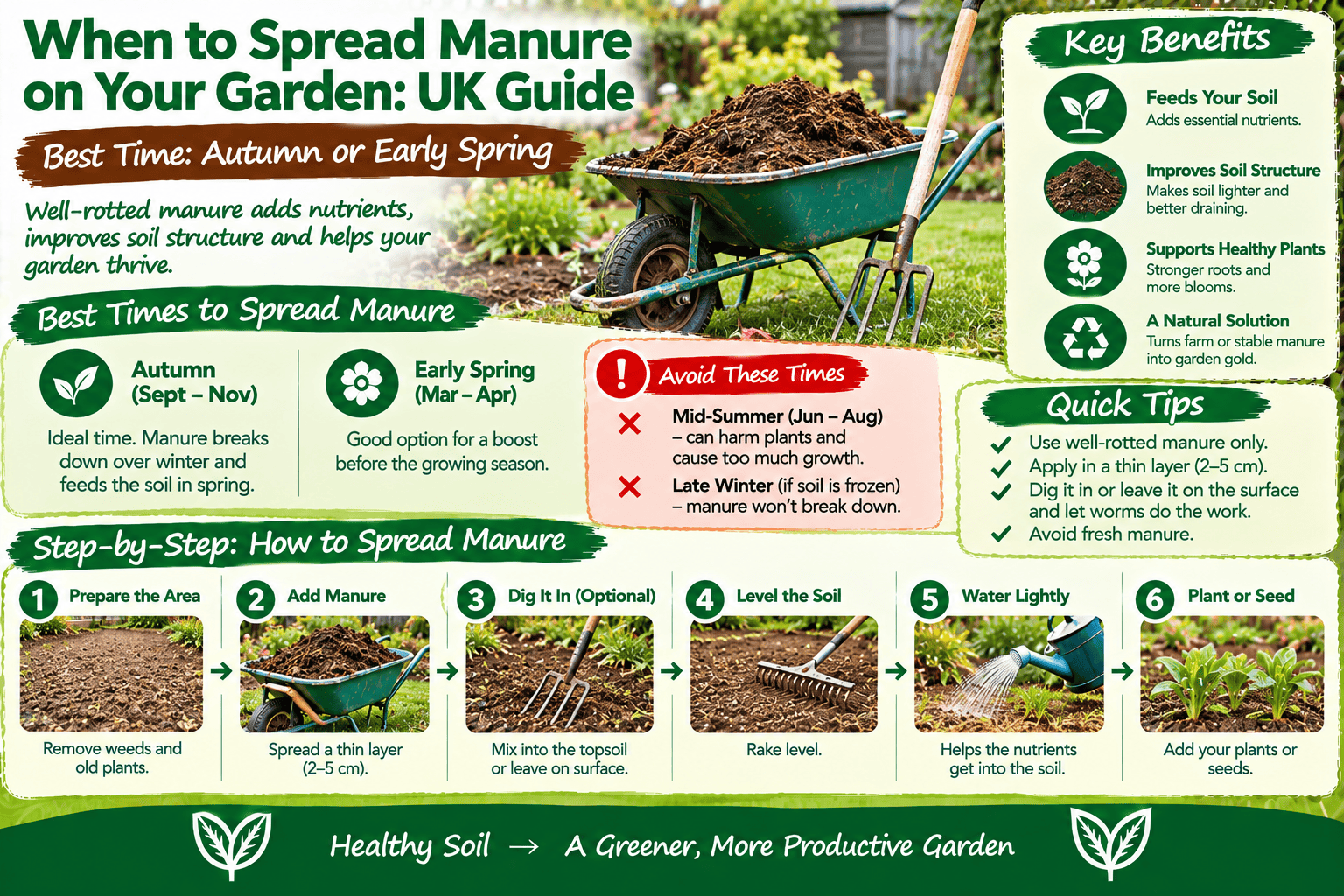
When to Spread Manure on Your Garden: Autumn or Spring? A UK & Scotland Guide
If you're preparing your garden for the next growing season, you may be wondering when to spread manure.
Should you add it in November before winter arrives? Is spring better? And can you put manure directly onto vegetable beds?
These are important questions, particularly for gardeners in Glasgow and across Scotland, where wet autumns and cold winters can affect soil conditions.
The best time to apply suitable well-rotted manure depends on the crop, soil condition and nutrient requirements. Autumn can be useful for some soil-improvement work, while spring applications may be appropriate in other situations.
However, applying manure to frozen, waterlogged or saturated ground can lead to nutrient losses and other problems.
This guide explains when to use manure, how to apply it safely and when organic compost may be a better alternative.
Quick Answer: When Should You Spread Manure?
For many garden situations:
Autumn: Suitable mature manure may be applied to some empty beds when the soil is workable and nutrient losses can be minimised.
Winter: Avoid applying manure to frozen, snow-covered or waterlogged ground.
Spring: Mature manure may be useful before planting certain crops, subject to crop requirements and food-safety precautions.
Summer: Established beds may not need additional manure, particularly if they have already received organic amendments.
Manure isn't a universal treatment for every garden.
Soil testing and previous applications should guide the decision.
1. Is Autumn a Good Time to Spread Manure?
Autumn can be a practical time for garden soil improvement.
After crops have been harvested, some vegetable beds are left empty until spring.
Suitable well-rotted manure may contribute organic matter and nutrients where needed.
However, heavy autumn rainfall can increase the risk of nutrient movement and losses.
For Scottish gardens, this is particularly important.
If the soil is saturated or heavy rain is forecast, postpone application.
Avoid spreading manure simply because the calendar says autumn.
2. Can You Put Manure on Your Garden in November?
Yes, in some circumstances.
November applications may be appropriate where the manure is sufficiently mature, the soil is suitable and the application is consistent with crop needs and environmental precautions.
However, November is often wet in Glasgow and western Scotland.
Avoid applying manure when:
The ground is frozen.
Snow covers the soil.
The soil is waterlogged.
Heavy rainfall is likely to cause runoff.
Nutrient additions are unnecessary.
The intended crop requires a different management approach.
For many gardens, waiting for more suitable conditions may be the better decision.
3. Is Spring Better Than Autumn for Manure?
Neither season is universally better.
Autumn application
Potential benefits include preparing suitable beds ahead of the next growing season.
However, nutrient losses during prolonged wet weather can be a concern.
Spring application
Spring applications can be timed closer to crop growth.
However, only suitably mature manure should be considered, and edible crops require particular attention to hygiene and application timing.
Avoid placing unsuitable manure directly around crops that will soon be harvested.
4. What Is Well-Rotted Manure?
Well-rotted manure has undergone substantial decomposition.
Compared with fresh manure, it generally has a more crumbly texture and less recognisable bedding material.
However, appearance alone doesn't guarantee that manure is free from harmful microorganisms.
Mature manure can still contain variable nutrients and should be handled carefully.
For edible gardening, follow appropriate food-safety guidance and avoid assuming that well-rotted manure is completely risk-free.
5. Can You Use Fresh Manure in Your Garden?
Fresh manure requires greater caution.
It may contain high levels of readily available nutrients, weed seeds and potentially harmful microorganisms.
Direct application near edible crops can create food-safety risks.
Fresh manure can also damage some plants if used improperly.
For most domestic gardeners, suitable mature manure or a properly processed soil improver is generally a more practical choice.
6. Is Horse Manure or Cow Manure Better?
Both can contribute organic matter and nutrients.
However, their properties vary depending on animal diet, bedding, storage and decomposition.
Horse manure may contain substantial bedding material.
Cattle manure can have different moisture and nutrient characteristics.
Neither is automatically superior.
When sourcing manure, ask about its maturity, intended use and any relevant herbicide-residue concerns.
Some persistent herbicides used on grassland can remain active in contaminated manure and damage sensitive garden plants.
7. How to Spread Manure on a Vegetable Garden
If manure is appropriate for your soil and crops, use a considered application method.
Step 1: Check soil condition
Avoid working saturated or frozen ground.
Step 2: Confirm manure suitability
Use appropriate mature material from a reliable source.
Step 3: Consider the next crop
Different vegetables have different nutrient requirements and food-safety considerations.
Step 4: Calculate the application quantity
Use soil-test recommendations or reliable product guidance rather than applying an arbitrary thick layer.
Step 5: Apply evenly
Distribute the material appropriately without piling it against vulnerable plants.
Step 6: Avoid unnecessary soil disturbance
Where suitable, surface application may be practical.
Step 7: Follow food-safety precautions
Wash hands and tools after handling manure, and take particular care with crops eaten raw.
8. Which Vegetables Benefit From Manure?
Some nutrient-demanding vegetables may benefit from appropriately managed organic amendments.
Examples include brassicas, courgettes and pumpkins.
However, requirements depend on existing soil fertility.
Root crops such as carrots and parsnips may perform poorly where unsuitable fresh organic material has recently been incorporated.
Crop rotation and soil testing can help determine where manure is needed.
9. Can You Put Manure Around Fruit Trees?
Suitable well-rotted manure may be used as part of soil management around established fruit trees.
However, avoid piling it against trunks.
Consider nutrient requirements and previous applications.
Excess nitrogen can encourage vegetative growth at the expense of balanced plant development.
For established trees, the appropriate treatment depends on soil fertility, tree health and growing conditions.
10. Is Manure Good for Roses?
Well-rotted manure can contribute organic matter and nutrients to suitable rose beds.
However, roses don't automatically require manure every year.
Where soil fertility is already adequate, further applications may be unnecessary.
Keep organic material away from stems and crowns.
11. Can Manure Improve Clay Soil?
Suitable organic matter can help improve some properties of clay-rich soil over time.
However, manure won't automatically fix severe compaction or waterlogging.
If your garden regularly floods, investigate drainage.
Avoid digging saturated clay soil, as this can damage its structure.
For some soil-improvement projects, mature organic compost may be a more predictable material.
12. Manure vs Compost: Which Should You Use?
| Feature | Well-rotted manure | Mature organic compost |
|---|---|---|
| Adds organic matter | Yes | Yes |
| Supplies nutrients | Yes, variable amounts | Yes, variable amounts |
| Improves suitable soil | Can help | Can help |
| Food-safety considerations | Particularly important | Depend on material and processing |
| Suitable for all plants | No | No |
| Can be overapplied | Yes | Yes |
The choice depends on the soil and intended crop.
Kelvin Compost supplies both manure and organic compost for appropriate garden projects.
13. How Much Manure Should You Apply?
There is no single safe application rate for every garden.
Manure nutrient content can vary substantially.
Soil fertility, crop requirements and environmental conditions should determine the quantity.
If you have a specific recommended application depth, you can calculate the required volume.
Area (m²) × depth (m) × 1,000 = litres
For example, covering a 10m² bed at 2cm depth requires:
10 × 0.02 × 1,000 = 200 litres
This is a volume calculation, not a recommended manure application rate.
For nutrient-rich manure, a thick layer may supply more nutrients than the crop needs.
14. Can You Leave Manure on Top of Soil?
In some growing systems, suitable mature organic amendments are applied to the surface.
However, leaving manure exposed during prolonged wet weather may increase the risk of nutrient runoff.
The best approach depends on manure characteristics, soil condition, crop plans and environmental guidance.
For no-dig gardening, mature compost is often used as a surface amendment.
15. Does Manure Need to Be Dug In?
Not always.
Some gardeners incorporate appropriate mature manure into workable soil.
Others use surface applications in suitable systems.
Avoid digging wet or frozen ground.
The correct method should reflect the intended crop and soil-management approach.
16. Can You Put Manure on Frozen Soil?
Avoid applying manure to frozen or snow-covered soil.
Frozen ground may prevent nutrients from entering the soil, increasing the potential for runoff when rain or thawing occurs.
Wait until conditions improve.
17. Can You Use Manure in Raised Beds?
Yes, appropriate mature manure may form part of a raised-bed soil-management plan.
However, don't fill a raised bed entirely with manure.
Raised beds need an appropriate growing medium with suitable mineral soil and organic matter.
For new beds, topsoil may be needed to provide suitable soil volume.
18. Can Manure Burn Plants?
Fresh or excessive manure can damage plants through high concentrations of soluble nutrients or other unsuitable conditions.
Even mature manure should be applied appropriately.
Avoid direct contact with sensitive roots, stems or crowns unless the product is specifically suitable for that use.
19. Does Manure Attract Weeds?
Manure can contain viable weed seeds, depending on its source and processing.
Well-managed composting can reduce some weed-seed viability, but not every material is guaranteed weed-free.
Inspect the product and manage emerging weeds promptly.
20. How Long Does Manure Take to Improve Soil?
Organic matter can influence soil properties over time.
Some nutrient effects may occur relatively quickly.
Improvements in soil structure and biological activity may require repeated appropriate management over several seasons.
The results depend on soil type, weather, manure composition and application practices.
21. Spreading Manure in Glasgow and Scotland
Gardens across Glasgow, East Kilbride and South Lanarkshire experience different soil conditions.
Some have productive established growing soil.
Others contain compacted clay, shallow topsoil or poorly drained ground.
During autumn and winter, rainfall and soil saturation are particularly important considerations.
Before applying manure:
Check soil moisture.
Consider the weather forecast.
Identify the next crop.
Review previous fertiliser and manure applications.
Confirm the material is suitable.
Avoid unnecessary nutrient additions.
Where manure isn't appropriate, other soil-management measures may be more useful.
Common Mistakes When Using Manure
Applying manure to waterlogged soil
This can increase runoff and nutrient-loss risks.
Using fresh manure near edible crops
This may create food-safety concerns.
Applying too much manure
Excess nutrients can cause problems.
Assuming all manure is weed-free
Processing and source matter.
Ignoring herbicide residues
Contaminated manure can damage sensitive plants.
Using manure to fix severe drainage problems
Organic matter isn't a substitute for proper drainage.
Adding manure every year without testing
Some soils may already contain sufficient nutrients.
Frequently Asked Questions
When is the best time to spread manure on a garden?
It depends on soil conditions, crop requirements and manure maturity. Autumn and spring may both be suitable.
Can you put manure on your garden in November?
Yes, where appropriate, but avoid frozen, saturated or waterlogged ground.
Is autumn or spring better for manure?
Neither is universally better. The right timing depends on the crop and local conditions.
Can you put manure on top of soil?
Suitable mature manure may be surface-applied in some systems, subject to nutrient and runoff considerations.
Should manure be dug into soil?
Not always. Some systems use surface applications, while others incorporate manure when soil conditions are suitable.
Can you put manure on frozen ground?
Avoid doing so because of runoff and nutrient-loss risks.
Is well-rotted manure safe for vegetables?
It generally presents fewer concerns than fresh manure, but maturity alone doesn't guarantee pathogen-free material. Follow food-safety guidance.
Is horse manure good for gardens?
Appropriately matured horse manure can contribute organic matter and nutrients.
Is cow manure better than horse manure?
Neither is automatically better. Composition and maturity matter.
Can manure improve clay soil?
Suitable organic matter can help over time, but it won't automatically solve severe drainage problems.
Can you use manure around roses?
Yes, where appropriate, keeping it away from stems and crowns.
How much manure should I use?
Base quantities on soil fertility, crop requirements and product characteristics rather than a universal depth.
Can manure damage plants?
Yes. Fresh or excessive manure can cause problems.
Does manure contain weed seeds?
It can, depending on source and processing.
Is compost better than manure?
Both can be useful. The better choice depends on the soil and intended application.
Final Thoughts: Apply Manure When Your Garden Actually Needs It
Manure can be a valuable garden soil amendment.
But timing matters.
In Scotland, wet autumn and winter conditions can make poorly timed applications ineffective or environmentally problematic.
For some beds, suitable mature manure may be useful in autumn.
For others, spring may be more appropriate.
And some gardens may not need additional manure at all.
The best approach is to match manure applications to soil conditions, crop needs and the weather—not simply the month.
Need Well-Rotted Manure in Glasgow?
Kelvin Compost supplies manure, organic compost and other garden materials for homeowners, allotments and landscaping projects across Glasgow, East Kilbride, South Lanarkshire and surrounding areas.
Explore our products:
For product quantities and delivery enquiries:
Phone: +44 7561 251350
Email: info@kelvincompost.co.uk
Need Garden Supplies Delivered in Glasgow?
Organic compost, topsoil, manure and more across Scotland