


When to Sow Grass Seed in Scotland: Glasgow Guide
Looking for compost, topsoil or garden supplies?
Browse our full product range or get in touch for delivery across Glasgow and Scotland.
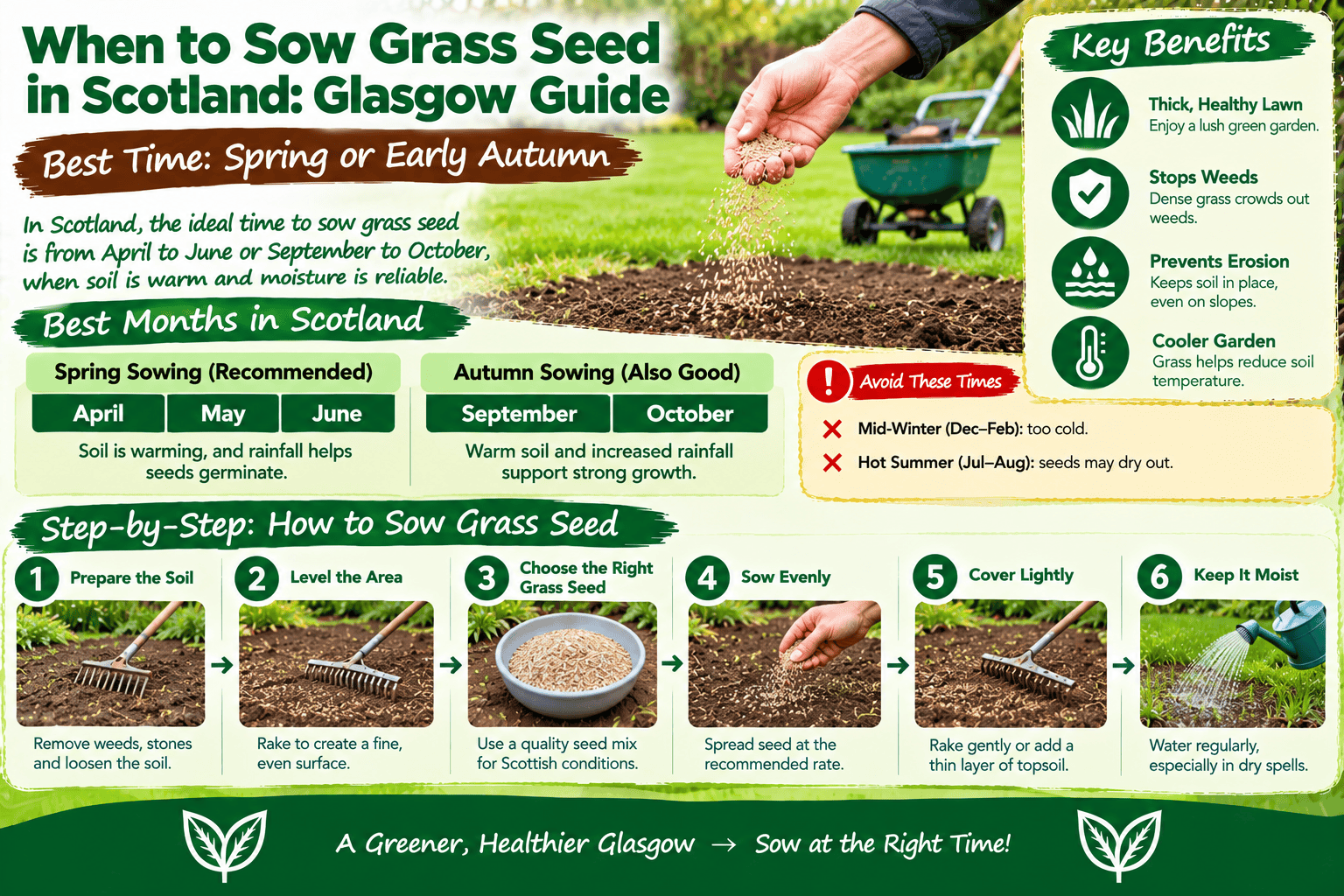
When Is the Best Time to Sow Grass Seed in Scotland? A Glasgow Lawn Guide
If you're planning a new lawn or repairing bare patches, one of the most important questions is: when should you sow grass seed in Scotland?
The answer depends on soil temperature, rainfall, sunlight and the condition of your garden.
For homeowners in Glasgow, East Kilbride and South Lanarkshire, the timing can be particularly important. Scotland's cooler climate and wet autumn weather mean that grass seed doesn't always germinate when you expect it to.
You might be wondering whether November is too late, whether grass seed can survive frost or whether it's better to wait until spring.
This guide explains the best months to sow grass seed, how to prepare the soil, how much topsoil you may need and how to establish a healthy lawn in Scottish conditions.
Quick Answer: When Should You Sow Grass Seed in Scotland?
The best times to sow grass seed in Scotland are generally spring (April–May) and late summer to early autumn (August–September), provided the soil is warm enough and conditions are suitable.
Early October may also work in mild years.
November is less reliable because soil temperatures are falling, daylight hours are shorter and frost becomes more likely.
Grass seed generally germinates best when the soil is consistently warm enough for the selected seed mixture.
Always check the seed manufacturer's temperature recommendations.
Best Months to Sow Grass Seed in Scotland
| Month | Suitability | What to consider |
|---|---|---|
| January–February | Poor | Cold or frozen soil |
| March | Variable | Soil may still be too cold |
| April | Good | Improving temperatures |
| May | Very good | Warmer soil and active growth |
| June | Possible | Watering may be needed |
| July | Variable | Dry weather can affect germination |
| August | Very good | Warm soil, often improving moisture |
| September | Very good | Excellent establishment window in suitable conditions |
| October | Variable | Shortening days and cooling soil |
| November | Generally poor | Cold soil and frost risk |
| December | Poor | Winter conditions |
This is a general guide. Actual suitability depends on local weather, soil temperature and the grass seed mixture.
1. Why Soil Temperature Matters More Than the Calendar
Grass seed needs appropriate moisture, oxygen and temperature to germinate.
Even if the air feels mild, the soil may still be cold.
Many common lawn seed mixtures germinate more reliably when soil temperatures are consistently around 8–10°C or higher, although requirements vary by grass species.
If soil temperatures are too low, germination may be delayed or uneven.
This is why grass seed sown in early spring sometimes takes much longer to establish than seed sown in May.
A soil thermometer can help you decide when conditions are suitable.
2. Can You Sow Grass Seed in November in Scotland?
Technically, grass seed can be sown in November, but successful immediate germination is less reliable.
By November, Glasgow gardens often experience:
Lower soil temperatures.
Shorter daylight hours.
Increased frost risk.
Prolonged rainfall.
Saturated or compacted soil.
Some seed may remain dormant until conditions improve.
However, winter rainfall, birds, surface movement and prolonged saturation can reduce establishment success.
Should you sow grass seed in November?
For most homeowners looking for a reliable new lawn, waiting until spring is usually the safer option.
If you're planning a new lawn in November, you can still prepare by measuring the garden, checking drainage and calculating topsoil requirements.
Avoid working frozen or waterlogged soil.
3. Is Spring or Autumn Better for Grass Seed?
Both seasons can work well.
Spring grass seeding
Spring is a good option when soil temperatures are rising and grass has the growing season ahead of it.
Advantages include:
Increasing daylight.
Warmer soil.
Time for establishment before winter.
Potential challenges include dry spells and competition from weeds.
Autumn grass seeding
Late summer and early autumn often provide favourable conditions.
Advantages can include:
Soil retaining summer warmth.
Reduced risk of intense heat.
More consistent moisture in some years.
Time for establishment before winter.
However, sowing too late increases the risk of poor germination.
For Glasgow, August and September are often particularly useful months for lawn establishment.
4. How to Prepare Soil Before Sowing Grass Seed
Good preparation is essential.
Grass seed may germinate poorly if the soil is compacted, waterlogged or covered with debris.
Step 1: Remove weeds and debris
Clear unwanted vegetation, stones and construction material.
If persistent perennial weeds are present, address them before seeding.
Step 2: Check drainage
Observe whether water collects after rainfall.
Grass seed will struggle to establish in persistently saturated ground.
Step 3: Check soil depth
New-build gardens sometimes have shallow topsoil over compacted subsoil.
If the growing layer is inadequate, additional suitable topsoil may be required.
Step 4: Relieve compaction
Where appropriate, loosen compacted soil when it is workable.
Avoid digging saturated clay.
Step 5: Improve the soil if necessary
Suitable mature organic matter may help improve soil structure.
However, excessive compost or fertiliser isn't automatically beneficial.
Step 6: Create a level seedbed
Rake the surface to produce a reasonably fine, even seedbed.
Remove large stones and firm gently.
The surface should be stable without being excessively compacted.
5. What Is the Best Topsoil for Grass Seed?
Grass seed needs a suitable growing layer that supports root development, moisture management and drainage.
Good-quality landscaping topsoil may be appropriate when existing soil depth is insufficient or the ground needs preparation.
Look for topsoil that is suitable for lawn establishment.
The material should be reasonably free from unsuitable debris and have an appropriate texture for the project.
Remember that screened topsoil isn't necessarily sterile or weed-free.
Kelvin Compost supplies topsoil for suitable garden and landscaping projects across the Glasgow area.
6. Can You Put Grass Seed Directly on Topsoil?
Yes, grass seed can be sown onto a properly prepared topsoil surface.
However, simply scattering seed onto hard, dry or compacted ground may lead to poor results.
For better establishment:
Prepare a fine seedbed.
Sow the recommended quantity evenly.
Lightly rake the seed into the surface according to the supplier's instructions.
Firm gently to improve seed-to-soil contact.
Maintain suitable moisture.
Keep heavy foot traffic off the area.
Avoid burying seed too deeply.
The correct sowing depth depends on the grass mixture.
7. How Much Topsoil Do You Need for a New Lawn?
If your garden requires additional topsoil, calculate the volume before ordering.
Use:
Area (m²) × required depth (m) = volume (m³)
For example, a 40m² garden requiring an additional 10cm of suitable topsoil needs:
40 × 0.10 = 4m³
That's equivalent to 4,000 litres.
Topsoil quantity guide
| Lawn area | 5cm additional depth | 10cm additional depth |
|---|---|---|
| 10m² | 500L | 1,000L |
| 20m² | 1,000L | 2,000L |
| 30m² | 1,500L | 3,000L |
| 40m² | 2,000L | 4,000L |
| 50m² | 2,500L | 5,000L |
| 100m² | 5,000L | 10,000L |
These figures represent additional soil volume, not universal recommendations for lawn soil depth.
Existing soil condition and the intended project determine how much topsoil is needed.
Allow for settlement and uneven ground.
8. How Much Grass Seed Do You Need?
The quantity depends on the seed mixture and whether you're establishing a new lawn or overseeding an existing one.
As an illustration, a product with a recommended new-lawn sowing rate of 35g/m² would require:
10m²: 350g.
20m²: 700g.
50m²: 1.75kg.
100m²: 3.5kg.
Always follow the actual seed manufacturer's application rate.
Using excessive seed can create overcrowding and uneven establishment.
9. How Long Does Grass Seed Take to Germinate in Scotland?
Under suitable conditions, some grass species may begin germinating within approximately 7–14 days.
Other species can take longer.
Cold soil can significantly delay the process.
A lawn may also need several additional weeks to develop enough growth for regular use.
Factors affecting germination include:
Soil temperature.
Grass species.
Moisture.
Seed-to-soil contact.
Soil structure.
Seed quality.
Weather conditions.
Don't assume that seed has failed simply because nothing appears after a few cold days.
10. How Often Should You Water New Grass Seed?
Newly sown grass seed needs consistent moisture during germination.
The surface should not be allowed to dry out repeatedly.
However, excessive watering can displace seed and contribute to waterlogging.
During dry weather, light and appropriately timed watering may be needed.
In wet Scottish conditions, rainfall may provide sufficient moisture.
Check the soil rather than watering automatically.
As grass establishes, watering practices can be adjusted to encourage deeper rooting.
11. Can Grass Seed Survive Frost?
Some ungerminated grass seed may survive freezing conditions.
However, frost can damage vulnerable young seedlings.
Repeated freezing and thawing may also disturb the soil surface.
This is one reason late-autumn sowing is less reliable than sowing during warmer periods.
If frost is forecast immediately after sowing, follow the seed supplier's guidance and avoid unnecessary disturbance.
12. Why Is My Grass Seed Not Growing?
Poor germination can have several causes.
Soil is too cold
Seed may remain dormant or germinate slowly.
Not enough moisture
The seedbed may dry out before germination.
Too much water
Waterlogged soil can restrict oxygen and damage seed.
Poor seed-to-soil contact
Seed sitting on debris or hard ground may establish poorly.
Seed buried too deeply
Some grass seed may struggle to emerge.
Birds or surface movement
Seed may be removed or displaced.
Unsuitable soil
Compaction, poor drainage or inadequate topsoil depth can affect establishment.
Investigate the cause before sowing more seed.
13. How to Repair Bare Patches in a Lawn
Bare patches are common in domestic gardens.
They may develop because of:
Heavy foot traffic.
Pets.
Shade.
Compaction.
Waterlogging.
Drought.
Disease.
Poor soil conditions.
Before reseeding, address the underlying problem.
Then prepare the surface, apply suitable seed and maintain appropriate moisture.
If the patch is significantly lower than the surrounding lawn, correct the level before sowing.
14. Can You Sow Grass Seed Over an Existing Lawn?
Yes. This is known as overseeding.
It can help improve a thin lawn when the underlying growing conditions are suitable.
A typical process involves:
Mowing the lawn appropriately.
Removing excessive debris or thatch where needed.
Addressing compaction if necessary.
Creating suitable seed-to-soil contact.
Applying the correct seed quantity.
Watering appropriately.
Limiting foot traffic during establishment.
Overseeding won't permanently fix a lawn if the original cause of poor growth remains unresolved.
15. Should You Add Compost Before Sowing Grass Seed?
Suitable mature compost can contribute organic matter to some soils.
However, compost is not automatically necessary for every new lawn.
If your existing soil is already fertile and has adequate organic matter, another heavy application may be unnecessary.
Avoid using coarse, unfinished compost as a direct seedbed material.
For suitable soil-improvement projects, Kelvin Compost supplies organic compost.
16. Grass Seed or Turf: Which Is Better?
Both methods can create a lawn.
| Factor | Grass seed | Turf |
|---|---|---|
| Initial material cost | Often lower | Usually higher |
| Immediate appearance | Bare ground initially | Instant green surface |
| Establishment | Requires germination and growth | Requires rooting |
| Weed competition | Can be more challenging | Usually less exposed initially |
| Variety choice | Wide range of seed mixtures | Depends on turf supplier |
| Soil preparation | Essential | Essential |
The better option depends on budget, timing, site conditions and how quickly you need a usable lawn.
Neither seed nor turf will solve severe drainage or soil problems on its own.
17. When Can You First Mow a Newly Seeded Lawn?
Wait until the grass is sufficiently established and tall enough for its first cut.
The exact timing depends on the seed mixture and growing conditions.
Use a sharp mower and avoid cutting the grass too short.
A common principle is to remove no more than approximately one-third of the grass blade in a single mowing.
Avoid mowing when the ground is saturated or the seedlings are easily disturbed.
18. How Long Before You Can Walk on New Grass?
Newly seeded lawns need time to establish roots.
Avoid regular foot traffic during germination and early growth.
The exact period depends on the species, weather and establishment rate.
A lawn that looks green isn't necessarily ready for heavy use.
For gardens with children or pets, consider temporary access arrangements while the grass establishes.
19. Growing Grass in Glasgow's Clay Soil
Clay-rich soil can support healthy lawns, but compaction and poor drainage may cause problems.
If your garden contains heavy clay:
Avoid working saturated soil.
Check for compacted layers.
Improve drainage where necessary.
Use suitable organic matter if appropriate.
Prepare the seedbed carefully.
Avoid adding excessive sand without a suitable soil-improvement plan.
Adding topsoil over severely compacted subsoil may not solve underlying drainage problems.
20. Grass Seed for New-Build Gardens in Scotland
Some new-build gardens have limited topsoil depth or compacted ground following construction.
Before sowing grass seed:
Inspect the existing growing layer.
Remove unsuitable construction debris.
Check drainage.
Assess compaction.
Add suitable topsoil if required.
Prepare a level seedbed.
Sow at an appropriate time.
Good preparation can reduce the risk of patchy growth and uneven settlement.
21. Should You Prepare Your Lawn in November for Spring Seeding?
Yes, November can be useful for planning a spring lawn project.
You can:
Measure the garden.
Identify drainage problems.
Check topsoil depth.
Compare suitable grass seed mixtures.
Calculate material requirements.
Plan access for deliveries.
However, avoid unnecessary digging or levelling when the soil is waterlogged or frozen.
Major soil preparation is often better completed when ground conditions improve.
Common Grass Seeding Mistakes
Sowing too early in cold soil
This can delay germination.
Sowing too late in autumn
Seedlings may not establish before winter.
Using too much seed
Overcrowding can affect growth.
Ignoring drainage
Waterlogged soil can prevent healthy establishment.
Burying seed too deeply
Seed may struggle to emerge.
Allowing the seedbed to dry out
Germination can be interrupted.
Walking on new seedlings
Young grass is easily damaged.
Using unsuitable topsoil
The growing layer must be appropriate for lawn establishment.
Frequently Asked Questions
What month is best to sow grass seed in Scotland?
April–May and August–September are generally good periods, depending on soil temperature and weather.
Can I sow grass seed in November in Glasgow?
You can, but immediate germination and establishment are less reliable. Waiting until spring is usually safer.
Is October too late to sow grass seed?
Not always. Early October may work in mild conditions, but the risk increases as temperatures fall.
Will grass seed grow at 5°C?
Germination is generally slow or unreliable at low soil temperatures, depending on the species.
Does grass seed need to be covered with soil?
Light raking or covering according to the seed manufacturer's instructions can improve seed-to-soil contact.
Can you put grass seed directly onto topsoil?
Yes, if the topsoil has been properly prepared.
How long does grass seed take to grow?
Germination may begin within 7–14 days for some species under suitable conditions, while others take longer.
Can grass seed survive winter?
Some ungerminated seed may survive, but winter sowing carries establishment risks.
How much topsoil do I need for a lawn?
It depends on the area, existing soil depth and the additional depth required.
Is compost good for growing grass?
Suitable mature compost can improve some soils, but excessive applications aren't always beneficial.
Can you sow grass seed in clay soil?
Yes, provided the soil has suitable structure and drainage.
Should I water grass seed every day?
Water according to actual moisture conditions. The seedbed should remain appropriately moist without becoming waterlogged.
Can you walk on newly seeded grass?
Avoid unnecessary foot traffic until the grass is sufficiently established.
Is turf better than grass seed in Scotland?
Both can work well. The choice depends on timing, cost, soil conditions and the desired result.
Final Thoughts: Choose the Right Time and Prepare the Soil Properly
Successful grass seeding in Scotland depends on more than scattering seed across the garden.
Soil temperature, drainage, moisture and seedbed preparation all influence the result.
For most Glasgow homeowners, spring and late summer to early autumn provide the most reliable opportunities.
If it's already November, there's no need to rush.
Use the colder months to assess your garden, calculate topsoil requirements and plan for a suitable sowing window.
A healthy lawn starts with the right conditions beneath the grass—not just the seed itself.
Need Topsoil for a New Lawn in Glasgow?
Kelvin Compost supplies topsoil, organic compost and other garden materials for lawn preparation, landscaping and garden improvements across Glasgow, East Kilbride, South Lanarkshire and surrounding areas.
Explore our products:
For product quantities and delivery enquiries:
Phone: +44 7561 251350
Email: info@kelvincompost.co.uk
Need Garden Supplies Delivered in Glasgow?
Organic compost, topsoil, manure and more across Scotland