




What to Do With Autumn Leaves | Leafmould Guide Scotland
Looking for compost, topsoil or garden supplies?
Browse our full product range or get in touch for delivery across Glasgow and Scotland.
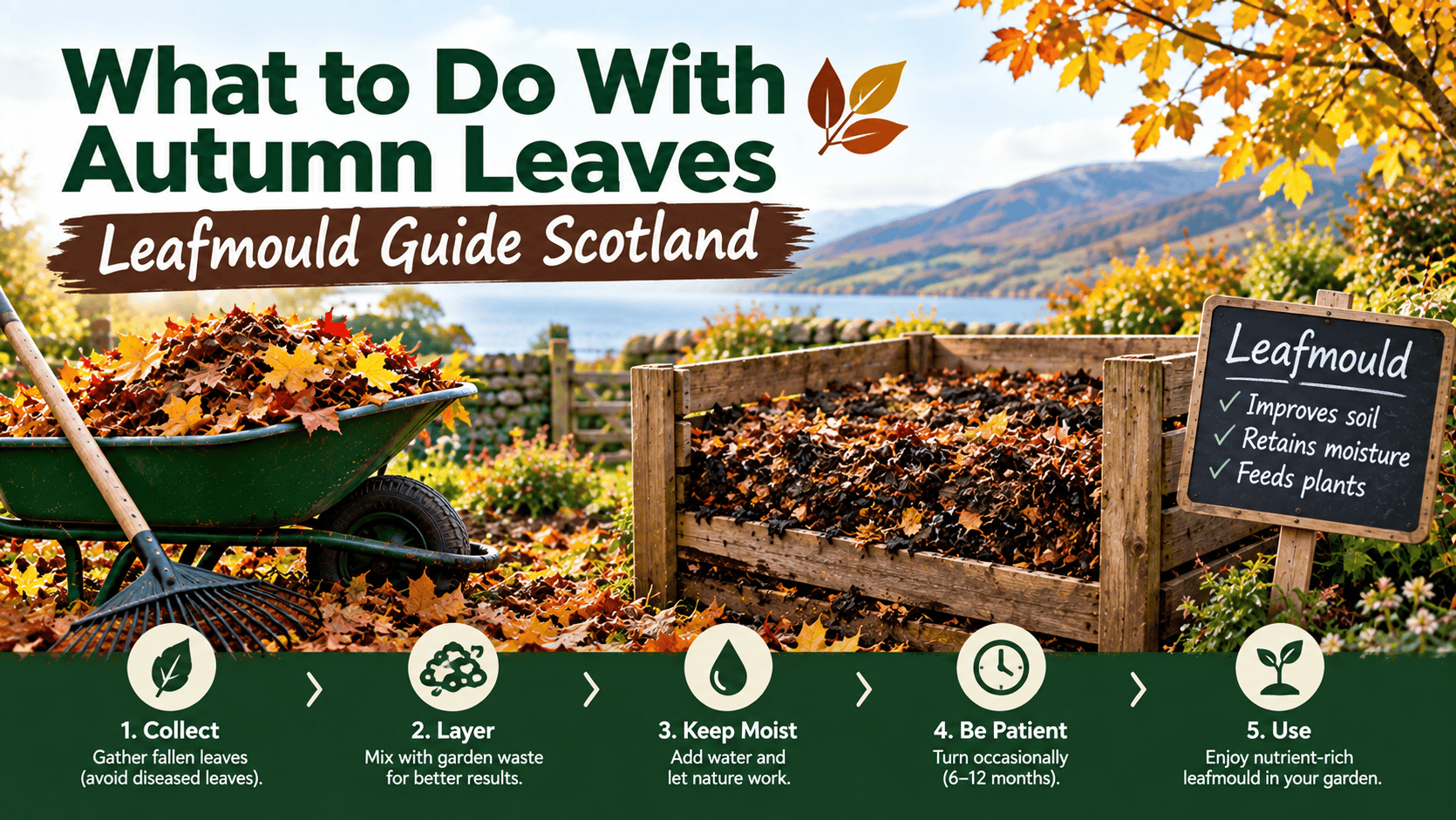
What to Do With Autumn Leaves: Make Leafmould, Mulch or Compost Them
Every autumn, Scottish gardens produce something gardeners often bag up and throw away:
fallen leaves.
But leaves aren't simply garden waste.
Collected and managed properly, they can become leafmould — a useful organic material for improving soil structure, retaining moisture and mulching beds.
You can also compost some leaves, shred them for use around suitable plants, or use them as part of your wider autumn garden routine.
So before filling the garden-waste bin this autumn, ask:
Could these leaves be useful in the garden instead?
This guide explains what to do with autumn leaves, how to make leafmould, how long it takes, which leaves work best and how leafmould differs from compost and woodchip.
Quick Answer: What Should You Do With Fallen Leaves?
For most healthy autumn leaves, you have four useful options:
| Leaves | What to do |
|---|---|
| Large quantity of deciduous leaves | Make leafmould |
| Leaves on the lawn | Collect or mow/shred them |
| Small quantity mixed with other garden waste | Add appropriately to compost |
| Partially decomposed leafmould | Use as mulch/soil improver |
| Mature leafmould | Use as soil conditioner |
| Diseased/problem material | Handle separately where appropriate |
If you have lots of leaves, making a dedicated leafmould pile is one of the simplest options.
What Is Leafmould?
Leafmould is the dark, crumbly material created as fallen leaves gradually decompose.
It is different from conventional garden compost.
A compost heap usually contains a mixture of materials such as:
Green plant material
Vegetable waste
Grass clippings
Cardboard
Woody material
Leafmould is predominantly made from:
fallen leaves.
Its decomposition is driven largely by fungi and tends to be considerably slower than a well-managed compost heap.
The result is a useful material for improving soil structure and moisture retention.
Is Leafmould the Same as Compost?
No.
Both are forms of decomposed organic matter, but they have different characteristics and uses.
Leafmould
Made mainly from fallen leaves.
Particularly useful for:
Soil conditioning
Improving soil structure
Moisture retention
Mulching
Adding organic matter
Garden compost
Made from a wider mixture of decomposed garden and kitchen materials.
Useful for:
Improving garden soil
Adding organic matter
Mulching
Productive beds
Borders
A useful way to think about it is:
Leafmould = excellent soil conditioner
Compost = broader organic soil improver
They can complement each other rather than compete.
Why Should You Collect Autumn Leaves?
Leaving a few leaves beneath shrubs or in wildlife-friendly corners isn't necessarily a problem.
But thick layers of wet leaves can create issues in other parts of the garden.
On lawns
A dense layer can block light from reaching the grass.
Wet leaves can also create damp conditions and make lawns slippery.
On paths
Wet leaves can become slippery.
On patios and decking
They can create mess and potentially hazardous surfaces.
On small plants
Heavy mats of wet leaves may smother low-growing plants.
So the goal isn't:
remove every leaf from the garden.
It's:
move leaves away from places where they cause problems and use them somewhere more useful.
Which Leaves Make the Best Leafmould?
Most deciduous tree leaves can eventually be turned into leafmould.
Some break down faster than others.
Leaves that generally decompose relatively well include:
Oak
Beech
Birch
Hazel
Hornbeam
Acer
Thicker or tougher leaves can take longer.
Examples include:
Sycamore
Horse chestnut
Sweet chestnut
Walnut
These tougher leaves benefit from being shredded before being added to the leafmould pile.
Shredding increases the surface area and can speed decomposition.
Can You Use Sycamore Leaves?
Yes.
Sycamore leaves can be turned into leafmould.
They are relatively substantial leaves, so shredding them first can help them break down more quickly.
One easy method is to run a lawn mower over dry or slightly damp leaves.
This chops them into smaller pieces before collection.
The shredded leaves can then be transferred to your leafmould pile or container.
What About Evergreen Leaves?
Evergreen leaves generally take longer to decompose.
Tough evergreen foliage shouldn't necessarily be mixed into your main leafmould pile in large quantities if you're hoping for relatively quick results.
Some evergreen material may be better:
Shredded
Composted separately
Added gradually to a suitable composting system
Conifer needles also decompose much more slowly than many deciduous leaves.
How to Make Leafmould
Making leafmould is surprisingly easy.
You don't need an expensive composting system.
Step 1: Collect the leaves
Use a rake, leaf blower or lawn mower.
Collect leaves from:
Lawns
Paths
Patios
Driveways
Suitable garden areas
Step 2: Shred larger leaves
This isn't essential for every leaf type, but it can speed up decomposition.
A lawn mower is one of the easiest tools for the job.
Step 3: Create a leaf pile
Put the leaves into:
A simple wire-mesh cage
A dedicated leaf bin
A suitable composting bay
Perforated bags
The material needs some airflow.
Step 4: Keep the leaves moist
Leaves should be damp rather than completely dry.
If you've collected very dry leaves, moisten them.
Don't turn the pile into a swamp.
Step 5: Wait
Leafmould is slow.
That's part of the process.
You aren't trying to create hot compost in a few weeks.
Allow fungi and other decomposers to do the work.
How Long Does Leafmould Take?
Patience is required.
After approximately one year, leaves may have decomposed enough to produce a rough leafmould suitable for some mulching applications.
After around two years, the material can become much finer and more crumbly.
The actual speed depends on:
Leaf type
Whether leaves were shredded
Moisture
Airflow
Pile size
Weather
Tough leaves can take longer.
Rather than asking:
“Is it exactly 12 months old?”
look at the material.
Finished leafmould should look dark, crumbly and substantially different from the leaves you originally collected.
Should You Shred Leaves Before Making Leafmould?
You don't always have to.
But shredding can help.
Smaller leaf pieces provide more surface area for decomposition.
Shredded leaves also tend to pack differently from whole large leaves, helping reduce dense, compacted layers.
Shredding is especially useful for tougher leaves.
One of the simplest methods is:
spread leaves over the lawn → run the mower over them → collect the shredded mixture.
Can You Make Leafmould in Bin Bags?
Yes.
This is useful for small gardens where you don't have room for a permanent leaf cage.
Use suitable bags and create ventilation holes.
Add damp leaves.
Then store the bags somewhere out of the way while decomposition occurs.
Check them occasionally.
If the leaves become completely dry, add a little moisture.
The process still takes time, but it requires very little active work.
Can You Put Autumn Leaves in a Compost Bin?
Yes — in moderation.
Dry autumn leaves are a useful brown, carbon-rich composting material.
They can balance wetter nitrogen-rich materials such as:
Fresh green plant waste
Some kitchen scraps
Grass clippings
But filling a conventional compost bin entirely with leaves isn't the same as making balanced garden compost.
If you have a large volume of leaves, consider keeping most of them in a separate leafmould pile.
You can then save some dry leaves beside your compost heap and add them gradually when you need carbon-rich material.
That's particularly useful when your compost becomes too wet.
Leafmould vs Compost: Which Is Better?
Neither is universally better.
They do different jobs.
| Material | Main benefit | Useful for |
|---|---|---|
| Leafmould | Soil structure/moisture retention | Beds, borders, mulch |
| Organic compost | Broad soil improvement | Beds, borders, vegetables |
| Well-rotted manure | Organic matter + fertility | Suitable productive beds |
| Woodchip | Longer-lasting surface cover | Paths, trees, shrubs |
Your garden can use all four materials in different places.
Is Leafmould High in Nutrients?
Leafmould isn't primarily used as a fertiliser.
Its biggest value is as a soil conditioner.
It can help improve:
Soil structure
Moisture retention
Organic-matter content
Soil environment
If your vegetable beds need additional fertility, leafmould alone may not provide everything required.
That's where other organic materials may be more appropriate.
Can Leafmould Improve Clay Soil?
Organic matter is useful for improving the structure of workable clay soil over time.
Leafmould can form part of that process.
It can help create a better soil environment, but don't expect one application to transform heavily compacted clay immediately.
For larger soil-improvement projects, Organic Compost may provide a practical way to add substantial quantities of organic matter.
If the ground is persistently waterlogged, investigate drainage separately.
Leafmould or compost cannot fix a fundamental drainage defect by itself.
Can Leafmould Improve Sandy Soil?
Yes.
Sandy soil generally drains freely but can struggle to retain moisture and nutrients.
Adding organic matter such as leafmould can improve its ability to hold useful moisture.
Again, this happens gradually.
Healthy soil is built over repeated seasons rather than transformed by one application.
Can You Use Leafmould as Mulch?
Yes.
Partially decomposed leafmould can be used as an organic mulch.
Apply it around suitable established plants and over bare soil.
Organic mulches can help:
Cover the soil
Reduce moisture loss
Suppress some weed growth
Protect the soil surface
Add organic matter as they continue decomposing
For effective mulching, you need enough material to create a meaningful layer rather than a light dusting.
Leafmould vs Woodchip for Mulching
Both can work, but they behave differently.
Leafmould
Breaks down relatively readily.
Useful when your priority is:
Soil conditioning
Organic matter
Moisture retention
Woodchip
Generally persists for longer on the surface.
Organic Woodchips can be useful around:
Trees
Shrubs
Hedges
Paths
Suitable established planting
If your priority is longer-lasting surface coverage and weed suppression around woody plants, woodchip may be more convenient.
If your priority is improving the soil with decomposed leaf material, leafmould is excellent.
Can You Put Fresh Leaves Directly on Flower Beds?
A small amount of naturally fallen leaves around suitable plants isn't necessarily a problem.
But avoid creating thick, wet mats of whole leaves over small plants.
Whole leaves can stick together and form dense layers.
A better approach for deliberate mulching is often to:
Shred the leaves.
Allow them to begin decomposing.
Use the resulting leaf material appropriately.
You can also collect the leaves separately and turn them into proper leafmould.
What Should You Do With Leaves on the Lawn?
Don't allow a thick blanket of leaves to sit on actively growing grass for long periods.
Collect them regularly.
One particularly useful technique is mowing them.
The mower:
Collects the leaves
Chops them into smaller pieces
Makes them easier to compost or turn into leafmould
If only a very small quantity is present, finely shredded leaves may disappear into the lawn.
But don't leave a thick layer that smothers the grass.
What Should You Do With Diseased Leaves?
Be more cautious.
If leaves come from plants affected by significant disease, don't automatically recycle them into material that will later be spread around susceptible plants.
Depending on the disease, appropriate disposal may be safer.
If you're unsure what disease affected the tree or plant, identify it first.
Healthy fallen leaves are the easiest material to recycle confidently.
Should You Collect Leaves From Roads?
Use caution.
Leaves collected from busy roads may contain:
Litter
Oil residues
Road contaminants
Plastics
Other debris
Leaves from your own lawn and garden are easier to manage because you know where they've come from.
If collecting leaves elsewhere, check that you have permission and that the material is suitable.
Can Leafmould Replace Bought Compost?
Sometimes it can reduce how much additional organic material you need.
But it isn't a complete replacement for every compost application.
Imagine you have:
A small woodland-style border
Homemade leafmould may provide much of the organic material you need.
A large new vegetable garden
You may need substantially more material than your garden produces.
A new-build garden with poor soil
A few bags of leaves won't create the missing soil depth.
A large landscaping project
You may require bulk topsoil and compost.
The sensible approach is:
use free garden resources where they work and buy additional material where the project requires it.
What If You Don't Have Enough Homemade Organic Matter?
This is common.
A typical domestic garden may produce useful leaves and compost, but not enough material to improve several large beds.
For example, suppose you want to improve:
30m² of garden
with a:
5cm layer of organic material
The calculation is:
30 × 0.05 = 1.5m³
That's:
1,500 litres.
Your autumn leaves may contribute something useful, but producing 1,500 litres of finished organic material at home takes considerable time and space.
Bulk compost can fill that gap.
How Much Compost Do I Need?
Use:
Area × depth = volume
For example:
10m² at 5cm
10 × 0.05 = 0.5m³
= 500 litres
20m² at 5cm
= 1,000 litres
30m² at 5cm
= 1,500 litres
50m² at 5cm
= 2,500 litres
Organic Matter Calculator
| Garden area | 2.5cm | 5cm |
|---|---|---|
| 5m² | 125L | 250L |
| 10m² | 250L | 500L |
| 20m² | 500L | 1,000L |
| 30m² | 750L | 1,500L |
| 50m² | 1,250L | 2,500L |
| 75m² | 1,875L | 3,750L |
| 100m² | 2,500L | 5,000L |
These are volume calculations rather than recommendations to apply a particular depth everywhere.
Assess the soil first.
Should You Use Compost or Manure in Autumn?
It depends on what you're growing and what the soil needs.
Organic Compost is useful for broad soil improvement.
Well-Rotted Manure can provide organic matter and fertility for suitable productive beds.
Don't spread nutrient-rich manure indiscriminately across every garden area simply because autumn has arrived.
Plan according to:
Soil type
Future crops
Existing fertility
Weather
Plant requirements
Leafmould, compost and manure all contain organic matter, but they aren't interchangeable.
A Simple Autumn Organic-Matter Strategy
Instead of treating every part of the garden identically, use different materials where they make sense.
Lawn
Remove heavy leaf cover.
Flower borders
Use suitable compost or leafmould where organic matter is required.
Trees and shrubs
Consider leafmould, compost or longer-lasting woodchip mulch.
Vegetable beds
Use mature compost or suitable well-rotted manure according to the crop plan.
Paths
Use woodchip where appropriate.
Fallen leaves
Turn them into next year's leafmould.
That creates a simple cycle:
Autumn leaves → leafmould → healthier soil → plants → more leaves → repeat.
Common Leafmould Mistakes
1. Throwing all leaves away
Healthy leaves are a useful garden resource.
2. Expecting finished leafmould in a few weeks
Leaf decomposition takes time.
3. Letting the pile completely dry out
Some moisture helps decomposition.
4. Making the pile waterlogged
Damp is useful. Saturated and compacted isn't.
5. Never shredding tough leaves
Large, leathery leaves can decompose much faster after shredding.
6. Mixing large quantities of leaves into a small compost bin
Keep a dedicated leafmould pile when you have substantial quantities.
7. Leaving thick wet leaves on the lawn
They can smother grass.
8. Using diseased leaves without considering the disease
Identify serious plant-health problems before recycling affected material.
9. Expecting leafmould to act like fertiliser
Its major benefit is soil conditioning rather than providing large amounts of nutrients.
Autumn Leaf Checklist
When the leaves start falling:
✓ Clear thick layers from lawns
✓ Clear slippery paths
✓ Keep suitable leaves from healthy trees
✓ Shred tough leaves
✓ Build a leafmould cage or use suitable bags
✓ Keep the leaves moist
✓ Save some dry leaves for your compost heap
✓ Keep diseased material separate where necessary
✓ Leave some appropriate habitat areas undisturbed
✓ Use mature leafmould in beds and borders
✓ Supplement with compost where your garden needs more organic matter
Don't look at autumn leaves as rubbish.
Think of them as next year's soil conditioner.
Need More Organic Matter Than Your Garden Can Produce?
Making leafmould is an excellent way to recycle what your garden already gives you.
But large beds, allotments and landscaping projects can require considerably more organic material.
Kelvin Compost supplies bulk garden materials across Glasgow, East Kilbride, South Lanarkshire and surrounding areas.
Improving existing garden soil?
Preparing suitable productive beds?
Need longer-lasting mulch?
Need additional actual soil depth?
Use your homemade leafmould where you can, then calculate how much additional material the rest of the project actually requires.
Frequently Asked Questions
What is the best thing to do with autumn leaves?
Healthy fallen leaves can be collected and turned into leafmould. They can also be used appropriately in composting or shredded for certain mulching applications.
How long does leafmould take to make?
Partially decomposed leafmould can be useful after roughly a year, while finer, well-rotted leafmould commonly takes around two years. Leaf type and conditions affect the speed.
Can I put fallen leaves straight onto flower beds?
Some leaves can remain naturally in suitable areas, but avoid thick mats of whole wet leaves over small plants. Shredding or composting the leaves first can make them easier to use.
Can you make leafmould from sycamore leaves?
Yes. Sycamore leaves can be used, but shredding helps tougher leaves break down faster.
Is leafmould better than compost?
Neither is universally better. Leafmould is particularly valuable as a soil conditioner, while mature garden compost is a broader soil improver.
Is leafmould a fertiliser?
Not primarily. Its main benefits are improving soil structure, moisture retention and organic-matter content.
Can I make leafmould in plastic bags?
Yes. Damp leaves can be stored in suitably ventilated bags while they decompose.
Can leafmould improve clay soil?
It can contribute organic matter and help improve soil structure over time. It won't solve severe compaction or drainage problems by itself.
Should I remove leaves from my lawn?
Remove thick accumulations so they don't block light and smother the grass. Collected leaves can then be turned into leafmould.
Can I mix leaves with compost?
Yes. Autumn leaves are a useful carbon-rich ingredient in a balanced composting system, although large quantities can be kept separately for leafmould.
Don't Throw Away This Autumn's Leaves
Fallen leaves are one of the easiest sources of free organic material available to gardeners.
Collect them.
Shred tougher leaves.
Keep them damp.
Give them time.
What looks like a pile of garden waste this autumn can eventually become dark, crumbly leafmould that helps improve your soil.
And if your garden needs more organic matter than you can produce yourself, Kelvin Compost can supply bulk compost and other garden materials for larger projects.
Garden Materials for Autumn
Call Kelvin Compost: +44 7561 251350
Email: info@kelvincompost.co.uk
What to Do With Autumn Leaves: Make Leafmould, Mulch or Compost Them
Every autumn, Scottish gardens produce something gardeners often bag up and throw away:
fallen leaves.
But leaves aren't simply garden waste.
Collected and managed properly, they can become leafmould — a useful organic material for improving soil structure, retaining moisture and mulching beds.
You can also compost some leaves, shred them for use around suitable plants, or use them as part of your wider autumn garden routine.
So before filling the garden-waste bin this autumn, ask:
Could these leaves be useful in the garden instead?
This guide explains what to do with autumn leaves, how to make leafmould, how long it takes, which leaves work best and how leafmould differs from compost and woodchip.
Quick Answer: What Should You Do With Fallen Leaves?
For most healthy autumn leaves, you have four useful options:
| Leaves | What to do |
|---|---|
| Large quantity of deciduous leaves | Make leafmould |
| Leaves on the lawn | Collect or mow/shred them |
| Small quantity mixed with other garden waste | Add appropriately to compost |
| Partially decomposed leafmould | Use as mulch/soil improver |
| Mature leafmould | Use as soil conditioner |
| Diseased/problem material | Handle separately where appropriate |
If you have lots of leaves, making a dedicated leafmould pile is one of the simplest options.
What Is Leafmould?
Leafmould is the dark, crumbly material created as fallen leaves gradually decompose.
It is different from conventional garden compost.
A compost heap usually contains a mixture of materials such as:
Green plant material
Vegetable waste
Grass clippings
Cardboard
Woody material
Leafmould is predominantly made from:
fallen leaves.
Its decomposition is driven largely by fungi and tends to be considerably slower than a well-managed compost heap.
The result is a useful material for improving soil structure and moisture retention.
Is Leafmould the Same as Compost?
No.
Both are forms of decomposed organic matter, but they have different characteristics and uses.
Leafmould
Made mainly from fallen leaves.
Particularly useful for:
Soil conditioning
Improving soil structure
Moisture retention
Mulching
Adding organic matter
Garden compost
Made from a wider mixture of decomposed garden and kitchen materials.
Useful for:
Improving garden soil
Adding organic matter
Mulching
Productive beds
Borders
A useful way to think about it is:
Leafmould = excellent soil conditioner
Compost = broader organic soil improver
They can complement each other rather than compete.
Why Should You Collect Autumn Leaves?
Leaving a few leaves beneath shrubs or in wildlife-friendly corners isn't necessarily a problem.
But thick layers of wet leaves can create issues in other parts of the garden.
On lawns
A dense layer can block light from reaching the grass.
Wet leaves can also create damp conditions and make lawns slippery.
On paths
Wet leaves can become slippery.
On patios and decking
They can create mess and potentially hazardous surfaces.
On small plants
Heavy mats of wet leaves may smother low-growing plants.
So the goal isn't:
remove every leaf from the garden.
It's:
move leaves away from places where they cause problems and use them somewhere more useful.
Which Leaves Make the Best Leafmould?
Most deciduous tree leaves can eventually be turned into leafmould.
Some break down faster than others.
Leaves that generally decompose relatively well include:
Oak
Beech
Birch
Hazel
Hornbeam
Acer
Thicker or tougher leaves can take longer.
Examples include:
Sycamore
Horse chestnut
Sweet chestnut
Walnut
These tougher leaves benefit from being shredded before being added to the leafmould pile.
Shredding increases the surface area and can speed decomposition.
Can You Use Sycamore Leaves?
Yes.
Sycamore leaves can be turned into leafmould.
They are relatively substantial leaves, so shredding them first can help them break down more quickly.
One easy method is to run a lawn mower over dry or slightly damp leaves.
This chops them into smaller pieces before collection.
The shredded leaves can then be transferred to your leafmould pile or container.
What About Evergreen Leaves?
Evergreen leaves generally take longer to decompose.
Tough evergreen foliage shouldn't necessarily be mixed into your main leafmould pile in large quantities if you're hoping for relatively quick results.
Some evergreen material may be better:
Shredded
Composted separately
Added gradually to a suitable composting system
Conifer needles also decompose much more slowly than many deciduous leaves.
How to Make Leafmould
Making leafmould is surprisingly easy.
You don't need an expensive composting system.
Step 1: Collect the leaves
Use a rake, leaf blower or lawn mower.
Collect leaves from:
Lawns
Paths
Patios
Driveways
Suitable garden areas
Step 2: Shred larger leaves
This isn't essential for every leaf type, but it can speed up decomposition.
A lawn mower is one of the easiest tools for the job.
Step 3: Create a leaf pile
Put the leaves into:
A simple wire-mesh cage
A dedicated leaf bin
A suitable composting bay
Perforated bags
The material needs some airflow.
Step 4: Keep the leaves moist
Leaves should be damp rather than completely dry.
If you've collected very dry leaves, moisten them.
Don't turn the pile into a swamp.
Step 5: Wait
Leafmould is slow.
That's part of the process.
You aren't trying to create hot compost in a few weeks.
Allow fungi and other decomposers to do the work.
How Long Does Leafmould Take?
Patience is required.
After approximately one year, leaves may have decomposed enough to produce a rough leafmould suitable for some mulching applications.
After around two years, the material can become much finer and more crumbly.
The actual speed depends on:
Leaf type
Whether leaves were shredded
Moisture
Airflow
Pile size
Weather
Tough leaves can take longer.
Rather than asking:
“Is it exactly 12 months old?”
look at the material.
Finished leafmould should look dark, crumbly and substantially different from the leaves you originally collected.
Should You Shred Leaves Before Making Leafmould?
You don't always have to.
But shredding can help.
Smaller leaf pieces provide more surface area for decomposition.
Shredded leaves also tend to pack differently from whole large leaves, helping reduce dense, compacted layers.
Shredding is especially useful for tougher leaves.
One of the simplest methods is:
spread leaves over the lawn → run the mower over them → collect the shredded mixture.
Can You Make Leafmould in Bin Bags?
Yes.
This is useful for small gardens where you don't have room for a permanent leaf cage.
Use suitable bags and create ventilation holes.
Add damp leaves.
Then store the bags somewhere out of the way while decomposition occurs.
Check them occasionally.
If the leaves become completely dry, add a little moisture.
The process still takes time, but it requires very little active work.
Can You Put Autumn Leaves in a Compost Bin?
Yes — in moderation.
Dry autumn leaves are a useful brown, carbon-rich composting material.
They can balance wetter nitrogen-rich materials such as:
Fresh green plant waste
Some kitchen scraps
Grass clippings
But filling a conventional compost bin entirely with leaves isn't the same as making balanced garden compost.
If you have a large volume of leaves, consider keeping most of them in a separate leafmould pile.
You can then save some dry leaves beside your compost heap and add them gradually when you need carbon-rich material.
That's particularly useful when your compost becomes too wet.
Leafmould vs Compost: Which Is Better?
Neither is universally better.
They do different jobs.
| Material | Main benefit | Useful for |
|---|---|---|
| Leafmould | Soil structure/moisture retention | Beds, borders, mulch |
| Organic compost | Broad soil improvement | Beds, borders, vegetables |
| Well-rotted manure | Organic matter + fertility | Suitable productive beds |
| Woodchip | Longer-lasting surface cover | Paths, trees, shrubs |
Your garden can use all four materials in different places.
Is Leafmould High in Nutrients?
Leafmould isn't primarily used as a fertiliser.
Its biggest value is as a soil conditioner.
It can help improve:
Soil structure
Moisture retention
Organic-matter content
Soil environment
If your vegetable beds need additional fertility, leafmould alone may not provide everything required.
That's where other organic materials may be more appropriate.
Can Leafmould Improve Clay Soil?
Organic matter is useful for improving the structure of workable clay soil over time.
Leafmould can form part of that process.
It can help create a better soil environment, but don't expect one application to transform heavily compacted clay immediately.
For larger soil-improvement projects, Organic Compost may provide a practical way to add substantial quantities of organic matter.
If the ground is persistently waterlogged, investigate drainage separately.
Leafmould or compost cannot fix a fundamental drainage defect by itself.
Can Leafmould Improve Sandy Soil?
Yes.
Sandy soil generally drains freely but can struggle to retain moisture and nutrients.
Adding organic matter such as leafmould can improve its ability to hold useful moisture.
Again, this happens gradually.
Healthy soil is built over repeated seasons rather than transformed by one application.
Can You Use Leafmould as Mulch?
Yes.
Partially decomposed leafmould can be used as an organic mulch.
Apply it around suitable established plants and over bare soil.
Organic mulches can help:
Cover the soil
Reduce moisture loss
Suppress some weed growth
Protect the soil surface
Add organic matter as they continue decomposing
For effective mulching, you need enough material to create a meaningful layer rather than a light dusting.
Leafmould vs Woodchip for Mulching
Both can work, but they behave differently.
Leafmould
Breaks down relatively readily.
Useful when your priority is:
Soil conditioning
Organic matter
Moisture retention
Woodchip
Generally persists for longer on the surface.
Organic Woodchips can be useful around:
Trees
Shrubs
Hedges
Paths
Suitable established planting
If your priority is longer-lasting surface coverage and weed suppression around woody plants, woodchip may be more convenient.
If your priority is improving the soil with decomposed leaf material, leafmould is excellent.
Can You Put Fresh Leaves Directly on Flower Beds?
A small amount of naturally fallen leaves around suitable plants isn't necessarily a problem.
But avoid creating thick, wet mats of whole leaves over small plants.
Whole leaves can stick together and form dense layers.
A better approach for deliberate mulching is often to:
Shred the leaves.
Allow them to begin decomposing.
Use the resulting leaf material appropriately.
You can also collect the leaves separately and turn them into proper leafmould.
What Should You Do With Leaves on the Lawn?
Don't allow a thick blanket of leaves to sit on actively growing grass for long periods.
Collect them regularly.
One particularly useful technique is mowing them.
The mower:
Collects the leaves
Chops them into smaller pieces
Makes them easier to compost or turn into leafmould
If only a very small quantity is present, finely shredded leaves may disappear into the lawn.
But don't leave a thick layer that smothers the grass.
What Should You Do With Diseased Leaves?
Be more cautious.
If leaves come from plants affected by significant disease, don't automatically recycle them into material that will later be spread around susceptible plants.
Depending on the disease, appropriate disposal may be safer.
If you're unsure what disease affected the tree or plant, identify it first.
Healthy fallen leaves are the easiest material to recycle confidently.
Should You Collect Leaves From Roads?
Use caution.
Leaves collected from busy roads may contain:
Litter
Oil residues
Road contaminants
Plastics
Other debris
Leaves from your own lawn and garden are easier to manage because you know where they've come from.
If collecting leaves elsewhere, check that you have permission and that the material is suitable.
Can Leafmould Replace Bought Compost?
Sometimes it can reduce how much additional organic material you need.
But it isn't a complete replacement for every compost application.
Imagine you have:
A small woodland-style border
Homemade leafmould may provide much of the organic material you need.
A large new vegetable garden
You may need substantially more material than your garden produces.
A new-build garden with poor soil
A few bags of leaves won't create the missing soil depth.
A large landscaping project
You may require bulk topsoil and compost.
The sensible approach is:
use free garden resources where they work and buy additional material where the project requires it.
What If You Don't Have Enough Homemade Organic Matter?
This is common.
A typical domestic garden may produce useful leaves and compost, but not enough material to improve several large beds.
For example, suppose you want to improve:
30m² of garden
with a:
5cm layer of organic material
The calculation is:
30 × 0.05 = 1.5m³
That's:
1,500 litres.
Your autumn leaves may contribute something useful, but producing 1,500 litres of finished organic material at home takes considerable time and space.
Bulk compost can fill that gap.
How Much Compost Do I Need?
Use:
Area × depth = volume
For example:
10m² at 5cm
10 × 0.05 = 0.5m³
= 500 litres
20m² at 5cm
= 1,000 litres
30m² at 5cm
= 1,500 litres
50m² at 5cm
= 2,500 litres
Organic Matter Calculator
| Garden area | 2.5cm | 5cm |
|---|---|---|
| 5m² | 125L | 250L |
| 10m² | 250L | 500L |
| 20m² | 500L | 1,000L |
| 30m² | 750L | 1,500L |
| 50m² | 1,250L | 2,500L |
| 75m² | 1,875L | 3,750L |
| 100m² | 2,500L | 5,000L |
These are volume calculations rather than recommendations to apply a particular depth everywhere.
Assess the soil first.
Should You Use Compost or Manure in Autumn?
It depends on what you're growing and what the soil needs.
Organic Compost is useful for broad soil improvement.
Well-Rotted Manure can provide organic matter and fertility for suitable productive beds.
Don't spread nutrient-rich manure indiscriminately across every garden area simply because autumn has arrived.
Plan according to:
Soil type
Future crops
Existing fertility
Weather
Plant requirements
Leafmould, compost and manure all contain organic matter, but they aren't interchangeable.
A Simple Autumn Organic-Matter Strategy
Instead of treating every part of the garden identically, use different materials where they make sense.
Lawn
Remove heavy leaf cover.
Flower borders
Use suitable compost or leafmould where organic matter is required.
Trees and shrubs
Consider leafmould, compost or longer-lasting woodchip mulch.
Vegetable beds
Use mature compost or suitable well-rotted manure according to the crop plan.
Paths
Use woodchip where appropriate.
Fallen leaves
Turn them into next year's leafmould.
That creates a simple cycle:
Autumn leaves → leafmould → healthier soil → plants → more leaves → repeat.
Common Leafmould Mistakes
1. Throwing all leaves away
Healthy leaves are a useful garden resource.
2. Expecting finished leafmould in a few weeks
Leaf decomposition takes time.
3. Letting the pile completely dry out
Some moisture helps decomposition.
4. Making the pile waterlogged
Damp is useful. Saturated and compacted isn't.
5. Never shredding tough leaves
Large, leathery leaves can decompose much faster after shredding.
6. Mixing large quantities of leaves into a small compost bin
Keep a dedicated leafmould pile when you have substantial quantities.
7. Leaving thick wet leaves on the lawn
They can smother grass.
8. Using diseased leaves without considering the disease
Identify serious plant-health problems before recycling affected material.
9. Expecting leafmould to act like fertiliser
Its major benefit is soil conditioning rather than providing large amounts of nutrients.
Autumn Leaf Checklist
When the leaves start falling:
✓ Clear thick layers from lawns
✓ Clear slippery paths
✓ Keep suitable leaves from healthy trees
✓ Shred tough leaves
✓ Build a leafmould cage or use suitable bags
✓ Keep the leaves moist
✓ Save some dry leaves for your compost heap
✓ Keep diseased material separate where necessary
✓ Leave some appropriate habitat areas undisturbed
✓ Use mature leafmould in beds and borders
✓ Supplement with compost where your garden needs more organic matter
Don't look at autumn leaves as rubbish.
Think of them as next year's soil conditioner.
Need More Organic Matter Than Your Garden Can Produce?
Making leafmould is an excellent way to recycle what your garden already gives you.
But large beds, allotments and landscaping projects can require considerably more organic material.
Kelvin Compost supplies bulk garden materials across Glasgow, East Kilbride, South Lanarkshire and surrounding areas.
Improving existing garden soil?
Preparing suitable productive beds?
Need longer-lasting mulch?
Need additional actual soil depth?
Use your homemade leafmould where you can, then calculate how much additional material the rest of the project actually requires.
Frequently Asked Questions
What is the best thing to do with autumn leaves?
Healthy fallen leaves can be collected and turned into leafmould. They can also be used appropriately in composting or shredded for certain mulching applications.
How long does leafmould take to make?
Partially decomposed leafmould can be useful after roughly a year, while finer, well-rotted leafmould commonly takes around two years. Leaf type and conditions affect the speed.
Can I put fallen leaves straight onto flower beds?
Some leaves can remain naturally in suitable areas, but avoid thick mats of whole wet leaves over small plants. Shredding or composting the leaves first can make them easier to use.
Can you make leafmould from sycamore leaves?
Yes. Sycamore leaves can be used, but shredding helps tougher leaves break down faster.
Is leafmould better than compost?
Neither is universally better. Leafmould is particularly valuable as a soil conditioner, while mature garden compost is a broader soil improver.
Is leafmould a fertiliser?
Not primarily. Its main benefits are improving soil structure, moisture retention and organic-matter content.
Can I make leafmould in plastic bags?
Yes. Damp leaves can be stored in suitably ventilated bags while they decompose.
Can leafmould improve clay soil?
It can contribute organic matter and help improve soil structure over time. It won't solve severe compaction or drainage problems by itself.
Should I remove leaves from my lawn?
Remove thick accumulations so they don't block light and smother the grass. Collected leaves can then be turned into leafmould.
Can I mix leaves with compost?
Yes. Autumn leaves are a useful carbon-rich ingredient in a balanced composting system, although large quantities can be kept separately for leafmould.
Don't Throw Away This Autumn's Leaves
Fallen leaves are one of the easiest sources of free organic material available to gardeners.
Collect them.
Shred tougher leaves.
Keep them damp.
Give them time.
What looks like a pile of garden waste this autumn can eventually become dark, crumbly leafmould that helps improve your soil.
And if your garden needs more organic matter than you can produce yourself, Kelvin Compost can supply bulk compost and other garden materials for larger projects.
Garden Materials for Autumn
Call Kelvin Compost: +44 7561 251350
Email: info@kelvincompost.co.uk
Need Garden Supplies Delivered in Glasgow?
Organic compost, topsoil, manure and more across Scotland