




Weeds in New Topsoil? Why & How to Stop Them
Looking for compost, topsoil or garden supplies?
Browse our full product range or get in touch for delivery across Glasgow and Scotland.
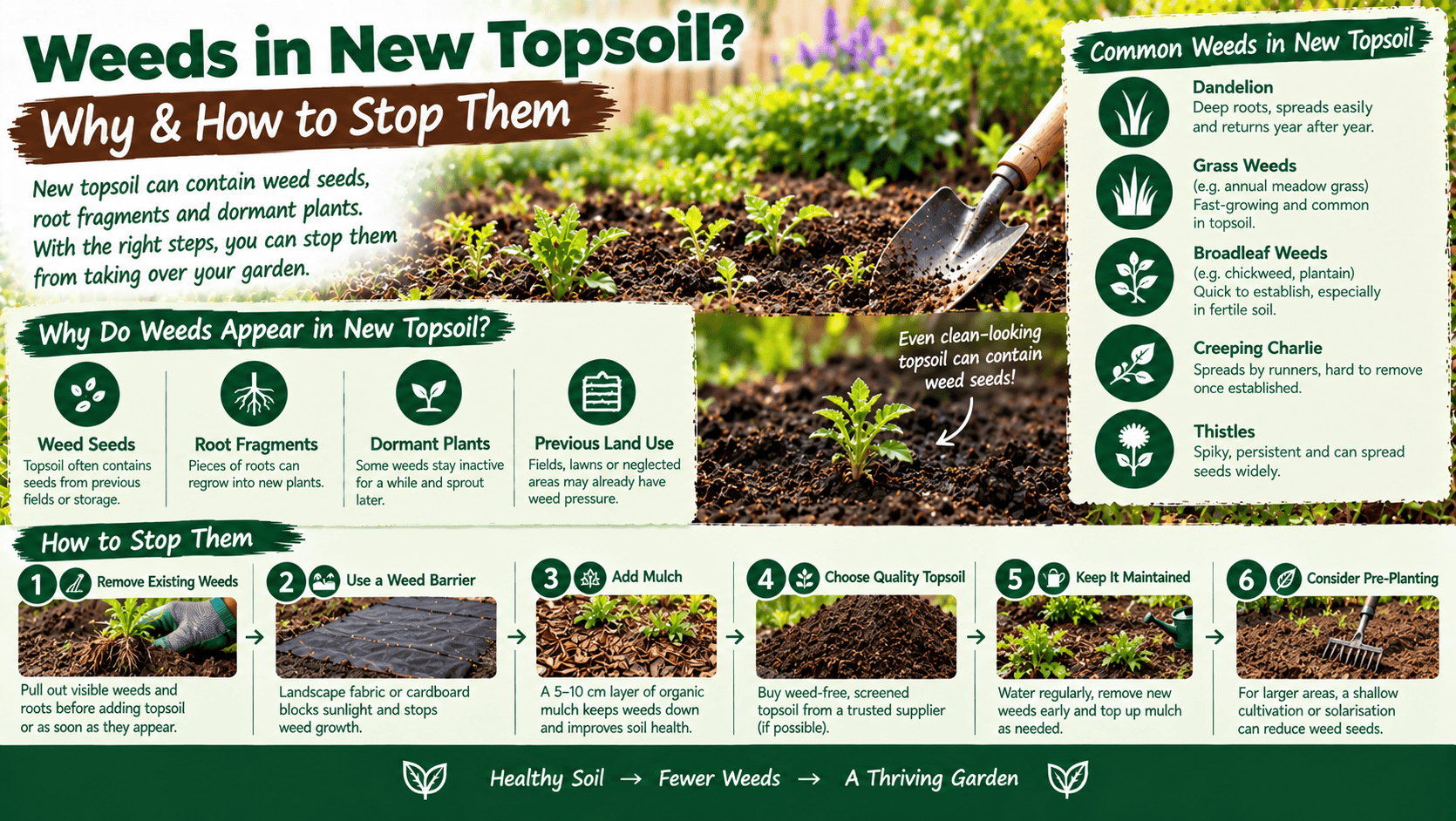
Weeds Growing in New Topsoil? Why It Happens and How to Stop Them
You've finally finished that garden project. The old ground has been cleared, fresh topsoil has been delivered, and everything looks ready for planting.
Then, a couple of weeks later, you notice little green shoots appearing across the surface.
You pull a few out. More appear.
Naturally, you start wondering: Why are weeds growing in my new topsoil? Was there something wrong with the soil?
It's a frustrating situation, especially when you've spent money preparing a new lawn, flower border or vegetable bed.
But weeds appearing after a topsoil delivery don't necessarily mean the soil was poor quality. Seeds may already have been present in the material, remained in the ground underneath or arrived from nearby gardens after the soil was spread.
The good news is that most early weed problems can be managed without starting the entire project again.
Here's how to work out where the weeds came from, remove them properly and reduce the chances of another flush of growth.
Why Are Weeds Growing in My New Topsoil?
Weeds can grow in new topsoil because dormant seeds are present in the soil, existing weeds survive underneath, or new seeds arrive through wind, birds and surrounding vegetation.
Once topsoil is spread, the combination of light, moisture and suitable temperatures can encourage seeds to germinate.
That means a newly prepared garden can suddenly become covered in tiny seedlings even when the surface looked completely clean on delivery day.
There are several possible causes.
| Possible cause | What you might notice | What to do |
|---|---|---|
| Dormant weed seeds | Many small seedlings appearing together | Remove while young |
| Existing weeds underneath | Shoots repeatedly returning from the same places | Investigate and remove roots |
| Windblown seeds | Scattered new weeds appearing over time | Maintain regular control |
| Weed roots in imported soil | Persistent regrowth from fragments | Identify and remove carefully |
| Bare, exposed soil | Repeated flushes of seedlings | Mulch or establish planting |
The important thing is identifying whether you're dealing with new seedlings or established perennial weeds.
The treatment can be quite different.
Does New Topsoil Normally Contain Weed Seeds?
It can.
Topsoil is a natural material, and soil can contain a seed bank: seeds that remain dormant until conditions favour germination.
Even carefully handled topsoil cannot automatically be assumed to contain zero viable weed seeds.
Screening can remove larger stones, roots and debris, but ordinary screening doesn't necessarily remove tiny seeds.
This is an important distinction when comparing suppliers.
A product described as screened topsoil is not automatically sterilised topsoil.
Likewise, the phrase premium topsoil should not be treated as a guarantee that no weeds will ever appear.
If weed content is particularly important for your project, ask the supplier about the material's source, specification and any relevant quality testing.
How Quickly Can Weeds Appear After Laying Topsoil?
Under suitable growing conditions, some weed seeds can germinate within days or weeks.
Others may remain dormant for much longer.
The timing depends on:
Weed species.
Soil temperature.
Moisture.
Light.
Seed dormancy.
Seasonal conditions.
In Glasgow and western Scotland, moist conditions during the growing season can create favourable conditions for weed germination.
You might spread topsoil in spring, see very little growth initially and then notice a flush of seedlings after a spell of warmer weather.
That doesn't prove where the seeds originated.
It simply means conditions have become suitable for germination.
How Can You Tell Whether the Weeds Came From the New Topsoil?
It's tempting to blame the latest delivery, but appearances alone aren't enough.
Consider when and where the weeds appeared.
If seedlings appear evenly across the entire new surface, the imported material may be one possible source.
If strong shoots repeatedly emerge from particular spots, surviving roots or underground stems in the original ground may be responsible.
If weeds appear gradually alongside surrounding vegetation, windblown or locally dispersed seeds may be contributing.
These are clues, not definitive tests.
For a serious concern, keep photographs, delivery details and any supplier documentation before disturbing the site extensively.
What's the Difference Between Annual and Perennial Weeds?
This is one of the most useful things to understand before picking up a hoe.
Annual weeds
Annual weeds complete their life cycle within a growing season.
They generally reproduce through seed.
When caught young, many are relatively easy to remove.
Examples include:
Groundsel.
Chickweed.
Hairy bittercress.
Annual meadow grass.
The key is to remove them before they flower and produce more seeds.
Perennial weeds
Perennial weeds survive for multiple years.
Some spread through extensive underground roots or stems.
Examples include:
Couch grass.
Bindweed.
Ground elder.
Docks.
Creeping thistle.
These can be much more persistent.
Simply cutting off the leaves may not prevent regrowth.
Removing as much of the underground system as practical is often necessary, sometimes over repeated attempts.
How Do You Remove Weeds From New Topsoil?
Start with the simplest effective method.
Step 1: Identify the weeds
Look at the size, growth pattern and whether the plants are returning from the same location.
A carpet of tiny seedlings is usually easier to deal with than established perennial roots.
Step 2: Remove young weeds early
For small annual weeds, gentle hoeing or hand removal is often enough.
Work carefully around desirable seedlings and young plants.
Step 3: Remove persistent roots
If you find couch grass, bindweed or other spreading perennials, investigate the root system rather than repeatedly pulling off the visible leaves.
Step 4: Avoid unnecessary deep disturbance
Repeatedly turning over soil can expose additional buried seeds to conditions that encourage germination.
Step 5: Protect the cleared surface
Once the weeds are removed, establish your intended planting or apply a suitable mulch.
Leaving the ground bare for long periods gives further weed seeds opportunities to establish.
Can You Kill Weeds Without Chemicals?
Yes. Many garden weeds can be controlled using non-chemical methods.
The most useful approaches include:
Hand weeding.
Hoeing.
Repeated removal of regrowth.
Smothering with appropriate coverings.
Mulching.
Maintaining established plant cover.
The best method depends on the weeds and the area.
For example, hoeing is useful for small annual seedlings in open soil, but it may spread certain perennial weeds if underground stems are chopped into pieces and left behind.
For persistent infestations, identification comes first.
Should You Remove Weeds Before Adding New Topsoil?
Yes, especially established perennial weeds.
One of the most common mistakes is spreading new topsoil directly over an area containing couch grass, bindweed or other persistent weeds.
The fresh material may hide the problem temporarily.
But surviving underground growth can eventually reach the surface again.
Before adding topsoil:
Identify existing weeds.
Remove persistent roots where practical.
Check for remaining underground growth.
Address compaction or drainage problems.
Prepare the original soil appropriately.
Add the required topsoil.
Establish planting or protective ground cover.
For a new garden, doing this preparation properly is usually easier than trying to remove established weeds after planting.
Will 10cm of Topsoil Stop Weeds Growing Through?
Not reliably.
A 10cm layer may suppress some small seedlings by blocking light, but persistent perennial weeds can grow through substantial amounts of material.
Some species store energy in underground structures and can push new shoots towards the surface.
Increasing topsoil depth solely to bury weeds is usually not a sensible solution.
You may end up buying more soil without eliminating the original problem.
If your garden needs 10cm of additional topsoil for growing purposes, calculate that quantity based on the project—not as a substitute for weed control.
Can You Put Topsoil Over Grass and Weeds?
You can physically cover existing vegetation, but whether it is appropriate depends on your project and preparation method.
For conventional lawn or border preparation, existing vegetation normally needs to be dealt with before the final soil surface is established.
For a deliberately planned no-dig bed, cardboard and organic mulch may be used to suppress some vegetation.
However, persistent perennial weeds can still require separate attention.
Don't assume a thin layer of new topsoil will permanently kill everything underneath.
How Do You Stop Weeds Growing in Flower Beds?
Once your flower bed is planted, prevention becomes just as important as removal.
A practical approach is to:
Remove existing perennial weeds before planting.
Keep annual weeds from setting seed.
Apply a suitable mulch.
Avoid unnecessary disturbance.
Maintain appropriate plant spacing.
Check the bed regularly.
For established borders, organic mulch can reduce light reaching the soil surface, making it harder for some weed seeds to establish.
However, mulch is not a complete barrier against all weeds.
Seeds can also land and germinate within the mulch itself.
Is Compost or Woodchip Better for Weed Control?
They have different strengths.
Mature compost
Compost is primarily used to improve soil by adding organic matter.
It may also be applied as a surface mulch in suitable planting areas.
However, its finer texture means it shouldn't automatically be expected to suppress weeds in the same way as a coarse mulch.
Woodchip
Woodchip is commonly used as a surface mulch around established shrubs, trees and certain garden borders.
An appropriate layer can reduce light at the soil surface and help limit weed establishment.
It also helps conserve moisture and gradually decomposes.
For many established ornamental beds, woodchip can be a practical weed-management material.
Avoid piling it directly against plant stems or tree trunks.
Which should you choose?
| Your goal | Material to consider |
|---|---|
| Add organic matter to garden soil | Mature compost |
| Suppress weeds around established shrubs | Woodchip mulch |
| Increase soil depth | Topsoil |
| Improve a vegetable bed | Suitable compost or other organic matter |
| Cover paths | Appropriate woodchip |
| Control established bindweed | Root management, not mulch alone |
How Deep Should Woodchip Mulch Be to Reduce Weeds?
For many established garden borders, a layer around 5–8cm can be a practical starting range.
The ideal depth depends on the material, plants and site conditions.
Too little may provide limited weed suppression.
Too much can create problems around vulnerable plants, especially if mulch accumulates against stems or trunks.
Always leave the base of plants clear.
And remember: mulch reduces weed pressure. It doesn't guarantee a permanently weed-free garden.
Can You Stop Weeds Growing in a Vegetable Garden?
Yes, although regular management is usually necessary.
Vegetable beds present a particular challenge because you may be deliberately sowing seeds into bare soil.
That same exposed soil can also allow weed seeds to germinate.
Useful strategies include:
Remove weeds before sowing
Clear existing growth, especially perennial weeds.
Prepare the seedbed in advance
Where practical, allow an initial flush of weeds to germinate, then remove them shallowly before sowing your crop.
This is often called a stale seedbed technique.
Weed while seedlings are small
Young annual weeds are generally easier to remove than mature plants.
Mulch between established crops
Use a suitable material without burying young seedlings.
Avoid letting weeds produce seed
A small weed today can contribute to future problems if it is allowed to mature and set seed.
What Is a Stale Seedbed?
A stale seedbed is a useful method for reducing early weed competition before planting.
Here's how it works:
Prepare the soil as though you're ready to sow.
Leave it undisturbed for a suitable period.
Allow weed seeds near the surface to germinate.
Remove the small weeds with minimal soil disturbance.
Sow your intended crop.
The idea is to encourage some of the weed seed bank to germinate before your vegetables are planted.
It's particularly useful where you want to avoid heavy disturbance or chemical weed control.
The method won't remove every seed or perennial root, but it can reduce the first wave of competition.
Can You Use Weed Membrane Under Topsoil?
Be cautious.
Weed-control membranes have particular uses, but placing a permanent impermeable or restrictive barrier beneath a growing layer can create problems for roots, soil life and water movement.
For beds where plants need to root into the underlying soil, a permanent membrane may be unsuitable.
Landscape fabric can also accumulate soil and organic matter on top, allowing weeds to establish above it.
For permanent planting areas, good preparation, appropriate mulch and ongoing maintenance may be preferable.
Choose the method based on the site rather than automatically installing fabric under every new bed.
How Do You Prevent Weeds in a New Lawn?
The approach differs slightly from a flower bed.
If you're preparing a lawn from seed:
Remove established weeds before sowing.
Prepare suitable topsoil.
Create an even seedbed.
Avoid unnecessary disturbance after preparation.
Sow at an appropriate time.
Maintain suitable moisture for grass establishment.
Control emerging weeds appropriately as the lawn develops.
Don't apply thick woodchip mulch to a lawn seedbed.
And avoid treating newly seeded grass with products that may damage young plants.
For established lawns, healthy grass coverage can help reduce opportunities for some weeds to establish.
Are Weeds More Common in Cheap Topsoil?
Not necessarily.
Price alone cannot tell you how many weed seeds a soil contains.
However, material with an unknown source, extensive roots or poorly controlled handling may present additional risks.
Before buying topsoil, ask:
Where does the soil come from?
Is it screened?
Is it intended for planting?
What quality information is available?
Does it contain visible roots or weeds?
Can I inspect a sample?
Is a relevant soil analysis available?
A supplier who can clearly explain the material is more useful than one who relies entirely on vague descriptions such as premium or high quality.
Does Screened Topsoil Have Fewer Weeds?
Screening can remove larger roots and plant fragments, depending on the screen size and process.
But tiny weed seeds may still pass through.
Therefore, screening alone isn't proof that soil is weed-free.
This matters when comparing topsoil grades.
A screened product may be easier to spread and level, but its suitability should still be assessed using source, specification and intended use.
Is Weed-Free Topsoil Available?
Some products are marketed as weed-free or low-weed.
If this is important to you, ask what the claim means and what evidence supports it.
Natural soil exposed outdoors can also receive new weed seeds after delivery.
Even material with very low initial weed content cannot prevent seeds blowing into your garden later.
A realistic goal is to minimise weed introduction and manage new growth promptly.
What If Weeds Appear Immediately After Topsoil Delivery?
First, take photographs.
Record:
Delivery date.
When the weeds appeared.
Whether they are seedlings or established plants.
Where they are growing.
Whether similar weeds were present before delivery.
If you suspect the material contains substantial unwanted roots or vegetation, contact the supplier with the details.
Avoid immediately concluding that all new weeds originated in the delivery.
A clear record helps establish what happened and makes any discussion more constructive.
What If the Weeds Keep Coming Back?
Repeated regrowth often suggests that you need to look below the surface.
If the same plant repeatedly appears in the same place, check for underground roots or stems.
Removing only the leaves may not be enough.
Persistent weeds can require repeated control over time.
Be particularly careful with unidentified invasive plants.
For example, suspected Japanese knotweed should be correctly identified and managed with appropriate specialist guidance rather than casually dug up or moved around the garden.
How to Prevent Weeds After Topsoil Delivery: A Practical Checklist
Before delivery:
Clear persistent weeds from the original ground.
Check the soil beneath for roots and underground stems.
Confirm the topsoil's intended use and quality information.
Prepare drainage and ground levels.
After delivery:
Spread the soil appropriately.
Remove visible unwanted roots or debris.
Avoid unnecessary repeated digging.
Watch for early weed germination.
Remove young annual weeds promptly.
Establish planting or appropriate mulch.
Continue regular checks.
Weed Prevention in Glasgow and Scottish Gardens
For gardeners across Glasgow, East Kilbride, South Lanarkshire and surrounding areas, timing matters.
Wet weather can delay soil preparation, while warmer periods encourage both desirable plants and weeds to grow.
If the soil is saturated, avoid heavy cultivation simply because weeds have appeared.
Working very wet soil can damage its structure, particularly where clay content is high.
Instead, wait for suitable conditions, remove weeds carefully and establish your intended planting as soon as practical.
A well-prepared garden is easier to maintain than one where weed control is left until the plants have become established.
Frequently Asked Questions
Why are weeds growing in my new topsoil?
Weeds may grow because dormant seeds were already present, existing roots survived underneath or new seeds arrived after the soil was laid.
Does topsoil contain weed seeds?
It can. Natural soil may contain dormant weed seeds even when no weeds are visible.
Does screened topsoil contain weed seeds?
It may. Screening can remove larger debris and roots but doesn't necessarily remove small seeds.
How do I stop weeds growing in topsoil?
Remove existing perennial weeds, control young seedlings promptly, minimise unnecessary disturbance and establish suitable planting or mulch.
Will covering weeds with topsoil kill them?
Not reliably. Some perennial weeds can regrow through additional soil.
Is 10cm of topsoil enough to stop weeds?
No fixed depth guarantees weed suppression. Persistent roots can grow through substantial soil layers.
Can I put topsoil over weeds?
It's usually better to address established weeds before adding new soil, particularly when preparing conventional garden beds or lawns.
Does compost stop weeds?
Mature compost can be used as a soil improver and sometimes as a surface mulch, but it isn't a guaranteed weed barrier.
Does woodchip prevent weeds?
An appropriate woodchip layer can reduce weed germination and growth, although some weeds may still appear.
Can weeds grow through landscape fabric?
Some persistent weeds may grow through openings or damaged areas, and new weeds can establish in material that accumulates on top.
Should I remove weeds before laying turf?
Yes. Proper preparation should include dealing with existing weeds before the new lawn is established.
Can new topsoil introduce invasive weeds?
It can be a possible route for unwanted plants or plant fragments. Source checks and inspection help reduce the risk.
Are weeds a sign of poor-quality topsoil?
Not necessarily. Weed growth alone doesn't establish whether topsoil meets an appropriate quality specification.
What should I do if my delivered topsoil contains roots?
Document the issue, inspect the material and contact the supplier if you have concerns about its suitability.
Can I make my garden completely weed-free?
Permanent zero-weed conditions are difficult to guarantee outdoors. Prevention and early control are more realistic goals.
Final Thoughts: A Few Weeds Don't Mean Your Garden Project Has Failed
Finding weeds in newly laid topsoil is annoying, especially after you've spent time and money preparing your garden.
But the appearance of a few seedlings doesn't automatically mean the soil is unusable.
The important questions are where the weeds came from and what type of growth you're dealing with.
Small annual weeds can often be managed quickly.
Persistent perennial weeds need more careful attention to their underground roots.
And prevention—through good preparation, early removal and suitable mulch—can make a substantial difference over time.
The best time to deal with weeds is before they become established.
Preparing a New Garden in Glasgow?
If you're creating a new lawn, flower border or vegetable bed, choosing the right soil and preparing the ground properly can save a great deal of work later.
Kelvin Compost supplies garden materials for projects across Glasgow, East Kilbride, South Lanarkshire and surrounding areas.
Explore:
Call: +44 7561 251350
Email: info@kelvincompost.co.uk
Need Garden Supplies Delivered in Glasgow?
Organic compost, topsoil, manure and more across Scotland