




Taking On an Allotment in Glasgow | First-Year Guide
Looking for compost, topsoil or garden supplies?
Browse our full product range or get in touch for delivery across Glasgow and Scotland.
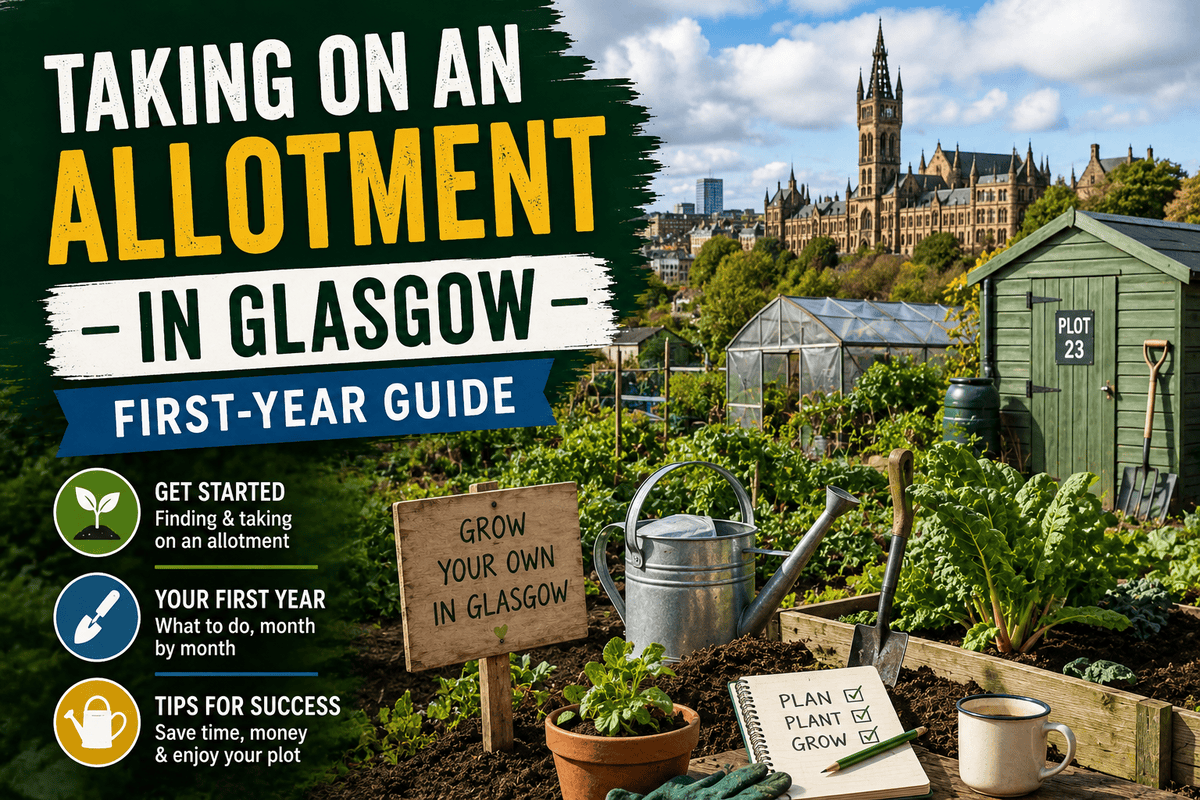
Short answer: a standard Scottish allotment is 250m², Glasgow has around 34 designated growing spaces, and as of June 2024 there were 1,823 people waiting for 1,623 plots. When your name comes up, don't try to cultivate the whole thing at once — clear and improve a third of it properly in year one, cover the rest, and expand as you go.
Most first-year allotment failures come from the same mistake: taking on 250m² of couch grass with a fork and a fortnight's enthusiasm. This guide covers how the system works in Glasgow, what you're entitled to under Scottish law, and a first year that's actually achievable alongside a job.
Getting a plot in Glasgow
The waiting list, honestly
Glasgow has roughly 34 designated growing spaces. A submission to the Scottish Parliament from the Glasgow Allotments Forum in July 2024 recorded 1,823 people on the waiting list for 1,623 plots.
That ratio is worth understanding, because it's not just a long queue — it exceeds what the law allows.
What Scottish law actually entitles you to
Part 9 of the Community Empowerment (Scotland) Act 2015 placed real duties on councils, and most allotment holders have never been told about them.
Under Section 112, a local authority must take reasonable steps to:
- Keep the waiting list at no more than half the number of allotments it has. For Glasgow's 1,623 plots that implies a cap of about 812 people. The recorded list of 1,823 is roughly 2.25 times that limit.
- Ensure nobody stays on the waiting list for more than five continuous years. Note the timing: this five-year element takes effect eight years after a council makes its first regulations under Section 115, so it is not yet fully in force everywhere. It is still the direction of travel.
Guidance also says allotments should be reasonably close to home — within about three miles or a 20-minute public transport journey — and that councils should offer a plot matching the size you requested, or the nearest available alternative.
What to do with that. Get on the list now, even if you're not ready — the wait is the constraint, not your readiness. You can apply as an individual or as a group, and you do not have to apply to the site nearest you, so putting your name down at several sites is sensible. The Glasgow Allotments Forum and Glasgow City Council both handle enquiries; contact details change, so check the Council's current allotments page rather than an old phone number.
Plot sizes in Glasgow
| Type | Size |
|---|---|
| Full plot | 125–250 m² |
| Half plot | 50–125 m² |
| Micro plot / raised beds | Under 50 m² |
The traditional "standard" Scottish allotment is 250m² — often described as a 10-rod plot. If you have any choice, take a half plot first. A well-run half plot produces more food than a neglected full one, and you can usually move up later. Nobody has ever regretted starting smaller.
Your first visit: assess before you touch anything
Spend an hour on the plot with a notebook before you spend a day on it with a spade.
Which way does it face? Note where the sun falls at midday. In Glasgow's latitude, the difference between a south-facing plot and one shaded by a hedge or a shed is substantial, especially in early and late season.
Where does the water sit? Come back after heavy rain. Standing water tells you which corner is heavy clay and which is free-draining. Much of the Central Belt sits on clay, so expect at least one soggy end.
What's actually growing? The weeds are a soil report. Docks, buttercup and rushes indicate wet, compacted ground. Nettles indicate high fertility — genuinely good news under the mess. Couch grass, bindweed, ground elder and mare's tail tell you clearing will be a campaign rather than an afternoon.
What's already there? Fruit bushes, rhubarb crowns and asparagus are worth keeping and are easy to destroy by accident. Old carpet, asbestos sheeting and buried glass are common on long-neglected plots — check before you dig, and ask your site secretary how the site disposes of hazardous material.
Where's the water tap, and what are the site rules? Hosepipe restrictions, shed and structure rules, bonfire policy, cultivation requirements and how much of the plot you're expected to have in use by when — these are in your tenancy agreement, and they're enforced.
Clearing: the one-third rule
This is the single most useful piece of advice in this guide.
Divide the plot in three. Take on one third properly. Cover the other two thirds.
Clear, improve and plant a third of the plot to a standard you'd be proud of. Cover the remaining two thirds with cardboard, black polythene or old tarpaulin, weighted down. Covered ground gets weaker every month it stays dark — you are still making progress on it while doing nothing. In year two you uncover the second third, by which point most of the annual weeds are gone and the perennials are much reduced.
Compare that with the alternative, which is what most people do: strip everything, run out of steam in June, and watch the whole plot return to couch grass by August with a warning letter arriving in September.
On perennial weeds: covering is the low-effort route, but be realistic about timescales. Couch grass, bindweed, ground elder and mare's tail need a full growing season under black polythene — not woven membrane, which lets light through. Brambles and dock crowns need physically removing; that is the one job where a spade is unavoidable.
Building the beds
Once your first third is clear, the question is what to put on it.
Beds and paths, not open ground. Mark out permanent beds about 1.2m wide — narrow enough to reach the middle from either side, so you never stand on the growing area. Compacting your own soil by walking on it is the commonest self-inflicted wound on an allotment.
Woodchip the paths. This is the cheapest, highest-return thing you can buy for a Scottish allotment. Paths of bare soil become mud from October to April, at which point you stop visiting, and a plot you don't visit is a plot you lose. Woodchip at 7.5–10cm keeps paths usable year-round and suppresses weeds. About 40m of path at 0.6m wide needs roughly 1.8m³ — two 850L bags.
Improve the soil by mulching, not digging. Spreading compost on the surface and letting worms and winter do the incorporating is less work and better for soil structure than turning it over — and on wet Central Belt clay, digging in the wrong conditions does real damage. Our no-dig guide for Scotland covers the method properly.
Rough quantities
| Job | Volume | In 850L bags |
|---|---|---|
| Half plot (125m²) mulched at 5cm | 6.25 m³ | ≈7 bags |
| Full plot (250m²) mulched at 5cm | 12.5 m³ | ≈15 bags |
| Half plot converted to no-dig at 10cm | 12.5 m³ | ≈15 bags |
| Full plot converted to no-dig at 10cm | 25 m³ | ≈29 bags, or a 20-tonne load |
| 40m of woodchip path at 7.5cm | 1.8 m³ | ≈2 bags |
Note how those numbers reward the one-third rule: improving a third of a full plot properly needs around five bags, not fifteen. For exact figures for your own plot, see our guide to working out how much compost you need.
A note for allotment associations: if several plot holders order together, a 10 or 20 tonne loose load delivered to the site works out dramatically cheaper per cubic metre than individual bags. It's worth raising at a site meeting — most associations that do this never go back.
What to grow in year one
Grow things that are hard to fail at and expensive to buy. Save the fiddly crops for when you know your plot.
Reliable in the Scottish climate:
- Potatoes — the traditional first-year crop for good reason; they break up rough ground and give a real harvest
- Kale and other brassicas — genuinely happy in a Scottish winter, and productive for months
- Leeks — slow but nearly foolproof, and they sit in the ground until you want them
- Broad beans — tough, early, and autumn-sowable
- Courgettes — one or two plants will overwhelm you
- Rhubarb — plant once, harvest for twenty years
- Soft fruit — blackcurrants, gooseberries and raspberries do particularly well in Scotland
Leave until year two: sweetcorn, outdoor tomatoes, aubergines and anything needing reliable heat. Carrots and parsnips are worth waiting for too, until you've got the stone and clay out of a bed.
Buy transplants rather than sowing everything from seed in your first season. It costs a bit more and removes the largest single source of first-year disappointment.
A realistic first year, month by month
Autumn (Sept–Nov) — Take on the plot if you can; autumn starts are the best. Assess it. Cut everything down. Cover two thirds. Clear the first third, mark out beds, woodchip the paths, and mulch the beds with compost. Plant garlic and autumn broad beans if you have the energy. Stop there.
Winter (Dec–Feb) — Very little. Order compost and seeds. Repair the shed. Visit occasionally to pull anything green pushing through the covered areas — it's easy now and hard in June.
Early spring (Mar–Apr) — First plantings: potatoes, onion sets, broad beans. Your mulched beds will be workable earlier than your neighbours' dug ones.
Late spring (May–Jun) — Main planting. Brassica and leek transplants, courgettes after the frost risk passes — usually late May in Glasgow, later in higher spots like East Kilbride. Expect slugs; protect young plants.
Summer (Jul–Aug) — Water, weed, harvest. Fifteen minutes of weeding twice a week beats three hours once a month. Uncover the second third and see how it's doing.
Following autumn — Top up beds with 2.5–5cm of compost. Expand into the second third. Repeat.
Frequently asked questions
How long is the waiting list for an allotment in Glasgow? As of June 2024, a Glasgow Allotments Forum submission recorded 1,823 people waiting for 1,623 plots across around 34 designated growing spaces. Waits vary considerably by site, so applying to several sites improves your chances.
How big is a standard allotment in Scotland? The traditional standard plot is 250m². In Glasgow, full plots range from 125–250m², half plots from 50–125m², and micro plots or raised beds are under 50m².
What are my rights under the Community Empowerment (Scotland) Act 2015? Section 112 requires councils to take reasonable steps to keep their waiting list at no more than half the number of allotments they provide, and to prevent anyone remaining on the list for more than five continuous years — the latter taking effect eight years after a council's first regulations under Section 115. Guidance also says a plot should be within about three miles or a 20-minute public transport journey of home.
Should I take a full plot or a half plot? Take a half plot if you have the choice. A well-managed half plot produces more food than a neglected full one, and you can usually move up later once you know how much time you really have.
How do I clear an overgrown allotment? Divide it in three. Clear and plant one third properly, and cover the other two thirds with cardboard or black polythene weighted down. Covered ground weakens continuously while you focus your effort where it counts. Perennial weeds like couch grass and bindweed need a full season under black polythene.
How much compost do I need for an allotment plot? A 125m² half plot mulched at 5cm needs about 6.25m³, roughly seven 850L bulk bags. A full 250m² plot at the same depth needs about 12.5m³, roughly 15 bags. Converting a full plot to no-dig at 10cm needs around 25m³, which is a 20-tonne loose load.
What should I grow in my first year on a Scottish allotment? Potatoes, kale and other brassicas, leeks, broad beans, courgettes, rhubarb and soft fruit are all reliable in the Scottish climate. Leave sweetcorn, outdoor tomatoes and aubergines until you know your plot. Buy transplants rather than sowing everything from seed.
When is the best time to take on a new allotment? Autumn. The ground is soft, beds are clearing, and you can cover ground and mulch beds over winter so they're ready to plant in spring — instead of trying to clear and plant simultaneously in April.
Can an allotment association order compost together? Yes, and it is much cheaper. A 10 or 20 tonne loose load delivered to a site costs dramatically less per cubic metre than individual bulk bags. We deliver loose loads to allotment sites, schools and community gardens across Glasgow and Lanarkshire.
Getting your plot supplied
Whether you need two bags for a half plot's paths or a 20-tonne load for a whole site, we can work out quantities with you.
Browse our products · call 07561 251350 · email info@kelvincompost.co.uk
We supply PAS 100 organic compost, well-rotted manure, topsoil and woodchip across Glasgow, East Kilbride, South Lanarkshire and the Central Belt — 850L bulk bags or 10 and 20 tonne loose loads, with HIAB delivery for tight allotment access and depot uplift from Chapelton. Use code INTERNET for 5% off 850L sacks.
Kelvin Compost is the trading arm of ASAP (After School Activities Programme) — proceeds support local community projects, including work with schools and community gardens across the city.
Need Garden Supplies Delivered in Glasgow?
Organic compost, topsoil, manure and more across Scotland