




Should You Add Compost in Autumn? | Scotland Garden Guide
Looking for compost, topsoil or garden supplies?
Browse our full product range or get in touch for delivery across Glasgow and Scotland.
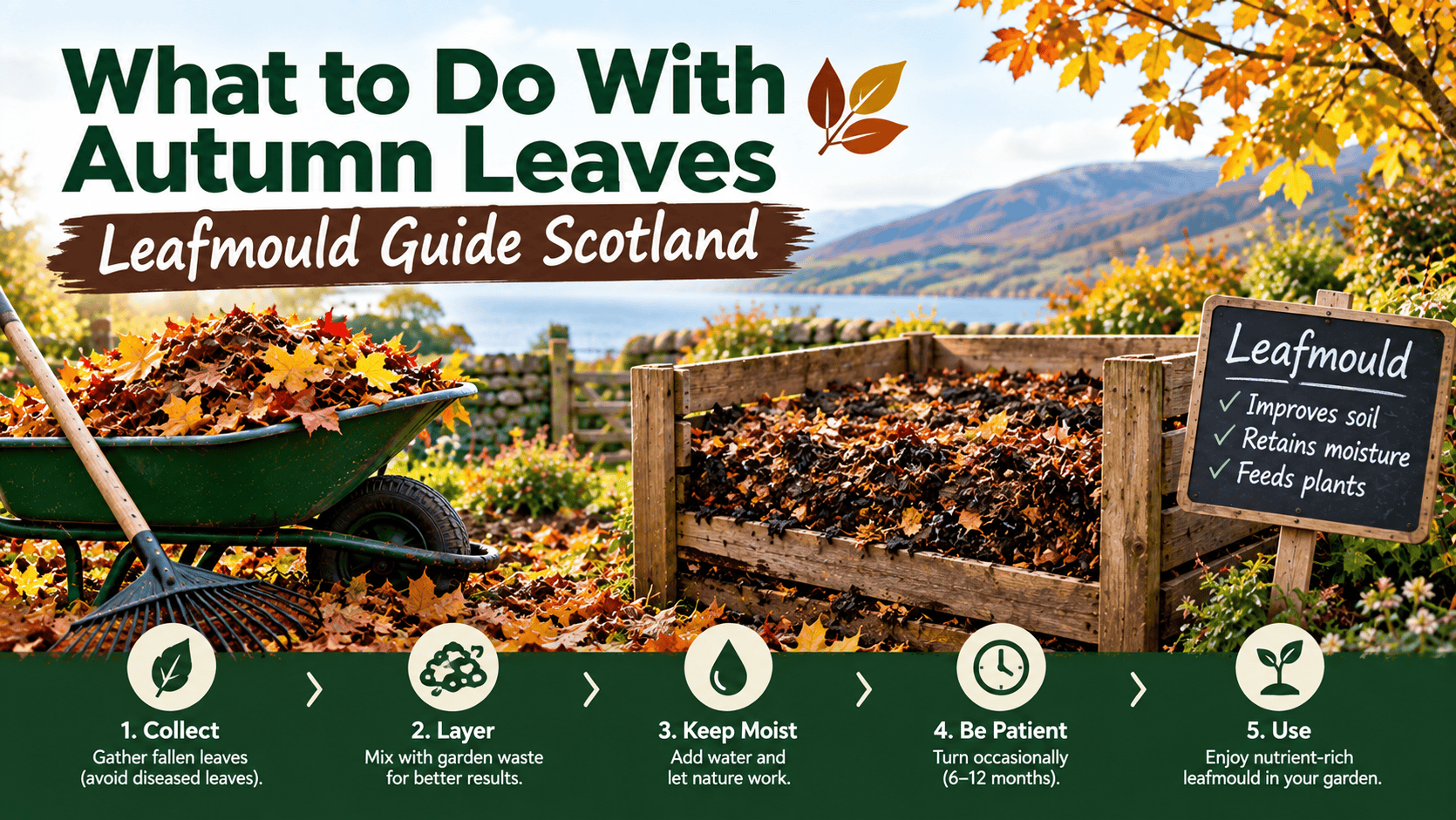
Should You Add Compost in Autumn? When, Where & How to Use It
Autumn is when many gardeners start clearing vegetable beds, cutting back plants and preparing the garden for winter.
That raises an obvious question:
Should you spread compost now, or wait until spring?
The answer depends on your soil, what you're growing and how you intend to use the compost.
For many established beds and borders, autumn can be a useful time to add well-rotted compost as organic matter or surface cover. But that doesn't mean every garden needs a thick layer of compost in September or October.
Sometimes it's better to wait.
And in many situations, you don't need to dig the compost in at all.
This guide explains when to add compost in autumn, when to leave it until later, how much you need and whether compost should be dug into the soil or left on top.
Quick Answer: Can You Put Compost on the Garden in Autumn?
Yes.
Well-rotted garden compost can be applied in autumn to suitable beds, borders and vegetable-growing areas.
However:
Don't spread compost onto waterlogged or frozen ground.
Sandy soils can lose nutrients more readily through winter rainfall.
Don't assume every part of the garden needs compost every year.
Established plants often don't need their roots disturbed by digging.
Compost can frequently be applied as a surface mulch instead.
Nutrient-rich materials should be used carefully before a wet winter.
For many gardens, the choice is between:
Autumn application → leave on surface
and
Wait until late winter/early spring → apply closer to active growth.
Why Add Compost to Garden Soil?
Compost is primarily a soil improver.
Good mature compost adds decomposed organic matter to existing soil.
Over time, organic matter can help improve:
Soil structure
Moisture management
Workability
Biological activity
Nutrient retention
Growing conditions for roots
It is useful for both heavy and light soils, although the reason for using it differs.
Heavy soil often benefits from improved structure.
Light soil can benefit from greater moisture and nutrient retention.
The important point is that compost isn't simply plant food.
Its value is also in what it does to the soil itself.
Is Autumn a Good Time to Add Compost?
It can be.
Autumn offers several practical advantages.
Beds are often becoming empty.
Annual plants are being removed.
Vegetable crops are finishing.
The soil is accessible.
Gardeners also tend to have more time to improve beds before the following growing season.
But timing matters.
Autumn in Scotland can quickly become:
Wet
Cold
Waterlogged
Once soil becomes saturated, avoid unnecessary cultivation.
Working very wet soil can damage its structure, particularly on clay ground.
So think in terms of soil condition, not simply calendar date.
A dry October day can be perfectly suitable.
A saturated October bed may be better left alone.
Should You Dig Compost Into the Soil?
Not necessarily.
This is one of the biggest misconceptions around compost.
You don't always need to:
spread → dig → turn → rotavate.
Soil organisms can gradually incorporate organic material from the surface.
For established beds and borders, surface application also avoids disturbing:
Plant roots
Soil structure
Earthworms
Fungal networks
This is one of the principles behind no-dig gardening.
Apply suitable mature compost over the surface and allow natural biological processes to work it into the soil.
When Should You Dig Compost In?
There are situations where incorporation can still be useful.
For example:
Creating a completely new bed
Improving severely compacted ground
Preparing poor soil before initial planting
Mixing organic matter through newly imported topsoil
Major garden renovation
Establishing a new vegetable-growing area
Even then, excessive cultivation isn't necessary.
The aim is to improve the soil — not pulverise it.
Should You Dig Around Established Plants?
Usually, avoid substantial digging around established trees, shrubs and perennials.
Digging can damage their roots.
Instead, apply suitable organic material to the surface.
Keep compost and mulch away from direct contact with woody stems and tree trunks.
A useful principle is:
New empty bed → incorporation may be appropriate.
Established planted bed → surface application is usually safer.
Compost on Top or Dug In?
Here's a simple guide.
| Situation | Surface | Dig in |
|---|---|---|
| Established flower border | ✓ | Usually unnecessary |
| Around shrubs | ✓ | Avoid root disturbance |
| Around trees | ✓ | Avoid root disturbance |
| No-dig vegetable bed | ✓ | No |
| Empty vegetable bed | ✓ | Optional |
| New planting bed | ✓ | Sometimes |
| Severely compacted new ground | Maybe | ✓ |
| Raised-bed top-up | ✓ | Light mixing optional |
| Existing productive soil | ✓ | Usually unnecessary |
There isn't one method that applies to every garden.
Can You Add Compost to Vegetable Beds in Autumn?
Yes, but think about what you're growing next.
If you've cleared a vegetable bed, mature compost can be applied as organic matter.
For a no-dig system, it can simply be spread over the surface.
However, don't automatically apply large quantities of nutrient-rich material simply because the bed is empty.
Ask:
What is going here next year?
Different crops have different fertility requirements.
What About Carrots and Parsnips?
Root crops are a good example of why planning matters.
Carrots and parsnips generally don't need freshly manured ground.
Excessively rich or recently manured soil can contribute to forked or distorted roots.
If you're planning a root-crop bed, don't treat it the same way as a bed intended for:
Courgettes
Pumpkins
Brassicas
Sweetcorn
Plan your crop rotation before spreading manure everywhere.
Mature compost and manure aren't identical materials either.
Use each according to the job.
Compost vs Manure in Autumn
These are often confused.
Organic compost
Primarily useful for adding stable organic matter and improving soil.
Suitable applications can include:
Borders
Vegetable beds
Raised beds
General soil improvement
No-dig beds
Mulching
Well-rotted manure
Provides organic matter but is also associated more strongly with fertility.
It can be particularly useful for suitable productive areas and hungry crops.
Kelvin Compost supplies both Organic Compost and Well-Rotted Manure.
The correct choice depends on what you're trying to achieve.
Should You Add Compost to Clay Soil in Autumn?
Autumn can be a useful opportunity to improve workable clay soil with organic matter.
Organic matter helps improve soil structure over time.
But there's an important rule:
Don't work saturated clay.
If the soil sticks heavily to your boots and tools and forms a wet, sticky mass, leave it.
Working wet clay can make structural problems worse.
Wait for conditions to improve.
If the garden remains waterlogged for prolonged periods, adding compost alone isn't necessarily the solution.
You may have a drainage or compaction problem that needs separate attention.
Should You Add Compost to Sandy Soil in Autumn?
This requires more caution.
Sandy soils drain freely.
That means soluble nutrients can be more easily washed through the soil during prolonged winter rainfall.
For light sandy ground, late winter or early spring can be a better time for incorporating organic matter, closer to when plants begin active growth.
If you're unsure whether to spread compost now or wait, soil type should be one of the first things you consider.
What About Scottish Winter Rain?
This is particularly relevant in Scotland.
Winter rainfall can move soluble nutrients through the soil.
That's why more isn't automatically better.
The goal isn't:
Put as much compost and manure down as possible before winter.
The goal is:
Use the right organic material, in the right place, at the right time.
Stable mature compost used as a surface soil improver behaves differently from applying fresh or highly nutrient-rich material.
If nutrient loss is a concern, waiting until later winter or early spring can make sense.
Can You Add Compost in September?
You can, but September can still have relatively warm soil.
Microorganisms remain active while the ground is warm.
If nutrient-rich organic materials break down rapidly before a wet winter, some soluble nutrients can subsequently be lost.
For that reason, don't feel pressured to cover every empty bed as soon as summer ends.
For surface mulching, the late-autumn to winter period can often be more appropriate.
Use September to:
Assess your soil
Clear finished crops
Remove perennial weeds
Measure beds
Decide which beds actually need improvement
Calculate compost requirements
Then apply material at an appropriate time for your soil and intended use.
Can You Add Compost in October?
Yes, depending on soil and weather conditions.
October can be convenient because many beds are empty.
On heavier soils, autumn application can be appropriate.
But again:
don't work waterlogged soil.
If conditions deteriorate, leave the compost on the surface rather than aggressively digging wet ground.
Or simply wait.
Garden soil doesn't care whether the job was completed on the weekend you originally put in the diary.
Can You Add Compost in November?
Yes.
For surface mulching, late autumn into winter is a common period.
At this point plant growth has slowed and beds may be largely dormant.
Apply compost to suitable soil surfaces and allow it to remain there.
You don't necessarily need to dig.
Can You Add Compost During Winter?
Yes, when conditions are suitable.
Avoid spreading or cultivating when the ground is:
Frozen
Snow covered
Saturated
Severely waterlogged
If conditions are reasonable, organic surface mulch can be applied during the dormant season.
For many gardeners, late winter is actually an excellent time because it places organic matter closer to the beginning of spring growth.
Should You Wait Until Spring?
Sometimes, yes.
Waiting can be sensible when:
Your soil is sandy
The garden is waterlogged
You haven't decided what you'll grow
You're using a more nutrient-rich material
You don't currently have time to apply it properly
The bed doesn't actually need additional organic matter
You want nutrients available closer to active plant growth
There's no prize for spreading compost earliest.
Good gardening is about timing the material to the garden.
How Thick Should Compost Be Applied?
This depends on why you're applying it.
For a meaningful organic surface mulch, around 5cm is a useful benchmark for many applications.
That's:
50 litres per square metre.
For lighter soil improvement, smaller quantities may be appropriate depending on the condition of the soil.
Don't blindly apply the same depth every year.
Well-maintained soil may require less frequent additions.
How Much Compost Do I Need?
Use this formula:
Area × depth = volume
Keep the measurements in metres.
Example
A bed measuring:
5m × 2m = 10m²
If applying:
5cm = 0.05m
Then:
10 × 0.05 = 0.5m³
One cubic metre equals 1,000 litres.
So:
0.5m³ = 500 litres
Autumn Compost Calculator
| Garden area | 2.5cm layer | 5cm layer |
|---|---|---|
| 5m² | 125L | 250L |
| 10m² | 250L | 500L |
| 15m² | 375L | 750L |
| 20m² | 500L | 1,000L |
| 25m² | 625L | 1,250L |
| 30m² | 750L | 1,500L |
| 50m² | 1,250L | 2,500L |
| 75m² | 1,875L | 3,750L |
| 100m² | 2,500L | 5,000L |
These are mathematical volumes rather than instructions to apply a particular depth to every garden.
Assess your soil first.
How Far Does an 850-Litre Bulk Bag Go?
Kelvin Compost supplies Organic Compost in approximately 850-litre bulk bags.
Theoretical coverage is:
At 2.5cm
850 ÷ 25 = approximately 34m²
At 5cm
850 ÷ 50 = approximately 17m²
At 7.5cm
Approximately 11.3m²
At 10cm
Approximately 8.5m²
| Depth | Approximate coverage |
|---|---|
| 2.5cm | 34m² |
| 5cm | 17m² |
| 7.5cm | 11.3m² |
| 10cm | 8.5m² |
Actual requirements can vary because garden surfaces aren't perfectly level and materials can settle.
Does Every Garden Need Compost Every Year?
No.
This is important.
More organic matter isn't automatically better.
A productive, well-structured garden soil that has received regular compost applications may not need a heavy application every year.
Look at the soil.
Ask:
Is it difficult to work?
Does it dry extremely quickly?
Is organic matter visibly low?
Has the bed been heavily cropped?
Is the structure poor?
Are you establishing a new growing area?
Apply compost because the soil benefits from it, not simply because autumn has arrived.
What About Raised Beds?
Raised beds often settle over time.
Organic materials decompose and soil levels gradually drop.
Autumn can therefore be a useful time to assess them.
If the soil level has dropped but the bed still contains sufficient actual soil, compost may be useful as a top-up and soil improver.
If a substantial amount of physical volume is missing, however, you may need Topsoil or a suitable topsoil/compost mixture rather than filling the entire missing depth with compost.
Remember:
Topsoil creates soil volume.
Compost improves soil.
Can You Put Compost Around Trees?
Yes, mature compost can be used as an organic surface mulch around suitable established trees.
But don't pile it against the trunk.
Leave space around the base.
The same principle applies to woodchip.
Avoid creating a mound of material against tree bark.
For longer-lasting surface mulching around trees and shrubs, Organic Woodchips may be another option.
Can You Put Compost Around Shrubs?
Yes.
Apply it over the soil around established shrubs rather than digging aggressively through their root systems.
Keep the material away from direct contact with woody stems.
Over time, soil organisms will help incorporate decomposed organic matter into the upper soil layers.
Can You Put Compost Over Weeds?
Don't use compost as an excuse to ignore serious perennial weeds.
Deal with problematic weeds first.
For annual weed seedlings, an effective mulch layer can help suppress new germination by reducing light at the soil surface.
But established perennial weeds may grow straight through.
Examples include persistent plants spreading through roots or rhizomes.
Clear the problem before covering the bed.
Should You Rotavate Compost Into the Garden?
Usually not just for the sake of it.
Rotavators can be useful when establishing or renovating certain areas, but routine cultivation isn't necessary simply because compost has been applied.
Excessive cultivation can:
Disturb soil structure
Damage soil organisms
Cut perennial weed roots into pieces
Disturb established plant roots
For many established gardens:
spread → leave → let the soil work
is enough.
What Is No-Dig Composting?
No-dig gardening uses compost as a surface layer rather than repeatedly turning the soil.
Instead of:
digging compost into the bed
you:
spread compost over the surface and plant into the upper layer.
Earthworms and other soil organisms gradually integrate organic matter.
Kelvin Compost's Organic Compost can be used for suitable soil-improvement and no-dig applications.
If you're starting a new no-dig bed, the quantity required can be substantially greater than a routine annual top-up.
Is Compost the Same as Potting Compost?
No.
This distinction is especially important when buying in bulk.
Bulk organic soil-improving compost is intended for appropriate garden-soil applications.
Specialist potting or seed compost is formulated for plants growing in containers or seedlings.
Don't assume a bulk soil improver should be used by itself to fill:
Seed trays
Small pots
Houseplant pots
Specialist containers
Choose the growing medium according to the job.
How Do You Know Whether Compost Is Good Quality?
When ordering a large volume, quality matters.
Kelvin Compost's Organic Compost is peat-free and produced to BSI PAS 100 standards.
PAS 100 is a recognised UK specification for composted materials and forms part of a controlled quality-assurance process.
That's particularly relevant when buying hundreds or thousands of litres.
A garden centre bag might contain 40 or 50 litres.
One Kelvin bulk bag contains approximately:
850 litres.
At that scale, consistency becomes much more important.
Autumn Compost Plan for Different Gardens
Small flower garden
Apply compost selectively to beds that need organic matter.
Don't disturb established roots unnecessarily.
Vegetable garden
Clear finished crops, plan next year's rotation and apply compost according to the needs of each bed.
Allotment
Treat different areas separately rather than spreading the same material everywhere.
New-build garden
If soil is shallow or physically lacking, you may need topsoil as well as compost.
Heavy clay garden
Organic matter can help structure, but don't work saturated clay.
Sandy garden
Consider waiting until later winter or spring so nutrients are closer to the growing season.
No-dig garden
Apply mature compost to the surface rather than incorporating it through cultivation.
Common Autumn Compost Mistakes
1. Adding compost simply because it's autumn
Check whether the soil actually needs it.
2. Digging every bed
Surface application is often sufficient.
3. Digging around established roots
You can damage plants while trying to help them.
4. Working waterlogged soil
Wait until conditions improve.
5. Treating sandy soil like clay soil
Different soils require different timing and management.
6. Confusing compost with topsoil
Compost improves soil; topsoil provides bulk soil volume.
7. Using compost as potting compost
Bulk garden compost and specialist container-growing media aren't automatically interchangeable.
8. Applying manure everywhere
Match manure to the crops and fertility requirements.
9. Leaving perennial weeds underneath
Deal with persistent weeds before mulching.
10. Ordering without measuring
Calculate your area and intended depth first.
Autumn Compost Checklist
Before ordering:
✓ Measure the beds
✓ Identify your soil type
✓ Decide what you're planting next
✓ Check whether the soil genuinely needs organic matter
✓ Remove problematic perennial weeds
✓ Avoid working waterlogged ground
✓ Decide whether you'll surface mulch or incorporate
✓ Calculate litres required
✓ Check delivery access
✓ Choose compost, manure or topsoil according to the actual job
A little planning can prevent both unnecessary work and unnecessary material.
Organic Compost Delivery in Glasgow & South Lanarkshire
If your garden needs more organic matter than your home compost heap can produce, Kelvin Compost supplies bulk garden materials across Glasgow, East Kilbride, South Lanarkshire and surrounding areas.
For general soil improvement:
For suitable productive beds:
For additional soil depth:
For longer-lasting surface mulch around suitable trees, shrubs and paths:
For larger garden, allotment, landscaping, school or community projects, bulk delivery can avoid handling dozens of small garden-centre bags.
Frequently Asked Questions
Is autumn a good time to put compost on the garden?
Yes, autumn can be suitable for adding mature compost to many garden soils. However, timing depends on soil type, weather and how the compost will be used. Sandy soils may benefit from later application.
Should I dig compost in or leave it on top?
You can often leave mature compost on the surface as mulch. Digging may be useful when establishing or substantially renovating a bed, but it isn't necessary for every application.
Can I spread compost in October?
Yes, provided conditions and soil type are suitable. Avoid unnecessary cultivation when soil is saturated.
Can I spread compost in November?
Yes. Late autumn into winter can be suitable for surface mulching with mature organic matter.
Can I add compost during winter?
Yes, when the ground isn't frozen, snow covered or waterlogged. Late winter can also be an excellent time to apply organic matter before spring growth.
Should I compost my garden every year?
Not necessarily. Well-maintained soil may not need a heavy annual application. Assess soil condition and what you intend to grow.
How much compost do I need for 20m²?
At a 5cm layer, the mathematical volume is approximately 1,000 litres. At 2.5cm, it is approximately 500 litres.
How much area will an 850L bulk bag cover?
Approximately 17m² at 5cm depth or 34m² at 2.5cm, based on theoretical volume.
Can I put compost around shrubs and trees?
Yes, mature compost can be used as surface organic matter around suitable established plants. Keep it away from direct contact with trunks and woody stems.
Is compost better than manure in autumn?
Neither is universally better. Compost is a broad soil improver, while well-rotted manure can contribute more strongly to fertility in suitable productive areas.
Can I put compost on clay soil?
Yes. Organic matter can help improve clay soil structure over time, but avoid cultivating clay when it is wet and sticky.
Can I put compost on sandy soil in autumn?
You can, but later winter or spring application may be preferable because freely draining sandy soils are more susceptible to nutrient losses during wet winter conditions.
Should You Add Compost This Autumn?
The answer isn't simply:
Yes, because it's autumn.
Look at your soil first.
If an established bed needs organic matter, a surface application of mature compost may be all that's required.
If you're creating a new bed, some incorporation may be useful.
If the ground is waterlogged, wait.
If your soil is very sandy, consider applying closer to spring.
And if the soil is already healthy and productive, you may not need to add a large quantity at all.
The best compost application isn't the biggest one.
It's the one that matches your soil, plants and season.
Need Compost for an Autumn or Winter Garden Project?
Kelvin Compost supplies peat-free, BSI PAS 100 organic compost in bulk quantities for gardens, allotments and landscaping projects.
'
Call: +44 7561 251350
Email: info@kelvincompost.co.uk
If you're unsure how much to order, measure the length × width of the area and decide approximately how deep an application you need before getting in touch.
Need Garden Supplies Delivered in Glasgow?
Organic compost, topsoil, manure and more across Scotland