




Planting Trees & Hedges in Scotland | Autumn Winter Guide
Looking for compost, topsoil or garden supplies?
Browse our full product range or get in touch for delivery across Glasgow and Scotland.
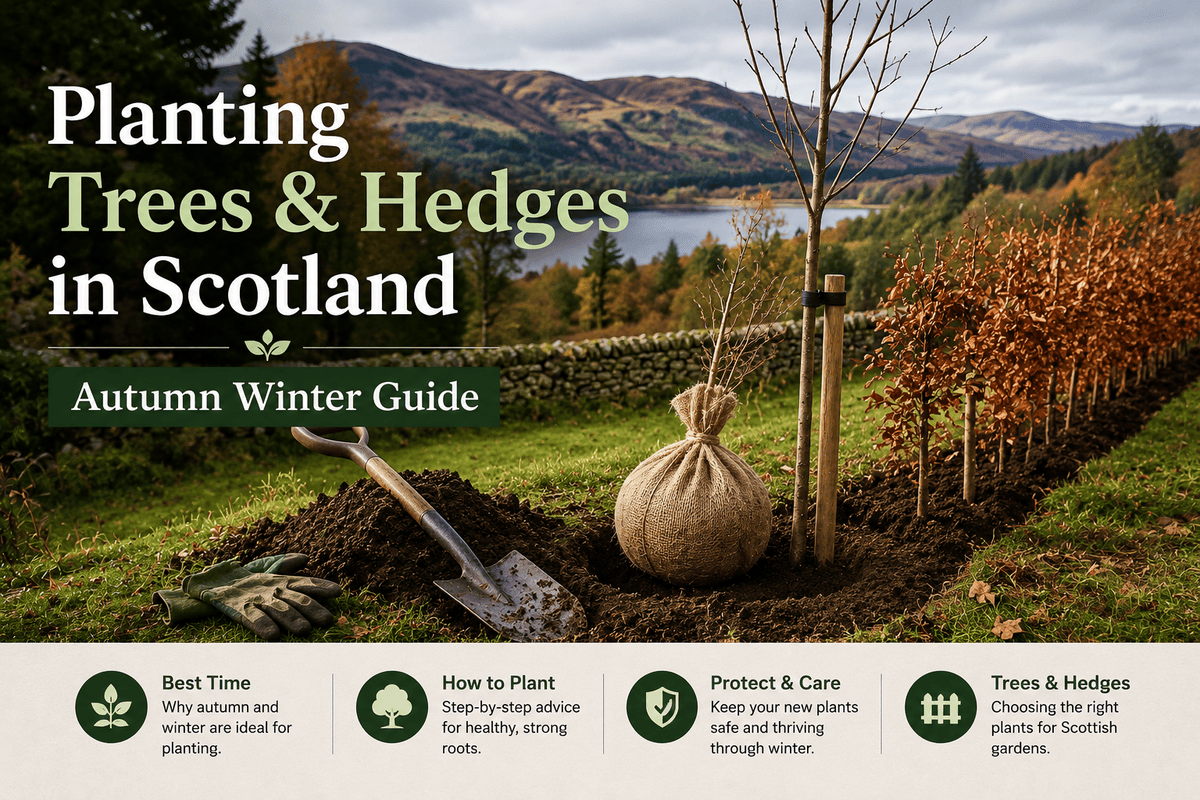
Short answer: plant bare-root trees and hedging between October and April — it's the cheapest and most reliable way to plant, and the window is the whole point. Dig a hole no deeper than the roots but at least three times as wide, don't put compost in the hole, and mulch the surface afterwards leaving a 10cm gap around the stem.
That third instruction surprises people, and it comes from the RHS rather than from us. It's also the single most common way a newly planted tree gets off to a bad start. Here's the full method, and what Scottish conditions change about it.
Why autumn and winter, and why bare-root
Bare-root and rootballed stock can only be planted from October to April — outside that window the plants are in leaf and won't survive the move. Container-grown plants can technically go in at any time of year, but the RHS notes they are far easier to care for if planted in autumn or winter, because you're not fighting to keep them watered through their first summer.
For Scotland the case for autumn and winter is stronger still. Soil is still warm in October, so roots make some growth before dormancy. Winter rainfall does your watering for you. And by the time the following summer's dry spell arrives, the plant has had six months to establish rather than six weeks.
Bare-root is also dramatically cheaper. A bare-root hedging whip costs a fraction of the same plant in a pot, and for a hedge of any length that difference is the entire budget. If you want a native hedge, an orchard, or a shelter belt, the November-to-March window is when it becomes affordable.
The trade-off: you have to be ready. Bare-root stock arrives dormant and should go in the ground quickly. Prepare the site before the plants arrive, not after.
Preparing the ground
Do this in early autumn, before the stock arrives.
Clear a vegetation-free circle or strip. This is more important than almost anything else you'll do. Grass and weeds competing at the base of a young tree are the leading cause of poor establishment — they out-compete it for water far more effectively than most people expect. Clear at least a 1m diameter circle for a tree, or a 1m wide strip along a hedge line, and keep it clear for the first three years.
Don't cultivate a huge area. Beyond clearing the vegetation, there's no need to dig over the whole site. Undisturbed soil supports the plant better than loosened soil, which settles.
Check the drainage. Much of the Central Belt is heavy clay, and a planting hole in clay can act as a sump — water collects in the loosened soil and the roots drown. If a test hole holds water for hours after rain, plant on a slight mound rather than in a depression, and don't dig deeper than you need to.
How to plant: the method
1. Dig the hole wide, not deep
Depth: no deeper than the roots. Width: ideally at least three times the diameter of the root system. Roots spread sideways, not down, so a wide shallow hole is exactly right and a deep narrow one is exactly wrong.
Fork the sides of the hole if the soil is compacted, so roots aren't confined by a smooth-walled pit.
2. Get the depth right
Position the plant so that the first flare of roots is level with the finished soil surface. This is where the trunk begins to widen into the root system.
Planting too deep is the commonest and most damaging mistake. Buried root flares restrict air movement to the roots and encourage disease and bark rot. A tree planted 10cm too deep may take years to fail, and no amount of aftercare will fix it. Lay a cane across the hole to check the level before you backfill.
3. Do not put compost in the planting hole
This one contradicts what most people have been told, so here is the RHS position directly: "There is little evidence that adding extra organic matter to the bottom of the planting hole helps; in fact this practice can hinder plant establishment as the organic matter decomposes."
Three things go wrong when you fill a hole with compost:
- It settles. Organic matter decomposes and loses volume, so the tree sinks — and now it's planted too deep, with all the problems above.
- It creates a "pot" effect. Roots reaching rich, loose material at the hole's edge tend to circle within it rather than pushing out into the surrounding soil. You've built a container in the ground.
- In clay, it makes a sump. A pocket of absorbent organic matter surrounded by clay collects water and holds it against the roots.
Backfill with the soil you dug out. Firm it gently with your heel as you go to remove air pockets, without compacting it hard.
We sell compost, and we're telling you not to put it in the hole. It goes on top instead — and over the life of the tree, mulching properly uses considerably more of it than filling a hole ever would.
4. Stake only if you need to
Small trees do not need staking. Movement in the wind is what makes a trunk thicken and strengthen; a rigidly staked tree grows a weak stem and becomes dependent on the support.
Stake only top-heavy or larger specimens. Use a short stake — roughly a third of the trunk's height — driven in at an angle away from the prevailing wind, with a proper tree tie. The aim is to hold the root ball steady while the roots grip, not to hold the whole tree upright.
Adjust ties each season as the trunk thickens, or they'll strangle it, and remove the stake after two growing seasons.
Scotland's exposure makes this judgement finer than it is further south. On a windy site, windrock — the trunk rocking and opening a gap around the base that then fills with water — is a genuine risk, so a low stake on an exposed plot is sensible. But the answer to a very windy site is usually a smaller plant, not a bigger stake: a 60cm whip establishes faster and ends up ahead of a 2m standard within a few years.
5. Mulch — this is where the compost goes
Spread compost or well-rotted manure over the cleared circle or strip at 5–7.5cm deep, and leave a 10cm collar around the stem completely free of mulch to avoid rotting the bark.
Mulch does four things at once for a new tree: suppresses the grass and weeds that would otherwise out-compete it, holds moisture through dry spells, feeds the soil as it breaks down, and moderates soil temperature.
Top it up annually. This is the single most effective aftercare there is.
6. Water properly, or not at all
Newly planted trees need 30–50 litres per square metre — four to six watering cans — each week in dry weather during the growing season.
For a 1m diameter cleared circle that's roughly 24–39 litres a week. Note what that means: a quick splash from a can every few days is worse than useless, because it encourages shallow surface rooting. Water heavily and less often.
In Scotland you'll often get away with doing very little in a normal summer. But dry springs happen, and a first-year tree has almost no root system to draw on. Watch it.
Rabbits and deer: on rural and semi-rural plots, spiral guards or tree shelters are not optional. A rabbit will ring-bark a young whip in a single winter night, and everything above the damage dies.
Planting a hedge
The method is identical, applied to a line rather than a circle.
Clear a strip at least 1m wide along the whole hedge line — not individual holes in turf. This matters even more for a hedge than a single tree, because grass competition along the whole run is what produces those patchy hedges with gaps at the bottom.
Spacing depends on the effect you want:
- Single row: about 3 plants per metre
- Double staggered row: about 5 plants per metre, in two rows roughly 30–40cm apart — denser and stock-proof faster
A 20m hedge therefore needs roughly 60 whips as a single row, or 100 as a double.
Plant into a slit or trench rather than individual holes. A trench along the line is quicker and gives more consistent depth.
Mulch the whole strip at 5–7.5cm and keep it mulched. A 20m hedge with a 1m mulched strip is 20m², needing about 1.5m³ of compost — roughly two 850L bulk bags.
Prune hard after planting. It feels brutal, but cutting back a new bare-root hedge encourages the bushy growth from the base that makes a hedge dense rather than leggy. A hedge you don't cut in year one is a row of thin trees by year five.
Quantities at a glance
| Job | Volume needed | In 850L bags |
|---|---|---|
| Mulching one 1m circle at 7.5cm | 0.06 m³ | One bag does 14 trees |
| Mulching one 1.2m circle at 7.5cm | 0.09 m³ | One bag does 10 trees |
| Mulching one 1.5m circle at 7.5cm | 0.13 m³ | One bag does 6 trees |
| 20m hedge, 1m strip at 7.5cm | 1.5 m³ | ≈2 bags |
| 30m hedge, 1m strip at 7.5cm | 2.25 m³ | ≈3 bags |
| 50m hedge, 1.2m strip at 7.5cm | 4.5 m³ | ≈5 bags |
Note how far one bag goes on individual trees — a small orchard is a surprisingly cheap thing to mulch properly. For working out your own areas, see our guide to how much compost you need.
Woodchip is the better choice for orchard floors, tree circles in grass and any area you'll walk on — it lasts far longer than compost and costs less. Use compost where you want to feed as well as suppress; woodchip where suppression and durability are the priority.
Frequently asked questions
When can you plant bare-root trees and hedges in the UK? Bare-root and rootballed stock can only be planted between October and April, while the plants are dormant. Container-grown plants can go in at any time of year but establish more easily if planted in autumn or winter.
Should I put compost in the planting hole? No. The RHS states there is little evidence that adding organic matter to the bottom of the planting hole helps, and that it can hinder establishment as the material decomposes — the tree sinks as it settles, roots circle within the rich pocket instead of spreading, and in clay it can create a waterlogged sump. Backfill with the soil you dug out and mulch the surface instead.
How big should a tree planting hole be? No deeper than the roots, and ideally at least three times the diameter of the root system. Roots spread sideways rather than down, so wide and shallow is correct. Fork the sides if the soil is compacted.
How deep should a tree be planted? So that the first flare of roots sits level with the finished soil surface. Planting too deep restricts air to the roots and encourages disease and bark rot, and it is the most common serious planting mistake. Lay a cane across the hole to check before backfilling.
Do newly planted trees need staking? Small trees do not — wind movement is what thickens and strengthens the trunk. Stake only top-heavy or larger specimens, using a short stake about a third of the trunk height, adjusting ties each season and removing the stake after two growing seasons.
How deep should I mulch around a new tree? 5–7.5cm over the cleared circle, leaving a 10cm collar around the stem completely free of mulch to prevent the bark rotting. Top it up annually.
How much should I water a newly planted tree? 30–50 litres per square metre — four to six watering cans — each week in dry weather during the growing season. For a 1m cleared circle that is about 24–39 litres weekly. Water heavily and less often rather than lightly and frequently.
How many plants do I need for a hedge? About 3 plants per metre for a single row, or about 5 per metre for a denser double staggered row set 30–40cm apart. A 20m hedge needs roughly 60 whips as a single row or 100 as a double.
How much compost do I need to mulch a hedge? A 20m hedge with a 1m wide mulched strip at 7.5cm deep needs about 1.5 cubic metres, roughly two 850L bulk bags. Keep the strip mulched and weed-free for the first three years.
Why is my newly planted tree not growing? The most common causes are planting too deep, grass and weeds competing at the base, and insufficient watering in the first two summers. Check the root flare is at soil level, clear and mulch a 1m circle, and water heavily during dry spells.
Planting this winter?
Tell us how many trees or how many metres of hedge and we'll work out the mulch. We supply PAS 100 organic compost, well-rotted manure, topsoil and woodchip across Glasgow, East Kilbride, South Lanarkshire and the Central Belt — 850L bulk bags or 10 and 20 tonne loose loads, with HIAB delivery for tight access and depot uplift from Chapelton.
Browse our products · call 07561 251350 · email info@kelvincompost.co.uk · use code INTERNET for 5% off 850L sacks.
Kelvin Compost is the trading arm of ASAP (After School Activities Programme) — proceeds support local community projects.
Need Garden Supplies Delivered in Glasgow?
Organic compost, topsoil, manure and more across Scotland