




Planting Spring Bulbs in Scotland | Autumn Soil Guide
Looking for compost, topsoil or garden supplies?
Browse our full product range or get in touch for delivery across Glasgow and Scotland.
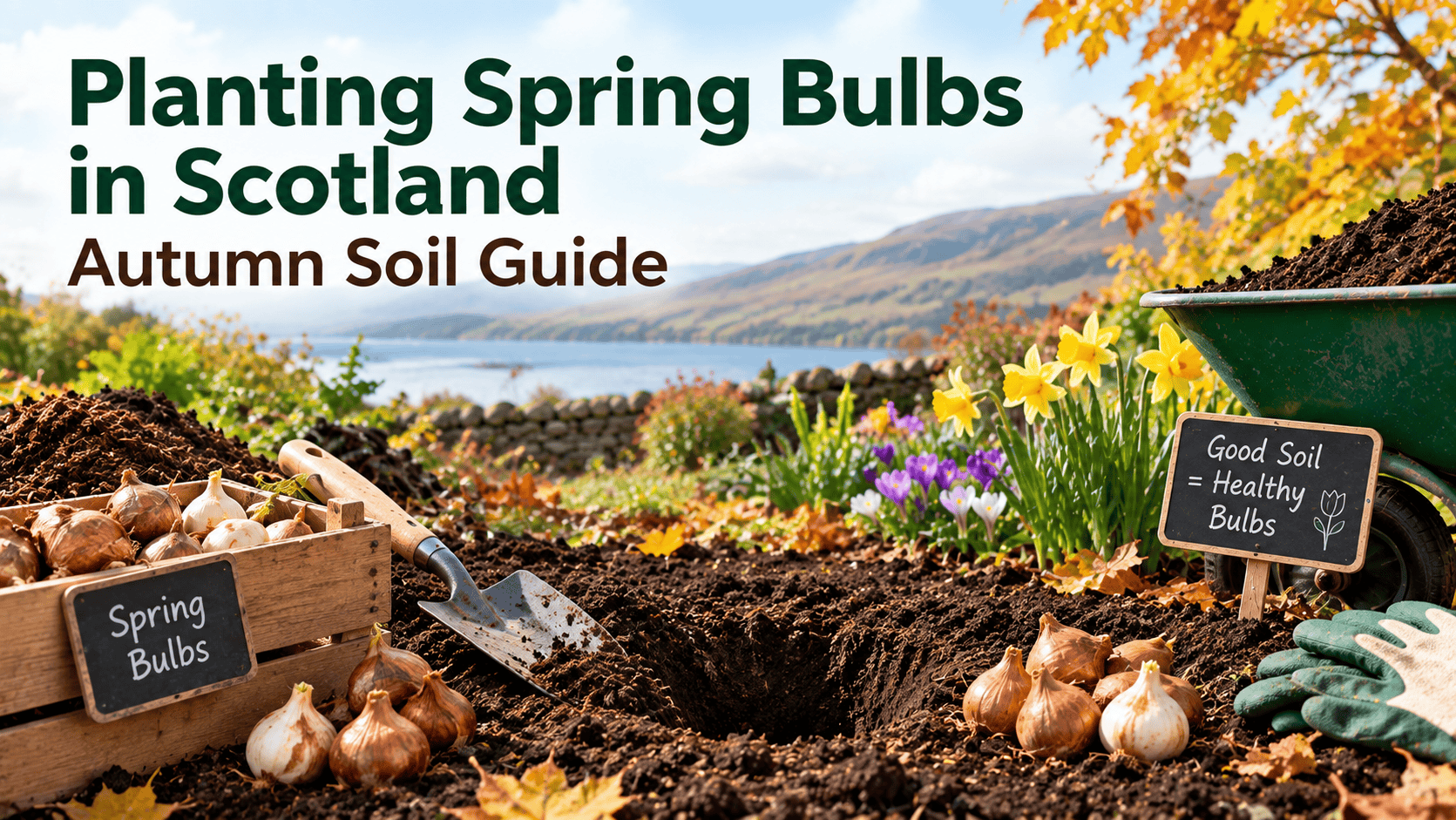
Planting Spring Bulbs in Scotland: Soil Preparation, Compost & Autumn Planting Guide
September and autumn are some of the most important months for creating next spring's garden.
If you want daffodils, crocuses, hyacinths, alliums and other spring-flowering bulbs, much of the work happens months before you see the first flower.
But successful bulb planting isn't simply a case of digging a hole and dropping a bulb into it.
Drainage, soil condition, planting depth and timing all matter.
This is particularly important in Scotland, where prolonged wet winter conditions can cause problems for bulbs planted in poorly drained or compacted ground.
The basic approach is:
Choose the right location → check drainage → improve poor soil where necessary → plant at the correct depth → cover and gently firm → allow the bulbs to establish.
This guide explains when to plant spring bulbs in Scotland, how to prepare your soil, whether you need compost or topsoil, and how to avoid some of the most common bulb-planting mistakes.
Quick Answer: When Should I Plant Spring Bulbs in Scotland?
Most spring-flowering bulbs are planted in autumn.
As a general guide:
| Bulb | Typical planting period |
|---|---|
| Daffodils | September |
| Crocuses | September–autumn |
| Hyacinths | September–autumn |
| Alliums | Early to mid-autumn |
| Tulips | Later autumn, often November |
| Snowdrops | Autumn or planted 'in the green' after flowering |
Exact timing varies with the species and conditions.
The important point is:
Don't wait until spring to plant spring-flowering bulbs.
They generally need to be planted while dormant so they can establish before flowering.
Why Autumn Is the Best Time to Plant Spring Bulbs
Spring bulbs spend months developing below the surface before their flowers appear.
Planting during autumn gives them time to establish roots before spring growth begins.
In Scotland, September is therefore a useful month for getting:
Daffodils
Crocuses
Hyacinths
Alliums
Many other hardy bulbs
into the ground.
Tulips are a notable exception.
They are often planted later in autumn, around November.
So if you've bought several types of bulb, don't assume they all need to go into the ground on the same weekend.
What Is the Best Soil for Spring Bulbs?
For many commonly grown bulbs, drainage is more important than extremely rich soil.
Most hardy bulbs such as daffodils and tulips prefer a sunny position with soil that drains well.
That's particularly relevant in western Scotland, where wet winter conditions can expose poorly drained planting areas.
Bulbs sitting for prolonged periods in saturated soil can rot.
The ideal soil should generally be:
Free draining
Workable
Not severely compacted
Appropriate for the bulb species
Capable of retaining some moisture without remaining waterlogged
If your garden soil already meets these conditions, you may not need to add very much at all.
Do I Need Compost Before Planting Bulbs?
Not necessarily.
First inspect your existing soil.
If it is in good condition, bulbs may grow perfectly well without major soil amendment.
However, organic matter can be useful if your soil is:
Light and sandy
Heavy but workable
Low in organic matter
Structurally poor
Kelvin Compost's Organic Compost can be used to add organic matter when broader soil improvement is needed.
But don't make the mistake of digging a hole and filling it entirely with compost.
The objective is to improve the soil environment, not create an isolated pocket.
Compost vs Potting Compost: An Important Difference
The word "compost" can mean two different things in gardening.
This distinction matters when planting bulbs.
Garden compost / soil improver
This is organic material used to improve garden soil.
Kelvin Compost's organic compost belongs in this category.
It is suitable for adding organic matter to garden beds and borders.
Potting compost / growing media
This is a formulated growing medium designed for plants grown in pots and containers.
If you're filling containers with bulbs, use an appropriate peat-free container growing medium rather than assuming a bulk garden soil improver can be used alone as potting compost.
For containers, drainage and the structure of the growing medium are especially important.
Do I Need Topsoil for Planting Bulbs?
Usually not if you already have enough suitable garden soil.
Topsoil becomes relevant when you need additional soil volume.
For example:
You're creating a completely new flower bed
The existing topsoil is very shallow
You're landscaping a previously paved area
You're creating a raised planting area
Soil has previously been removed
You need to increase growing depth
If your existing flower bed already has adequate soil but needs more organic matter, compost is generally more relevant than adding another layer of topsoil.
Remember:
Topsoil = additional soil volume
Organic compost = improving suitable existing soil
How Do I Prepare Soil for Spring Bulbs?
Before planting:
1. Remove weeds
Clear the planting area, particularly persistent perennial weeds.
You don't want to disturb newly emerging bulbs in spring because you're trying to remove established weeds.
2. Check drainage
After rainfall, inspect the area.
Does water drain away?
Or does it remain saturated for long periods?
If water regularly sits on the surface, investigate the problem before planting bulbs that require free-draining conditions.
3. Check for compaction
Compacted soil can reduce drainage.
Loosen compacted ground where necessary without destroying good soil structure.
4. Add organic matter where appropriate
If the soil would benefit from additional organic matter, apply suitable compost over the broader planting area.
5. Rake and level
Remove large debris and prepare the surface before positioning the bulbs.
How Deep Should You Plant Bulbs?
A useful general rule for many bulbs is:
Plant at approximately two to three times the bulb's own depth.
For example:
If a bulb is 5cm high, the planting hole may be around:
10–15cm deep.
Place the bulb with its pointed end or shoot facing upwards.
Then replace the soil and gently firm it.
Avoid heavily stamping down the ground.
Some individual bulbs have different planting requirements, so always check the packet or supplier's instructions as well.
How Far Apart Should Spring Bulbs Be?
A useful general rule is to space many bulbs at least around twice the bulb's width apart when planting in borders.
But planting style also matters.
For a natural-looking display, bulbs often look better planted in groups rather than evenly spaced like soldiers.
For example, instead of:
○ ○ ○ ○ ○ ○
consider:
○ ○○ ○○○ ○○
Irregular groups can produce a more natural effect.
For a stronger display, plant several bulbs of the same type together.
How Many Bulbs Should I Plant Together?
More bulbs generally create more visual impact.
A group of three tiny daffodils in a large border can disappear visually.
Larger groups are more noticeable.
For many border displays, consider groups of:
6+
10+
20+
25–50 for a substantial display
depending on the bulb, garden size and effect you want.
Don't forget the mature spacing recommended for the particular variety.
Planting Daffodils in Scotland
Daffodils are among the easiest spring bulbs to grow.
September is an excellent planting period.
Choose a location with:
Suitable light
Well-drained soil
Enough room for the clump to develop
Plant them at an appropriate depth, generally around two to three times the height of the bulb.
One mistake to avoid is planting daffodils too shallowly.
Shallow planting can contribute to poor flowering in future years.
After flowering, allow the foliage to die back naturally rather than immediately cutting it away.
Those leaves are helping replenish the bulb for the following year's flowers.
Planting Crocuses
Crocuses can provide some of the earliest colour of the year.
They work well in:
Borders
Lawns
Gravel gardens
Containers
Around deciduous trees where conditions suit them
Plant spring-flowering crocuses in autumn.
For a natural display, plant them in informal groups rather than perfectly straight rows.
If you're naturalising crocuses in grass, remember that the foliage needs time to die back naturally before mowing.
When Should You Plant Tulips?
Don't rush your tulips into the ground simply because you're planting daffodils in September.
Tulips are generally planted later.
November is commonly recommended in the UK.
Later planting can reduce the risk of certain diseases, including tulip fire.
So a sensible autumn bulb schedule might look like:
September
Plant:
Daffodils
Crocuses
Hyacinths
Hardy summer-flowering bulbs
September–October
Plant:
Alliums
Lilies
Other suitable hardy bulbs
November
Plant:
Tulips
This spreads the work across autumn rather than trying to plant everything at once.
Planting Alliums
Alliums can produce dramatic flower heads in late spring and summer.
They generally prefer:
Plenty of sunshine
Free-draining soil
A relatively sheltered position for taller varieties
Early to mid-autumn is a good planting period.
Avoid planting alliums in areas that remain waterlogged.
Also avoid adding excessive amounts of fresh manure immediately before planting.
Rich, freshly manured ground isn't necessary for good results.
Should I Add Manure Before Planting Bulbs?
Usually, don't make manure your first choice specifically for bulb planting.
Well-Rotted Manure is valuable for many soil-improvement and productive gardening applications, but bulbs don't generally need highly enriched planting pockets.
Some bulbs, including alliums, are better planted away from freshly manured soil.
If your whole border needs organic-matter improvement for other plants, well-rotted organic matter may form part of the wider soil-management strategy.
But don't simply put manure underneath individual bulbs.
What If I Have Heavy Clay Soil?
Clay can create challenges for bulbs because it may remain wet for long periods.
However, clay itself isn't automatically unsuitable.
First determine whether the problem is:
Heavy soil
Compaction
Persistent waterlogging
Poor surface drainage
An impermeable layer
For workable heavy soil, adding organic matter such as Organic Compost can help improve soil structure over time.
Avoid aggressively working saturated clay.
And don't assume that adding compost alone will fix a fundamentally waterlogged site.
For bulbs that strongly require free-draining conditions, consider a raised bed or container if your ground remains persistently wet.
What If My Soil Is Sandy?
Light sandy soil usually drains very well.
The problem can be the opposite of clay:
it may lose moisture and nutrients too quickly.
Adding organic matter can improve:
Moisture retention
Soil structure
Nutrient-holding capacity
This makes compost particularly useful when preparing light soils for mixed planting.
Again, the goal isn't to replace the soil with compost.
Improve what you already have.
Can I Plant Bulbs in a New Garden Border?
Absolutely.
In fact, if you're creating a new border this autumn, it's an ideal opportunity to include bulbs before the planting area fills with established perennials and shrubs.
Think in layers.
For example:
Shrubs provide permanent structure.
Perennials provide seasonal growth and flowers.
Spring bulbs provide early colour.
Ground-cover plants fill lower spaces.
This gives the border interest over a much longer period.
If you're starting from scratch, read our guide to creating a new garden border.
Can I Plant Bulbs Between Existing Perennials?
Yes.
This can be an excellent way to extend the flowering season.
Spring bulbs emerge before many herbaceous perennials reach full size.
Later, the emerging perennial foliage can help disguise bulb leaves as they die back.
Good combinations can include spring bulbs planted among suitable:
Geraniums
Hostas
Ornamental grasses
Salvias
Hardy perennials
Always consider the light, drainage and soil requirements of the individual plants.
Should I Plant Bulbs Under Trees?
Some bulbs are well suited to planting beneath deciduous trees, particularly woodland-type species.
Before planting, consider:
Shade level
Tree-root competition
Summer dryness
Soil depth
Drainage
Spring bulbs can benefit from the fact that deciduous trees haven't yet produced their full leaf canopy when the bulbs are actively growing.
But don't damage major tree roots simply to install bulbs.
Work carefully around established trees.
Can I Plant Bulbs in Grass?
Yes.
Daffodils and crocuses can create attractive naturalised displays in lawns and grassy areas.
For a natural appearance, scatter the bulbs gently and plant them roughly where they land rather than creating straight lines.
The most important aftercare comes after flowering.
Don't mow the bulb foliage immediately.
Allow it to die back naturally so the leaves can replenish the bulbs for next year.
This makes naturalised bulbs more suitable for areas where you're happy to delay mowing.
Can I Grow Spring Bulbs in Pots?
Yes.
Bulbs can perform extremely well in containers.
This is particularly useful if you:
Have a small garden
Have a patio or balcony
Want colour near a doorway
Have poorly drained garden soil
Want to move displays around
The container must have adequate drainage.
For seasonal bulb containers, use an appropriate peat-free potting compost with good drainage.
Don't fill pots exclusively with garden topsoil.
And don't assume bulk garden compost is identical to formulated potting compost.
What Is a Bulb Lasagne?
A "bulb lasagne" is a container planted with several layers of bulbs.
Different bulbs are positioned at different depths.
For example:
Bottom layer: larger/deeper-planted bulbs
Middle layer: medium bulbs
Top layer: smaller, shallower bulbs
This can produce successive waves of flowers from one container.
Bulbs can be planted relatively close together in containers because the display is usually designed for maximum seasonal impact.
Make sure they aren't physically touching each other.
How to Plant a Bulb Lasagne
Use a deep container with drainage holes.
Step 1
Add a layer of suitable peat-free potting compost.
Step 2
Place the largest/deepest-planted bulbs on the first layer.
Step 3
Cover with compost.
Step 4
Add the second bulb layer.
Step 5
Cover again.
Step 6
Add the smallest/shallowest bulbs near the top.
Step 7
Finish with compost and gently firm.
Step 8
Water after planting.
Keep the container outdoors and make sure it doesn't become waterlogged.
Do Spring Bulbs Need Fertiliser?
Bulbs contain stored energy, which is why they can produce impressive growth from something relatively small.
That doesn't mean established bulbs never benefit from feeding.
Once bulbs are actively growing, suitable feeding can support future flowering.
High-potassium feeds are often used for bulbs grown in containers.
But don't confuse feeding with soil preparation.
Your priorities at planting time should be:
correct location + suitable drainage + correct planting depth + healthy bulbs.
Adding large quantities of fertiliser won't compensate for bulbs sitting in saturated ground.
Can Potash Be Used for Flowering Plants?
Potassium supports flowering and fruiting in plants.
Kelvin Compost supplies Potash-Potassium for suitable garden applications.
However, fertiliser should be used according to the requirements of the plant and the product instructions.
Don't assume that adding more potassium automatically creates more flowers.
Soil conditions and overall plant health still matter.
Should I Mulch After Planting Bulbs?
You can mulch a mixed border after planting.
Suitable organic mulch can help:
Suppress weeds
Protect the soil surface
Add organic matter
Reduce moisture loss
Organic Compost can be used as an organic soil-improving mulch in suitable beds.
Organic Woodchips may be more appropriate around established shrubs, trees and woody planting.
If bulbs are planted through a mulched border, remember where they are so you don't accidentally damage them during later gardening work.
How Much Compost Do I Need to Improve a Bulb Border?
Suppose you're preparing a border measuring:
10m long × 1.5m wide
Area:
15m²
If you're applying a 5cm layer of organic matter:
15 × 0.05 = 0.75m³
That's approximately:
750 litres.
For a 20m² area:
20 × 0.05 = 1m³
or:
1,000 litres.
For a 30m² area:
30 × 0.05 = 1.5m³
or:
1,500 litres.
This is where bulk quantities become much more practical than dozens of small bags.
Compost Quantity Calculator
| Border area | 5cm layer | 7.5cm layer |
|---|---|---|
| 5m² | 250L | 375L |
| 10m² | 500L | 750L |
| 15m² | 750L | 1,125L |
| 20m² | 1,000L | 1,500L |
| 25m² | 1,250L | 1,875L |
| 30m² | 1,500L | 2,250L |
| 50m² | 2,500L | 3,750L |
These are volume calculations.
They don't mean every bulb border requires a 5cm or 7.5cm application.
If your soil is already healthy, don't add organic material simply to hit a number.
Common Spring Bulb Planting Mistakes
1. Planting too shallowly
Follow the recommended depth for the bulb.
For many bulbs, around two to three times the bulb's own height is a useful guide.
2. Planting the bulb upside down
The pointed end normally faces upwards.
3. Ignoring drainage
Wet winter ground can cause bulb rot.
4. Adding too much manure
Bulbs don't need to sit in rich pockets of manure.
5. Planting tulips too early
Tulips are generally better planted later in autumn.
6. Using garden soil alone in containers
Use a suitable free-draining container growing medium.
7. Cutting leaves off immediately after flowering
Allow bulb foliage to die back naturally.
8. Mowing naturalised bulbs too soon
Wait for the foliage to die back.
9. Buying bulbs and leaving them in the shed for months
Plant bulbs during the appropriate planting window.
10. Treating every bulb the same
Different species have different requirements.
Always check the specific variety.
September Bulb-Planting Checklist for Scottish Gardens
If you're gardening in Glasgow or elsewhere in Scotland this September:
✓ Order spring bulbs
✓ Plant daffodils
✓ Plant crocuses
✓ Plant hyacinths
✓ Start planting suitable alliums
✓ Check garden drainage
✓ Improve poor soil where required
✓ Clear weeds before planting
✓ Prepare containers
✓ Leave tulips until later in autumn
✓ Mark where bulbs have been planted
✓ Plan spring colour in groups rather than isolated bulbs
Do the work now and your garden can look completely different next spring.
Buying Compost for Autumn Bulb Planting in Glasgow
If your borders need soil improvement before autumn planting, Kelvin Compost supplies bulk garden materials across Glasgow, East Kilbride, South Lanarkshire and surrounding areas.
Existing garden soil needs more organic matter?
Creating a new bed that needs additional soil depth?
Improving other productive areas of the garden?
Mulching around established shrubs and trees?
Looking for potassium for suitable flowering or fruiting plants?
For larger beds and landscaping projects, measure the area before ordering so you can estimate the amount of material required.
Frequently Asked Questions About Planting Bulbs
When should I plant spring bulbs in Scotland?
Autumn is the main planting season. Daffodils, crocuses and hyacinths are commonly planted in September or early autumn, while tulips are generally planted later, around November.
Is September too early to plant daffodils?
No. September is an excellent time to plant daffodil bulbs.
When should I plant tulips in Scotland?
November is generally a good time to plant tulips in the UK.
How deep should I plant bulbs?
Many bulbs are planted approximately two to three times their own height. Check the instructions for the specific species because requirements vary.
Do bulbs need compost?
Healthy garden soil may need no additional compost. If the existing soil is light, heavy or low in organic matter, suitable organic compost can be used to improve the broader planting area.
Can I plant bulbs in clay soil?
Yes, but drainage is important. Improve suitable heavy soil with organic matter and avoid planting bulbs that require free drainage in persistently waterlogged areas.
Can I put manure under bulbs?
Avoid creating manure-filled planting holes or putting a concentrated manure layer immediately beneath bulbs. Some bulbs, including alliums, don't benefit from freshly manured soil.
Do bulbs grow better in sun or shade?
Many popular spring bulbs, including tulips and daffodils, perform well in sunny, free-draining positions, but other bulb species tolerate or prefer partial shade. Check the requirements of the variety you're planting.
Can I grow bulbs in pots?
Yes. Use containers with drainage holes and an appropriate peat-free, free-draining potting compost.
Should I water bulbs after planting?
If soil is already moist during autumn, additional watering may not be necessary. In dry conditions, water after planting. Containers should be monitored so they remain moist but don't become waterlogged.
Plant This Autumn for Colour Next Spring
Spring gardens are created months in advance.
If you want beds filled with daffodils, crocuses, alliums, tulips and other spring colour, autumn is the time to prepare.
Start by checking your soil.
If the soil already drains well and is in good condition, don't overcomplicate things.
If it needs organic matter, improve it with Organic Compost.
If you're creating an entirely new planting area and need additional soil depth, consider Topsoil.
Then plant the right bulbs at the right time and at the correct depth.
Prepare Your Garden for Autumn Planting
Organic Compost:
Shop Organic Compost
Topsoil:
Shop Topsoil
Well-Rotted Manure:
Shop Manure
Organic Woodchips:
Shop Woodchips
Call Kelvin Compost: +44 7561 251350
Email: info@kelvincompost.co.uk
If you're preparing a large new border for autumn planting, measure the length × width of the area before ordering. If you also know approximately how much additional depth or organic matter you need, it's much easier to calculate the right quantity for delivery.
Need Garden Supplies Delivered in Glasgow?
Organic compost, topsoil, manure and more across Scotland