



Peat-Free Compost vs Peat-Based Compost: What’s the Difference?
Looking for compost, topsoil or garden supplies?
Browse our full product range or get in touch for delivery across Glasgow and Scotland.
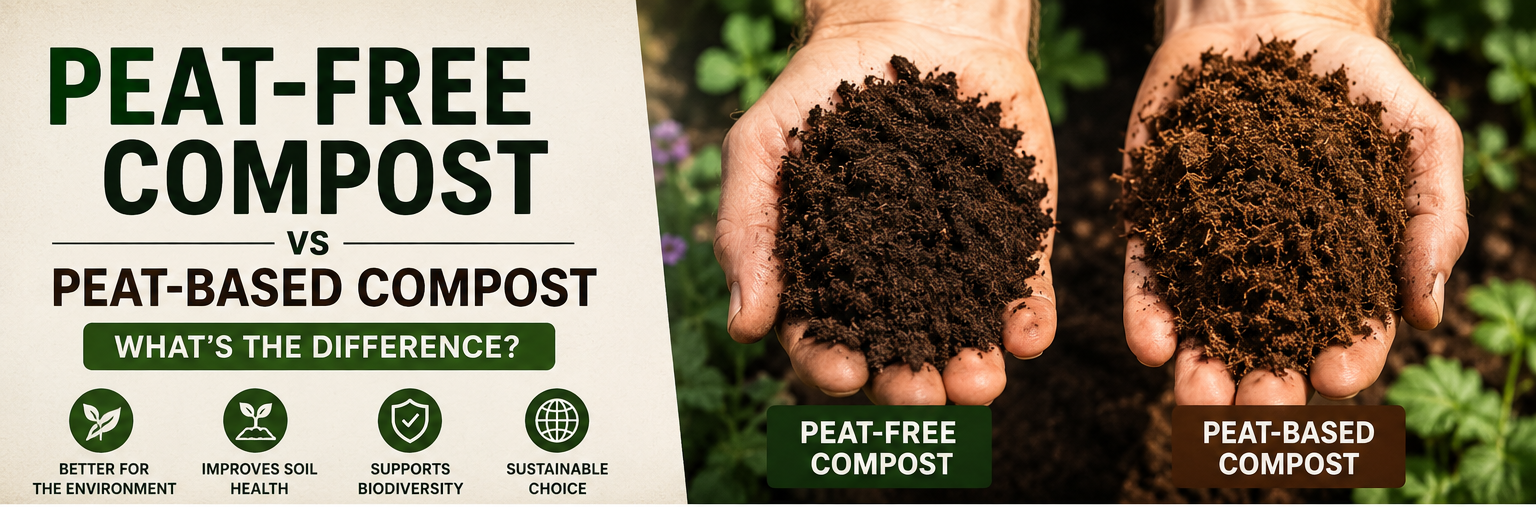
If you are buying compost for your garden, allotment, raised beds or containers, you may have noticed that many products are now labelled peat-free.
But what does peat-free compost actually mean? Is peat-free compost as good as peat-based compost? What is the difference between the two, and which should you choose for your garden?
For gardeners in Glasgow and across Scotland, peat-free compost is becoming an increasingly popular choice. However, choosing the right product is about more than simply looking for the words "peat-free" on the packaging.
This guide explains the main differences between peat-free and peat-based compost, where each type is used, what to look for when buying compost and how to choose the right material for your gardening project.
Quick Answer: What Is the Difference Between Peat-Free and Peat-Based Compost?
Peat-free compost contains no peat, while peat-based compost uses peat as one of its main ingredients.
Peat has traditionally been used in horticulture because it is lightweight, holds moisture effectively and provides a relatively consistent growing medium.
Peat-free compost uses alternative materials instead, which can include composted green waste, bark, wood fibre, coir, loam and other organic or mineral ingredients.
For general garden soil improvement, a quality mature peat-free organic compost can be an excellent way to add organic matter and improve soil structure.
The important point is that peat-free compost is not one single type of product. Different peat-free composts are made for different applications.
What Is Peat-Based Compost?
Peat-based compost is a growing medium that contains peat extracted from peatlands.
Peat forms naturally over very long periods when partially decomposed organic material accumulates in waterlogged conditions.
Historically, peat became widely used in horticulture because of its useful physical properties. It can hold water, provide air space around plant roots and create a relatively predictable growing environment.
However, peatlands are environmentally important ecosystems.
They store carbon, support wildlife and play a role in water management. Peat extraction can damage these habitats.
This is one of the main reasons the horticultural industry and gardeners are moving towards peat-free alternatives.
What Is Peat-Free Compost?
Peat-free compost is made without peat.
Instead, manufacturers can use alternative materials with different combinations of water retention, drainage, aeration, nutrient content and structure.
Common ingredients in peat-free growing media can include:
- Composted green waste
- Composted bark
- Wood fibre
- Coir
- Loam
- Sand
- Grit
- Other suitable organic materials
For garden soil improvement, composted green waste can be particularly useful because it contributes organic matter to the soil.
However, gardeners should always check what a particular product is designed for.
A soil improver, a multi-purpose growing compost, a seed compost and a container compost are not necessarily interchangeable.
Is Peat-Free Compost Better Than Peat-Based Compost?
For gardeners who want to reduce their environmental impact, peat-free compost is generally the preferred option.
The RHS recommends moving away from peat and using suitable peat-free alternatives. Peatlands are important carbon stores and habitats, making peat conservation an important environmental consideration.
But "better" also depends on what you are trying to grow.
A specialist seed compost, for example, needs different characteristics from a bulk compost used to improve garden soil.
The best approach is therefore:
Choose peat-free where possible, then choose the correct peat-free product for the job.
Peat-Free Compost vs Peat-Based Compost: Key Differences
| Feature | Peat-Free Compost | Peat-Based Compost |
|---|---|---|
| Contains peat | No | Yes |
| Uses alternative materials | Yes | Usually limited |
| Environmental consideration | Avoids peat extraction | Relies on peat |
| Suitable for soil improvement | Yes, where appropriate | Product dependent |
| Suitable for containers | Specialist products available | Traditionally common |
| Suitable for seedlings | Specialist formulations available | Traditionally common |
| Bulk garden use | Suitable products available | Less commonly used for this purpose |
| Sustainability focus | Generally preferable | Less sustainable choice |
The table is a useful starting point, but product specifications matter more than the label alone.
Why Are Gardeners Moving Away From Peat?
The main reason is environmental.
Peatlands are not simply piles of garden material waiting to be used. They are functioning ecosystems that develop over very long periods.
They:
- Store significant amounts of carbon
- Provide habitats for plants and wildlife
- Help regulate water
- Contribute to wider ecosystem health
When peat is extracted, these functions can be damaged.
That is why peat-free gardening has become increasingly important in the UK.
For an individual gardener, switching from peat-based to peat-free compost is a relatively simple change that can contribute to reducing demand for extracted peat.
Is Peat-Free Compost Good for Garden Soil?
Yes, when the product is suitable for soil improvement.
A mature organic compost can help increase the organic matter content of soil.
This can support:
- Better soil structure
- Improved moisture management
- Improved workability
- Biological activity
- More favourable growing conditions
This can be particularly useful in gardens where soil has become depleted or compacted.
However, compost is not a replacement for every type of soil material.
If you are creating a new lawn, for example, you will generally need an appropriate topsoil rather than filling the entire area with compost.
Similarly, if you are filling a large raised bed, combining quality topsoil with compost can be more appropriate and economical than using compost alone.
Can Peat-Free Compost Be Used on Clay Soil?
Yes.
Many gardeners with heavy clay soil use organic matter to gradually improve soil structure.
Adding mature compost can help increase organic matter and improve the way the soil behaves.
However, avoid digging or cultivating clay soil when it is saturated.
Wet clay can be easily compacted, which can make drainage problems worse.
A sensible soil-improvement strategy is to:
- Wait until soil conditions are suitable.
- Add mature organic matter.
- Avoid excessive cultivation.
- Improve drainage where necessary.
- Repeat organic matter applications over time.
If a garden has serious waterlogging, compost alone may not solve the underlying drainage problem.
Is Peat-Free Compost Suitable for Vegetable Gardens?
Yes.
Suitable peat-free compost can be used in vegetable beds and allotments to add organic matter and improve soil.
It can be incorporated before planting or applied as a suitable surface mulch.
Vegetable gardeners should still consider the individual needs of their crops.
Some crops are heavy feeders, while others are less demanding. Compost should therefore form part of an overall soil fertility programme rather than being treated as a complete fertiliser for every vegetable.
For large allotments and vegetable gardens, buying compost in bulk can also be significantly more convenient than transporting dozens of small bags.
Is Peat-Free Compost Suitable for Raised Beds?
Yes.
Peat-free compost is useful in raised-bed projects, but you generally do not need to fill the entire bed with compost.
For many raised beds, a mixture involving:
- Quality topsoil
- Organic compost
- Appropriate soil amendments
provides a better balance.
Topsoil provides the bulk soil component, while compost contributes organic matter.
This can also be more economical for large raised beds.
Is Peat-Free Compost Suitable for Containers?
This depends on the product.
A specialist peat-free container compost can be suitable for pots and planters.
However, bulk soil-improvement compost should not automatically be used as a substitute for a formulated container growing medium.
Containers have different requirements because they have limited space and drainage.
If you are growing plants in pots, check that the compost is specifically suitable for container growing.
Is Peat-Free Compost Good for Seedlings?
Seedlings have more specific requirements than established garden plants.
A specialist peat-free seed compost can be suitable for seed sowing.
Do not assume that a general-purpose garden compost or bulk green-waste compost is appropriate for germinating seeds.
Seed composts are generally formulated with characteristics suitable for young plants, including appropriate nutrient levels and texture.
How Do You Choose Quality Peat-Free Compost?
When buying peat-free compost, consider five things.
1. What is it made from?
Look for clear information about the ingredients and source materials.
2. What is it designed for?
Check whether it is intended for soil improvement, containers, seed sowing, raised beds or another application.
3. Is it mature and stable?
For garden soil improvement, use appropriately composted and mature material.
4. Does it meet a recognised quality standard?
For composted green waste, recognised standards such as BSI PAS 100 provide useful reassurance about product quality.
5. How much do you need?
If you are improving a large garden, allotment or landscaping project, calculate the required volume before ordering.
What Is BSI PAS 100 Compost?
BSI PAS 100 is a recognised UK specification for composted materials.
For customers buying bulk compost, certification can provide additional confidence that the material has been produced to a recognised standard.
Kelvin Compost supplies BSI PAS 100 certified organic compost for gardens, allotments, landscaping projects and other applications around Glasgow and Scotland.
This makes it particularly suitable for customers who want a recognised-quality compost rather than an unknown bulk material.
Peat-Free Compost in Glasgow
For gardeners searching for peat-free compost in Glasgow, buying locally can make bulk ordering considerably easier.
Kelvin Compost supplies compost, topsoil, manure and woodchip from its South Lanarkshire base, with delivery to gardens, allotments, schools, farms and landscaping projects.
Bulk compost can be supplied in larger quantities for projects where retail bags are impractical.
When comparing suppliers, consider:
- Product quality
- Certification
- Volume
- Delivery arrangements
- Access to your property
- Intended use
- Total delivered cost
The cheapest product is not always the best-value product if you need to order substantially more material or arrange separate transport.
Peat-Free Compost vs Peat-Based Compost: Which Should You Buy?
For most gardeners who are choosing between otherwise suitable products, peat-free compost is the better environmental choice.
But the most important consideration is still choosing a product suitable for your particular gardening application.
Use:
- Specialist peat-free seed compost for seeds
- Suitable peat-free container compost for pots
- Mature organic compost for soil improvement
- Topsoil for bulk soil creation
- A suitable topsoil-and-compost blend for many raised beds
The goal is not simply to buy "compost".
The goal is to choose the right growing or soil-improvement material for the job.
Frequently Asked Questions
Is peat-free compost really better?
Peat-free compost avoids the use of extracted peat and is therefore the preferred option for gardeners who want to reduce their reliance on peat. Performance depends on the specific formulation and intended use.
Does peat-free compost contain manure?
Not necessarily. Peat-free describes the absence of peat. Different products can contain different ingredients.
Can peat-free compost improve clay soil?
Yes. Suitable mature compost can add organic matter and help improve soil structure over time. Severe drainage problems may require additional measures.
Can I use peat-free compost for vegetables?
Yes. Suitable mature peat-free compost can be incorporated into vegetable beds and allotments or used as mulch where appropriate.
Can I use peat-free compost in raised beds?
Yes. It can be combined with suitable topsoil to create an appropriate growing medium.
Is peat-free compost organic?
Some peat-free composts are organic, but "peat-free" and "organic" do not mean exactly the same thing. Check the product specification.
Where can I buy peat-free compost in Glasgow?
Kelvin Compost supplies BSI PAS 100 certified organic compost and other soil products for customers across Glasgow and surrounding areas.
Final Verdict
The move from peat-based to peat-free compost is one of the simplest changes gardeners can make when looking for more sustainable gardening materials.
Peat-free compost can be highly effective, but there is no single formulation that is perfect for every situation.
Choose the product according to your application, look for reliable quality information and consider buying in bulk when you have a larger garden, allotment or landscaping project.
For gardeners in Glasgow and across Scotland, Kelvin Compost supplies BSI PAS 100 certified organic compost, topsoil, manure and woodchip with bulk delivery options.
Need Garden Supplies Delivered in Glasgow?
Organic compost, topsoil, manure and more across Scotland