



Peat-Free Compost Glasgow: Complete UK Guide to Choosing, Buying and Using It
Looking for compost, topsoil or garden supplies?
Browse our full product range or get in touch for delivery across Glasgow and Scotland.
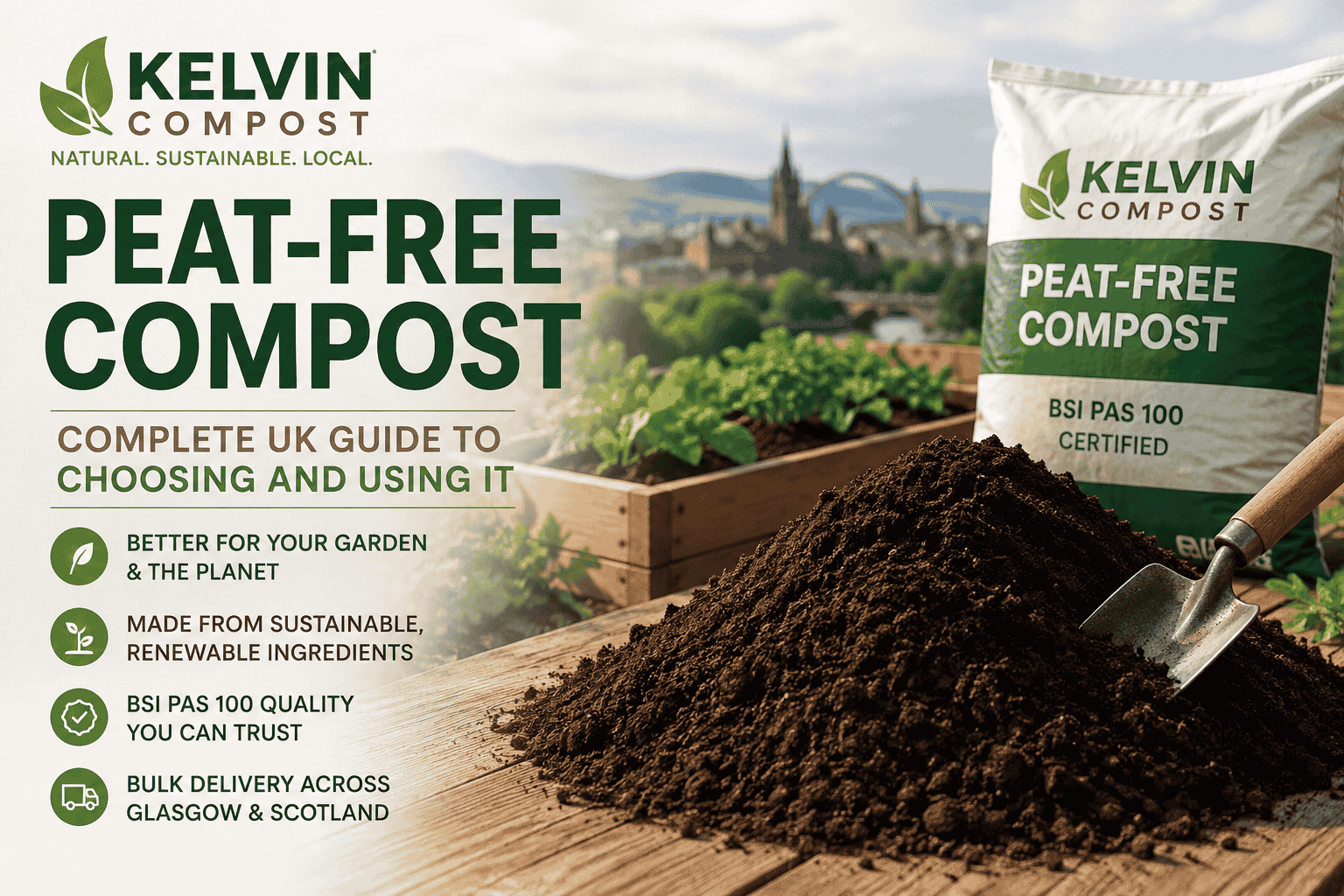
Peat-free compost is now one of the most important choices for gardeners looking to improve their soil while reducing their reliance on peat-based growing materials. For gardeners in Glasgow and across Scotland, peat-free compost can be used for vegetable beds, borders, raised beds, planters, allotments, lawn improvement and general soil conditioning.
But what exactly is peat-free compost, and is it suitable for your garden?
The short answer is yes for many gardening applications — but it is important to choose the right type of compost for the job.
In this guide, Kelvin Compost explains what peat-free compost means, why gardeners are choosing it, how it differs from peat-based compost, what to look for when buying it, and how to use organic compost effectively in Glasgow gardens.
Quick Answer: What Is Peat-Free Compost?
Peat-free compost is a growing or soil-improvement material made without peat. Depending on the product, it can contain materials such as composted green waste, bark, wood fibre, coir, grit or other suitable organic and mineral ingredients.
For garden soil improvement, mature green-waste compost is particularly useful because it adds organic matter and helps improve soil structure, moisture management and biological activity.
Peat-free does not automatically mean that every compost product is identical. Different composts are formulated for different purposes, so gardeners should choose a product according to whether they are improving garden soil, filling raised beds, planting containers or growing seedlings.
Why Are More Gardeners Choosing Peat-Free Compost?
Peat has historically been widely used in horticulture because it is lightweight, holds moisture well and provides consistent growing conditions.
However, peatlands are important natural ecosystems and major carbon stores. Peat extraction can damage these habitats and release stored carbon.
The RHS recommends peat-free alternatives and explains that modern peat-free growing media can contain materials including composted bark, wood fibre, coir and green-waste compost.
For gardeners in Scotland, the issue is particularly relevant because Scottish peatlands are valuable ecosystems that provide important environmental benefits.
Choosing peat-free compost is therefore one practical way to make garden soil improvement and growing more environmentally responsible.
Is Peat-Free Compost the Same as Organic Compost?
Not necessarily.
The terms peat-free and organic compost describe different characteristics.
Peat-free
Means that peat has not been used as an ingredient.
Organic compost
Generally refers to compost made from organic materials such as plant matter and green waste.
A compost can therefore be organic and peat-free, but gardeners should still check the product description and certification rather than assuming that the terms mean exactly the same thing.
Kelvin Compost supplies peat-free organic compost produced from green waste and states that its organic compost is BSI PAS 100 certified.
That certification is particularly useful when buying compost in larger quantities because it provides an independently recognised quality standard for composted materials.
What Does BSI PAS 100 Mean?
If you are buying bulk compost for a garden, allotment, landscaping project, school garden or commercial site, quality matters just as much as price.
BSI PAS 100 is a recognised specification for quality composted materials in the UK.
The standard covers characteristics such as compost quality, stability and physical contamination.
For a gardener, the practical benefit is consistency and greater confidence in the material being purchased.
This is especially important when buying an 850-litre bulk bag or ordering loose loads because you are applying a much larger quantity than you would with a small retail bag.
Kelvin Compost's organic compost is BSI PAS 100 certified and is supplied across Glasgow and surrounding areas.
What Can Peat-Free Compost Be Made From?
There is no single recipe for all peat-free compost.
Commercial peat-free growing media can contain a mixture of materials selected for properties such as drainage, water retention, aeration, nutrient availability and structure.
Common ingredients include:
- Composted green waste
- Composted bark
- Wood fibre
- Coir
- Loam
- Grit
- Sand
- Other suitable organic or mineral materials
The RHS notes that peat-free growing media can have different physical and nutritional properties from peat-based products, so gardeners should follow the instructions supplied for the particular product and intended plant use.
For general garden soil improvement, mature composted plant material is particularly useful.
What Is the Best Peat-Free Compost for a Garden?
There is no single compost that is best for every gardening job.
The right choice depends on what you are trying to achieve.
For improving existing garden soil
Use a quality mature organic compost to increase the amount of organic matter in the soil.
This is particularly useful when improving tired, compacted or low-organic-matter soil.
For raised beds
A compost can be incorporated into a suitable soil or growing-medium mix.
For large raised beds, combining compost with appropriate topsoil can provide both bulk and organic matter rather than filling the entire bed with compost.
For vegetable gardens and allotments
Quality compost is useful for preparing beds before planting and maintaining soil organic matter.
It can be incorporated into the soil or applied as a surface mulch depending on the crop and growing system.
For borders and planting areas
Compost can be used as a soil improver around established plants or incorporated into soil when preparing new planting areas.
For containers
Container growing is different from improving open garden soil.
Many container plants require a specifically formulated potting compost with suitable drainage, structure and nutrient levels. A bulk soil-improving compost should not automatically be treated as a substitute for specialist seed or container compost.
The RHS recommends choosing compost according to the plants being grown and their particular requirements.
Can You Use Peat-Free Compost on Clay Soil?
Yes.
This is particularly relevant to many gardens around Glasgow and wider Scotland where heavy or compacted soils can present drainage and cultivation problems.
Adding well-rotted organic matter can improve the structure of soil and make it easier to work.
However, compost is not a magic cure for severe waterlogging.
If the underlying problem is poor drainage, a high water table, compaction or an unsuitable site, simply adding compost may not solve the problem.
For heavy clay soil, a better approach can involve:
- Avoiding working the soil when it is saturated.
- Improving organic matter gradually.
- Aerating compacted areas where appropriate.
- Improving surface drainage where necessary.
- Using suitable planting methods.
- Applying compost regularly rather than relying on one large application.
Well-rotted organic matter is recommended by the RHS as a soil improver, while poorly decomposed material should be avoided because it can cause problems including temporary nitrogen depletion.
How Much Peat-Free Compost Should You Use?
The quantity depends on the application.
For general soil improvement, a layer of approximately 5–10 cm is a useful starting point for many garden projects, although the ideal amount depends on the condition of the soil and what you are growing.
For example, Kelvin Compost's current guidance gives approximately:
| Application | Typical depth | Approximate coverage from an 850-litre bulk bag |
|---|---|---|
| Soil improvement | 5–10 cm | 3–5 m² |
| Border mulching | 5–8 cm | 5–8 m² |
| Lawn top dressing | 0.5–1 cm | 15–20 m² |
These figures are approximate because coverage varies according to application depth and how the material is spread.
A simple calculation
You can estimate the volume of compost required using:
Length × width × depth = volume
Remember to convert the depth into metres.
For example:
A 5 m × 4 m bed covered with 0.05 m of compost requires:
5 × 4 × 0.05 = 1 cubic metre
That gives you an approximate volume requirement before allowing for practical factors such as settlement and uneven ground.
If you are ordering several bulk bags or a loose load, it is worth calculating the required volume before ordering so you do not significantly over- or under-order.
Peat-Free Compost for Vegetable Gardens and Allotments
Peat-free compost is a particularly useful option for gardeners growing vegetables in beds and allotments.
Adding organic matter helps maintain soil structure and supports the biological activity that makes healthy soil productive.
Compost can be used when:
- Preparing beds before planting
- Improving depleted soil
- Mulching around established crops
- Preparing new vegetable beds
- Maintaining organic matter between growing seasons
Heavy-feeding crops such as brassicas, courgettes and other productive vegetables can benefit from well-prepared fertile soil.
However, compost should be considered part of an overall soil-management programme rather than a complete fertiliser replacement for every crop.
Different plants have different nutritional requirements, and container-grown crops can require additional feeding.
Peat-Free Compost for Raised Beds
Raised beds are one of the most common reasons gardeners buy compost in bulk.
But there is an important distinction:
You generally do not need to fill a large raised bed entirely with compost.
A better approach for many projects is to create a suitable growing medium using materials such as quality topsoil and compost.
Topsoil provides the bulk mineral soil component, while compost adds organic matter and helps improve the growing environment.
For example, a new raised bed may benefit from a carefully selected mixture of:
- Quality topsoil
- Organic compost
- Other amendments appropriate to the plants being grown
The exact ratio should depend on the existing material, bed depth and plants.
For large raised beds, using a suitable soil-and-compost blend can also be considerably more economical than filling the entire volume with compost.
Peat-Free Compost for Lawns
Compost can also play a role in lawn renovation.
A fine, suitable compost can be used as a lawn top dressing following appropriate preparation.
A typical lawn renovation programme may include:
- Mowing the lawn.
- Removing excessive thatch.
- Aerating compacted areas.
- Applying suitable top dressing.
- Overseeding where necessary.
- Watering appropriately.
- Maintaining the lawn while new grass establishes.
The purpose of compost top dressing is not simply to put nutrients on top of the grass.
It can help introduce organic matter and improve the growing environment around the grass roots.
For significant lawn reconstruction or creating a completely new lawn, however, topsoil is usually the more appropriate bulk material.
Peat-Free Compost vs Topsoil
These products perform different jobs.
| Product | Main purpose | Typical uses |
| Peat-free compost | Add organic matter and improve soil | Beds, borders, soil improvement, mulching |
| Topsoil | Provide bulk soil volume | New lawns, levelling, raised beds, landscaping |
| Well-rotted manure | Add organic matter and nutrients | Vegetable beds, borders, soil improvement |
| Topsoil/compost mix | Provide a ready-blended growing medium | Raised beds, planting areas, landscaping |
The easiest way to think about it is:
Topsoil provides the bulk. Compost improves the soil.
Many garden projects need both.
If you are unsure which product is appropriate, consider what you are actually trying to achieve rather than simply searching for the cheapest soil product.
Peat-Free Compost vs Manure
Compost and well-rotted manure are both useful organic soil improvers, but they are not identical.
Compost is generally produced through controlled decomposition of plant-based organic material.
Manure comes from animal waste that has been appropriately composted or matured before use.
Well-rotted manure can be particularly useful for improving organic matter and fertility in vegetable gardens and borders.
However, fresh or insufficiently rotted manure should not simply be spread around plants.
The RHS recommends using well-rotted or composted organic matter for soil improvement.
For many Glasgow gardens, the choice is not necessarily compost or manure.
Both can have a role depending on the soil, crop and timing.
How to Use Peat-Free Compost in a Glasgow Garden
Glasgow's climate means gardeners often have to deal with wet conditions, cool periods and heavy soils.
That makes soil structure particularly important.
A sensible approach is to improve soil gradually rather than repeatedly digging large quantities of material into already wet ground.
Spring
Spring is a useful time to prepare vegetable beds, borders and planting areas.
Apply compost when soil conditions allow you to work the ground without damaging its structure.
Summer
Compost can be used as a mulch around suitable plants.
A surface layer can help protect the soil and contribute organic matter as it breaks down.
Autumn
Autumn is an excellent opportunity to improve beds before winter.
Adding well-rotted organic matter can leave the soil in better condition for the following growing season.
Winter
Avoid heavily working saturated soil.
If the ground is waterlogged, walking repeatedly over it or digging it can increase compaction.
Instead, plan your soil-improvement work for periods when conditions are suitable.
Is Peat-Free Compost Better for the Environment?
In general, choosing peat-free compost is a more sustainable option because it avoids the extraction of peat.
Peatlands are valuable habitats and important carbon stores, so reducing dependence on peat helps support their protection.
However, "peat-free" does not automatically mean that every product has the same environmental impact.
The materials used, how they are sourced, how the compost is manufactured and how far it is transported can all matter.
The RHS recommends looking at the sourcing information associated with peat-free products and highlights the Responsible Sourcing Scheme as one way consumers can compare the sustainability of growing media ingredients.
For locally supplied bulk compost, shorter delivery distances can also be relevant when considering the overall supply chain.
Why Certification Matters When Buying Bulk Compost
Buying a small bag of compost is relatively low risk.
Buying hundreds or thousands of litres is different.
If you are ordering bulk compost for a:
- Large garden
- Allotment
- Community garden
- School
- Landscaping project
- Commercial planting scheme
- Farm
- New development
then consistency becomes much more important.
A certified compost provides greater confidence that the product meets a recognised specification.
Kelvin Compost supplies BSI PAS 100 certified organic compost and offers bulk bags and larger loose-load quantities for customers across Glasgow and Scotland.
Buying Peat-Free Compost in Glasgow
If you are searching for peat-free compost in Glasgow, there are several things worth checking before ordering.
1. Check what the product actually contains
Do not rely solely on words such as "natural", "green" or "organic".
Look for clear information about the material.
2. Check whether it is suitable for your application
Compost designed for soil improvement is not automatically the same as specialist seed compost or container compost.
3. Look for recognised quality standards
For bulk green-waste compost, BSI PAS 100 is an important quality benchmark.
4. Calculate the quantity you need
Buying too little can leave a project unfinished.
Buying too much can create unnecessary storage and handling problems.
5. Compare delivered cost
The cheapest compost per bag may not be the cheapest overall option once delivery is included.
Bulk bags and loose loads can make sense for larger projects.
Bulk Peat-Free Compost Delivery in Glasgow
Kelvin Compost supplies organic compost, topsoil, manure, woodchip and other soil products across Glasgow and surrounding areas.
The company currently offers 850-litre bulk bags, with larger loose-load quantities available for bigger projects.
Delivery is available across Glasgow, South Lanarkshire and surrounding areas, with wider delivery across Scotland available depending on the order and location.
For customers with restricted access, larger loads can also be arranged with HIAB delivery where suitable.
If you are unsure how much compost your project requires, calculating the area and desired application depth before ordering is the best starting point.
How Much Does Peat-Free Compost Cost in Glasgow?
The cost depends on the quantity, product specification, delivery location and whether you order bulk bags or loose loads.
For example, Kelvin Compost currently lists its 850-litre organic compost bulk bag at £69.99, although prices and promotions can change.
For larger projects, it is worth comparing the cost per cubic metre rather than simply comparing the headline price of individual bags.
Delivery should also be included in the calculation.
A bulk bag that appears cheaper may not represent better value if the delivery charge is significantly higher.
Can Peat-Free Compost Be Used as Mulch?
Yes, suitable mature compost can be used as a surface mulch around many plants.
Apply an even layer around the plants while avoiding direct contact with stems and trunks.
Compost mulch can:
- Add organic matter
- Improve soil structure over time
- Help retain moisture
- Support soil organisms
- Reduce the amount of bare soil exposed to weather
For longer-lasting decorative or moisture-retaining surface cover, materials such as woodchip may be more appropriate.
The right mulch therefore depends on the purpose of the project.
Common Mistakes When Using Peat-Free Compost
Using compost for every job
Compost is not a universal substitute for topsoil, potting compost or specialist growing media.
Filling raised beds entirely with compost
This can be unnecessarily expensive and may not provide the ideal long-term growing medium.
Working wet soil
Adding compost to saturated ground does not fix compaction caused by excessive cultivation.
Applying fresh organic material
Use mature, appropriately composted material for soil improvement.
Assuming all peat-free compost behaves identically
Different materials have different water-holding, drainage and nutrient characteristics.
Ignoring plant requirements
Some plants require specialist growing conditions, including particular pH or nutrient requirements.
Frequently Asked Questions About Peat-Free Compost
What is peat-free compost?
Peat-free compost is compost or growing media made without peat. It may contain materials such as composted green waste, bark, wood fibre, coir, loam, grit or sand depending on its intended use.
Is peat-free compost good for gardens?
Yes. Suitable peat-free compost can be used to add organic matter, improve soil structure and support healthy growing conditions. The correct product should be selected for the particular gardening application.
Is peat-free compost the same as organic compost?
No. Peat-free describes what the product does not contain, while organic compost generally refers to composted organic material. A product can be both organic and peat-free.
Is peat-free compost better than peat-based compost?
For gardeners concerned about peatland conservation and environmental sustainability, peat-free compost is the preferred choice. Modern peat-free products can provide good growing performance when selected and used appropriately.
Can I use peat-free compost for vegetables?
Yes, suitable mature compost can be used for vegetable beds and allotments as a soil improver or mulch. Make sure the product is appropriate for the intended use.
Can I use peat-free compost in raised beds?
Yes. Compost can be combined with suitable topsoil or another appropriate growing medium when filling raised beds.
Can I use peat-free compost for seedlings?
Only use a product specifically suitable for seed sowing if you are starting seeds. General garden compost is not automatically suitable for seedlings.
The RHS recommends specialist seed and cutting composts for this purpose.
Is peat-free compost suitable for clay soil?
Yes. Suitable mature organic compost can help improve soil structure and organic matter. However, severe drainage or waterlogging problems may require additional measures beyond adding compost.
Where can I buy peat-free compost in Glasgow?
Kelvin Compost supplies peat-free organic compost in bulk bags and larger quantities across Glasgow and surrounding areas. The current product range includes organic compost, topsoil, manure, woodchip, loam soil and topsoil mix.
Does Kelvin Compost deliver compost across Scotland?
Kelvin Compost provides delivery across Glasgow, South Lanarkshire and surrounding areas, with wider Scottish delivery available depending on the location and order.
Peat-Free Compost: The Bottom Line
For gardeners looking to improve soil while reducing their reliance on peat, peat-free compost is a practical and environmentally responsible choice.
The most important thing is to select the right material for the job.
Use quality organic compost to improve garden soil, prepare vegetable beds, mulch suitable borders and support soil health. Use topsoil where you need bulk soil volume, and choose specialist growing media for applications such as seed sowing and containers.
For larger projects, look beyond the price of a single bag. Check the product quality, certification, volume, delivery cost and suitability for your intended use.
For gardeners in Glasgow and across Scotland, Kelvin Compost supplies BSI PAS 100 certified, peat-free organic compost in bulk bags and larger quantities.
Whether you are improving a small garden border, preparing an allotment, filling raised beds or ordering compost for a larger landscaping project, choosing the right compost can make the job easier and give your soil a better foundation for healthy plant growth.
Need Peat-Free Compost Delivered in Glasgow?
Kelvin Compost supplies organic compost, topsoil, manure, woodchip and other soil products for gardens, allotments, landscaping projects and larger growing areas.
For current availability, pricing and delivery options, visit the Kelvin Compost website or contact the team directly.
Kelvin Compost
Glasgow, Scotland
Phone: +44 7561 251350
Email: info@kelvincompost.co.uk
Related Kelvin Compost Guides
For readers who want more information, the following guides provide useful next steps:
- Best Compost and Soil for Pots, Containers and Raised Planters — choosing suitable growing media for containers and raised planters.
- How to Fix Clay and Waterlogged Soil in Scottish Gardens — practical soil-improvement advice for heavy and poorly drained ground.
- Compost vs Manure vs Topsoil — understanding the differences between the three main soil-improvement products.
- How Much Compost Do I Need? — calculating the quantity required for a garden project.
- Autumn vs Spring: When to Add Compost, Manure and Mulch in Scottish Gardens — seasonal guidance for applying organic matter.
- Organic Compost Benefits, Uses & Buying Guide — a broader introduction to organic compost and its uses.
Need Garden Supplies Delivered in Glasgow?
Organic compost, topsoil, manure and more across Scotland