



Peat-Free Compost: Benefits, Uses & Buying Guide | UK
Looking for compost, topsoil or garden supplies?
Browse our full product range or get in touch for delivery across Glasgow and Scotland.
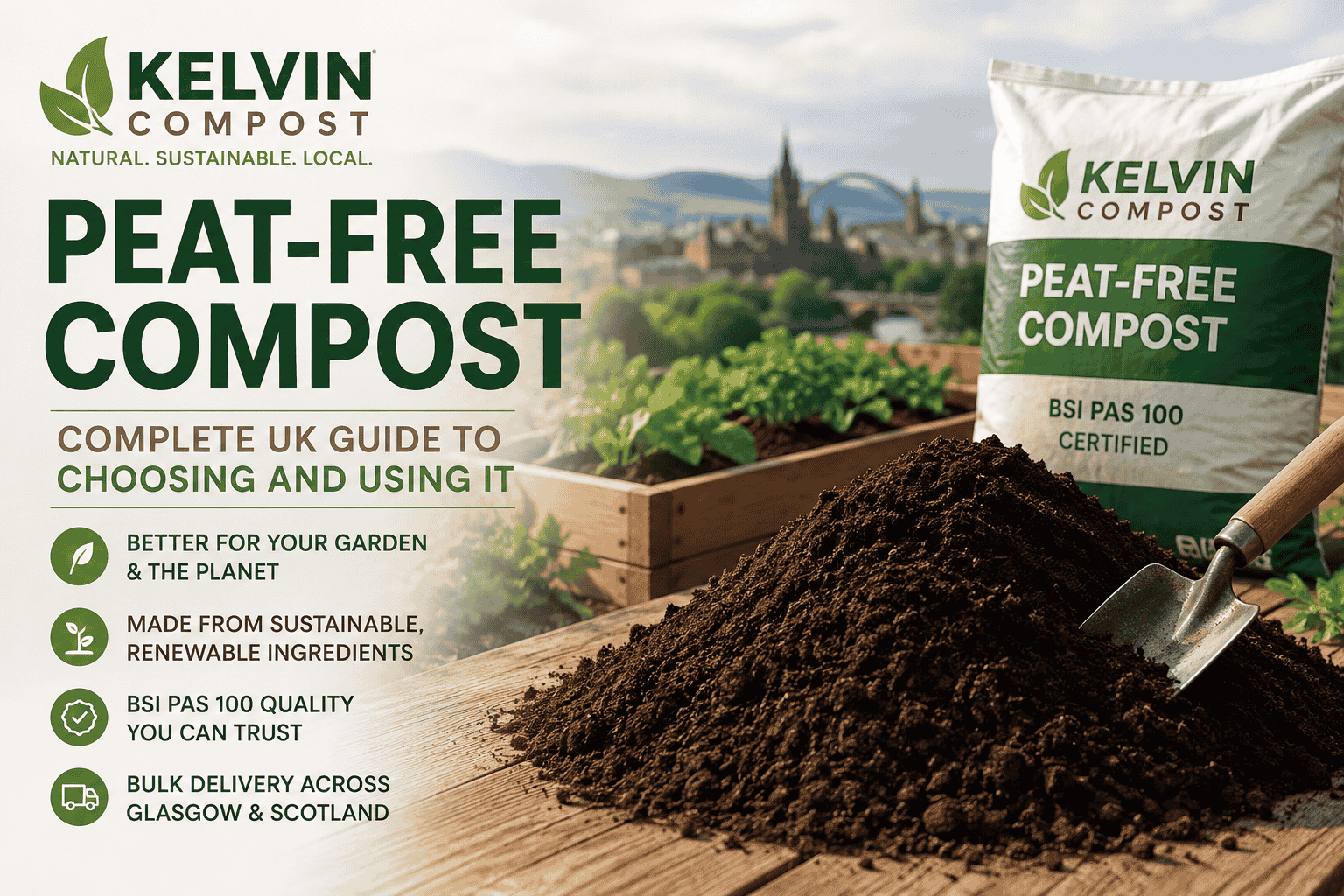
Peat-free compost is a growing choice for gardeners who want an effective growing medium without using peat.
But what exactly is peat-free compost, what is it made from, and is it suitable for vegetables, flowers, pots, raised beds and general garden use?
Yes — quality peat-free compost can be used for a wide range of gardening applications. The important thing is choosing a compost that is suitable for the job you are doing.
Peat-free compost can be made using materials such as green waste compost, wood fibre, bark, coir and other renewable organic materials. Different products have different characteristics, so it is worth checking the product specification before buying.
In this guide, Kelvin Compost explains what peat-free compost is, its benefits, how to use it and what to look for when buying quality compost.
What Is Peat-Free Compost?
Peat-free compost is a growing medium that contains no peat.
Instead of relying on peat, manufacturers use alternative materials to provide the structure, moisture retention, drainage and organic matter required for plant growth.
Depending on the product, ingredients can include:
- Green waste compost
- Wood fibre
- Bark
- Coir
- Composted organic materials
- Other plant-based growing-medium ingredients
The exact ingredients vary between products.
This means two bags labelled peat-free compost are not necessarily identical.
The quality, texture, nutrient content, water retention and drainage characteristics can all vary.
Why Are Gardeners Choosing Peat-Free Compost?
Peat has traditionally been widely used in horticultural growing media because it has useful physical properties.
However, peatlands are important natural ecosystems and carbon stores.
Using alternatives allows gardeners to grow plants without relying on peat-based growing media.
For gardeners, the key point is that peat-free does not mean low quality.
A well-made peat-free compost can provide a useful growing medium for many plants and gardening applications.
What Is Peat-Free Compost Made From?
There is no single recipe for peat-free compost.
Different manufacturers use different combinations of materials.
Green Waste Compost
Composted green waste can provide organic matter and nutrients.
It is commonly produced from materials such as:
- Grass cuttings
- Leaves
- Prunings
- Plant material
- Garden waste
Once properly composted and processed, green waste can become a useful soil improver and compost ingredient.
Wood Fibre
Wood fibre can provide structure and help create air spaces within a growing medium.
It can also contribute to drainage and reduce compaction.
Bark
Composted or processed bark can be used in growing media to provide structure and improve aeration.
Coir
Coir is derived from coconut fibre.
It is used in some growing media because it can hold moisture while maintaining useful air space.
Not every peat-free compost contains coir, however.
What Are the Benefits of Peat-Free Compost?
There are several reasons gardeners choose peat-free compost.
1. No Peat
The most obvious benefit is that peat-free compost does not rely on peat as an ingredient.
2. Useful for Sustainable Gardening
Peat-free gardening can form part of a wider approach to reducing reliance on finite or environmentally sensitive materials.
3. Suitable for Many Garden Uses
Good-quality peat-free compost can be used for:
- Flowers
- Vegetables
- Containers
- Pots
- Hanging baskets
- Raised beds
- Planting
- Seedlings, where the product is specifically suitable
4. Organic Matter
Many peat-free composts contain organic materials that can contribute to soil structure and organic matter.
5. Useful for Soil Improvement
Compost can be incorporated into existing garden soil to improve its organic matter content and structure.
Is Peat-Free Compost as Good as Peat Compost?
For many gardening applications, yes.
However, gardeners sometimes notice that peat-free compost behaves differently from traditional peat-based compost.
This is because peat-free composts use different materials.
You may notice differences in:
- Water retention
- Drying speed
- Texture
- Nutrient availability
- Weight
- Structure
This does not necessarily mean one is better than the other.
It means you may need to adjust how you use and water peat-free compost.
For example, some peat-free growing media can become difficult to re-wet if allowed to dry out completely, so regular watering is important.
Is Peat-Free Compost Good for Vegetables?
Yes, provided you choose a compost suitable for vegetable growing.
Vegetables need a growing medium with appropriate:
- Nutrients
- Structure
- Moisture
- Drainage
- Rooting environment
Peat-free compost can be used for:
- Vegetable beds
- Containers
- Potato growing
- Herbs
- Salad crops
- Tomato growing
- Raised beds
However, not every peat-free compost is designed for every stage of vegetable growing.
Always check whether the product is recommended for the particular application.
Is Peat-Free Compost Good for Pots and Containers?
Yes.
Peat-free compost can be used for many container-grown plants.
Containers have limited space, so the growing medium needs to provide a good balance between:
Water + Air + Nutrients + Root Space
When using peat-free compost in pots:
- Fill the container with suitable compost.
- Plant at the appropriate depth.
- Water thoroughly.
- Keep the compost consistently moist without leaving the plant waterlogged.
- Feed plants when the available nutrients begin to decline.
The correct watering routine is particularly important during warm or dry periods.
Is Peat-Free Compost Good for Raised Beds?
Peat-free compost can be useful in raised beds, but it is important to distinguish between compost and bulk soil.
Large raised beds require substantial quantities of material.
Using pure compost to fill a large raised bed can be unnecessarily expensive and may not provide the ideal long-term structure for every application.
A more practical approach can be:
Quality topsoil + suitable peat-free compost
The topsoil provides the bulk growing medium, while compost contributes organic matter.
This is particularly useful when creating new vegetable beds or improving an existing raised bed.
For more information, see Kelvin Compost's guide to topsoil for gardens and raised beds.
Peat-Free Compost vs Topsoil
Topsoil and compost perform different jobs.
| Feature | Peat-Free Compost | Topsoil |
|---|---|---|
| Main purpose | Organic matter and growing medium | Soil volume and structure |
| Suitable for containers | Yes | Usually not ideal alone |
| Suitable for raised beds | Yes, as part of a mix | Yes |
| Suitable for improving soil | Yes | Yes |
| Main bulk material | Not usually for large projects | Yes |
| Organic matter | Generally high | Variable |
| Suitable for lawns | Soil improvement/top dressing depending on product | Yes |
A simple way to remember the difference is:
Topsoil builds the soil. Compost improves the soil.
For many garden projects, using both products together gives better results than relying entirely on one.
Peat-Free Compost vs Organic Compost
The terms peat-free and organic do not necessarily mean exactly the same thing.
Peat-free tells you that the compost does not contain peat.
Organic describes the nature or source of the materials and how the product is produced, depending on the specific certification or product definition.
A compost can be peat-free without necessarily being certified organic.
If organic certification is important to you, check the actual product certification rather than assuming that “peat-free” automatically means “certified organic”.
How to Choose the Best Peat-Free Compost
Not all peat-free composts are designed for the same purpose.
Before buying, consider the following.
1. What Are You Growing?
A compost for ornamental plants may have different characteristics from compost designed for vegetables, seeds or containers.
2. Is It Ready to Use?
Some composts are ready-to-use growing media.
Others are intended primarily as soil improvers.
Check the product description carefully.
3. What Does It Contain?
Look at the ingredients or product specification.
This can tell you more about the compost than the marketing name alone.
4. Does It Have a Consistent Texture?
Good-quality compost should have a suitable structure for its intended use.
Avoid products containing excessive:
- Large pieces
- Plastic
- Glass
- Rubbish
- Uncomposted material
5. What Is the Product Standard?
Where relevant, look for recognised quality standards and certification.
For compost products, BSI PAS 100 is an important UK specification associated with quality compost produced from source-segregated biodegradable materials.
If certification is important for your project, check the supplier's current certification and product documentation.
How to Use Peat-Free Compost in the Garden
There are several ways to use peat-free compost.
Improving Existing Soil
Spread compost over the soil surface and incorporate it where appropriate.
This can increase organic matter and help improve soil structure.
Planting New Borders
Peat-free compost can be incorporated into planting areas when preparing new beds.
Vegetable Gardens
Add suitable compost to vegetable beds before planting.
Containers
Use a peat-free compost designed for container growing.
Mulching
Some compost products can be used as an organic mulch around established plants.
Check the product's recommended application before using it as a mulch.
How Much Peat-Free Compost Do I Need?
The amount depends on what you are doing.
For an area, calculate:
Length × Width × Depth = Volume
For example:
5 m × 4 m × 0.05 m = 1 m³
So a 5 m × 4 m area with a 5 cm layer requires approximately:
1 cubic metre of material
For smaller jobs, compost is commonly sold in bags.
For larger projects, bulk bags or loose loads can be more economical and practical.
Bulk Peat-Free Compost: Is It Worth Buying?
If you only need a small quantity, retail bags may be convenient.
If you are improving a large garden, allotment, school garden or landscaping project, buying compost in bulk can make more sense.
Bulk compost can be useful for:
- Large planting areas
- Vegetable gardens
- Allotments
- Raised beds
- Community gardens
- Schools
- Landscaping projects
Instead of carrying dozens of small bags, a bulk bag provides a much larger quantity in one delivery.
Peat-Free Compost for Allotments
Allotment gardeners often need significant amounts of organic matter.
Peat-free compost can be useful for:
- Vegetable beds
- Soil improvement
- Mulching
- Planting
- Seasonal soil preparation
For larger allotments, bulk delivery can be more convenient than buying compost in individual bags.
Kelvin Compost supplies compost and soil products for allotments and community growing projects around Glasgow and South Lanarkshire.
Peat-Free Compost for Schools and Community Gardens
School gardens and community growing projects can benefit from compost because it can be used across many growing areas.
It can support:
- Vegetable growing
- Flower beds
- Raised beds
- Educational gardening
- Community allotments
- Wildlife-friendly planting
For larger projects, buying compost in bulk can also reduce packaging compared with purchasing many small retail bags.
Peat-Free Compost in Glasgow
If you are looking for peat-free compost in Glasgow, consider both the compost itself and how it will be delivered.
For a small garden, bags may be convenient.
For a large garden, allotment, school or landscaping project, bulk delivery may be more practical.
Kelvin Compost is based in South Lanarkshire and supplies compost, topsoil, manure and woodchip for customers across Glasgow and surrounding areas.
When ordering, consider:
- Quantity required
- Intended use
- Access to the property
- Bulk bag or loose delivery
- Where the material needs to be placed
Peat-Free Compost and Scottish Gardens
Scottish gardens can experience challenging growing conditions, including:
- High rainfall
- Wet winters
- Heavy soils
- Clay
- Poor drainage
- Shorter growing seasons
Using compost as part of a wider soil-management strategy can help increase organic matter and improve soil structure.
However, compost should not be considered a cure for severe drainage problems.
If water regularly sits on the surface of your garden, you may need to address the underlying drainage or compaction issue first.
Common Mistakes When Using Peat-Free Compost
Letting it dry out completely
Some peat-free growing media can be harder to re-wet after becoming extremely dry.
Regular watering helps prevent this.
Using the wrong compost
A general-purpose compost may not be ideal for seeds, ericaceous plants or specialist crops.
Always check the intended use.
Filling large beds entirely with compost
For large raised beds, using quality topsoil as the bulk material and adding compost can be a more practical approach.
Assuming all peat-free compost is identical
Different ingredients produce different characteristics.
Always check the product specification.
Buying purely on price
The cheapest compost may not provide the consistency or performance required for your particular project.
Is Peat-Free Compost Better for the Environment?
Peat-free compost avoids the use of peat, which is important because peatlands are valuable ecosystems and significant carbon stores.
However, “peat-free” should not automatically be interpreted as meaning that every product has the same environmental footprint.
Different alternative ingredients have different production, processing, transportation and sourcing considerations.
A sensible approach is to look at:
- The source of ingredients
- Renewable content
- Local production where possible
- Recycled or recovered organic materials
- Product certification
- Packaging
- Delivery distance
For gardeners, choosing quality peat-free compost from a transparent supplier is one practical step towards reducing reliance on peat.
Frequently Asked Questions About Peat-Free Compost
What is peat-free compost?
Peat-free compost is a growing medium made without peat. It uses alternative materials such as green waste compost, wood fibre, bark, coir and other organic materials depending on the product.
Is peat-free compost good?
Yes. Quality peat-free compost can be suitable for many gardening applications, including containers, vegetables, flowers, raised beds and soil improvement.
What is the best peat-free compost?
The best peat-free compost depends on what you are growing. Choose a product specifically suited to your plants and check its ingredients, specification and quality.
Can you grow vegetables in peat-free compost?
Yes. Suitable peat-free compost can be used for vegetables, herbs and many other edible crops.
Can I use peat-free compost in pots?
Yes. Choose a peat-free compost suitable for container growing and maintain appropriate watering and feeding.
Is peat-free compost the same as organic compost?
No. Peat-free describes what the compost does not contain. Organic describes the nature or certification of the materials and production process. Check the product's actual certification if this matters to you.
Can peat-free compost be used in raised beds?
Yes. It can be incorporated into raised beds, although quality topsoil is generally more practical as the main bulk material for a large raised bed.
Does peat-free compost dry out?
Some peat-free growing media can behave differently from peat-based compost and may become difficult to re-wet if allowed to dry out completely. Regular watering is important.
How much peat-free compost do I need?
Calculate the required volume using:
Length × Width × Depth = cubic metres
For larger areas, buying compost in bulk can be more practical.
Is peat-free compost good for lawns?
Compost can be useful for soil improvement and certain lawn applications, but dedicated lawn topsoil is generally more appropriate when creating a new lawn.
Can peat-free compost improve clay soil?
Yes, adding suitable organic matter can help improve soil structure over time. However, compost alone will not necessarily solve serious drainage or waterlogging problems.
Where can I buy peat-free compost in Glasgow?
Kelvin Compost supplies compost and soil products to gardens, allotments, schools, farms and landscaping projects around Glasgow and South Lanarkshire.
Peat-Free Compost: Final Verdict
Peat-free compost is a practical choice for gardeners who want to grow plants without using peat-based growing media.
It can be used for:
- Vegetable gardens
- Flower beds
- Containers
- Pots
- Raised beds
- Allotments
- Soil improvement
- Community gardens
The most important thing is to choose a product that matches your application.
For containers, select a suitable growing compost.
For vegetables, choose compost appropriate for edible crops.
For raised beds, combine compost with suitable topsoil where appropriate.
For larger gardens and allotments, consider buying compost in bulk.
If you are looking for peat-free compost in Glasgow, South Lanarkshire or surrounding areas, Kelvin Compost supplies compost, topsoil, manure and woodchip for domestic, commercial, community and landscaping projects.
Need help choosing the right compost or working out how much you need? Contact Kelvin Compost with your project details and requirements.
Need Garden Supplies Delivered in Glasgow?
Organic compost, topsoil, manure and more across Scotland