




Making Your Own Compost | How Much You'll Actually Get
Looking for compost, topsoil or garden supplies?
Browse our full product range or get in touch for delivery across Glasgow and Scotland.
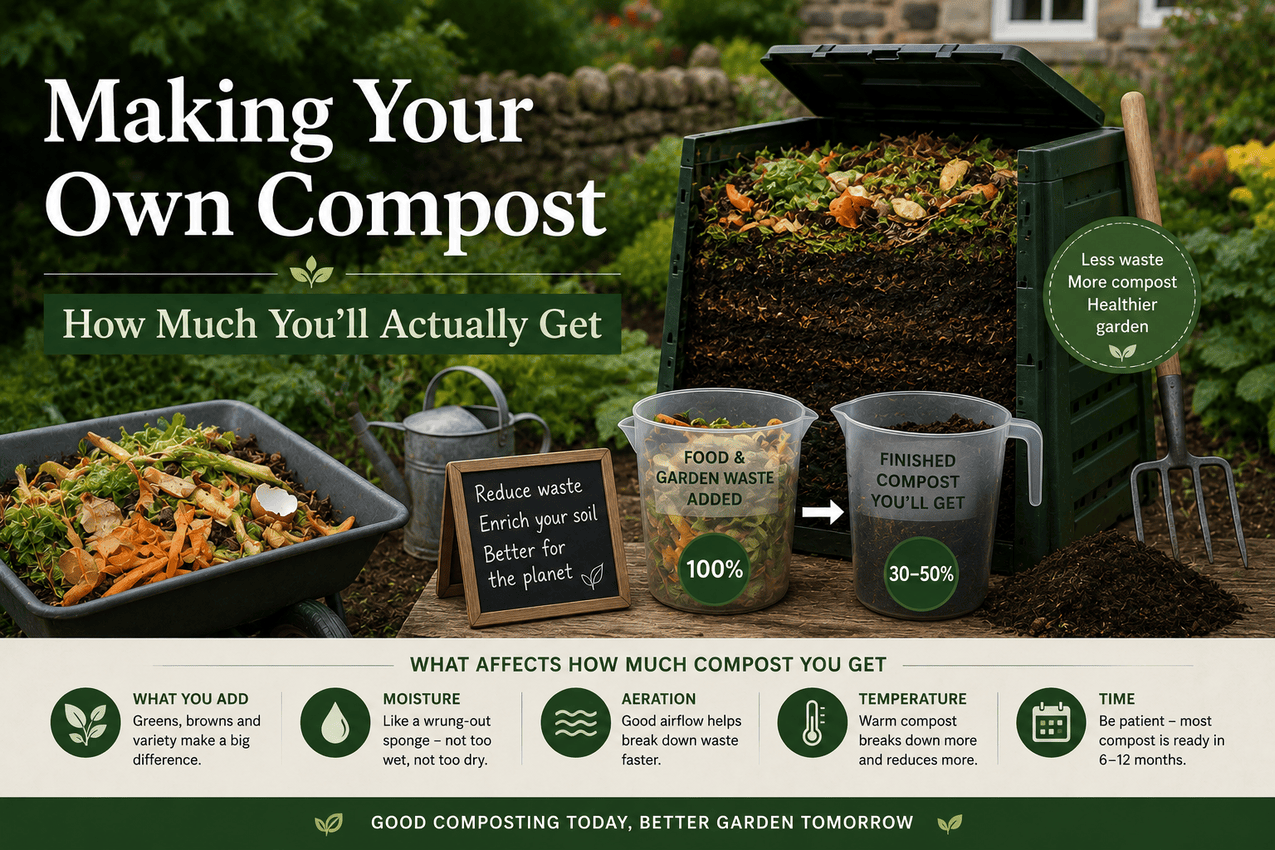
Short answer: get the ratio right — roughly a quarter to a half green material, the rest brown — keep it moist, turn it a few times a year, and you'll have compost in six months to two years. But be realistic about volume: a standard home bin produces somewhere around 100–200 litres of finished compost a year. That's 0.1–0.2m³. A half allotment plot mulched at 5cm needs 6.25m³.
We sell compost for a living, and we'd still tell every gardener to make their own. It's free, it recycles waste that would otherwise be collected, and home-made compost is genuinely excellent material. What almost no guide will tell you is how little of it you end up with — so this one covers both the method and the maths.
The one thing that decides whether it works
Composting is a ratio problem. Everything else is detail.
Greens are soft, wet, nitrogen-rich: grass clippings, vegetable peelings, fruit scraps, annual weeds, soft prunings, coffee grounds.
Browns are dry, woody, carbon-rich: shredded prunings, hedge trimmings, dried stems, straw, torn cardboard, paper, autumn leaves.
The RHS ratio is 25–50% greens to 75–50% browns — in other words, browns should be at least half the heap and can be as much as three quarters.
Almost every failed compost bin has too many greens. A bin filled with grass clippings and kitchen waste turns into a slimy, sour, anaerobic mass that smells of ammonia and never becomes compost. The fix is almost always the same: add cardboard.
That's the practical trick worth remembering. Keep a stack of torn-up cardboard next to the bin. Every time you add a caddy of kitchen waste or a mowing, add a roughly equal or greater volume of cardboard. It costs nothing and it solves 90% of composting problems before they start.
Getting it right
Size matters. Bins under 1 cubic metre are less efficient than larger ones — they don't hold heat as well — though they will still make compost. If you have room for two bins, use two: fill one while the other finishes.
Keep it moist, not wet. It should feel like a wrung-out sponge. Water it in dry weather; cover it against heavy rain if it's getting sodden. In the west of Scotland, keeping rain out is usually the more common problem.
Chop things up. Surface area drives decomposition. A shredded prunings pile composts in a fraction of the time whole stems take.
Turn it several times a year. Turning introduces air and moves the cool outer material into the hot centre. You don't have to — a well-balanced heap will compost without turning — but turning roughly halves the time.
Site it on soil, in a spot with some sun if possible. Contact with soil lets worms and organisms move in from below.
What not to compost
- Cooked food, meat and fish — attracts rats, and Glasgow allotments have enough rats already
- Dog and cat faeces — pathogen risk
- Perennial weed roots — couch grass, bindweed and ground elder survive a cold heap and you'll spread them
- Seeding weeds — a home heap rarely gets hot enough to kill weed seed
- Diseased plant material — particularly blighted potato and tomato foliage, and clubroot-affected brassica roots
- Glossy printed card, and anything with tape or plastic
- Grass clippings from a lawn treated with weedkiller — some lawn products contain clopyralid, which survives composting and damages sensitive crops
That last point deserves emphasis. It's the same chemistry that causes aminopyralid contamination in bought-in manure, and you can introduce it to your own heap without realising.
How long it takes
Six months to two years to reach maturity, depending on bin size, ratio, how finely you chopped things and how often you turned it.
- Turned regularly, well-balanced, decent size: six to nine months
- Filled and forgotten: 18 months to two years
- Hot composting (large volume built in one go, turned frequently): a few weeks — but it needs a lot of material at once and real commitment
It's ready when it's dark brown, crumbly, smells of woodland floor rather than anything sour, and you can no longer identify what went in. A few twigs and eggshell fragments are fine — sieve them out or throw them back in the next batch.
Now the honest arithmetic
Here's the part missing from most home composting guides.
Material loses a great deal of volume as it decomposes — typically finishing at something like a third to a half of what you put in. A standard 330-litre "dalek" bin, filled and topped up through the year, realistically yields somewhere in the region of 100–200 litres of finished compost annually. Call it 0.15m³ as a working figure.
Now compare that against what gardens actually consume:
| Job | Compost needed | Years of one home bin |
|---|---|---|
| Topping up four raised beds at 5cm | 0.58 m³ | ≈4 years |
| Mulching a 10m × 1.5m border at 7.5cm | 1.13 m³ | ≈8 years |
| Half allotment plot (125m²) at 5cm | 6.25 m³ | ≈42 years |
| Full plot (250m²) at 5cm | 12.5 m³ | ≈83 years |
| Converting a full plot to no-dig at 10cm | 25 m³ | ≈167 years |
Those numbers aren't an argument against home composting. They're an argument for understanding what it's for.
What home composting realistically covers: kitchen and garden waste recycling, top-ups for a few raised beds, potting mixes, a small border, and the genuine satisfaction of closing the loop. For a modest garden with several bins and plenty of material, it can cover most annual needs.
What it cannot cover: converting a plot, establishing beds, mulching an allotment, filling raised beds, or any project measured in cubic metres. There is simply no way to produce that volume from one household's waste stream.
Most serious growers end up doing both — composting everything they generate, and buying in bulk for the jobs that need volume. That isn't a failure of home composting; it's just arithmetic.
How to get more from your own heap
If you want to close the gap, the levers are:
- More bins. Three bins in rotation produce far more than one, and cost very little.
- Import browns. Cardboard is free and abundant. Autumn leaves from your street are free. Both are pure gain.
- Get grass clippings from neighbours — with cardboard to balance them.
- Leafmould separately. Leaves composted alone in a bin bag or wire cage make excellent material with almost no effort, just time.
- Stop throwing away woody prunings. Shredded, they're your brown supply.
Home-made vs bought-in: what each is good for
| Home-made compost | Bought PAS 100 compost | |
|---|---|---|
| Cost | Free | Paid |
| Volume available | 0.1–0.2 m³ per bin per year | Any quantity |
| Weed seed | Likely — home heaps rarely get hot enough | Killed by the certified process |
| Consistency | Variable batch to batch | Screened and consistent |
| Herbicide risk | Only if you introduce it | Managed and certified |
| Best used for | Top-ups, potting, small borders | Bulk mulching, bed conversion, filling, projects |
The one meaningful quality difference is temperature. A PAS 100 process must reach and hold a high enough temperature to destroy weed seed and pathogens. A home bin usually doesn't — which is why home compost is best used where a few weed seedlings don't matter, and bought compost is better where you're spreading over a large area or planting straight into it.
Fixing a compost bin that isn't working
| Problem | Cause | Fix |
|---|---|---|
| Slimy, smelly, sour | Too many greens, not enough air | Add cardboard and dry browns, turn it |
| Dry, nothing happening | Too many browns, too dry | Add greens, water it, turn it |
| Ammonia smell | Excess nitrogen | Add browns immediately |
| Rats | Cooked food, meat, or a dry cosy heap | Remove food waste, keep it moist, use a bin with a base |
| Flies | Exposed food waste | Bury kitchen waste under browns |
| Taking forever | Material too coarse, heap too small, never turned | Chop finer, combine bins, turn it |
Frequently asked questions
How do you make compost at home? Combine roughly 25–50% soft green material (grass clippings, vegetable peelings, annual weeds) with 50–75% woody brown material (cardboard, shredded prunings, dried stems, leaves). Keep it as moist as a wrung-out sponge, turn it several times a year, and it will be ready in six months to two years.
What is the correct green to brown ratio for compost? The RHS advises 25–50% greens and 50–75% browns. Most failed heaps have too many greens — the reliable fix is adding torn-up cardboard whenever you add kitchen waste or grass clippings.
How long does garden compost take? Between six months and two years, depending on bin size, the green-to-brown balance, how finely material is chopped and how often it is turned. A well-balanced, regularly turned bin of decent size is usually ready in six to nine months.
How much compost does a home bin produce in a year? Roughly 100–200 litres — about 0.1 to 0.2 cubic metres — from a standard 330-litre bin, because material loses most of its volume as it decomposes. For comparison, mulching a 125m² allotment half plot at 5cm needs 6.25 cubic metres.
Can home composting supply all the compost I need? For a small garden with several bins, often yes. For an allotment or any project measured in cubic metres, no. A half plot mulched at 5cm needs the equivalent of about 42 years of one home bin's output, so most growers compost what they generate and buy in bulk for the bigger jobs.
What should you not put in a compost bin? Cooked food, meat and fish (rats), dog and cat faeces, perennial weed roots such as couch grass and bindweed, seeding weeds, diseased plant material, glossy printed card, and grass clippings from a lawn treated with weedkiller — some lawn products contain clopyralid, which survives composting.
How do I know when compost is ready? It is dark brown and crumbly, smells like a woodland floor rather than anything sour, and you can no longer identify the original ingredients. A few twigs and eggshell fragments are normal — sieve them out or return them to the next batch.
Why does my compost smell bad? Almost always too many greens and not enough air, which turns the heap anaerobic. Add cardboard and dry brown material, turn it thoroughly, and the smell should clear within days.
Do I need to turn my compost? Not strictly — a well-balanced heap will compost without turning — but turning introduces air and moves cool outer material into the centre, which roughly halves the time. Several turns a year is enough.
Is home-made compost as good as bought compost? For soil improvement, home-made compost is excellent. The difference is temperature: a certified PAS 100 process reaches and holds temperatures that destroy weed seed and pathogens, while a home bin usually does not. Use home-made compost where a few weed seedlings don't matter, and certified compost for large areas or where plants root directly into it.
When you need more than a bin can make
Compost everything you generate — then let us cover the volume jobs. We supply BSI PAS 100 certified organic compost, well-rotted manure, topsoil and woodchip across Glasgow, East Kilbride, South Lanarkshire and the Central Belt, in 850L bulk bags or 10 and 20 tonne loose loads, with HIAB delivery for tight access and depot uplift from Chapelton.
Browse our products · call 07561 251350 · email info@kelvincompost.co.uk · use code INTERNET for 5% off 850L sacks.
Kelvin Compost is the trading arm of ASAP (After School Activities Programme) — proceeds support local community projects.
Need Garden Supplies Delivered in Glasgow?
Organic compost, topsoil, manure and more across Scotland