




Looking for woodchip, bark or compost mulch delivered in bulk?
Looking for compost, topsoil or garden supplies?
Browse our full product range or get in touch for delivery across Glasgow and Scotland.
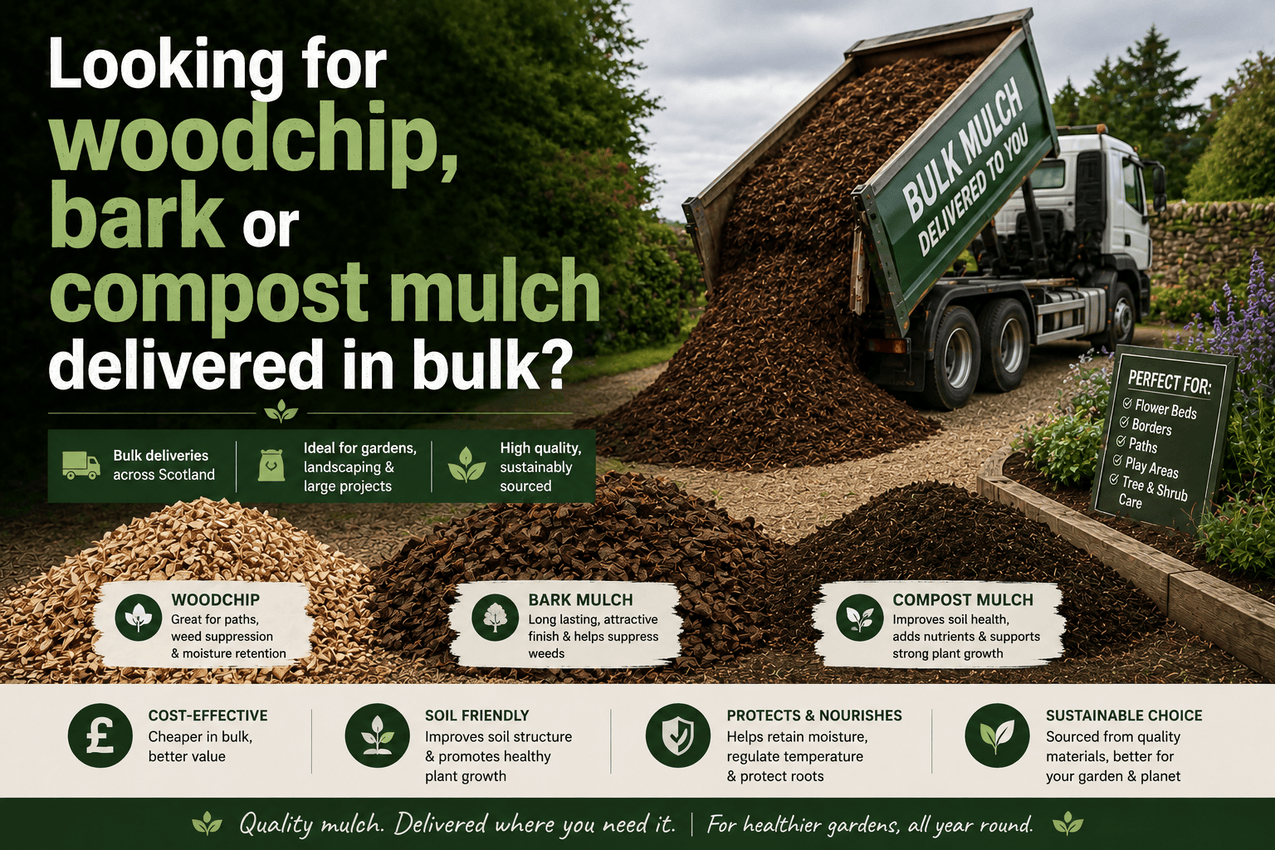
Woodchip vs Bark vs Compost Mulch: Which Is Best for Weed Suppression?
Quick answer: For weed suppression specifically, woodchip and bark mulch outperform compost, because they form a denser, longer-lasting physical barrier that compost breaks down through too quickly to block light effectively. Apply woodchip or bark at 7–10cm depth for genuine weed suppression; compost works better as a soil-feeding mulch at 5cm and needs topping up more often if weed control is the main goal. For the best of both, many gardeners use compost as a base feed layer with woodchip or bark on top.
Mulch does two different jobs — feeding the soil and blocking weeds — and no single material is best at both. Compost is a better feed; woodchip and bark are better barriers. Buying the wrong one for the job means either weeds coming through within weeks, or a barrier layer that does nothing for soil health underneath. This guide breaks down which material suits which goal, so you're not choosing based on price alone.
What's the difference between woodchip, bark and compost mulch?
Woodchip is coarse, irregular wood pieces that break down slowly and form a dense physical barrier; bark mulch is more uniform, decorative bark chips that behave similarly to woodchip but often at a higher price point; compost is a fine, nutrient-rich organic material that feeds soil as it breaks down but offers a much thinner, shorter-lived barrier against weeds.
| Material | Weed suppression | Soil feeding | Breakdown speed | Best for |
|---|---|---|---|---|
| Woodchip | Strong | Minimal (can temporarily reduce nitrogen) | Slow (1–3 years) | Paths, borders, tree surrounds, weed-heavy areas |
| Bark mulch | Strong | Minimal | Slow to moderate (1–2 years) | Ornamental borders, ericaceous beds, ornamental appearance |
| Compost | Moderate | Strong | Fast (within one season) | Vegetable beds, feeding soil, areas replanted often |
Which mulch is best for weed suppression specifically?
Woodchip is generally the most effective mulch for weed suppression, because its coarse, irregular structure creates a deep, light-blocking barrier that's slow to break down and difficult for weed seedlings to push through. Bark mulch performs similarly, though it's often applied at a slightly shallower depth for appearance, which can reduce its weed-blocking effectiveness compared to a thicker woodchip layer.
Compost, by contrast, breaks down and thins out over a single growing season, and its finer texture doesn't block light as effectively even at the same depth — it's a poor primary choice if weed suppression is the main goal, though it remains valuable for what it adds to the soil underneath.
How deep does mulch need to be for weed suppression?
For genuine weed suppression, apply woodchip or bark mulch at 7–10cm depth — anything shallower than 5cm allows enough light through for many weed seeds to germinate. Compost used as a weed-suppressing mulch needs a similar 7–10cm depth to be effective, but because it breaks down faster, that depth doesn't hold for as long before needing topping up.
| Goal | Material | Recommended depth |
|---|---|---|
| Strong weed suppression | Woodchip or bark | 7–10cm |
| Light weed suppression + feeding | Compost | 5–7cm |
| Moisture retention only | Any of the three | 5cm |
| Decorative finish (borders visible from paths) | Bark | 5–7cm |
Does woodchip mulch take nutrients from the soil?
Fresh woodchip can temporarily reduce nitrogen at the soil surface as it starts to break down, since the micro-organisms decomposing the wood draw nitrogen from the surrounding soil to do so — this mainly affects the top few centimetres and rarely causes problems for established plants with deeper root systems, but it's worth avoiding fresh, unweathered woodchip worked directly into soil around shallow-rooted or young plants. Using woodchip as a surface mulch rather than digging it in avoids most of this issue, since the nitrogen draw happens mainly at the wood-soil contact layer.
Can I combine compost and woodchip or bark mulch?
Yes, and it's often the best approach — apply a layer of compost directly onto the soil to feed it, then top with 5–7cm of woodchip or bark mulch for weed suppression and moisture retention. This combination gets the soil-feeding benefit of compost without sacrificing the weed barrier that woodchip and bark provide, and it's a common approach for ornamental borders and shrub beds where both goals matter.
Which mulch is best for vegetable beds?
Compost is generally the better mulch for actively cropped vegetable beds, since woodchip and bark can be too acidic and nutrient-poor for annual vegetables, and their slow breakdown doesn't suit beds that are dug over and replanted every season. Woodchip and bark are better suited to permanent plantings — trees, shrubs, and perennial borders — where the bed isn't disturbed annually and the mulch has years to do its job.
Which mulch is best for paths and low-maintenance areas?
Woodchip is the standard choice for garden paths and low-maintenance ground cover, since it's cheaper than bark at scale, forms a durable surface underfoot, and doesn't need refreshing as often as compost. Bark is more often used where appearance matters more than cost, such as visible ornamental borders near a house or entrance.
Is Kelvin woodchip, bark and compost mulch peat-free and locally sourced?
Yes. Our woodchip and compost are produced and matured at our site in Chapelton, South Lanarkshire, with no synthetic chemicals or peat used in either product. We supply both in bulk bags and loose tonne loads, which works out considerably more cost-effective than bagged mulch from a garden centre for anything beyond a small border.
Ordering mulch delivery in Glasgow
- Decide whether the priority is weed suppression, feeding, or appearance
- Choose Woodchip for weed-heavy paths and borders, Bark for ornamental areas, or Compost for actively cropped beds
- Order online through our product pages, or call +44 7561 251350 for bulk tonne loads on larger areas
We deliver across Glasgow, East Kilbride and South Lanarkshire (£15 local delivery in East Kilbride and surrounding areas), with quotes available for the wider Central Belt.
Frequently Asked Questions
Does bark mulch stop weeds completely? No mulch stops weeds completely, but a 7–10cm layer of bark or woodchip significantly reduces germination by blocking light — some weeds, particularly wind-blown seeds landing on top of the mulch, can still establish and will need occasional hand-weeding.
How often does woodchip mulch need replacing? Woodchip typically lasts 1–3 years before needing topping up, considerably longer than compost mulch, which usually needs refreshing within a single growing season.
Is compost or bark better for acid-loving plants? Bark, particularly pine or ericaceous bark, tends to suit acid-loving plants like azaleas, camellias and blueberries better than compost, which is closer to neutral pH and doesn't provide the same acidifying effect over time.
Can I use woodchip mulch on a vegetable bed? It's not ideal — woodchip breaks down slowly and can temporarily tie up nitrogen at the soil surface, which isn't well suited to annual vegetable beds that are dug over and replanted each season. Compost is the better choice there.
Is woodchip cheaper than bark mulch? Generally yes, particularly when bought in bulk — bark is often more processed and sold at a premium for its more uniform, decorative appearance, while woodchip is a more economical choice for larger areas like paths and informal borders.
Need Garden Supplies Delivered in Glasgow?
Organic compost, topsoil, manure and more across Scotland