


How to Stop a Muddy Garden in Winter: Scotland
Looking for compost, topsoil or garden supplies?
Browse our full product range or get in touch for delivery across Glasgow and Scotland.
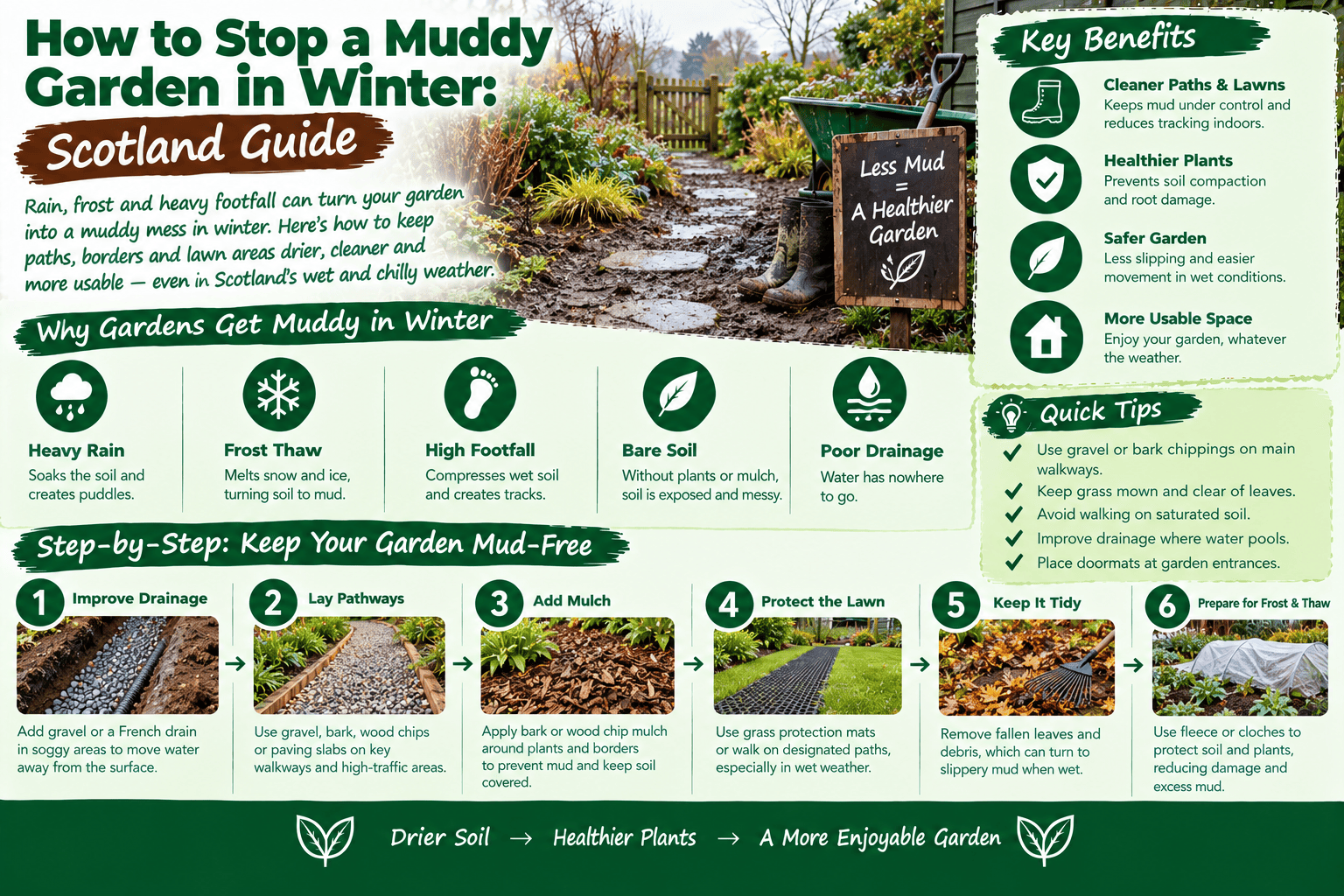
How to Stop Your Garden Turning Into Mud in Winter: A Glasgow & Scotland Guide
You step outside after another rainy day and find the same problem: muddy footprints across the lawn, slippery garden paths and patches of bare soil that never seem to dry.
If you live in Glasgow or elsewhere in western Scotland, the combination of frequent rainfall, shorter winter days and heavy foot traffic can make outdoor spaces difficult to use.
The good news is that you don't always need to redesign your entire garden.
Sometimes the answer is as simple as creating a proper path, protecting exposed soil or keeping people off vulnerable lawn areas. In other cases, poor drainage or serious compaction needs attention first.
The best way to stop a garden becoming muddy is to identify where the water and wear are coming from, then choose a suitable surface or drainage solution. Woodchip can be useful for informal paths, while properly constructed gravel or paved paths may be better for heavily used routes.
Here's how to make your garden more usable through a Scottish winter.
Why Does My Garden Get So Muddy in Winter?
Mud forms when soil becomes wet and is repeatedly disturbed.
A healthy lawn normally protects the soil beneath it, but grass can wear away when people or pets follow the same route every day.
Once the soil is exposed, rainfall and foot traffic can quickly turn it into a muddy patch.
Common causes include:
Repeated walking over the same area.
Dogs running along fences or between doors and gates.
Compacted soil.
Poor drainage.
Heavy shade and weak grass growth.
Bare soil around garden beds.
Water running from patios, roofs or higher ground.
Several problems may occur together.
For example, a shaded garden with compacted clay soil may remain wet long after rainfall, making grass recovery difficult.
Is Muddy Soil the Same as Waterlogged Soil?
Not necessarily.
A muddy garden may simply have exposed soil that is repeatedly walked on while wet.
A waterlogged garden has excess water occupying soil pores for extended periods, restricting oxygen around plant roots.
The distinction matters.
If your main problem is a worn pathway, creating a suitable walking surface may help.
If water remains standing across the garden for days, the underlying drainage needs investigating.
Covering a serious drainage problem with woodchip or topsoil won't solve it.
1. Create a Woodchip Garden Path
For informal paths, suitable coarse woodchip can be a practical option.
It's particularly useful for:
Allotment paths.
Routes between vegetable beds.
Informal garden walkways.
Access around established planting areas.
Woodchip provides a sacrificial surface that can be replenished as it breaks down.
However, it isn't a permanent engineered drainage system.
On very soft or persistently waterlogged ground, woodchip may sink into the soil or become saturated.
For heavily used paths, a properly designed base may be necessary.
How deep should a woodchip path be?
The required depth depends on the site and intended use.
A layer around 7.5–10cm may be a starting point for some informal paths, but this is not a universal construction specification.
Consider ground conditions, expected traffic and whether an appropriate base or edging is needed.
2. Use Gravel for Heavily Used Garden Routes
Where a path is used daily, gravel may offer a more durable option than loose woodchip.
But pouring gravel directly onto mud rarely produces a good long-term result.
A suitable gravel path generally needs proper excavation, a stable sub-base, appropriate separation materials where required and edging.
The exact design depends on the ground and expected use.
If water collects in the area, drainage may need to be addressed as part of the construction.
3. Protect Bare Soil in Flower Beds
Exposed soil can become messy during prolonged rain.
Suitable organic mulch may help protect the surface from direct rainfall and reduce erosion.
For established shrub borders, woodchip or bark can be practical choices.
For suitable vegetable beds, mature compost may be useful as a soil-improving surface layer.
However, don't automatically spread thick compost across every bed.
Repeated heavy applications can add more nutrients than the soil needs.
4. Stop Walking Across Wet Lawns
This sounds simple, but it can make a substantial difference.
When soil is saturated, repeated foot traffic can compact it and damage the grass.
If the same route is used daily, consider creating a defined path rather than expecting the lawn to tolerate constant winter wear.
Temporary access boards may help during short periods of garden work, but they should be used appropriately to avoid creating new damage.
5. Improve Compacted Soil
Compaction reduces pore space in the soil, making it harder for air and water to move through.
It can also restrict grass roots.
Signs may include:
Hard ground during dry periods.
Water collecting after rain.
Weak grass growth.
Shallow rooting.
Repeated muddy patches.
For lawns, appropriate aeration may help where compaction is the main problem.
For garden beds, adding suitable organic matter over time can support better soil structure.
Avoid digging or aerating when the ground is saturated.
6. Check Where Rainwater Is Coming From
Sometimes the garden isn't simply receiving rain from above.
Water may be flowing into it from nearby surfaces.
Check for:
Downpipes discharging near the lawn.
Patio runoff.
Water flowing from higher ground.
Blocked drainage channels.
Low areas where water accumulates.
If roof water or surface runoff is contributing to the problem, it may need a properly designed drainage solution.
Do not redirect water onto neighbouring properties or public areas.
7. Repair Worn Lawn Areas at the Right Time
If grass has disappeared from a muddy patch, reseeding may eventually be necessary.
However, winter isn't always the best time for establishing new grass.
In Scotland, soil temperatures and weather conditions can make seed germination unreliable during colder months.
It may be better to protect the area temporarily and carry out lawn repairs when suitable growing conditions return.
For larger repairs, suitable topsoil may be needed to correct levels or improve the growing surface.
But adding topsoil alone won't resolve a drainage defect.
8. Consider Stepping Stones or Paving
For routes between a back door, shed, gate or washing line, a permanent hard surface may be more practical than repeatedly repairing grass.
Stepping stones can provide defined access while retaining some planted or grassed areas.
Paving may be more suitable for heavily used routes.
Whichever option you choose, consider drainage, slip resistance, accessibility and proper construction.
A badly installed hard surface can create additional runoff problems.
9. Use the Right Material for the Right Problem
One of the most common mistakes is ordering a material because it's advertised as a general garden solution.
Woodchip, topsoil and organic compost do different jobs.
| Material | Main purpose | Suitable for muddy areas? |
|---|---|---|
| Woodchip | Surface cover and informal paths | Often useful for suitable paths |
| Topsoil | Mineral soil for landscaping and lawn preparation | Useful for rebuilding suitable growing areas |
| Organic compost | Soil improvement | Not a direct solution for muddy paths |
| Gravel | Durable path surface | Useful with proper construction |
| Paving | Permanent access | Useful with appropriate design |
If you're unsure, identify whether the main problem is traffic, drainage or poor soil structure before ordering.
How Much Woodchip Do You Need for a Garden Path?
Measure the length and width of the proposed path.
Then choose the appropriate depth.
Use:
Length × width × depth = volume in cubic metres
For example, a path measuring 10 metres long and 1 metre wide has an area of 10m².
At 10cm depth:
10 × 1 × 0.10 = 1m³
That's equivalent to 1,000 litres of woodchip.
Woodchip quantity guide for paths
| Path area | 7.5cm depth | 10cm depth |
|---|---|---|
| 5m² | 375L | 500L |
| 10m² | 750L | 1,000L |
| 15m² | 1,125L | 1,500L |
| 20m² | 1,500L | 2,000L |
| 30m² | 2,250L | 3,000L |
These are theoretical material volumes, not guaranteed installed quantities. Settlement, uneven ground and site conditions can increase requirements.
Check the supplier's actual bag capacity before ordering.
Can You Put Woodchip Directly on Mud?
Sometimes, but it's not always the best approach.
On a reasonably firm site with occasional foot traffic, woodchip may provide a useful temporary or informal surface.
On very soft, saturated ground, it may become embedded in the mud.
If the path is heavily used, proper ground preparation and a suitable base may be necessary.
Woodchip shouldn't be treated as a substitute for correcting serious drainage problems.
Will Woodchip Stop Mud Coming Through?
It can help separate footwear from exposed soil on suitable paths.
However, woodchip gradually breaks down and may need topping up.
On unstable or waterlogged ground, the underlying soil may mix with the woodchip.
The result depends on the path's construction and conditions.
Can Organic Compost Fix Muddy Soil?
Mature organic compost can help improve some soil properties over time.
But it doesn't instantly turn waterlogged ground into a well-drained garden.
If your garden has suitable soil that needs organic matter, compost may be useful.
If the area is persistently flooded or compacted over an impermeable layer, investigate the underlying cause first.
Can Topsoil Fix a Muddy Garden?
Topsoil can be useful when creating new growing areas or correcting appropriate levels.
However, placing a layer of topsoil over saturated ground can conceal rather than solve the problem.
If the soil beneath remains poorly drained, the new surface may also become wet.
Before adding substantial quantities, establish whether drainage, compaction or grading needs attention.
How to Keep a Garden Usable for Dogs in Winter
Dogs often create muddy tracks along fences, near gates and around favourite routes.
If the same areas are repeatedly worn bare, consider providing a dedicated path or durable surface.
Avoid assuming that grass seed alone will solve the problem.
The new grass needs suitable conditions and time to establish without heavy wear.
Choose materials that are appropriate for pets, and check for sharp objects, contaminants or unsuitable treatments.
For a heavily used dog run, a professionally designed surface may be more practical than loose organic mulch.
What Is the Best Surface for a Muddy Garden Path?
It depends on how the path will be used.
For a lightly used allotment path, coarse woodchip may be convenient.
For a daily route between the house and garage, a properly constructed hard surface may be more durable.
For a garden with severe waterlogging, drainage assessment should come before surface selection.
The right solution balances cost, maintenance, appearance, accessibility and site conditions.
Muddy Gardens in Glasgow: What Should Homeowners Consider?
Gardens across Glasgow, East Kilbride and South Lanarkshire vary considerably.
Some have clay-rich soil.
Others contain imported topsoil, compacted subsoil or areas affected by building work.
Western Scotland's wet weather can make existing problems more noticeable in autumn and winter.
Before starting a landscaping project:
Observe where mud forms after rain.
Identify heavily used routes.
Check for standing water.
Decide whether you need a path, lawn repair or drainage work.
Measure the area.
Choose materials suitable for the intended use.
Confirm delivery access before ordering.
Kelvin Compost supplies garden materials for landscaping and soil-improvement projects in the Glasgow area.
You can explore our woodchip, topsoil and organic compost.
Common Mistakes When Fixing a Muddy Garden
Adding topsoil without investigating drainage
The new surface may become muddy too.
Pouring gravel directly onto saturated ground
Without proper construction, gravel can sink or mix with the soil.
Using compost as a path surface
Compost is primarily a soil improver, not a durable walking surface.
Ignoring foot traffic
Repeated wear can destroy newly established grass.
Working wet clay soil
This can worsen compaction and damage soil structure.
Choosing woodchip without considering maintenance
Organic woodchip decomposes and needs replenishing.
Reseeding in unsuitable weather
Grass seed needs suitable growing conditions to establish.
Frequently Asked Questions
How do I stop my garden getting muddy in winter?
Identify the cause first. Defined paths, reduced foot traffic, suitable mulch and drainage improvements may help depending on the problem.
What can I put over mud in my garden?
For suitable informal paths, coarse woodchip may help. Heavily used areas may require a properly constructed gravel or paved surface.
Is woodchip good for muddy paths?
Yes, it can be useful for informal paths, but it may sink into very soft or waterlogged ground.
Can I put gravel straight onto mud?
It's generally better to prepare a suitable base rather than placing gravel directly onto unstable ground.
Will compost improve muddy soil?
Suitable mature compost can improve some soil properties over time, but it won't automatically solve waterlogging.
Can topsoil improve a muddy lawn?
Topsoil may be useful for suitable lawn repairs, but drainage and compaction problems need addressing first.
How deep should woodchip be on a path?
The appropriate depth depends on the path and ground conditions. Around 7.5–10cm may be considered for some informal paths.
How do I stop dogs making the garden muddy?
Protect heavily used routes with a suitable durable surface and allow worn grass areas to recover.
Why does my garden stay muddy after rain?
Possible causes include compaction, poor drainage, shade, heavy traffic and water runoff from surrounding areas.
Can I fix a muddy garden in winter?
Some surface improvements may be possible, but avoid major soil work when the ground is frozen or saturated.
What is the cheapest way to cover a muddy garden path?
Woodchip can be an economical option for suitable informal paths, although costs depend on quantity, delivery and maintenance.
Does mulch stop mud?
Suitable mulch can protect exposed soil and reduce surface disturbance, but it won't correct severe drainage problems.
Final Thoughts: Make Your Garden Practical, Not Just Tidy
A muddy garden can make winter frustrating, especially when you need regular access to sheds, bins, gates or growing areas.
But the solution doesn't always involve expensive landscaping.
For some gardens, a defined woodchip path and reduced lawn traffic may be enough.
Others need better drainage, more durable surfaces or repairs to compacted soil.
Start with the cause, then choose the material that solves the actual problem.
That approach is more effective than repeatedly spreading fresh material over the same muddy patch.
Planning a Garden Improvement Project in Glasgow?
Kelvin Compost supplies woodchip, topsoil, organic compost and other garden materials for homeowners, allotments and landscaping projects across Glasgow, East Kilbride, South Lanarkshire and surrounding areas.
Explore our products:
For product and delivery enquiries:
Phone: +44 7561 251350
Email: info@kelvincompost.co.uk
Need Garden Supplies Delivered in Glasgow?
Organic compost, topsoil, manure and more across Scotland