


How to Soften Hard Garden Soil: UK Guide
Looking for compost, topsoil or garden supplies?
Browse our full product range or get in touch for delivery across Glasgow and Scotland.
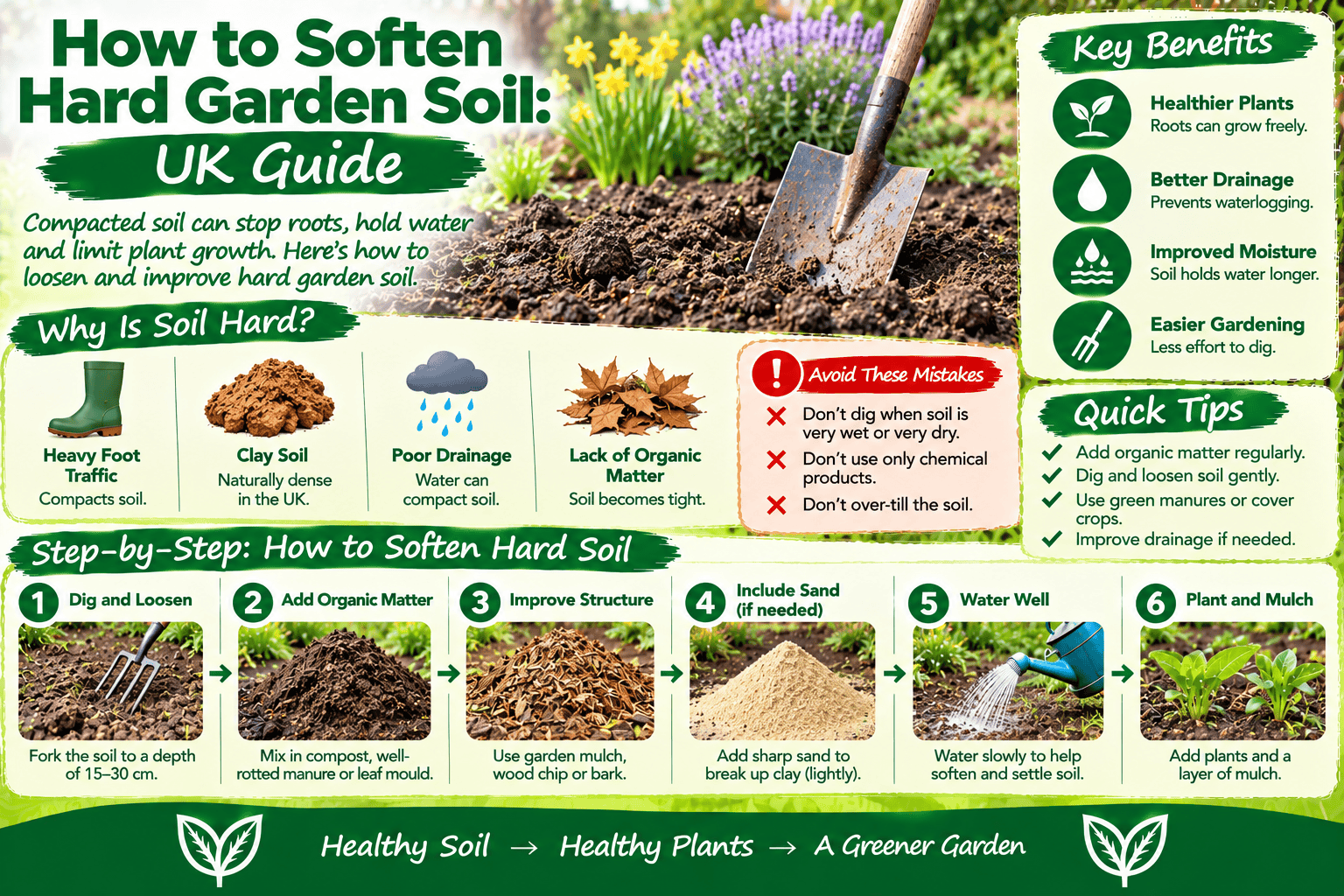
Why Is My Garden Soil So Hard? How to Soften Compacted Soil in the UK
You go into your garden with a spade, ready to plant flowers or vegetables, but the soil is so hard that you can barely dig into it.
Perhaps the ground feels like concrete after a dry spell. Maybe water sits on the surface after rain, or your plants seem to struggle even when you water them regularly.
Hard garden soil is often caused by compaction, clay-rich soil, dry conditions or poor soil structure. The best way to improve it depends on the underlying cause.
For homeowners in Glasgow, East Kilbride, South Lanarkshire and across Scotland, wet weather and heavy soils can make compaction particularly troublesome.
The good news is that many soil problems can be improved with careful management.
This guide explains why garden soil becomes hard, how to loosen it without damaging its structure and when organic compost or additional topsoil may help.
Quick Answer: How Do You Soften Hard Garden Soil?
If your garden soil is hard and difficult to dig:
Check whether it is dry, compacted or naturally clay-rich.
Avoid digging when the soil is saturated.
Identify whether water drains properly.
Relieve compaction using a suitable method when the soil is workable.
Add mature organic matter where appropriate.
Protect the surface with suitable mulch.
Avoid walking on planting beds.
Allow soil structure to improve over time.
Don't automatically add sand, gypsum or fertiliser. These are not universal solutions for compacted garden soil.
1. Why Is My Garden Soil So Hard?
Several factors can make soil difficult to work.
Soil compaction
Compaction occurs when soil particles are pressed closer together.
This reduces pore spaces that normally allow air and water to move through the ground.
Common causes include:
Repeated foot traffic.
Heavy machinery.
Building work.
Working wet soil.
Repeated pressure on the same areas.
Clay-rich soil
Clay contains very fine mineral particles.
It can become sticky when wet and extremely firm when dry.
Clay soil isn't automatically bad soil. It can retain nutrients and water well.
However, poor structure or compaction can make it difficult to manage.
Dry soil
Some soils become hard after prolonged dry weather.
This doesn't necessarily mean they are permanently compacted.
Low organic matter
Organic matter can contribute to soil structure and biological activity.
Some soils with little organic matter are more vulnerable to poor structure.
Construction-related problems
New-build gardens may contain compacted subsoil, shallow topsoil or buried construction debris.
These issues may require more substantial remediation.
2. Is Hard Soil the Same as Compacted Soil?
Not always.
Dry clay soil can feel very hard without being severely compacted.
Compacted soil has reduced pore space and may restrict root growth, drainage and aeration.
To investigate, examine the soil under different moisture conditions.
If it becomes workable when slightly moist but very hard when dry, clay content may be an important factor.
If roots struggle to penetrate the ground and water drains poorly, compaction may be contributing.
For serious problems, professional soil assessment may be useful.
3. How to Tell If Your Garden Soil Is Compacted
Look for these signs:
Water pooling after rain.
Slow drainage.
Poor root growth.
Hard layers beneath the surface.
Difficulty inserting a garden fork.
Patchy plant growth.
Soil that becomes muddy when wet and very firm when dry.
However, these symptoms can have more than one cause.
For example, poor drainage may also result from a high water table or unsuitable ground levels.
Avoid assuming compaction is responsible without investigating.
4. How to Soften Hard Clay Soil
Clay soil can be productive when managed properly.
The aim isn't to eliminate clay.
Instead, improve soil structure and reduce unnecessary compaction.
Step 1: Wait for suitable conditions
Avoid digging clay when it is saturated.
Wet clay can smear and compact when worked.
Step 2: Loosen compacted areas carefully
Where appropriate, use a garden fork to gently loosen the soil without repeatedly turning it.
Step 3: Add suitable organic matter
Mature organic compost may help improve soil properties over time.
Step 4: Protect the surface
Suitable mulch can reduce surface disturbance and moisture fluctuations.
Step 5: Keep traffic off planting beds
Use paths or stepping stones to reduce repeated pressure.
Step 6: Monitor improvement
Changes in soil structure can take several growing seasons.
5. Can Compost Soften Hard Soil?
Mature organic compost can help improve some soil properties.
It contributes organic matter that supports soil organisms and aggregation.
In suitable soils, this can improve workability and water movement over time.
However, compost doesn't instantly remove severe compaction.
If the ground has been heavily compacted by machinery, physical remediation may be needed before organic matter can provide its full benefit.
For appropriate garden soil improvement, explore Kelvin Compost's organic compost.
6. How Much Compost Should You Add to Hard Soil?
The amount depends on the soil, existing organic matter and intended use.
There is no universal application depth suitable for every garden.
If you have an appropriate recommended depth, calculate the volume using:
Area (m²) × depth (m) × 1,000 = litres
For example, a 20m² border receiving a 2.5cm layer of mature compost would require:
20 × 0.025 × 1,000 = 500 litres
This is a volume example, not a universal recommendation.
Avoid repeatedly adding large amounts without considering soil fertility.
7. Can You Improve Hard Soil Without Digging?
Yes, in some situations.
No-dig gardening focuses on reducing soil disturbance and using suitable surface organic matter.
Soil organisms gradually incorporate some organic material and create biological channels.
This can support soil structure over time.
However, no-dig methods don't instantly correct every severe compaction problem.
A heavily compacted construction site may require initial remediation.
8. Should You Add Sand to Clay Soil?
Adding a small amount of sand to clay soil is not a reliable general solution.
The outcome depends on soil texture, the sand used and the proportions involved.
Inappropriate mixtures can remain dense and difficult to work.
For most home gardeners, avoid adding sand simply because the soil feels heavy.
Investigate drainage and structure first.
9. Does Gypsum Help Clay Soil?
Gypsum can improve certain soils with specific chemical problems.
However, it is not a universal treatment for ordinary garden clay.
Whether gypsum is beneficial depends on soil chemistry.
Don't apply it without an appropriate reason or soil assessment.
10. Can You Use Manure to Improve Hard Soil?
Suitable well-rotted manure can contribute organic matter.
However, its nutrient content varies.
It should not be applied excessively or used without considering crop requirements.
Fresh manure also presents additional plant-health and food-safety concerns.
For appropriate garden applications, Kelvin Compost supplies manure.
11. How to Loosen Soil Without Damaging Plant Roots
If established plants are growing in compacted soil, avoid aggressive digging close to their roots.
Depending on the situation, options may include:
Reducing foot traffic.
Using suitable surface mulch.
Improving watering practices.
Adding mature organic matter where appropriate.
Carefully loosening exposed areas away from major roots.
For trees and mature shrubs, extensive excavation can cause serious root damage.
Seek specialist advice for significant compaction around valuable trees.
12. Why Is My Soil Hard After Rain?
Soil can become firm after rainfall when the surface dries and forms a crust.
This is sometimes associated with poor soil structure or surface sealing.
Heavy rainfall can also compact or disperse the surface of vulnerable soils.
If water regularly pools, investigate drainage and compaction.
Avoid working saturated soil, as this can make the problem worse.
13. Why Is My Soil Hard in Summer?
Dry conditions can make some soils extremely firm.
Clay-rich soils may shrink and develop cracks as they dry.
This doesn't automatically mean the soil is unhealthy.
Appropriate watering, organic-matter management and mulching may help reduce extreme moisture fluctuations.
Avoid trying to force tools into exceptionally hard ground if doing so could damage nearby roots or buried services.
14. Why Does My Garden Soil Crack?
Cracks often appear when clay-rich soil dries and shrinks.
Some cracking is a normal physical response to changing moisture.
However, severe movement near structures may require professional investigation.
Garden soil cracking alone doesn't establish a foundation problem.
15. How to Improve Compacted Soil in a Vegetable Garden
Vegetable roots need access to air, water and nutrients.
If the soil is compacted:
Avoid walking on growing beds.
Check drainage.
Wait until the soil is workable.
Loosen severe compaction where appropriate.
Add mature organic matter if needed.
Use suitable mulch.
Rotate crops and maintain soil cover where practical.
For vegetable beds, soil fertility should also be considered.
Excessive organic amendments can create nutrient imbalances.
16. How to Improve Hard Soil in Raised Beds
Raised beds can become compacted if repeatedly walked on or filled with unsuitable material.
Check:
Soil depth.
Growing-medium composition.
Drainage.
Organic-matter content.
Previous amendments.
Whether the bed is settling.
If a raised bed needs additional suitable soil volume, topsoil may be required.
Explore Kelvin Compost's topsoil.
Avoid filling a raised bed entirely with compost or manure.
17. Can You Put Topsoil Over Hard Ground?
Sometimes, but it depends on the project.
Adding suitable topsoil can provide additional growing depth where existing soil is inadequate.
However, spreading topsoil over severely compacted or poorly drained subsoil may create a new problem.
Roots may struggle to penetrate the underlying layer.
Water may also accumulate at the boundary between different materials.
Address the underlying ground condition before adding a new growing layer.
18. How to Improve Hard Soil Before Laying Turf
A new lawn needs suitable soil structure and drainage.
Before laying turf:
Remove unsuitable debris.
Check existing soil depth.
Assess compaction.
Correct drainage problems.
Loosen compacted areas when workable.
Add suitable topsoil if required.
Prepare a level surface.
Allow appropriate settlement.
Lay turf under suitable conditions.
Good preparation is more important than simply covering the problem with fresh soil.
19. Why Is My New-Build Garden Soil So Hard?
Construction activity can compact the ground.
Heavy machinery, repeated vehicle movement and disturbed soil layers can reduce soil quality.
Some new-build gardens also contain:
Shallow topsoil.
Compacted subsoil.
Buried rubble.
Poor drainage.
Unevenly distributed fill.
If your garden has these problems, adding compost alone may not be enough.
For serious construction-related issues, consider professional assessment or contacting the developer.
20. How to Fix Hard Soil in Glasgow and Scotland
Gardens across Glasgow, East Kilbride and South Lanarkshire vary in soil type and drainage.
Some contain clay-rich ground that becomes sticky during wet weather.
Others have compacted soil from landscaping or construction work.
Scottish weather adds another challenge.
During autumn and winter, prolonged rainfall can leave soil too wet to work safely.
In November, avoid digging saturated ground simply to prepare for spring.
Instead, assess the problem and plan improvements for suitable conditions.
Where appropriate, mature compost and surface mulch can support long-term soil management.
21. Can Woodchip Help Improve Hard Soil?
Suitable woodchip mulch can help protect the soil surface.
It may reduce weed growth, moderate moisture fluctuations and contribute organic matter as it decomposes.
However, woodchip isn't a direct cure for severe compaction.
Avoid mixing large amounts of fresh woodchip into the soil, as decomposition can temporarily affect nitrogen availability.
For suitable mulching projects, explore Kelvin Compost's woodchip.
22. How Deep Should Woodchip Mulch Be?
The appropriate depth depends on the application.
For many garden borders, a layer around 5cm may be useful.
Keep mulch away from plant stems and tree trunks.
Avoid creating deep wet piles around crowns.
Woodchip volume guide
| Area | 5cm layer |
|---|---|
| 5m² | 250L |
| 10m² | 500L |
| 20m² | 1,000L |
| 30m² | 1,500L |
| 50m² | 2,500L |
These are volume calculations, not universal mulching recommendations.
23. How Long Does It Take to Improve Hard Soil?
It depends on the cause.
Dry soil may become easier to work after suitable moisture returns.
Mild compaction may improve gradually with better management.
Severe construction-related compaction may require mechanical remediation.
Organic-matter improvements often develop over multiple seasons.
Avoid expecting one application of compost to permanently solve every soil problem.
24. Common Mistakes When Fixing Hard Garden Soil
Digging when the ground is saturated
This can damage soil structure.
Adding sand without understanding the soil
It may not produce the desired improvement.
Using gypsum as a universal treatment
Gypsum is useful only in certain soil conditions.
Adding excessive compost
More organic matter isn't always better.
Ignoring drainage
Persistent waterlogging needs investigation.
Walking on planting beds
Repeated pressure can recreate compaction.
Covering severe compaction with topsoil
The underlying problem may remain.
Expecting immediate results
Soil structure often improves gradually.
Frequently Asked Questions About Hard Garden Soil
Why is my garden soil so hard?
Common causes include clay-rich soil, compaction, dry conditions and poor soil structure.
How do I soften hard garden soil naturally?
Reduce compaction, improve soil management and add suitable mature organic matter where needed.
Can compost loosen compacted soil?
Compost may improve soil properties over time, but it won't instantly correct severe compaction.
How do you soften hard clay soil?
Avoid working it when wet, relieve compaction appropriately and manage organic matter and mulch.
Can you put topsoil over compacted soil?
Sometimes, but severe compaction and drainage problems should be addressed first.
Is sand good for hard clay soil?
Not automatically. Adding unsuitable amounts of sand can fail to improve soil structure.
Does gypsum break up clay soil?
Gypsum can help certain chemically affected soils, but isn't a universal treatment for garden clay.
Can manure improve hard soil?
Suitable well-rotted manure can contribute organic matter, but should be applied according to soil and crop needs.
Why is my soil hard after rain?
Surface crusting, poor structure or compaction may be contributing.
Why does my garden soil crack in summer?
Clay-rich soils often shrink and crack as they dry.
Can I improve compacted soil without digging?
Some mild problems may improve with reduced traffic, suitable mulch and organic-matter management.
How long does it take to fix compacted soil?
It depends on severity. Some improvements take several growing seasons.
Can woodchip help clay soil?
Surface woodchip can protect soil and contribute organic matter as it decomposes.
Is hard soil bad for vegetables?
Severe compaction can restrict root growth, aeration and water movement.
Why is my new-build garden soil hard?
Construction traffic, compacted subsoil and inadequate soil preparation may be responsible.
Should I dig hard soil in November?
Only if conditions are suitable. Avoid digging frozen or waterlogged ground.
Is hard soil always unhealthy?
No. Some soils become naturally firm when dry. The important factors are structure, drainage and plant growth.
What's the best way to improve soil in Glasgow?
Identify the soil type and cause of the problem, then use suitable drainage, compaction and organic-matter management.
Final Thoughts: Fix the Cause of Hard Soil, Not Just the Surface
Hard garden soil can be frustrating, but the solution depends on what's causing it.
Clay-rich soil may need careful moisture and organic-matter management.
Compacted ground may require loosening and reduced foot traffic.
New-build gardens may need more substantial preparation.
And some dry soils simply become easier to work when moisture conditions improve.
The best results come from improving soil structure, protecting the surface and avoiding practices that recreate compaction.
Need Organic Compost or Topsoil in Glasgow?
Kelvin Compost supplies garden materials for homeowners, allotments and landscaping projects across Glasgow, East Kilbride, South Lanarkshire and surrounding areas.
Explore our products:
Organic Compost — for appropriate soil improvement.
Topsoil — for projects requiring additional suitable soil depth.
Woodchip — for appropriate mulching.
Manure — for suitable soil-fertility projects.
Phone: +44 7561 251350
Email: info@kelvincompost.co.uk
Need Garden Supplies Delivered in Glasgow?
Organic compost, topsoil, manure and more across Scotland