


How to Protect Plants From Frost in Scotland
Looking for compost, topsoil or garden supplies?
Browse our full product range or get in touch for delivery across Glasgow and Scotland.
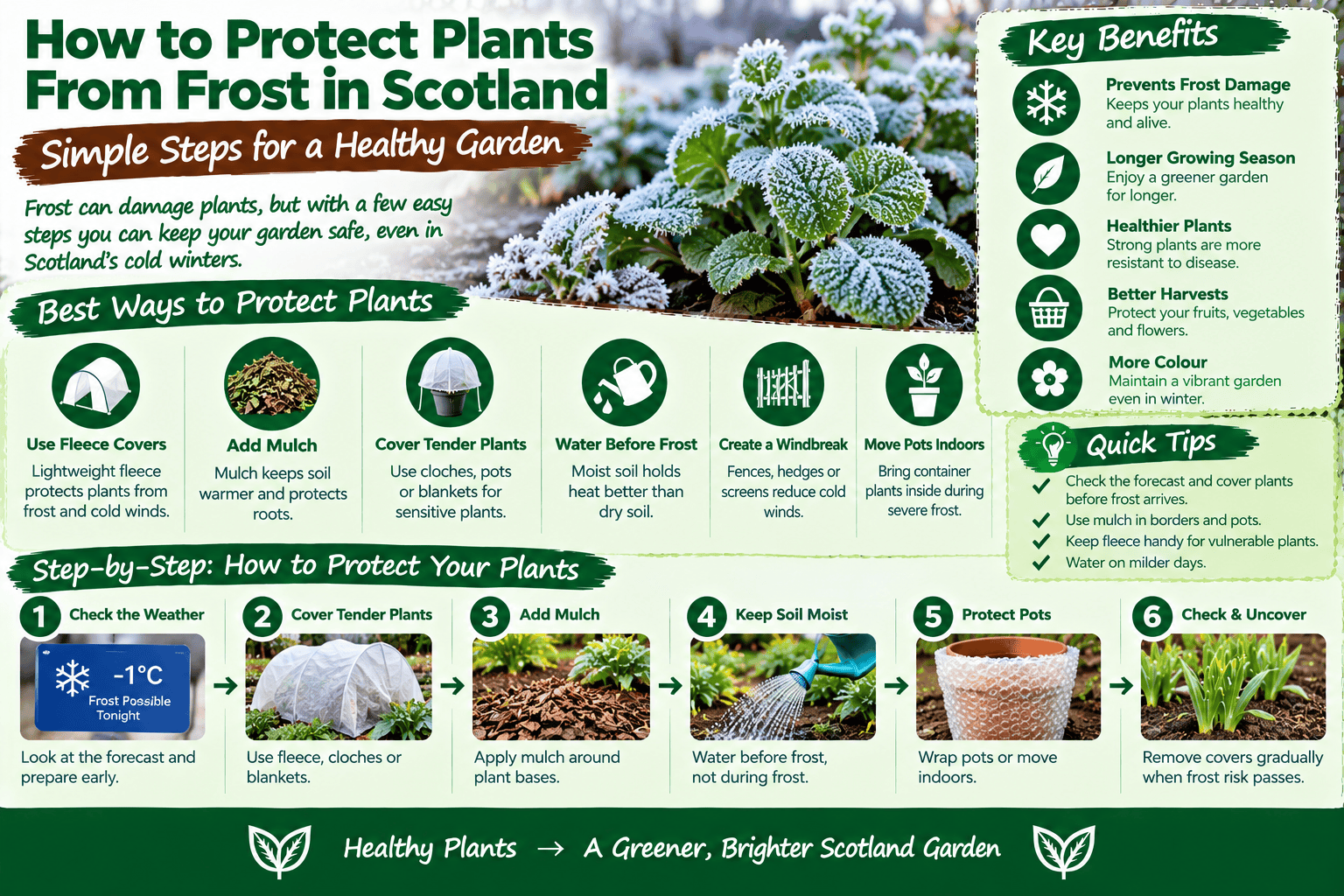
How to Protect Plants From Frost in Scotland: 12 Winter Gardening Tips for Glasgow
Winter can arrive quickly in a Scottish garden.
One week, your plants are enjoying a relatively mild autumn. The next, temperatures drop overnight, frost appears on the lawn, and tender plants begin to suffer.
For gardeners in Glasgow, East Kilbride, South Lanarkshire and surrounding areas, knowing how to protect plants from frost can make a significant difference to their survival and recovery.
But do you need to cover every plant? Does mulch really help? And what should you do when frost is forecast for tonight?
The best way to protect plants from frost is to identify vulnerable plants, move containers into shelter where possible, use suitable horticultural fleece and protect the soil around established plants with appropriate mulch.
The right approach depends on the plant species, its hardiness, location and the severity of the cold.
This guide explains what works, what doesn't and how to prepare your garden for Scottish winter weather.
Quick Answer: How Do You Protect Plants From Frost?
If frost is forecast, take these practical steps:
Move tender potted plants into a frost-free or sheltered location.
Cover vulnerable plants with horticultural fleece.
Protect suitable exposed soil with organic mulch.
Keep mulch away from plant stems and crowns.
Group containers together in a sheltered position.
Avoid walking on frosty lawns.
Check greenhouse temperatures.
Protect outdoor taps and irrigation equipment.
Avoid unnecessary pruning before severe cold.
Check local weather forecasts regularly.
Not every plant needs all these measures.
Hardy plants are often adapted to normal winter conditions, while tender plants may need more substantial protection.
1. Know Which Plants Need Frost Protection
Before covering your garden, identify which plants are actually vulnerable.
Some plants tolerate freezing temperatures very well.
Others may be damaged by relatively light frost.
Plants that may need protection
Depending on their variety and growing conditions, vulnerable plants can include:
Tender geraniums (pelargoniums).
Dahlias that haven't been lifted or otherwise protected.
Some young or recently planted shrubs.
Tender Mediterranean plants.
Citrus trees grown in containers.
Tender succulents.
Certain herbs.
Young plants that haven't hardened off.
Plant labels and RHS hardiness ratings can help you understand their requirements.
A plant's ability to tolerate frost also depends on soil moisture, exposure, maturity and the duration of freezing conditions.
2. Use Horticultural Fleece to Protect Vulnerable Plants
Horticultural fleece is one of the most practical materials for temporary frost protection.
It provides a protective covering that can reduce exposure to cold air and wind.
For small plants, fleece can be supported using hoops or a simple frame.
For larger plants, suitable fleece may be wrapped around the vulnerable parts.
How to use frost fleece correctly
Choose fleece designed for horticultural use.
Secure it against strong winds.
Avoid crushing delicate foliage.
Use supports where appropriate.
Check plants regularly for moisture and ventilation needs.
Remove or adjust temporary coverings when conditions improve.
Fleece provides limited protection and cannot guarantee survival during prolonged severe freezing weather.
Very tender plants may need to be moved indoors or into a suitable frost-free structure.
3. Move Potted Plants Into a Sheltered Area
Container plants can be particularly vulnerable during cold weather.
Unlike plants growing in open ground, their roots are surrounded by a relatively small volume of growing medium.
That medium can freeze more readily during prolonged cold conditions.
Move suitable containers to:
A frost-free greenhouse.
A suitable conservatory.
A sheltered porch.
An unheated but frost-free outbuilding.
Another location appropriate for the plant.
Avoid placing plants that require cool winter conditions directly beside radiators.
Check light and ventilation requirements, especially if plants will remain indoors for several weeks.
4. Protect Plant Roots With Suitable Mulch
Mulching can help moderate soil temperature fluctuations around suitable established plants.
Organic materials such as woodchip, bark and mature compost may provide useful surface protection.
However, mulch isn't a substitute for the correct hardiness rating or proper winter shelter.
Which mulch should you use?
| Material | Main benefit | Suitable applications |
|---|---|---|
| Woodchip | Longer-lasting surface coverage | Established shrubs, hedges and trees |
| Bark mulch | Surface insulation and weed suppression | Ornamental borders and shrubs |
| Mature organic compost | Adds organic matter and provides soil cover | Suitable established beds |
| Dry straw | Can provide insulation in specific applications | Selected plants and protected growing areas |
| Leaf mould | Organic surface protection | Suitable garden beds |
Choose according to the plants and soil conditions.
How deep should mulch be?
For many organic mulches, a layer around 5cm is commonly used.
However, depth should reflect the material, plant type and existing mulch.
Avoid piling mulch against trunks, stems or vulnerable crowns.
Repeated thick applications of nutrient-rich compost may also be unnecessary.
Kelvin Compost supplies woodchip and organic compost for suitable garden and landscaping projects.
5. Protect Plants From Cold Winds
Frost isn't the only winter threat.
Cold, drying winds can damage exposed foliage, particularly on evergreen plants.
In some locations, wind exposure may be more damaging than a short period of frost.
How to reduce wind damage
Consider temporary windbreaks, suitable garden screening or moving containers to more sheltered positions.
Avoid completely enclosing plants in materials that trap excessive moisture or restrict ventilation.
For permanent planting, choose species suited to the garden's exposure.
6. Avoid Overwatering During Cold Weather
Plants still need moisture during winter, but their requirements often change.
Many plants use less water when growth slows.
Excess water can contribute to root problems, particularly where drainage is poor.
Check the growing medium before watering.
For container plants, ensure drainage holes are functioning and pots aren't standing in water.
Evergreen plants may still need water during dry, frost-free periods.
Avoid watering frozen soil simply because the surface appears dry.
7. Protect Young Trees and Shrubs
Newly planted trees and shrubs may be more vulnerable to winter stress because their roots are not fully established.
However, suitable hardy species often tolerate normal winter temperatures without extensive wrapping.
The priorities are:
Correct planting depth.
Appropriate soil conditions.
Adequate drainage.
Protection from excessive wind where necessary.
Suitable mulch around the root zone.
Avoiding unnecessary disturbance.
Keep mulch away from the trunk.
If a plant requires fleece or another covering, follow species-specific guidance.
8. Protect Raised Beds and Vegetable Gardens
Not every vegetable needs frost protection.
Some winter vegetables tolerate low temperatures relatively well.
Others, particularly tender summer crops, cannot survive freezing conditions.
What can you do?
Use suitable fleece or cloches for crops that benefit from protection.
Remove finished tender crops when appropriate.
Protect exposed soil with suitable organic matter where needed.
Avoid unnecessary digging when the ground is saturated or frozen.
For empty beds, a suitable surface mulch can help reduce soil exposure during winter.
9. Protect Greenhouse Plants From Frost
A greenhouse isn't automatically frost-free.
During cold nights, temperatures inside an unheated greenhouse can fall below freezing.
If you're overwintering tender plants, monitor temperatures.
Depending on the plants and greenhouse design, you may need:
Appropriate greenhouse insulation.
A suitable thermostatically controlled heater.
A minimum-maximum thermometer.
Improved draught protection.
Appropriate ventilation during milder periods.
Follow electrical safety guidance when using greenhouse heaters.
10. Don't Walk on Frosty Grass
When grass blades are frozen, walking across the lawn can damage them.
This may leave visible footprints or discoloured areas after the frost clears.
Avoid unnecessary foot traffic until the frost has thawed.
If you regularly need access across the garden during winter, consider a suitable path rather than repeatedly walking over vulnerable lawn areas.
11. Avoid Heavy Pruning Before Severe Frost
Pruning can encourage new growth in some plants or expose tissues to cold.
However, the appropriate timing varies considerably by species.
Some trees and shrubs are routinely pruned during dormancy.
Others are better pruned after flowering or when the risk of severe frost has passed.
Don't apply a single winter-pruning rule to every plant.
Check the recommended pruning period for each species.
12. Monitor Frost Forecasts and Act Early
The easiest time to protect a vulnerable plant is before frost arrives.
Check a reliable local forecast and pay attention to overnight minimum temperatures.
Conditions can vary significantly between nearby gardens.
A sheltered urban garden may remain warmer than an exposed rural location.
Low-lying areas can also experience frost when nearby higher ground remains frost-free.
For Glasgow-area gardeners, this means checking the actual forecast for your location rather than relying only on a broad regional prediction.
At What Temperature Should You Cover Plants?
There isn't one temperature that applies to every plant.
Some tender plants can be damaged around 0°C.
Others tolerate temperatures well below freezing.
The RHS hardiness system provides a useful starting point for understanding which plants are suitable for different winter conditions.
If you're unsure about a tender plant, check its species-specific requirements before cold weather arrives.
Can You Use Plastic Bags to Protect Plants From Frost?
Plastic can sometimes be used as part of a properly designed temporary protective structure, but directly wrapping plants in plastic bags is generally not recommended.
Plastic in contact with foliage can create condensation and temperature problems.
For routine frost protection, horticultural fleece is usually a more suitable choice.
If using a plastic cloche, provide appropriate support and ventilation.
Does Mulch Really Protect Plants From Frost?
Mulch can help reduce fluctuations in soil temperature.
This is particularly useful around roots and in suitable established borders.
However, mulch doesn't necessarily prevent foliage from freezing.
A plant with tender leaves may still require fleece or relocation even when its root zone is mulched.
Think of mulch as one part of winter garden protection rather than a complete solution.
Is Woodchip Good for Winter Plant Protection?
Suitable woodchip can provide useful surface coverage around established trees, shrubs and hedges.
It also helps protect exposed soil from direct rainfall and can reduce weed growth.
Because woodchip breaks down gradually, it may provide longer-lasting coverage than fine compost.
Avoid creating deep piles around trunks.
For very wet gardens, investigate drainage problems rather than relying on woodchip alone.
Should You Add Organic Compost Before Frost?
Mature organic compost can be applied to suitable garden beds during autumn or winter when conditions allow.
However, it isn't necessary to apply compost to every bed simply because frost is forecast.
If the soil already has sufficient organic matter and nutrients, another heavy application may be unnecessary.
Avoid working saturated or frozen soil.
For soil-improvement projects, explore Kelvin Compost's organic compost.
How Much Woodchip Do You Need for Winter Mulching?
Before ordering, measure the area you want to cover.
Use:
Area (m²) × mulch depth (m) = volume (m³)
For example, covering 20m² at 5cm depth requires:
20 × 0.05 = 1m³, equivalent to 1,000 litres.
Woodchip quantity guide
| Garden area | 5cm depth | 7.5cm depth |
|---|---|---|
| 5m² | 250L | 375L |
| 10m² | 500L | 750L |
| 20m² | 1,000L | 1,500L |
| 30m² | 1,500L | 2,250L |
| 50m² | 2,500L | 3,750L |
These are theoretical volumes. Actual requirements depend on uneven ground, existing mulch and settlement.
The appropriate mulch depth varies by application.
How to Protect Plants From Frost Tonight
If temperatures are expected to fall below freezing tonight, focus on the most vulnerable plants first.
Before sunset
Move suitable tender containers into shelter.
Cover vulnerable outdoor plants with horticultural fleece.
Check that greenhouse protection is working.
Secure temporary coverings against wind.
Avoid unnecessary watering if the soil is already wet.
The following morning
Wait for frost to thaw before handling delicate foliage.
Inspect coverings and ventilation.
Don't immediately prune every frost-damaged leaf or stem.
Some damage becomes clearer after several days, and affected foliage can sometimes provide temporary protection to underlying growth.
What to Do After Frost Damages Your Plants
Frost damage can appear as:
Blackened leaves.
Wilted or collapsed shoots.
Water-soaked foliage.
Brown patches.
Damaged growing tips.
Don't assume the entire plant has died.
Some hardy plants recover from their roots or surviving buds when conditions improve.
Wait until the extent of the damage becomes clear before carrying out major pruning.
For tender plants with extensive damage, recovery depends on the species and severity of freezing.
Winter Frost Protection in Glasgow and Scotland
Scottish gardens experience different winter conditions depending on location, altitude, exposure and surrounding buildings.
A sheltered Glasgow garden may have different frost conditions from an exposed garden in South Lanarkshire.
For local homeowners, preparation should focus on:
Identifying tender plants.
Checking the local frost forecast.
Protecting vulnerable containers.
Improving shelter where needed.
Maintaining suitable soil conditions.
Applying appropriate mulch.
Avoiding unnecessary work on frozen or saturated ground.
The aim isn't to make the entire garden frost-free.
It's to give vulnerable plants the protection they need while allowing hardy plants to experience normal seasonal conditions.
Common Frost Protection Mistakes
Covering every plant unnecessarily
Hardy plants often don't need additional protection.
Using plastic directly against foliage
This can create moisture and temperature problems.
Piling mulch against plant stems
Excessive material around plant bases can cause problems.
Overwatering in cold weather
Wet roots may suffer when drainage is poor.
Assuming greenhouses are frost-free
Unheated structures can still experience freezing temperatures.
Pruning damaged plants too quickly
Some plants may recover from apparently damaged growth.
Ignoring cold winds
Wind exposure can cause additional winter stress.
Using compost as a universal frost solution
Compost may help protect suitable soil surfaces, but it cannot protect every plant from freezing.
Frequently Asked Questions
How do I protect my plants from frost in Scotland?
Move tender containers into shelter, use suitable horticultural fleece and protect appropriate root zones with mulch.
What is the best material to cover plants from frost?
Horticultural fleece is commonly used for temporary frost protection.
At what temperature should I cover my plants?
It depends on the species and its hardiness. Some tender plants may be damaged around freezing, while hardy plants tolerate much lower temperatures.
Can I leave plants covered all winter?
Some protective coverings can remain in place for extended periods, but plants need appropriate ventilation, light and monitoring.
Does woodchip protect plants from frost?
Woodchip can help moderate soil temperature fluctuations around roots, but it won't prevent all frost damage.
Can compost protect plant roots in winter?
Suitable organic compost can provide soil cover and organic matter, but it isn't a guaranteed frost barrier.
Should I water plants before frost?
Water according to actual soil moisture and plant requirements. Avoid unnecessary watering of already wet soil.
Can frost kill newly planted shrubs?
Some shrubs may be damaged, particularly if they are tender or poorly established. Hardy species often tolerate normal winter conditions.
Should I remove frost-damaged leaves?
Not always immediately. Wait until the extent of damage is clear and follow species-specific guidance.
Can you protect plants with cardboard boxes?
A suitable temporary cover may offer limited protection, but it must be stable, appropriate for the plant and removed or ventilated when necessary.
Is November too late to mulch a garden?
No. Suitable mulching may be carried out when soil conditions allow.
How do I protect potted plants from freezing?
Move vulnerable containers to an appropriate sheltered or frost-free location and monitor their moisture requirements.
Do plants need sunlight during winter?
Most living plants still need suitable light, although requirements vary by species and dormancy.
Can frost damage grass?
Yes. Walking on frozen grass can damage the blades and leave visible marks.
Final Thoughts: Prepare Your Garden Before Frost Arrives
Protecting plants from frost doesn't have to involve expensive equipment or complicated gardening techniques.
The most important step is understanding which plants are vulnerable.
Tender containers may need moving.
Exposed plants may benefit from fleece.
Established trees and shrubs may benefit from suitable mulch around their root zones.
And sometimes the best action is simply to leave hardy plants alone.
For gardeners in Glasgow and across Scotland, planning ahead can help reduce unnecessary winter damage.
Protect the plants that need help, use the right materials and let the weather and plant requirements guide your decisions.
Need Woodchip or Organic Compost in Glasgow?
Kelvin Compost supplies woodchip, organic compost, topsoil and other garden materials for homeowners, allotments and landscaping projects across Glasgow, East Kilbride, South Lanarkshire and surrounding areas.
Explore our products:
For product and delivery enquiries:
Phone: +44 7561 251350
Email: info@kelvincompost.co.uk
Need Garden Supplies Delivered in Glasgow?
Organic compost, topsoil, manure and more across Scotland