




How to Prepare Soil for Trees & Shrubs | Scotland Planting Guide
Looking for compost, topsoil or garden supplies?
Browse our full product range or get in touch for delivery across Glasgow and Scotland.
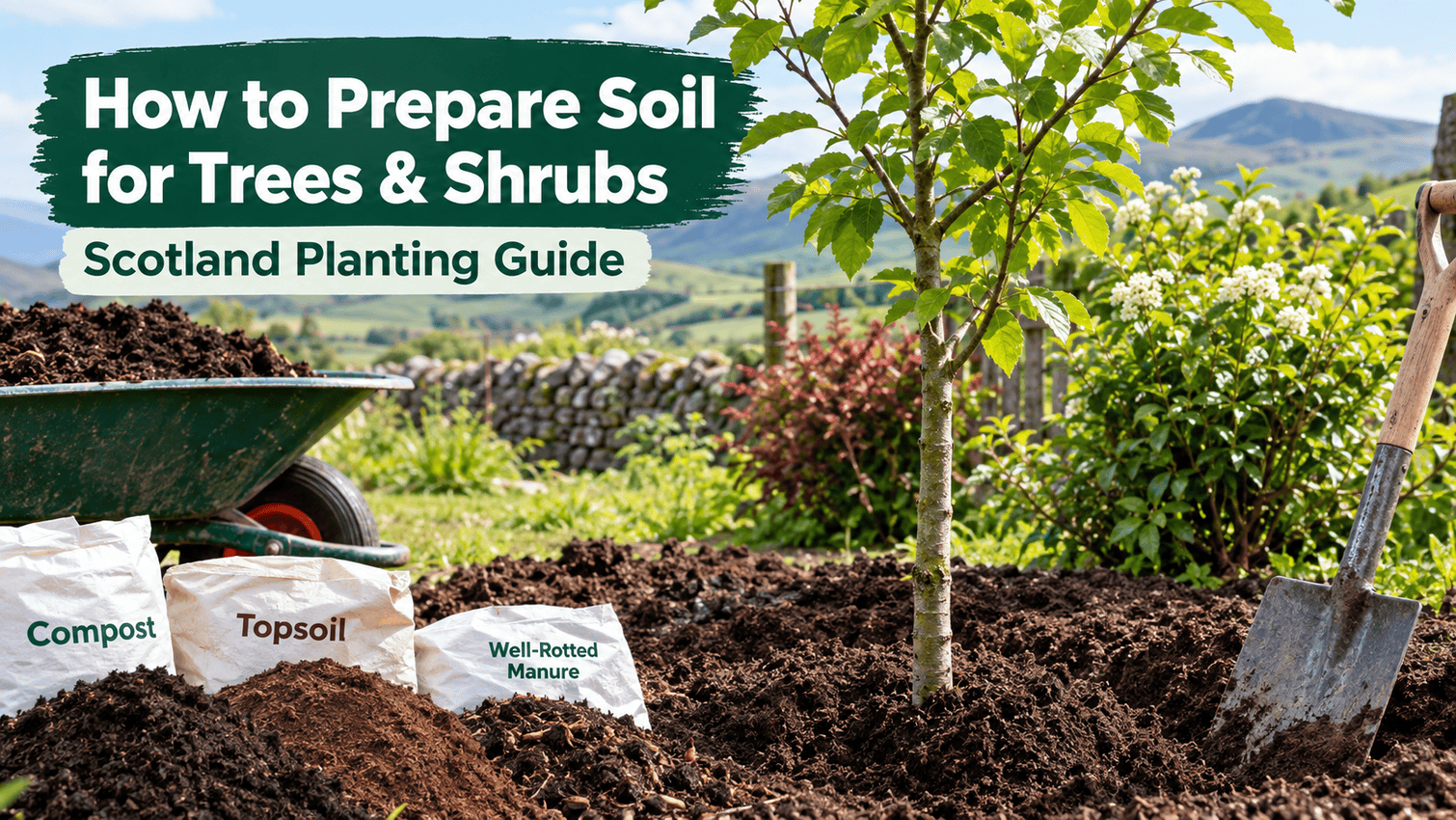
How to Prepare Soil for Planting Trees & Shrubs in Scotland
Planting a new tree or shrub this autumn?
Before spending money on plants, spend some time looking at the ground they are going into.
Good soil preparation can be more important than adding large quantities of fertiliser or compost to the planting hole.
For most garden trees and shrubs, the basic process is:
Check the drainage → remove weeds and grass → loosen compacted soil over a wide area → improve poor soil where necessary → plant at the correct depth → water → mulch.
Depending on your existing garden, you may need topsoil, organic compost, well-rotted manure or woodchip.
But they perform different jobs.
This guide explains which material to use, how much you may need and how to prepare trees and shrubs for successful establishment in Glasgow and the wider Scottish climate.
Quick Answer: What Is the Best Soil for Trees and Shrubs?
Most garden trees and shrubs need soil that provides:
Enough air around the roots
Adequate moisture
Suitable drainage
Sufficient soil depth
Organic matter
A structure that allows roots to spread
You usually do not need to replace all of your existing soil.
Instead:
Use topsoil when you don't have enough suitable soil or need additional growing depth.
Use organic compost to improve suitable existing soil that is low in organic matter.
Use well-rotted manure as organic matter where appropriate, particularly for established planting areas.
Use woodchip as a surface mulch after planting.
The first question shouldn't be:
"Which compost should I buy?"
It should be:
"What problem does my existing soil have?"
When Is the Best Time to Plant Trees and Shrubs in Scotland?
Autumn is an excellent time to start many tree and shrub planting projects.
For many trees and shrubs, the main planting period runs from autumn through early spring, provided the soil is neither frozen nor waterlogged.
Container-grown plants can be planted at other times, but plants installed during warm or dry periods usually require more attention to watering.
Bare-root and root-balled trees are generally available during the dormant season.
In Scotland, always let the actual ground conditions guide you.
Don't plant simply because the calendar says October.
If your soil is:
Saturated
Frozen
Severely compacted
Holding standing water
deal with the underlying issue first.
Step 1: Check the Soil Before You Buy Anything
Dig several test holes around the proposed planting area.
You're looking for four things.
1. Soil depth
How much usable topsoil is actually present?
This is particularly important in:
New-build gardens
Previously paved areas
Recently landscaped properties
Gardens containing construction rubble
If you only have a shallow layer of usable soil over poor subsoil, you may require additional Topsoil.
2. Compaction
Push a garden fork into the ground.
If penetration is extremely difficult, the soil may be compacted.
Compaction reduces the amount of air available to roots and can restrict water movement.
3. Drainage
After heavy rain, does water disappear reasonably quickly?
Or does the area remain saturated?
Trees need water, but many species won't tolerate permanently waterlogged soil.
4. Soil structure
Is the soil:
Heavy clay?
Very sandy?
Low in organic matter?
Easy to work?
Full of rubble?
Once you understand the problem, choosing the correct material becomes much easier.
Step 2: Remove Grass and Weeds
Don't plant a young tree in the middle of a lawn and allow grass to grow right up to its trunk.
Grass and weeds compete with newly planted trees and shrubs for:
Water
Nutrients
Rooting space
Clear the immediate planting area first.
For an individual tree, creating a broad vegetation-free circle around the plant also makes future mulching and watering much easier.
For groups of shrubs, consider preparing the whole bed rather than maintaining small individual circles.
Step 3: Loosen Compacted Soil Over a Wide Area
This is one of the most important steps.
Don't think only about the planting hole.
Think about where the roots will grow after they leave the planting hole.
A common mistake is:
Dig a small hole.
Fill it with beautiful compost.
Put the plant inside.
Leave the surrounding ground hard and compacted.
You've effectively created a small pocket surrounded by hostile soil.
Instead, loosen compacted ground across a wider area.
For a new shrub border, preparing the whole bed is often preferable.
For an individual tree, loosen the surrounding soil without destroying its natural structure unnecessarily.
Should You Put Compost in a Tree Planting Hole?
This deserves special attention because it's frequently misunderstood.
Don't simply fill the planting hole with compost.
If the surrounding garden soil needs improvement, Organic Compost can be useful for adding organic matter.
But you want the roots to establish into the surrounding soil.
Creating a highly enriched pocket can produce a sharp difference between the planting hole and the ground beyond it.
Likewise, don't put a thick layer of compost or manure at the bottom of the hole.
As organic material decomposes, it can settle.
This may cause the tree or shrub to sink lower than its correct planting level.
Better approach
Where soil improvement is appropriate:
improve the broader soil environment rather than creating a compost-filled pot underground.
When Should You Use Organic Compost?
Kelvin Compost's Organic Compost can be considered when suitable existing soil needs more organic matter.
It can be particularly useful for:
Heavy workable soil
Organic matter can help improve soil structure over time.
Light sandy soil
Organic matter can help increase moisture and nutrient retention.
Tired garden borders
Established planting areas can gradually lose organic matter.
New shrub beds
Where an entire planting area is being prepared, organic compost can form part of broader soil improvement.
The important distinction is:
Compost improves soil.
It isn't automatically a replacement for soil.
When Do You Need Topsoil?
Topsoil performs a different job.
You should consider additional topsoil when you actually need more suitable soil volume.
For example:
New-build garden
You may discover only a thin layer of topsoil over compacted subsoil.
Former patio
After paving and hardcore are removed, additional suitable soil may be needed to create a planting area.
Raised border
You're physically creating additional growing depth.
Landscaping project
Ground levels may need to be built up with appropriate material.
In these situations, compost alone isn't the answer.
You need actual soil volume.
A useful rule is:
Not enough soil = topsoil.
Enough soil but poor organic matter = compost.
Some projects need both.
Can You Use Manure When Planting Trees and Shrubs?
Well-Rotted Manure is another source of organic matter.
It can be useful for suitable established beds and soil-improvement projects.
But again:
don't fill the bottom of a tree planting hole with manure.
If you're improving poor ground before establishing a larger planting bed, suitable well-rotted manure can form part of the overall organic-matter strategy.
For individual trees and shrubs, focus first on:
Soil structure
Drainage
Correct planting depth
Water
Weed control
Mulching
More fertility isn't always what a struggling new tree needs.
Step 4: Dig the Planting Hole Correctly
The planting hole should accommodate the roots without forcing them into an unnatural position.
For container-grown plants, dig a hole wide enough to allow the root system to establish into loosened surrounding soil.
The depth is particularly important.
Don't automatically dig a very deep hole.
You generally want the root flare — where the roots begin spreading from the trunk — around soil level.
Planting a tree too deeply can cause serious establishment problems.
If necessary, scrape excess compost away from the top of a container-grown rootball so you can find the first major roots.
Step 5: Don't Bury the Tree Trunk
This mistake can happen in two ways:
Planting too deeply
or
Piling soil or mulch against the trunk afterwards.
The trunk isn't a root.
Keep the root flare around the appropriate soil level and don't bury the lower trunk under compost, soil or woodchip.
The same basic principle applies to woody shrubs.
Step 6: Backfill With Soil
Once the plant is positioned correctly, backfill carefully.
Work soil between and around the roots so you don't leave large air pockets.
Firm gently.
You don't need to stamp the ground into a hard surface.
Remember that you're trying to create soil that contains:
solids + moisture + air.
Roots need all three.
Step 7: Water Thoroughly
Newly planted trees and shrubs need a thorough watering after planting.
Even when the weather seems wet, don't automatically assume the rootball is sufficiently moist.
Water the root zone properly.
After planting, continue monitoring soil moisture.
New trees and shrubs can require regular watering during dry periods for their first year or two while their root systems establish.
Step 8: Mulch the Surface
After planting and watering, mulch is one of the most useful things you can add.
Kelvin Compost's Organic Woodchips can be used as a surface mulch around suitable trees and shrubs.
Mulching can help:
Suppress weeds
Reduce competition
Conserve soil moisture
Protect the soil surface
Gradually contribute organic matter as biodegradable material decomposes
Give newly landscaped areas a finished appearance
For many trees and shrubs, aim for approximately:
5–8cm of organic mulch
over the soil surface.
But there's one critical rule:
Don't pile woodchip against the trunk.
Leave approximately 10cm clear around the base of woody stems or trunks.
You want:
tree → small clear collar → mulch
not:
tree → mountain of woodchip against bark.
Why "Mulch Volcanoes" Are a Bad Idea
You've probably seen them.
A tree stands in the middle with woodchip piled high around the trunk like a volcano.
It might look tidy, but it's poor practice.
Constant moisture against bark can encourage deterioration and create conditions favourable to disease.
Instead, spread mulch outwards across the root zone.
The useful area is around the tree — not vertically up the trunk.
How Much Woodchip Do I Need Around Trees?
Use:
Area × depth = volume
Let's use a simple example.
Suppose you create a circular mulched area roughly 1.2m in diameter around each new tree.
The radius is:
0.6m
Area of a circle:
π × radius²
So:
3.14 × 0.6 × 0.6 ≈ 1.13m²
At a mulch depth of 7.5cm:
1.13 × 0.075 ≈ 0.085m³
That's approximately:
85 litres per tree.
For 10 trees:
approximately 850 litres.
That means a bulk quantity of woodchip can become very practical for a landscaping project involving multiple trees.
Actual requirements will vary depending on the mulched diameter, depth and existing ground conditions.
Woodchip Calculator for Multiple Trees
Using the approximate example above:
| Number of trees | Approx. woodchip at 7.5cm |
|---|---|
| 1 | 85L |
| 2 | 170L |
| 5 | 425L |
| 10 | 850L |
| 15 | 1,275L |
| 20 | 1,700L |
These figures are volume calculations based on a 1.2m-diameter circle and shouldn't be treated as a required quantity for every tree.
Measure your actual planting area before ordering.
How Much Compost Do I Need for a New Shrub Border?
For an entire border, calculation is easier.
Suppose you're preparing:
10m × 2m = 20m²
If you're applying a 5cm layer of organic matter:
20 × 0.05 = 1m³
That's:
approximately 1,000 litres.
For a 30m² border:
30 × 0.05 = 1.5m³
or approximately:
1,500 litres.
This illustrates why bulk delivery can be much more practical for substantial garden projects than buying dozens of small bags.
The correct application rate still depends on your existing soil and intended use.
How Much Topsoil Do I Need for a New Planting Area?
The same calculation works.
Example
You're creating a shrub bed:
8m long × 2m wide
Area:
16m²
You need to add approximately 15cm of suitable soil:
16 × 0.15 = 2.4m³
That's approximately:
2,400 litres of material.
For projects of this scale, calculate the entire job before ordering.
Otherwise you risk paying for another delivery simply because you underestimated the volume.
What Should I Buy for a New Shrub Border?
Here's a simple decision guide.
| Your situation | Material to consider |
|---|---|
| Existing good garden soil | Mulch |
| Soil low in organic matter | Organic compost |
| Very sandy soil | Organic compost |
| Heavy but workable soil | Organic compost |
| Not enough suitable soil | Topsoil |
| New raised border | Topsoil + organic matter |
| Established productive bed | Compost / suitable well-rotted manure |
| Weed suppression | Woodchip |
| Multiple new trees | Woodchip for mulching |
| Major landscaping project | Combination according to existing ground |
Don't automatically order everything.
Match the product to the problem.
What About Heavy Clay Soil?
Heavy clay is common in many gardens.
It isn't automatically poor soil.
Clay can hold considerable moisture and nutrients.
Problems arise when it becomes:
Compacted
Structurally poor
Waterlogged
Difficult to cultivate
If workable clay already provides sufficient soil depth, Organic Compost may be more useful than simply covering it with more topsoil.
Organic matter can help improve structure over time.
Avoid working saturated clay aggressively, as this can damage its structure.
What About a Waterlogged Planting Area?
Stop before planting.
A hole that repeatedly fills with water is warning you about the site.
Possible causes include:
Compaction
Heavy soil
High water table
Impermeable subsoil
Runoff from neighbouring surfaces
Poor garden levels
Adding compost isn't a substitute for drainage.
Depending on the severity of the problem, you may need:
Soil decompaction
Drainage work
A raised planting area
A tree or shrub that tolerates wetter soil
Don't bury the evidence under new topsoil and hope the problem disappears.
Should I Add Sand to Clay Before Planting?
Don't automatically add sand to heavy clay.
Adding relatively small quantities of sand to very heavy clay may fail to improve it and can sometimes leave an unpleasantly hard mixture.
For ordinary garden soil improvement, organic matter is generally a more useful starting point.
If drainage is genuinely poor, diagnose the drainage problem rather than attempting to solve it with a few bags of sand.
Should I Fertilise a New Tree When Planting?
More fertiliser does not necessarily mean faster establishment.
When planting, concentrate first on:
Correct depth
Root-to-soil contact
Soil structure
Moisture
Weed control
Appropriate mulching
Once established, particular trees and shrubs may have different feeding requirements.
Fruit trees are a good example.
Established fruit trees may benefit from appropriate feeding, particularly potassium for flowering and fruit development.
Kelvin Compost also supplies Potash-Potassium for suitable garden applications.
Don't confuse:
soil improvement
with:
fertilising plants.
They aren't exactly the same thing.
Planting Fruit Trees? Pay Extra Attention to Mulching
Apple, pear, plum and other fruit trees benefit from good establishment conditions.
For a newly planted fruit tree:
Prepare the ground.
Plant at the correct depth.
Water thoroughly.
Keep competing grass and weeds away.
Apply organic mulch.
Keep mulch away from the trunk.
Monitor watering while the tree establishes.
Organic mulch is especially useful because young fruit trees don't benefit from competing with a dense circle of lawn immediately around their roots.
Can I Use Woodchip Around Fruit Trees?
Yes, suitable woodchip can be useful as surface mulch around fruit trees.
Use it to cover the soil around the root zone while maintaining a mulch-free collar around the trunk.
Don't dig large quantities of fresh woodchip directly into the soil.
Think of the different materials this way:
Topsoil
Adds soil volume.
Organic compost
Adds organic matter and improves suitable existing soil.
Well-rotted manure
Provides organic matter and fertility for appropriate applications.
Woodchip
Primarily acts as a surface mulch.
Potash
Provides potassium for suitable feeding applications.
Once you understand these roles, choosing garden materials becomes much easier.
How to Prepare a New Tree or Shrub Bed: Complete Checklist
Before planting:
✓ Measure the planting area.
✓ Remove perennial weeds.
✓ Remove competing grass where appropriate.
✓ Check soil depth.
✓ Check for compaction.
✓ Check drainage.
✓ Loosen compacted ground across a broad area.
✓ Add suitable topsoil only if additional soil is actually required.
✓ Improve poor existing soil with organic matter where appropriate.
During planting:
✓ Find the root flare.
✓ Avoid planting too deeply.
✓ Spread roots naturally where appropriate.
✓ Backfill carefully.
✓ Firm gently.
✓ Water thoroughly.
After planting:
✓ Apply surface mulch.
✓ Keep mulch away from the trunk.
✓ Keep the root zone weed-free.
✓ Monitor moisture.
✓ Water during dry periods.
✓ Check staking where necessary.
Common Tree and Shrub Planting Mistakes
Mistake 1: Digging a tiny hole in compacted ground
Roots eventually need to grow beyond that hole.
Prepare a wider area.
Mistake 2: Filling the hole with compost
Improve the wider soil environment instead of creating an underground compost pot.
Mistake 3: Planting too deeply
Locate the root flare and maintain the appropriate planting level.
Mistake 4: Adding manure underneath the tree
Organic material can decompose and settle, potentially causing the plant to sink.
Mistake 5: Ignoring waterlogging
Trees need both moisture and air around their roots.
Mistake 6: Letting grass grow against a young tree
Grass competes for water.
Mistake 7: Piling mulch against the trunk
Leave a clear collar.
Mistake 8: Forgetting aftercare
The job isn't finished when the spade goes back in the shed.
New plants still require monitoring and watering.
Buying Soil, Compost & Woodchip for Tree Planting in Glasgow
If you're preparing a garden, shrub border, orchard or landscaping project around Glasgow, Kelvin Compost supplies bulk garden materials for both small and larger jobs.
Need additional growing depth?
Need to improve existing soil?
Need well-rotted organic matter?
Need mulch around trees and shrubs?
Looking for potassium for suitable established plants?
Kelvin Compost supplies gardeners, allotments, landscapers, community projects and other customers across Glasgow, East Kilbride, South Lanarkshire and surrounding areas.
Frequently Asked Questions
What should I put in the hole when planting a tree?
In most cases, backfill primarily with the excavated soil after preparing the surrounding ground appropriately. Avoid putting a thick layer of compost or manure at the bottom of the planting hole.
Should I mix compost with soil when planting a tree?
If the existing soil genuinely needs organic-matter improvement, compost can be used as part of broader soil preparation. Avoid creating a small planting hole filled almost entirely with compost.
Do I need topsoil to plant a tree?
Not necessarily. If you already have adequate suitable soil depth, additional topsoil may be unnecessary. Topsoil becomes useful when you need to add suitable soil volume or create additional growing depth.
Is manure good for trees?
Well-rotted manure can provide useful organic matter and can be used as surface mulch or in suitable established planting areas. Avoid putting a thick manure layer underneath a newly planted tree.
Can I put woodchip around a tree?
Yes. Woodchip can help suppress weeds and conserve moisture when used as surface mulch. Keep it away from direct contact with the trunk.
How deep should woodchip be around trees?
A layer around 5–8cm deep is suitable for many tree and shrub planting situations.
Should mulch touch a tree trunk?
No. Keep approximately 10cm around the trunk clear rather than piling mulch directly against the bark.
Is autumn a good time to plant trees in Scotland?
Yes. Autumn through early spring is an important planting period for many trees and shrubs, provided the ground is neither frozen nor waterlogged.
Can I plant trees in clay soil?
Yes, provided the chosen species suits the site and serious problems such as compaction and persistent waterlogging are addressed.
How much woodchip do I need for 10 trees?
Using a 1.2m-diameter mulched circle around each tree at approximately 7.5cm depth gives a calculated requirement of roughly 850 litres. Your actual requirement depends on the area and depth you choose.
Planting Trees or Shrubs This Autumn?
Prepare the ground before your plants arrive.
If you need additional soil depth, consider topsoil.
If your existing soil needs more organic matter, consider organic compost.
If you need an appropriate organic soil improver, consider well-rotted manure.
And once your trees or shrubs are planted, protect the soil surface with organic woodchip mulch.
For larger planting projects, measure the area before ordering so you can buy the appropriate amount in one delivery.
Order Garden Materials from Kelvin Compost
Topsoil:
Shop Topsoil
Organic Compost:
Shop Organic Compost
Well-Rotted Manure:
Shop Manure
Organic Woodchips:
Shop Woodchips
Potash-Potassium:
Shop Potash
Call Kelvin Compost: +44 7561 251350
Email: info@kelvincompost.co.uk
If you're unsure what to order, tell us the size of the planting area, what you're planting and the condition of your existing soil. We can help you work out which materials are suitable before you order.
Need Garden Supplies Delivered in Glasgow?
Organic compost, topsoil, manure and more across Scotland