




How to Plant a Hedge in Scotland | Soil, Compost & Mulch Guide
Looking for compost, topsoil or garden supplies?
Browse our full product range or get in touch for delivery across Glasgow and Scotland.
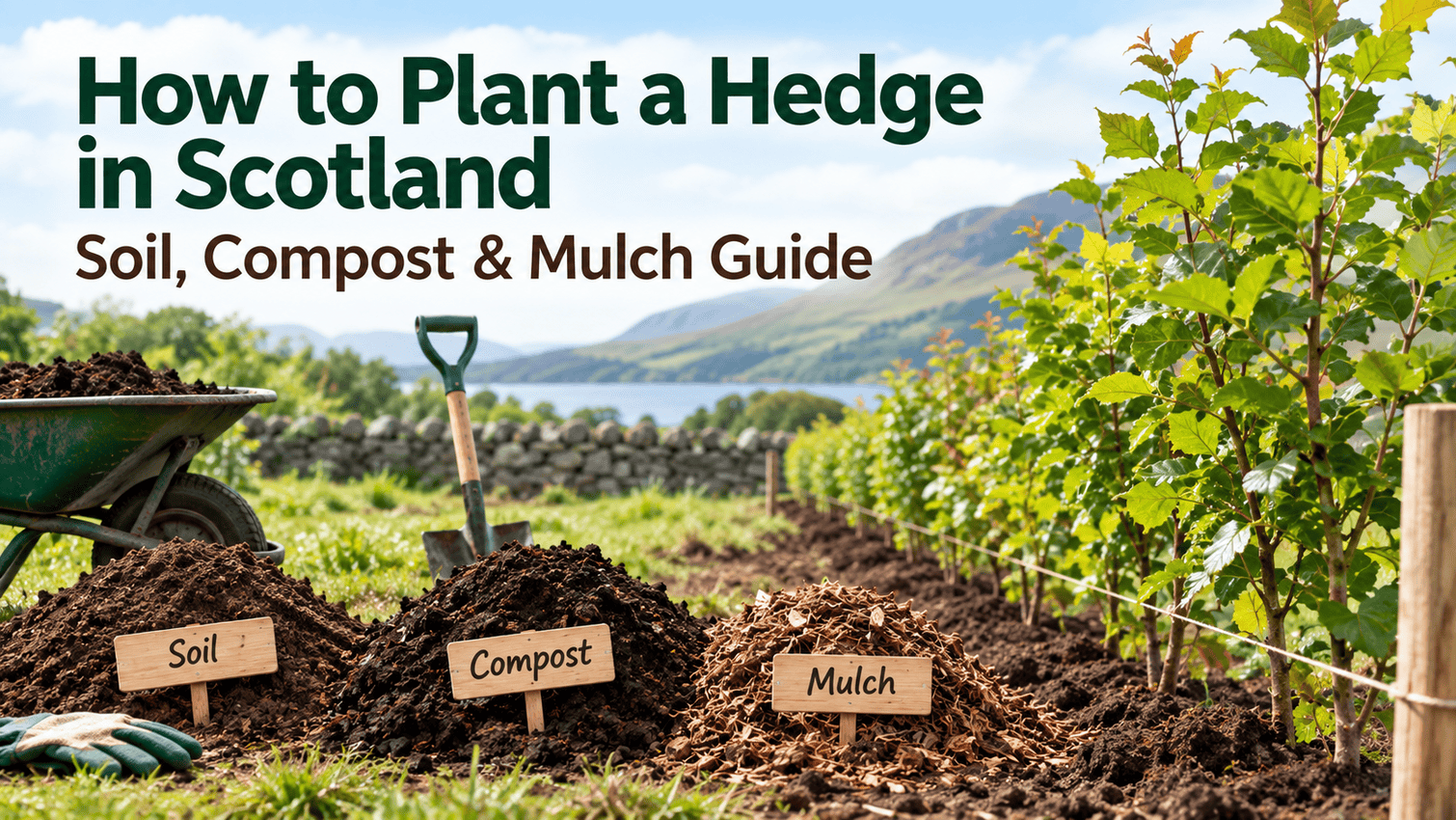
Planning to plant a new hedge in Glasgow or elsewhere in Scotland?
Buying healthy hedge plants is only part of the job. Preparing the soil properly before planting can make a major difference to how successfully a new hedge establishes.
For many gardens, the basic process is:
Remove weeds → loosen compacted soil → improve poor soil where necessary → plant at the correct depth → water thoroughly → mulch the surface.
Depending on your existing ground, you may need topsoil, organic compost, well-rotted manure or woodchip — but these materials have different jobs.
This guide explains exactly what to use, how to prepare the ground and how to calculate the amount of material you may need.
Quick Answer: What Soil Is Best for Planting a Hedge?
Most hedging plants need well-prepared, workable soil that provides suitable drainage while retaining enough moisture for the roots.
You don't normally need to replace all your existing garden soil.
Instead:
Use topsoil if you need additional suitable soil or need to improve soil depth.
Use organic compost to add organic matter to suitable poor, sandy or heavy soil.
Use well-rotted manure where appropriate to improve organic matter and fertility.
Use woodchip as a surface mulch after planting to help suppress weeds and conserve soil moisture.
For a new hedge, soil preparation across the planting area is usually more important than simply filling individual planting holes with rich material.
When Is the Best Time to Plant a Hedge in Scotland?
It depends on the type of hedge you buy.
Bare-root and root-balled deciduous hedging is commonly planted during the dormant period from autumn into late winter.
Container-grown hedging gives you a wider planting window, although establishing plants can require considerably more watering during warm or dry conditions.
Whatever type you choose, avoid planting when the ground is:
Frozen
Severely waterlogged
Unworkably wet
Extremely dry and hard
For many Scottish gardens, autumn and the dormant season provide an excellent opportunity to establish a hedge, particularly when using bare-root plants.
Why Soil Preparation Matters Before Planting a Hedge
A hedge isn't just a row of individual shrubs.
Over time, you want the plants to develop into a continuous root system and canopy.
Poor preparation can leave young plants competing with:
Compacted soil
Grass
Perennial weeds
Poor drainage
Insufficient soil depth
Very sandy soil that dries rapidly
This is why digging one small hole for each plant and hoping for the best isn't always the right approach.
Preparing a continuous planting strip gives the developing root systems better conditions in which to establish.
How Wide Should You Prepare the Ground for a Hedge?
For a traditional hedge planting area, prepare a strip approximately:
60–90cm wide
and roughly:
one spade depth
where ground conditions allow.
Remove weeds and loosen compacted soil throughout this area rather than concentrating solely on the individual planting holes.
If you're planting along a lawn, removing the turf around the hedge is also important.
Grass competes strongly with young hedging plants for water and nutrients.
Step 1: Check Your Existing Soil
Before ordering a bulk bag of anything, inspect the soil you already have.
Dig several small test holes along the proposed hedge line.
Ask:
Is there enough actual soil?
If you've got a shallow layer of soil over rubble, hardcore or poor subsoil, you may need additional Topsoil.
Is the ground heavily compacted?
Compaction needs physical improvement.
Don't simply cover badly compacted soil with compost.
Loosen the ground first.
Does water remain in the area after rainfall?
Persistent waterlogging needs to be investigated before planting.
Adding compost doesn't turn a fundamentally waterlogged site into a freely draining one.
Is the soil very sandy or low in organic matter?
Adding Organic Compost can help improve soil structure and moisture retention.
Is it heavy clay?
Clay isn't automatically bad soil.
It can retain nutrients and moisture well, but compaction and poor structure can make establishment difficult.
Organic matter can help improve workable clay soils over time.
Step 2: Remove Weeds and Grass
Clear the planting strip before your hedge arrives.
Remove:
Grass
Perennial weeds
Large stones
Building debris
Unwanted roots
Surface rubbish
Don't plant your hedge through an established strip of grass and expect young plants to compete successfully.
Keeping the immediate hedge area relatively weed-free is particularly important while plants establish.
Once planted, mulch can make this considerably easier.
Step 3: Loosen Compacted Ground
This step is particularly important in gardens where soil has been compressed by:
Construction
Heavy machinery
Repeated foot traffic
Previous paving
Landscaping work
Use a garden fork or suitable digging tools to loosen compacted ground.
You want roots to be able to move beyond the original planting hole.
A common mistake is creating a beautifully prepared small hole surrounded by hard, compacted soil.
The roots then encounter an abrupt barrier as they begin spreading.
Think beyond the planting hole.
Prepare the root zone.
Step 4: Should You Add Compost Before Planting a Hedge?
Sometimes — but use it correctly.
Organic Compost is a soil improver rather than a replacement for all garden soil.
It can be particularly useful where existing soil is:
Low in organic matter
Heavy and difficult to work
Light and sandy
Tired after previous cultivation
Rather than filling the planting hole entirely with compost, improve the broader planting area where required.
This encourages the hedge roots to establish into the surrounding soil rather than remaining within a small pocket of unusually rich material.
Step 5: Should You Add Manure When Planting a Hedge?
Well-rotted manure can provide useful organic matter, but more isn't automatically better.
Kelvin Compost's Well-Rotted Manure can be useful for improving suitable garden soil and established planting areas.
However, avoid creating a thick layer of organic matter at the bottom of a hedge trench.
As organic material decomposes and settles, it can affect the planting level.
If manure is being used as a soil improver, use it appropriately through the wider soil preparation rather than creating a soft manure-filled base directly underneath the plants.
Step 6: When Do You Need Topsoil for a Hedge?
You don't necessarily need new topsoil simply because you're planting a hedge.
Use Topsoil when the project actually requires additional soil volume or suitable growing depth.
For example:
Scenario A — Established garden with reasonable soil
You may only need to loosen the soil and add organic matter where appropriate.
Scenario B — New-build garden with shallow soil
Additional topsoil may be necessary after addressing compaction underneath.
Scenario C — Old paved area converted to planting
You may need substantially more suitable soil to establish a proper growing area.
Scenario D — Raised hedge planting area
Topsoil may be needed to create additional soil volume.
The key question is:
Do I need more soil, or do I need to improve the soil I already have?
If you need more soil, consider topsoil.
If you have sufficient soil but need more organic matter, consider compost.
Step 7: Plant the Hedge at the Correct Depth
Planting too deeply is a common mistake.
Your hedge plants should generally sit at approximately the same depth at which they were previously growing.
For bare-root hedging, you can often identify the previous soil mark around the stem.
For container-grown plants, inspect the root flare and rootball rather than automatically burying the top of the container compost.
Spread the roots naturally where appropriate and backfill with the prepared soil.
Firm gently enough to remove large air pockets without compacting the soil excessively.
Then water thoroughly.
Step 8: Mulch Your New Hedge
This is where Organic Woodchips can become particularly useful.
After planting and watering, applying a suitable surface mulch around the hedge can help:
Suppress weeds
Reduce moisture loss
Moderate soil conditions
Reduce competition around young plants
Give the planting strip a cleaner appearance
A layer around 5–8cm deep is useful for many woody plantings.
However, don't pile woodchip directly against the hedge stems.
Leave a small clear area immediately around each stem.
Think:
mulch around the plant — not against the plant.
How Much Woodchip Do I Need for a Hedge?
This is easy to calculate.
Use:
Length × Width × Depth = Volume
Suppose your hedge is:
20m long
and you mulch a:
0.8m-wide strip
to:
0.075m (7.5cm) deep
The calculation is:
20 × 0.8 × 0.075 = 1.2m³
That's approximately:
1,200 litres of woodchip
If a bulk bag contains approximately 850 litres, a single bag wouldn't provide that full calculated volume.
For a smaller 10m hedge:
10 × 0.8 × 0.075 = 0.6m³
That's approximately:
600 litres
So an approximately 850-litre bulk bag would provide enough volume for that example, with material remaining for other suitable areas.
Always calculate using your actual hedge dimensions before ordering.
Hedge Mulch Calculator
| Hedge length | 0.8m-wide strip at 5cm | 0.8m-wide strip at 7.5cm |
|---|---|---|
| 5m | 200L | 300L |
| 10m | 400L | 600L |
| 15m | 600L | 900L |
| 20m | 800L | 1,200L |
| 25m | 1,000L | 1,500L |
| 30m | 1,200L | 1,800L |
These figures are volume calculations rather than a guarantee of how much a particular garden will require. Ground levels, existing mulch and planting configuration will affect the final quantity.
How Much Compost Do I Need for Hedge Soil Improvement?
Again, calculate by area and intended depth.
A hedge strip:
20m long × 0.8m wide
has an area of:
16m²
If you're applying a 5cm layer of organic matter across that area:
16 × 0.05 = 0.8m³
That's approximately:
800 litres
This shows why a bulk bag can make more sense than repeatedly buying small bags for a long hedge.
But don't automatically apply 5cm and dig it into every hedge project.
The correct amount depends on your existing soil and how you're using the compost.
If you're unsure, assess the soil first.
What Should You Order for a New Hedge?
Here's a practical starting point.
| Existing condition | Product to consider |
|---|---|
| Good existing garden soil | Possibly mulch only |
| Poor soil with low organic matter | Organic compost |
| Heavy but workable soil | Organic compost |
| Very light/sandy soil | Organic compost |
| Insufficient soil depth | Topsoil |
| Productive/tired soil needing organic matter | Compost or suitable well-rotted manure |
| Need weed suppression after planting | Woodchip |
| Large new planting area | Combination of topsoil/compost/mulch as required |
Don't order every product simply because you're planting a hedge.
Order according to the problem you're solving.
What Is the Best Mulch for a New Hedge?
Organic mulch is particularly useful around newly planted hedges because it helps reduce weed competition and moisture loss.
Options can include:
Woodchip
Composted bark
Garden compost
Well-rotted organic material
For someone who wants a relatively durable surface mulch with a tidy natural appearance, woodchip is an excellent option.
Kelvin Compost supplies Organic Woodchips for garden and landscaping applications.
Can You Put Woodchip Around Laurel, Beech and Privet Hedges?
Woodchip can generally be used as surface mulch around many established and newly planted woody hedges when applied correctly.
The important principles are:
Prepare the soil first.
Water newly planted hedging thoroughly.
Spread woodchip over the soil surface.
Keep it away from direct contact with stems.
Maintain appropriate watering while plants establish.
Woodchip shouldn't be used to hide a drainage or compaction problem.
Fix the underlying ground first.
How Far Apart Should Hedge Plants Be?
There isn't one spacing that works for every hedge.
Plant spacing depends on:
Species
Plant size
Desired final hedge
Whether you're planting a single or double row
How quickly you want coverage
Many traditional hedge plants are spaced somewhere around 30–60cm apart, but you should follow the recommended spacing for the particular species and plant size you've purchased.
Buying more plants and cramming them together isn't necessarily better.
They still need sufficient root space, water and light to establish properly.
What If My Hedge Line Is Waterlogged?
Don't simply add topsoil or compost and plant immediately.
Persistent waterlogging can deprive roots of oxygen and lead to poor establishment.
First investigate:
Whether the soil is compacted
How long standing water remains
Whether there is an impermeable layer
Whether runoff is collecting from another area
Whether drainage work is required
In some situations, planting on a slightly raised area may help. More serious drainage problems may require a proper drainage solution or different plant selection.
Most importantly:
Don't bury a drainage problem underneath expensive new soil.
What If I Have Heavy Clay Soil?
You don't necessarily need to remove clay.
Instead:
Remove weeds.
Loosen compacted ground.
Improve workable soil with suitable organic matter.
Avoid working saturated clay.
Plant at the correct depth.
Mulch after planting.
Monitor drainage.
Organic matter can gradually improve soil structure and make heavy soil easier to work.
Kelvin Compost's Organic Compost is an option where organic soil improvement is required.
Can I Use Fresh Woodchip in the Soil?
Use woodchip primarily on the soil surface as mulch, rather than mixing large quantities of fresh woody material directly into the hedge's root zone.
Surface woodchip performs a different job from compost.
Remember:
Compost = soil improvement
Topsoil = additional soil volume
Woodchip = surface mulch
Well-rotted manure = organic matter/fertility where appropriate
Understanding those four jobs makes buying the right product much easier.
Common Hedge Planting Mistakes
Planting too deeply
Keep the original planting depth/root flare in mind.
Planting into compacted soil
Prepare the wider root zone, not just a small hole.
Leaving grass around young plants
Grass competes for moisture and nutrients.
Adding rich material only to the planting hole
Improve poor soil over the wider planting area where appropriate.
Piling mulch against stems
Leave the immediate stem area clear.
Ignoring waterlogging
Organic matter cannot replace a necessary drainage solution.
Forgetting to water after planting
Newly planted hedging still needs watering, even in a relatively wet climate.
Assuming expensive plants compensate for poor soil
A £1,000 hedge planted into badly prepared ground can still struggle.
Spend time preparing the soil before the plants arrive.
How to Care for a Newly Planted Hedge
Planting day is only the beginning.
During establishment:
Keep the hedge line weed-free.
Check soil moisture regularly.
Water during dry periods.
Maintain mulch.
Check plants after strong winds.
Replace failed plants promptly.
Avoid allowing grass to recolonise the root zone.
Newly planted hedges can require regular watering for their first couple of growing seasons while their root systems establish.
A good mulch layer makes ongoing maintenance considerably easier.
Buying Hedge Soil, Compost & Woodchip in Glasgow
A hedge project often needs more than the plants themselves.
Depending on your ground, you may need:
Organic Compost
For adding organic matter and improving suitable existing garden soil.
Topsoil
For projects requiring additional suitable soil depth or growing volume.
Well-Rotted Manure
For suitable soil-improvement and gardening applications where additional organic matter and fertility are required.
Organic Woodchips
For surface mulching around hedges, trees, shrubs and other suitable planted areas.
Kelvin Compost supplies bulk garden materials to customers across Glasgow, East Kilbride, South Lanarkshire and surrounding areas of Scotland.
Frequently Asked Questions
Should I put compost in the hole when planting a hedge?
Avoid simply filling the planting hole with compost. Where soil improvement is needed, organic matter is generally better incorporated into or applied across the broader planting area so roots establish into the surrounding ground.
Is topsoil or compost better for hedges?
They do different jobs. Topsoil is appropriate when you need additional soil volume or depth. Compost is primarily used to add organic matter and improve suitable existing soil.
Can I put manure around a hedge?
Well-rotted manure can be used as organic matter in suitable situations, including as a surface mulch, but it should be applied appropriately and shouldn't be piled against woody stems.
Should I use woodchip around a new hedge?
Yes, woodchip can make a useful surface mulch around many new hedges. It helps suppress weeds and conserve moisture. Keep it away from direct contact with the stems.
How deep should woodchip be around a hedge?
A layer around 5–8cm deep is suitable for many woody planting applications. Existing soil conditions and the type of mulch should also be considered.
When is the best time to plant a bare-root hedge?
Bare-root deciduous hedging is generally planted during the dormant period, from leaf fall through late winter, when the ground is workable and neither frozen nor waterlogged.
Can I plant a hedge in clay soil?
Yes. Many hedging plants can grow successfully in clay provided the chosen species suits the conditions and problems such as severe compaction or persistent waterlogging are addressed.
How much mulch do I need for a 20-metre hedge?
For a 20m hedge with a mulched strip 0.8m wide and 7.5cm deep, the calculated volume is approximately 1.2m³, or 1,200 litres.
Do I need to replace all my garden soil before planting?
Usually not. Assess the existing soil first. Improving the ground you already have may be more appropriate than replacing it
.
Planting a Hedge This Autumn or Winter?
Don't wait until your hedge plants arrive to discover that the ground needs preparation.
Prepare the planting strip first.
Measure the hedge.
Check the soil.
Work out whether you need additional topsoil, organic matter, mulch — or a combination.
Kelvin Compost supplies topsoil, organic compost, well-rotted manure and organic woodchip for domestic gardens, landscaping projects, allotments and larger planting jobs around Glasgow and surrounding areas.
Order Your Hedge-Planting Materials
Need to improve existing soil?
Order Organic Compost
Need additional soil depth?
Order Topsoil
Need well-rotted organic matter?
Order Manure
Need mulch for the finished hedge?
Order Organic Woodchips
For larger hedge or landscaping projects, calculate the approximate length, width and depth required before contacting us.
Call Kelvin Compost: +44 7561 251350
Email: info@kelvincompost.co.uk
Tell us your hedge length, existing soil condition and delivery area, and we'll help you work out which bulk garden materials are appropriate for your project.
Need Garden Supplies Delivered in Glasgow?
Organic compost, topsoil, manure and more across Scotland