



How to Make Compost at Home: Complete Beginner’s Guide
Looking for compost, topsoil or garden supplies?
Browse our full product range or get in touch for delivery across Glasgow and Scotland.
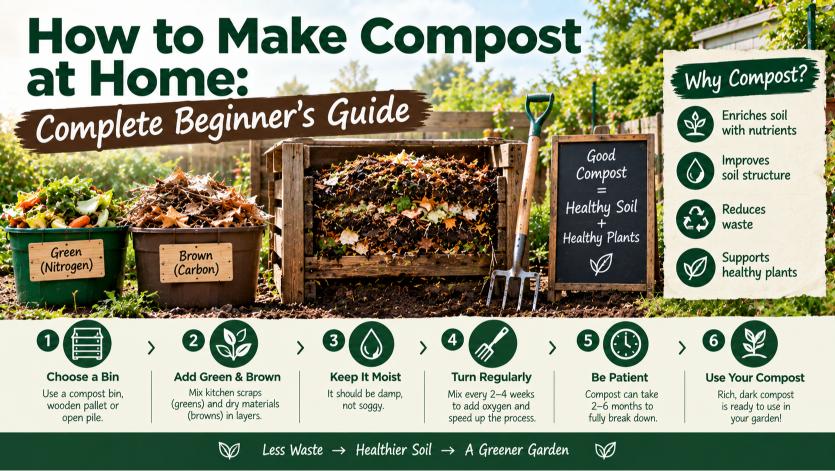
How to Make Compost at Home: A Complete Beginner’s Guide
Making your own compost is one of the simplest ways to turn everyday garden and kitchen waste into useful organic matter for your soil.
Grass clippings, autumn leaves, vegetable peelings, plant trimmings and cardboard can all contribute to a compost heap instead of going to waste. Given the right balance of materials, moisture and air, microorganisms gradually break them down into dark, crumbly compost that can be used around the garden.
But composting can also go wrong.
A heap that is too wet can become slimy and unpleasant. Too much dry material can leave it sitting unchanged for months. Food added incorrectly can attract pests, while woody material may take far longer to decompose than expected.
The good news is that successful home composting does not need to be complicated.
This guide explains how to make compost at home, what you can and cannot compost, how to balance green and brown materials, how long compost takes, how to troubleshoot common problems and how to use the finished material in your garden.
Quick Answer: How Do You Make Compost at Home?
To make garden compost:
Choose a suitable compost bin or heap.
Add a mixture of nitrogen-rich green materials and carbon-rich brown materials.
Chop larger material into smaller pieces where practical.
Keep the pile moist but not waterlogged.
Include enough coarse material to maintain airflow.
Turn or mix the compost occasionally if you want faster decomposition.
Continue adding suitable material.
Allow it to decompose until it becomes dark, crumbly and earthy-smelling.
The biggest mistake is treating a compost heap like a rubbish bin.
Good compost comes from a balanced mixture of materials, not simply filling a container with whatever garden waste happens to be available.
What Is Compost?
Garden compost is organic material that has been broken down through biological decomposition.
Your compost heap contains an entire ecosystem.
Bacteria, fungi and other organisms help break down organic materials, while larger organisms such as worms and various invertebrates may also contribute as conditions develop.
Over time, recognisable garden and kitchen waste becomes a darker and more stable material that can be returned to the soil.
Finished garden compost can contribute:
Organic matter
Improved soil structure
Better moisture retention
Improved workability
Nutrient recycling
Biological activity
However, it is important to distinguish home-made garden compost from the products commonly sold as potting compost.
They are not necessarily interchangeable.
Garden Compost vs Potting Compost
The word compost is used for several different products.
Home-made garden compost is decomposed organic waste and is primarily used as a soil improver or mulch.
Potting or growing media are specially formulated materials intended for growing plants in containers, trays or pots.
You should therefore not automatically fill pots or seed trays with material taken straight from your garden compost heap.
Similarly, bulk organic soil improver has a different role from a specialist seed-sowing compost.
Understanding that distinction prevents a lot of gardening problems.
Why Make Your Own Compost?
Home composting allows nutrients and organic material from your garden to be recycled back into the soil.
Instead of disposing of:
Grass clippings
Fallen leaves
Annual weeds
Vegetable peelings
Prunings
Dead bedding plants
Cardboard
you can use many of these materials to produce something useful.
There are several benefits.
1. It reduces garden waste
Gardens continually generate organic material.
Composting provides somewhere productive for much of it to go.
2. It produces a useful soil improver
Finished compost can be incorporated into suitable soil or applied to the surface as organic matter.
3. It recycles nutrients
Plants absorb nutrients while growing.
Composting suitable plant material allows some of those nutrients to return to the garden rather than leaving the system completely.
4. It can improve soil over time
Regular additions of mature organic matter can help both heavy and light soils.
Heavy soils can become easier to work as their structure improves, while light soils can benefit from increased organic matter and moisture retention.
5. It makes gardening more circular
Material grows in the garden, becomes compost and eventually returns to the soil to support future growth.
What Are Greens and Browns in Compost?
One of the most important composting concepts is the difference between green and brown materials.
You need both.
Greens are generally relatively nitrogen-rich and moist.
Browns are generally relatively carbon-rich and drier.
A healthy compost heap contains a mixture rather than being dominated by one category.
Green Compost Materials
Examples include:
Fresh grass clippings
Vegetable peelings
Fruit scraps
Coffee grounds
Fresh plant trimmings
Young annual weeds
Spent plants
Fresh soft growth
These materials tend to decompose relatively quickly.
But too many greens—especially grass clippings—can create a dense, wet mass with poor airflow.
Brown Compost Materials
Examples include:
Dry autumn leaves
Torn cardboard
Plain paper in appropriate quantities
Small woody prunings
Straw
Dried plant stems
Woodier garden material
Brown material helps create structure and balance wetter ingredients.
Do You Need an Exact Green-to-Brown Ratio?
You do not need to weigh every bucket.
For ordinary home composting, focus on maintaining a varied mixture.
If you add a large quantity of wet grass clippings, mix in dry leaves, torn cardboard or another suitable brown material.
If the pile contains mostly dry woody material and leaves, add some softer green material.
Think in terms of balance, not laboratory precision.
What Can You Put in a Compost Bin?
Many everyday garden and kitchen materials can be composted.
Usually suitable
| Material | Compost? | Notes |
|---|---|---|
| Vegetable peelings | Yes | Chop large pieces if convenient |
| Fruit scraps | Yes | Mix through the heap |
| Coffee grounds | Yes | Don't rely on them as the only green |
| Tea leaves | Yes | Check whether tea bags contain plastic |
| Grass clippings | Yes | Mix with brown material |
| Autumn leaves | Yes | Can also be composted separately as leafmould |
| Annual weeds | Usually | Avoid problematic seed heads |
| Soft plant trimmings | Yes | Smaller pieces decompose faster |
| Torn plain cardboard | Yes | Remove plastic tape and labels where necessary |
| Small woody prunings | Yes | Chop or shred where practical |
| Spent vegetable plants | Usually | Exclude seriously diseased material where appropriate |
| Straw | Yes | Useful carbon-rich material |
| Crushed eggshells | Yes | Break down slowly |
Variety is useful.
A heap containing grass, leaves, cardboard, kitchen vegetable waste and garden trimmings will generally behave differently from one containing almost nothing but grass.
What Should You Not Put in Home Compost?
Not everything biodegradable belongs in a normal garden compost heap.
Avoid materials that introduce unnecessary risks, persistent contamination or pest problems.
Meat and fish
Ordinary open garden composting systems are generally not the place for meat, fish and similar food waste.
They can attract pests and create odour problems.
Dairy products
Milk, cheese and other dairy products are also best kept out of a conventional garden compost heap.
Oils and fats
Cooking oil, fats and greasy food should not be added.
Dog and cat faeces
Do not put pet faeces from dogs and cats into compost intended for ordinary food-growing areas.
Diseased plant material
Whether diseased material can be composted safely depends on the disease and whether your composting process reaches conditions capable of destroying it.
A normal cool domestic heap may not.
When in doubt, dispose of seriously diseased plant material through an appropriate alternative route.
Persistent perennial weeds
Be careful with weeds capable of regenerating from roots or rhizomes.
Examples can include:
Bindweed
Ground elder
Couch grass
A cool compost heap may not reliably destroy viable pieces.
Weeds full of mature seed
If your heap does not become sufficiently hot, viable weed seeds may survive and later be spread around the garden with the compost.
Treated or painted wood
Do not treat a compost heap as somewhere to dispose of processed building timber.
Glossy or plastic-coated cardboard
Use clean, suitable cardboard rather than material with substantial plastic coatings, tape or other contaminants.
Where Should You Put a Compost Bin?
The best location is somewhere convenient enough that you will actually use it.
A compost bin hidden at the far end of a large garden may sound tidy, but if adding kitchen scraps becomes inconvenient, it may be neglected.
Look for:
Reasonably easy access
A stable surface
Some shelter from extreme conditions
Space to add and remove material
Enough room to turn the heap if required
A location that won't cause problems for neighbours
Many traditional compost systems benefit from contact with the ground.
This allows drainage and gives soil organisms access to the material.
Avoid placing an ordinary compost heap where liquid runoff could create a problem.
Do You Need a Compost Bin?
No.
Compost can be made using several systems.
Plastic compost bin
A common choice for smaller gardens.
Advantages:
Compact
Neat
Helps retain some warmth
Easy to add material
Disadvantages:
Can become compacted
Turning may be awkward
Removing finished material can sometimes be inconvenient
Wooden compost bay
Useful for larger gardens.
Advantages:
Holds substantial volumes
Easy to access
Easier to turn
Multiple bays can create a useful rotation system
Open compost heap
Simple and inexpensive.
However, it may lose moisture or become excessively wet depending on exposure, so covering and management become important.
Three-bay composting system
Excellent where space permits.
For example:
Bay 1: fresh material
Bay 2: decomposing material
Bay 3: mature compost
This creates a continuous cycle and avoids constantly adding fresh waste to material that is nearly ready.
How to Start a Compost Heap Step by Step
Step 1: Choose your location
Set up the bin or heap somewhere accessible and suitable.
Step 2: Start with mixed material
Avoid creating one enormous layer of a single ingredient.
A mixture of coarse brown material and softer green material gives the heap a better start.
Step 3: Break up large material
A whole thick branch decomposes slowly.
The same branch shredded into small pieces provides far more surface area for decomposers to work on.
You do not need to finely chop everything, but reducing very large pieces can significantly speed up composting.
Step 4: Add greens and browns
Continue alternating or mixing materials as they become available.
You don't need perfect layers.
In fact, mixing materials can help avoid dense pockets of grass or dry pockets of leaves.
Step 5: Monitor moisture
Your compost should be moist but not saturated.
If it is extremely dry, decomposition slows.
If it is waterlogged, oxygen becomes limited and unpleasant anaerobic decomposition can develop.
Step 6: Maintain airflow
Air is important for normal aerobic composting.
Coarse materials create spaces through which air can move.
Turning the heap can also introduce oxygen.
Step 7: Let biology do the work
You do not need to constantly interfere with the heap.
Monitor it and correct obvious problems, then allow decomposition to continue.
How Wet Should Compost Be?
Moisture is one of the main factors controlling decomposition.
Too little water and microorganisms become less active.
Too much water fills air spaces and creates oxygen-poor conditions.
The goal is damp rather than dripping wet.
If the heap is too dry:
Add fresh green material.
Add water gradually if necessary.
Mix dry and moist material together.
Cover the heap to reduce excessive drying.
If the heap is too wet:
Add dry brown material.
Mix in torn cardboard or dry leaves.
Turn the heap to introduce air.
Protect it from excessive rainfall.
This last point can be particularly relevant during a wet Scottish autumn and winter.
Do You Need to Turn Compost?
Not necessarily.
Compost will decompose without regular turning, but turning can speed the process by:
Introducing oxygen
Mixing wet and dry areas
Redistributing materials
Breaking up compacted layers
If you want compost quickly, turning is useful.
If you are happy to wait longer, a more passive approach can also work.
The important thing is to intervene if the heap becomes compacted, waterlogged or smelly.
How Long Does Compost Take to Make?
There is no single answer.
Composting speed depends on:
Temperature
Material size
Moisture
Airflow
Ingredient balance
Heap size
How frequently it is turned
Time of year
A carefully managed active compost heap can decompose relatively quickly.
A cool, passive heap containing large woody pieces can take a year or considerably longer.
For most home gardeners, it is better to judge compost by its condition rather than by the calendar.
How Do You Know When Compost Is Ready?
Finished compost should generally be:
Dark
Crumbly
Earthy-smelling
Cooler and relatively stable
Difficult to identify as the original ingredients
A few woody fragments may remain.
These can be screened out and returned to the next compost heap if desired.
If you can still clearly identify large amounts of fresh grass, vegetable peelings or other undecomposed ingredients, give the material more time.
Why Does My Compost Smell Bad?
A strong unpleasant smell usually indicates that something is wrong.
Healthy mature compost should smell earthy rather than rotten.
A common cause is excessive moisture combined with insufficient oxygen.
For example, a large layer of wet grass can collapse into a dense mass.
Air disappears from the spaces between the material and anaerobic conditions develop.
How to fix smelly compost
Try:
Turning the pile.
Breaking up compacted layers.
Adding dry brown material.
Mixing everything together.
Protecting the heap from excessive rain.
Avoid simply adding more wet kitchen waste to an already saturated heap.
Why Is My Compost Not Breaking Down?
If your heap seems unchanged after months, investigate the conditions.
It may be too dry
A dry pile decomposes slowly.
Add moisture if needed and mix in fresh green material.
There may be too many browns
A heap made almost entirely from dry leaves, woody stems and cardboard can be slow.
Add appropriate green material.
Pieces may be too large
Large woody branches naturally take longer.
Chop or shred material where practical.
The heap may be too small
A tiny pile loses heat quickly.
Larger heaps can maintain more favourable composting conditions.
It may simply be cold
Decomposition slows during winter.
This does not necessarily mean the heap has failed.
Activity usually increases again as temperatures rise.
Why Is My Compost Slimy?
Slimy compost often contains too much wet, nitrogen-rich material.
Grass clippings are a common culprit.
A thick layer of grass can rapidly become dense and airless.
Correct it by adding structure.
Mix in:
Dry leaves
Torn cardboard
Small woody material
Other suitable dry browns
Then turn the pile.
Why Are There Flies Around My Compost?
Small numbers of insects are normal in a compost ecosystem.
Large numbers of flies around exposed kitchen scraps may indicate that food waste is sitting on the surface.
Mix suitable kitchen scraps into the heap and cover them with garden material or finished compost.
Also check that you are not adding unsuitable cooked foods, meat or dairy products.
Will Compost Attract Rats?
A well-managed garden compost heap containing suitable materials should be less attractive to rodents than one filled with inappropriate food waste.
To reduce risk:
Don't add meat.
Don't add fish.
Avoid dairy.
Avoid cooked food scraps where pest attraction is a concern.
Manage exposed kitchen material.
Keep the area around the bin tidy.
Use an appropriate rodent-resistant system if rodents are a known local problem.
Can You Compost Grass Clippings?
Yes, but grass needs management.
Fresh grass is rich in nitrogen and moisture.
A thin amount mixed through other ingredients can be useful.
A whole bin filled with grass is another story.
It can compact rapidly and become wet, hot, slimy and oxygen-poor.
When mowing a large lawn, mix clippings with brown materials such as:
Dry leaves
Cardboard
Woody shreddings
Alternatively, consider leaving suitable finely cut clippings on the lawn when mowing conditions allow rather than removing every clipping.
Can You Compost Autumn Leaves?
Yes.
Leaves can be added to a mixed compost heap, but you can also compost them separately to produce leafmould.
Leafmould is different from conventional garden compost.
It is produced mainly through fungal decomposition of leaves and can take considerably longer to mature.
If your garden produces huge quantities of autumn leaves, separating some for leafmould prevents your normal compost pile from becoming dominated by one carbon-rich material.
Can You Compost Cardboard?
Plain cardboard can be a useful brown ingredient.
It is particularly handy when you have a large amount of wet green material but few dry leaves available.
Remove unsuitable components such as:
Plastic tape
Plastic windows
Non-compostable coatings
Staples where practical
Tear or shred the cardboard before adding it.
Large flat sheets can stick together and restrict airflow when wet.
Can You Compost Weeds?
Many weeds can be composted, but use judgement.
Young annual weeds that have not produced mature seed are generally much easier to manage.
Be more cautious with:
Seed-filled weeds
Persistent perennial roots
Rhizomes
Plants capable of regenerating from fragments
A domestic heap does not necessarily reach or maintain temperatures sufficient to kill every seed or persistent root.
If you are uncertain, keep troublesome material out of your main compost.
Can You Compost Woodchip?
Small quantities of fine woody material can contribute carbon and structure to a compost heap.
However, a pile of woodchip is not the same as a balanced compost heap.
Woody material decomposes relatively slowly.
If your main goal is to use woodchip as a surface mulch around established trees, shrubs, hedges or paths, it may be more useful applied directly in an appropriate location rather than composting all of it first.
Kelvin Compost supplies Organic Woodchips for larger garden and landscaping projects.
Does Composting Stop in Winter?
No, but it usually slows considerably.
The microorganisms responsible for decomposition are affected by temperature.
As conditions become colder, biological activity decreases.
In Scotland, winter composting therefore requires a little patience.
You can continue adding suitable material, but don't expect the same rate of decomposition you might see during warmer months.
How to manage compost through a Scottish winter
Keep excessive rain out
A heap that remains saturated throughout winter can lose valuable air spaces.
Use a lid or suitable cover where appropriate.
Keep adding browns
Autumn provides an excellent supply of dry leaves.
Store some separately so you have carbon-rich material available when kitchen scraps are added during winter.
Chop materials
Smaller pieces generally break down more readily.
Don't worry if the heap cools
A cool winter heap is not necessarily a failed heap.
Decomposition can accelerate again when temperatures rise.
Avoid repeatedly disturbing a very wet heap
If conditions are saturated, wait for a suitable opportunity before carrying out major turning.
Can You Make Compost Faster?
Yes, although there is always a biological limit.
To encourage faster composting:
Use smaller pieces
Shredded material exposes more surface area.
Maintain a balanced mixture
Avoid heaps dominated by one ingredient.
Keep moisture appropriate
Neither desert-dry nor waterlogged.
Maintain oxygen
Use coarse material and turn when appropriate.
Build a reasonable volume
Larger compost heaps generally retain warmth better than tiny piles.
Turn the heap
Turning redistributes materials and introduces oxygen.
But remember:
Fast compost isn't automatically better compost.
If you are not in a hurry, slower decomposition is perfectly acceptable.
Hot Composting vs Cold Composting
There are two broad approaches.
Hot composting
A carefully constructed heap containing an appropriate mixture of ingredients can heat considerably as microorganisms become active.
Hot composting requires more management.
It typically involves:
Sufficient volume
Balanced ingredients
Correct moisture
Regular monitoring
Turning
Its main attraction is speed.
Cold composting
This is what many gardeners naturally do.
You add material gradually and allow it to break down over a longer period.
It requires less work but can take much longer.
Neither approach is automatically correct for every household.
Choose according to how much material, space and time you have.
How Do You Use Finished Compost?
Once mature, home-made compost can be extremely useful.
Improve garden soil
Mature compost can be incorporated into suitable beds to increase organic matter.
Mulch established beds
Compost can be spread over the soil surface around suitable established plants.
Keep material away from direct contact with vulnerable stems and woody trunks.
Vegetable gardens
Mature compost can contribute organic matter to productive beds.
How much you need depends on existing soil condition and your management system.
Raised beds
Home-made compost can form part of the organic component of a raised-bed mixture.
However, don't assume a deep raised bed should be filled entirely with compost.
A substantial raised bed generally needs a stable soil-based growing medium.
Around trees and shrubs
Mature compost can be used appropriately as part of soil management around established plants.
Avoid piling material directly against trunks.
Should You Dig Compost Into the Soil?
You can, but you don't always need to.
Traditional gardening often incorporates organic matter through cultivation.
Another option is to apply mature compost to the surface.
In a no-dig system, organic matter is spread as a surface layer and soil organisms gradually work at the interface between compost and soil.
The best approach depends on:
Existing soil condition
What you're growing
Whether the ground is compacted
Your gardening method
Avoid digging merely because you think compost cannot work unless buried.
How Much Compost Does a Garden Need?
This depends on what you are trying to achieve.
For volume calculations, use:
Area × depth = volume
For example:
A bed measuring:
5m × 2m = 10m²
If you wanted a 5cm layer:
10 × 0.05 = 0.5m³
That's approximately:
500 litres
Here are theoretical volumes at a 5cm depth:
| Garden area | Compost required at 5cm |
|---|---|
| 5m² | 250L |
| 10m² | 500L |
| 15m² | 750L |
| 20m² | 1,000L |
| 30m² | 1,500L |
| 50m² | 2,500L |
| 100m² | 5,000L |
These calculations tell you the volume, not whether every garden should receive a 5cm application.
Assess the soil and intended use first.
What If You Can't Make Enough Compost?
This is where home composting meets reality.
A household compost heap can be extremely useful, but larger gardens consume a surprising volume of organic matter.
Consider a 50m² garden area.
At a 5cm application:
50 × 0.05 = 2.5m³
That's:
2,500 litres
Producing that amount of mature compost at home requires a considerable volume of raw organic material, space and time.
You don't have to choose between home composting and buying compost.
Many gardeners do both.
Use your home-made compost where you can and supplement it with quality bulk organic compost when you're improving a larger area.
Kelvin Compost supplies organic compost in bulk quantities for gardens, allotments, schools, community growing projects and landscaping work across Glasgow and surrounding areas.
Home-Made Compost vs Bulk Organic Compost
They can complement each other.
| Home-made compost | Bulk organic compost |
|---|---|
| Recycles your own garden waste | Provides substantial volume |
| Composition varies | More consistent product |
| Requires time to produce | Ready when required |
| Excellent for ongoing garden recycling | Useful for major soil-improvement projects |
| Quantity limited by your waste | Suitable for larger areas |
| Essentially produced at home | Purchased and delivered |
If you only need a small amount, your own compost may be enough.
If you're improving a large garden, building several beds or managing an allotment, bought compost can provide the volume that a household heap cannot realistically produce.
Compost, Manure or Topsoil: Which Do You Need?
These materials are often confused.
Compost
Choose compost when the objective is primarily to add mature organic matter and improve suitable existing soil.
Well-rotted manure
Manure contributes organic matter and nutrients and can be useful for suitable productive beds and hungry crops.
It should not automatically be applied everywhere.
Topsoil
Topsoil provides actual soil volume.
Use it when you need to:
Increase growing depth
Establish new beds
Prepare suitable lawn areas
Replace missing soil
Fill substantial areas
Topsoil adds soil. Compost improves suitable existing soil.
A garden can require both.
Common Composting Mistakes
1. Adding only grass
This often produces a wet, compacted heap.
Mix grass with brown material.
2. Letting the heap become waterlogged
Cover it where necessary and introduce dry material and air.
3. Letting it become completely dry
Add moisture when required.
4. Adding large woody branches
Cut or shred them if you want faster decomposition.
5. Adding inappropriate food waste
Keep meat, fish, dairy and fats out of a normal garden compost heap.
6. Expecting compost in a few weeks
Home composting requires patience.
7. Assuming winter inactivity means failure
Cold weather naturally slows decomposition.
8. Spreading unfinished compost everywhere
Allow the material to mature before using it for applications that require finished compost.
9. Treating compost as topsoil
They perform different jobs.
10. Giving up because the first heap isn't perfect
Composting becomes easier once you learn how your own combination of materials behaves.
A Simple Year-Round Composting Routine
You don't need a complicated schedule.
Spring
Add:
Garden cuttings
Weeds before seeding
Vegetable scraps
Early grass clippings
Mix grass with stored brown material.
Summer
The heap can decompose quickly in warm weather.
Monitor moisture carefully because it can dry out.
Continue balancing grass and other green material with browns.
Autumn
This is one of the most useful composting periods.
You may have:
Fallen leaves
Finished annual plants
Vegetable-crop residues
Prunings
Final grass clippings
Store some dry leaves separately rather than putting every leaf into the compost heap at once.
Winter
Continue adding suitable kitchen and garden material.
Expect decomposition to slow.
Protect the heap from becoming excessively wet and keep a supply of brown material available.
By managing compost throughout the year, you create a continuous recycling system rather than a one-off project.
Frequently Asked Questions About Making Compost
How do I make compost at home?
Combine suitable green and brown organic materials, maintain moisture and airflow, and allow microorganisms to break the materials down until the compost becomes dark, crumbly and mature.
What is the best mixture for compost?
Use a varied combination of nitrogen-rich greens and carbon-rich browns rather than relying heavily on one ingredient.
Can I put grass clippings in compost?
Yes. Mix them with dry brown materials because thick layers of fresh grass can become compacted and slimy.
Can I compost leaves?
Yes. Add leaves to mixed compost or compost them separately to produce leafmould.
Can I put cardboard in compost?
Suitable plain cardboard can be torn or shredded and used as brown material. Remove plastic tape and unsuitable coatings.
Can I compost weeds?
Many young annual weeds can be composted. Be cautious with mature seeds and persistent perennial weeds that may survive a cool domestic compost heap.
Why does my compost smell?
A rotten smell commonly indicates excessive moisture and insufficient oxygen. Turn the heap and mix in dry brown material.
Why is my compost too wet?
It may contain too much wet green material or be exposed to excessive rainfall. Add browns, improve airflow and cover the heap appropriately.
Why is my compost dry?
It may lack moisture or contain too much dry material. Add suitable green ingredients and water gradually if required.
Does composting work in winter?
Yes, but decomposition usually slows as temperatures fall.
Do I have to turn my compost?
No. Turning generally speeds decomposition and improves aeration, but passive composting can also work if you are prepared to wait longer.
How long does home-made compost take?
It varies considerably. Temperature, ingredient balance, particle size, moisture, airflow and management all affect the speed of decomposition.
Can I grow plants directly in home-made compost?
Home-made garden compost is primarily a soil improver rather than a specially formulated potting medium. Use an appropriate growing medium for containers and seed sowing.
Can I use compost on clay soil?
Mature organic matter can help improve the structure and workability of suitable clay soil over time. It is not, however, a substitute for fixing severe drainage or compaction problems.
Is home-made compost better than bought compost?
Neither is universally better. Home compost is excellent for recycling household garden waste, while purchased bulk compost provides consistent, ready-to-use volume for larger projects.
What should finished compost look like?
It should generally be dark, crumbly and earthy-smelling, with most original ingredients no longer recognisable.
Make Your Own Compost — and Supplement It When You Need More
Home composting is worth doing whether you have a small garden or a large allotment.
You don't need expensive equipment or a perfect recipe.
Remember the fundamentals:
Mix greens and browns.
Keep the heap moist, not waterlogged.
Maintain airflow.
Keep unsuitable waste out.
Give decomposition time.
The result is a useful source of organic matter that can be returned to your garden year after year.
And if your garden project requires more compost than you can realistically produce at home, Kelvin Compost can supply bulk organic compost and other garden materials across Glasgow, East Kilbride, South Lanarkshire and surrounding areas.
Need More Compost Than Your Heap Can Produce?
Organic Compost: Browse Kelvin Compost Organic Compost
Topsoil: Browse Kelvin Compost Topsoil
Well-Rotted Manure: Browse Kelvin Compost Manure
Organic Woodchips: Browse Kelvin Compost Woodchips
Delivery: Compost and garden-material delivery is available across Glasgow and surrounding areas, subject to location and access.
Call: +44 7561 251350
Email: info@kelvincompost.co.uk
Need Garden Supplies Delivered in Glasgow?
Organic compost, topsoil, manure and more across Scotland