



How to Improve Garden Soil UK | Compost, Topsoil & More
Looking for compost, topsoil or garden supplies?
Browse our full product range or get in touch for delivery across Glasgow and Scotland.
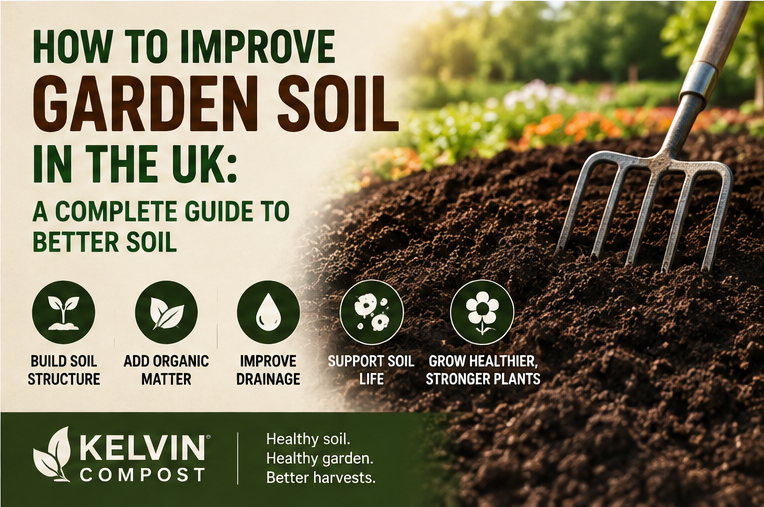
How to Improve Garden Soil in the UK
Good soil is the foundation of a healthy garden. Whether you are growing vegetables, planting shrubs, creating flower borders or repairing a tired lawn, improving the soil can make a noticeable difference to plant growth.
The good news is that you do not necessarily need to replace your entire garden soil. In many cases, adding the right organic matter and improving the soil structure is enough.
The simplest way to improve most garden soils is to add well-matured organic matter such as quality compost, then use the right soil or soil amendment for the particular problem.
Heavy clay soil, sandy soil, compacted ground and depleted soil all require slightly different approaches.
This guide explains how to improve garden soil in the UK, what materials to use and how to decide whether you need compost, manure, topsoil or another soil improver.
What Does It Mean to Improve Garden Soil?
Improving garden soil means changing its physical and biological condition so that plants have a better environment for healthy root growth.
Good garden soil should generally provide:
- Good drainage without drying out too quickly
- Enough moisture for plant roots
- Space for roots to grow
- Organic matter
- Access to nutrients
- Good aeration
- A healthy soil ecosystem
Organic matter is particularly useful because it can improve soil structure, water-holding capacity and fertility. The RHS describes organic matter as a soil improver or soil conditioner and lists materials such as garden compost, well-rotted manure and leafmould as examples.
However, more organic matter is not automatically better. The right material and application rate depend on your soil and what you are trying to grow.
How Do You Know If Your Garden Soil Is Poor?
Poor soil can show itself in several ways.
You may notice:
- Water sitting on the surface after rain
- Soil becoming hard and compacted
- Large cracks during dry weather
- Plants growing slowly
- Poor root development
- Very little earthworm activity
- Soil that is extremely sandy and dries quickly
- Low fertility
- Difficulty establishing lawns or plants
- Soil containing large amounts of stones or construction debris
One problem can also lead to another.
For example, heavy clay soil can become compacted, reducing drainage and making it difficult for plant roots to access air. Sandy soil has the opposite problem: it may drain quickly and struggle to retain moisture and nutrients.
The solution should therefore be based on the type of soil you actually have.
How to Improve Clay Soil
Clay soil contains a high proportion of very fine mineral particles. When wet, it can become sticky and difficult to work. When dry, it can become extremely hard.
Clay is not necessarily bad soil. It can contain valuable minerals and retain moisture well. The main challenge is improving its structure.
Add compost or other well-rotted organic matter
Adding quality compost introduces organic matter into the soil and can help create a more workable structure.
Spread the material across the surface and incorporate it into the upper layer of soil where appropriate.
Avoid working very wet clay because digging or walking on it when saturated can cause further compaction.
Improve drainage where necessary
If water remains on the surface for long periods, simply adding compost may not solve every drainage problem.
Consider whether the problem is caused by:
- Compaction
- A naturally heavy clay soil
- Poor ground levels
- An impermeable layer
- Excessive foot traffic
- A high water table
For severely waterlogged gardens, the solution may require drainage or changes to the landscape rather than simply adding more organic matter.
How to Improve Sandy Soil
Sandy soil usually drains quickly because the particles are relatively large and leave more spaces between them.
That can be useful for drainage, but sandy soil may struggle to retain water and nutrients.
Adding organic matter can help improve its ability to hold moisture and support plant growth.
Compost is particularly useful as part of a long-term soil improvement programme because it adds organic material rather than simply supplying a short-term nutrient boost.
Apply compost regularly rather than expecting one application to permanently transform sandy ground.
How to Improve Compacted Garden Soil
Compaction is common in lawns, new-build gardens, paths, heavily used areas and gardens that have been walked on when wet.
Compacted soil has fewer air spaces, which can restrict root growth and reduce water infiltration.
Before adding compost, loosen the soil where possible.
For small beds, a garden fork can be used to break up compacted areas without completely turning the soil over.
For lawns, aeration can help open up compacted ground before applying a suitable top dressing.
A thin compost-based top dressing can then provide organic matter at the surface.
Is Compost Good for Improving Garden Soil?
Yes. Compost is one of the most useful materials for improving garden soil.
Garden compost acts primarily as a soil improver rather than simply functioning as a fertiliser. It can add organic matter and help improve soil structure and moisture management.
The RHS recommends organic matter for improving soil structure and notes that garden compost can improve fertility, structure and water-holding capacity.
Quality matters, however.
Look for compost that is:
- Fully matured
- Consistent in texture
- Free from obvious contaminants
- Suitable for the intended use
- Produced to an appropriate quality standard
For larger gardens, allotments and landscaping projects, buying compost in bulk can also be considerably more practical than using dozens of small bags.
Compost vs Manure for Improving Soil
Both compost and well-rotted manure can improve garden soil, but they are not identical.
| Material | Main purpose | Best suited to |
|---|---|---|
| Compost | Adds organic matter and improves soil structure | General soil improvement, beds, borders and vegetables |
| Well-rotted manure | Adds organic matter and nutrients | Hungry crops, borders and established planting areas |
| Topsoil | Provides a growing medium and changes soil depth | New beds, lawns, landscaping and ground preparation |
| Loam soil | Balanced growing medium | Planting, turf and general garden applications |
| Woodchip | Surface mulch | Paths, borders and moisture conservation |
Manure should be well rotted before being incorporated into soil. Fresh manure can be unsuitable for many garden applications and may cause problems for plants.
When Should You Improve Garden Soil?
For many UK gardens, autumn is an excellent time for major soil improvement.
Adding organic matter before winter gives the material time to integrate into the soil and allows the garden to be prepared for the following growing season.
However, there is no single correct month for every project.
Soil can be improved:
- Before creating a new bed
- Before planting
- During autumn preparation
- During spring preparation
- When renovating depleted soil
- After harvesting vegetable crops
Avoid heavily working saturated soil because this can damage soil structure.
How Much Compost Should You Add to Garden Soil?
The quantity depends on the soil, material and intended use.
As a general soil-improvement guide, the RHS gives an application rate of around 5–10 kg of organic matter per square metre, while noting that the weight varies considerably according to how wet or dry the material is.
For bulk compost, it is often easier to calculate by volume.
Measure:
Length × width × depth = volume
For example:
A bed measuring 5m × 2m with a 0.05m layer requires:
5 × 2 × 0.05 = 0.5m³
Since 1m³ equals 1,000 litres, that is approximately 500 litres of material.
For larger projects, ordering a bulk bag can be more economical and convenient than buying numerous small bags.
Can You Improve Soil Without Replacing It?
In most gardens, yes.
Completely removing poor soil is expensive, disruptive and often unnecessary.
A better approach is usually to identify the underlying problem and improve the existing soil.
For example:
Heavy clay → add organic matter and improve structure.
Sandy soil → add organic matter to improve moisture retention.
Compacted soil → aerate or loosen it, then improve with organic matter.
Insufficient soil depth → consider adding suitable topsoil.
Low organic matter → add mature compost or another suitable soil conditioner.
The exception is severely contaminated or unsuitable ground, where professional assessment and removal may be necessary.
Can You Mix Compost With Topsoil?
Yes. Compost and topsoil can work extremely well together.
Topsoil provides the mineral soil component and physical growing medium, while compost adds organic matter.
This is particularly useful for:
- New garden beds
- Raised beds
- Landscaping
- Planting areas
- Lawn preparation
- Vegetable gardens
The exact ratio depends on the project, plants and quality of the materials.
Do not assume that a garden bed should be filled entirely with compost. Compost is generally used to improve soil rather than replace the entire mineral soil profile.
How to Improve Soil for a New Lawn
Good soil preparation is one of the most important stages of establishing a lawn.
For a new lawn:
- Remove large stones, rubble and debris.
- Level the ground.
- Address severe compaction.
- Add suitable topsoil if the existing soil is unsuitable or insufficient.
- Incorporate organic matter where appropriate.
- Create a firm but workable surface.
- Seed or turf the lawn.
For established lawns, aeration and appropriate top dressing can help improve the growing environment around the grass roots.
How to Improve Soil for Vegetable Gardens
Vegetables benefit from fertile, well-structured soil.
Before planting, remove weeds and debris and work mature organic matter into the growing area where appropriate.
Compost can be especially useful for:
- Vegetable beds
- Allotments
- Raised beds
- Crop rotation
- Improving depleted soil
Do not assume that every crop needs the same fertility level. Some plants prefer richer conditions than others.
How to Improve Soil for Flowers, Trees and Shrubs
Established trees and shrubs generally do not need large amounts of soil disturbance around their roots.
Instead, organic matter can often be applied as a surface mulch.
For new planting, incorporate suitable organic matter into the planting area according to the requirements of the plant and soil.
For established borders, a surface layer of compost or another suitable mulch can gradually contribute organic matter while helping to reduce moisture loss.
What Is the Best Soil Improver?
There is no single best soil improver for every garden.
For general garden soil improvement, mature compost is one of the most versatile options.
However:
- Use topsoil when you need additional soil or growing depth.
- Use manure when you need well-rotted organic matter with greater nutrient contribution.
- Use loam where a balanced soil is required.
- Use woodchip or other suitable mulch materials primarily on the soil surface.
The best product is the one that solves the actual soil problem.
Quick Guide: Which Material Should You Use?
Need to improve existing soil?
→ Compost
Need to add soil depth?
→ Topsoil
Need nutrient-rich organic matter?
→ Well-rotted manure
Need a balanced planting soil?
→ Loam
Need surface protection and weed suppression?
→ Compost, bark or woodchip mulch depending on the application
Need to prepare a new lawn?
→ Suitable topsoil, with compost/organic matter where appropriate
Frequently Asked Questions
What is the quickest way to improve garden soil?
Adding suitable mature organic matter such as compost is one of the simplest ways to improve many garden soils. However, heavily compacted, waterlogged or structurally unsuitable soil may require additional work.
How often should I add compost to my garden?
There is no universal schedule. Many gardeners add organic matter as part of their annual soil and bed maintenance, particularly during autumn or before the main growing season.
Can I put compost directly on soil?
Yes. Mature compost can be applied to the surface as a mulch or incorporated into soil when appropriate.
Does compost improve clay soil?
Compost can help improve the structure of clay soil by adding organic matter. However, severe drainage or compaction problems may need additional measures.
Does compost improve sandy soil?
Yes. Organic matter can help sandy soil retain moisture and nutrients more effectively.
Is compost better than topsoil?
They perform different jobs. Compost primarily improves soil, while topsoil provides a mineral growing medium and can increase soil depth.
Should I use compost or manure?
Use mature compost for versatile soil improvement. Well-rotted manure can be useful where additional organic matter and nutrients are desirable.
Improve Your Garden Soil With the Right Material
Improving garden soil does not have to mean digging everything out and starting again.
For many UK gardens, the best approach is to understand the existing soil, identify the problem and add the appropriate material.
Quality compost can improve soil structure and organic matter, while topsoil, manure and loam have their own specific roles.
For larger gardens, allotments and landscaping projects, buying compost or soil in bulk can make soil improvement considerably easier and more cost-effective.
Looking for compost, topsoil, manure or other garden materials in Glasgow and surrounding areas? Kelvin Compost supplies a range of bulk garden materials for domestic and landscaping projects.
Need Garden Supplies Delivered in Glasgow?
Organic compost, topsoil, manure and more across Scotland