




How to Improve Clay Soil UK: Best Compost & Soil Improvers
Looking for compost, topsoil or garden supplies?
Browse our full product range or get in touch for delivery across Glasgow and Scotland.
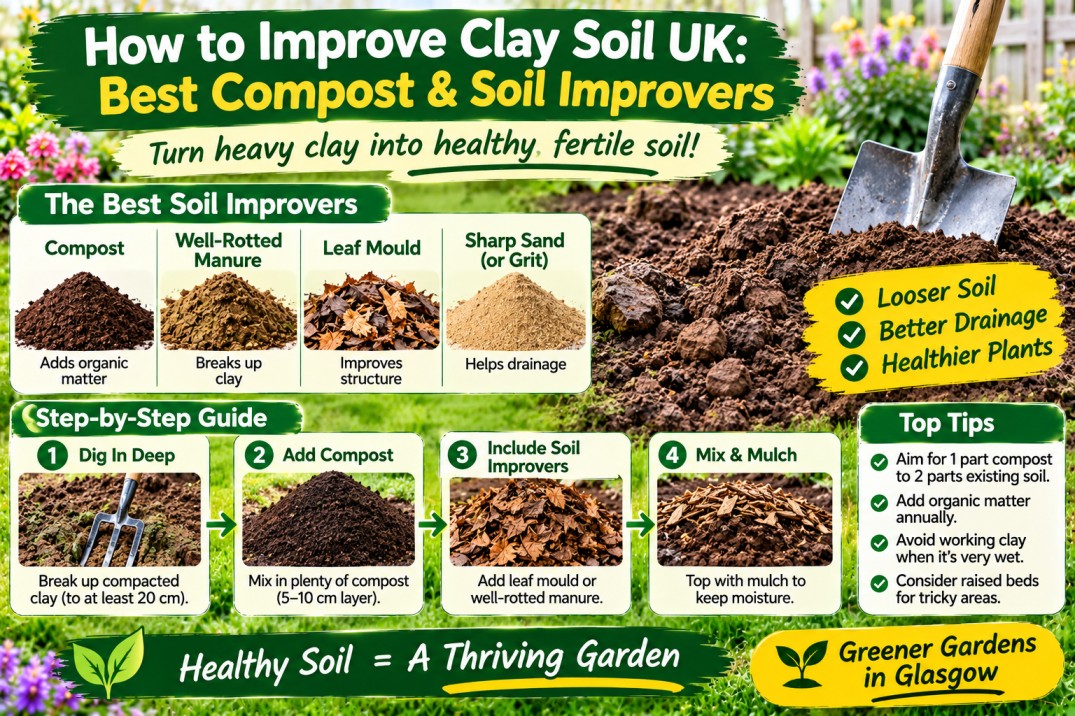
How to Improve Clay Soil in Your Garden: Best Compost, Manure & Soil Improvers for Glasgow and Scotland
Does your garden become sticky and muddy during winter but hard and cracked during summer? Do your plants struggle to establish, or does water collect on the surface after heavy rainfall?
You may have heavy clay soil.
Clay soil is a familiar challenge for gardeners across Glasgow, East Kilbride, South Lanarkshire and other parts of Scotland, particularly where wet weather and compacted ground make gardening difficult.
One of the best ways to improve clay soil is to add suitable mature organic matter, protect the soil surface, reduce compaction and address underlying drainage problems. Organic compost and well-rotted manure can help improve soil structure gradually when used appropriately.
At Kelvin Compost, we supply organic compost, manure, topsoil and woodchip for garden improvement projects across Glasgow and surrounding areas.
This guide explains how to improve heavy clay soil, which products to use, how much material you may need and when to start improving your garden.
What Is Clay Soil?
Clay soil contains a high proportion of very fine mineral particles. These particles influence how the soil holds water, nutrients and air.
Although clay soil can be naturally fertile, it can also be difficult to manage.
Common characteristics include:
Sticky soil during wet weather.
Hard, cracked ground during dry periods.
Slow drainage in some gardens.
Difficulty digging and cultivating.
Dense, compacted areas.
Restricted root growth where soil structure is poor.
Clay soil is not necessarily bad soil. With suitable management, it can support productive vegetable gardens, attractive flower borders and healthy lawns.
The objective is to improve its structure rather than completely replace it.
How Can You Tell If Your Garden Has Clay Soil?
You can perform a simple soil texture test at home.
Take a small handful of soil and remove any stones or large pieces of organic material. Add a little water if necessary and gently roll the soil between your fingers.
If the soil feels smooth and sticky and can be rolled into a long ribbon without breaking easily, it may contain a substantial proportion of clay.
Other signs include:
Water remaining on the surface after rainfall.
Soil sticking heavily to gardening tools.
Large, hard lumps forming after digging.
Cracks appearing during dry weather.
Difficulty preparing a fine seedbed.
These observations provide an indication of soil texture, although professional soil testing can give a more accurate assessment.
Why Is Clay Soil Difficult to Manage in Scotland?
Scotland's wet autumns and winters can make poorly drained clay soil particularly challenging.
When soil remains saturated, air spaces become filled with water. This can create unsuitable conditions for plants that require well-aerated soil.
Walking across wet ground or using heavy machinery can also damage soil structure.
During drier periods, exposed clay soil may become hard and difficult to cultivate.
These contrasting conditions make long-term soil improvement particularly valuable for Scottish gardeners.
Adding suitable organic matter and protecting the soil surface can help, but persistent waterlogging may also require drainage improvements.
What Is the Best Way to Improve Clay Soil?
The best approach combines several soil-management techniques.
| Method | Main benefit |
|---|---|
| Organic compost | Adds organic matter and supports soil structure |
| Well-rotted manure | Contributes organic matter and nutrients |
| Woodchip mulch | Protects the soil surface |
| Reduced cultivation | Helps prevent unnecessary structural damage |
| Raised beds | Can provide improved growing conditions |
| Drainage improvements | Address persistent excess water |
| Suitable ground cover | Protects exposed soil |
For many established gardens, applying suitable mature compost is a practical starting point.
Shop Organic Compost for Garden Soil Improvement
1. Improve Clay Soil With Organic Compost
Organic compost is one of the most useful materials for managing heavy garden soil.
When applied appropriately, mature compost contributes organic matter that supports soil organisms and the formation of stable soil aggregates.
Over time, this can help improve:
Soil workability.
Rooting conditions.
Soil structure.
Moisture management.
Biological activity.
Unlike simply adding another layer of mineral soil, compost contributes organic material that gradually becomes incorporated into the existing soil ecosystem.
How to apply compost to clay soil
Remove established weeds from the area.
Wait until the soil is workable rather than saturated.
Spread an appropriate layer of mature compost across the surface.
For established beds, surface application may be sufficient. For new beds, gentle incorporation may be appropriate where soil conditions allow.
Avoid repeatedly digging or cultivating wet clay soil.
Continue monitoring soil condition and apply further organic matter when appropriate.
Buy Organic Compost in Glasgow
2. How Much Compost Do You Need for Clay Soil?
The amount of compost required depends on the area, soil condition and appropriate application rate.
For a volume calculation, use:
Garden area in square metres × compost depth in centimetres × 10 = litres required
For example, a 20m² garden receiving a 3cm layer requires:
20 × 3 × 10 = 600 litres.
Compost quantity calculator
| Garden area | 2cm layer | 3cm layer | 5cm layer |
|---|---|---|---|
| 5m² | 100L | 150L | 250L |
| 10m² | 200L | 300L | 500L |
| 15m² | 300L | 450L | 750L |
| 20m² | 400L | 600L | 1,000L |
| 30m² | 600L | 900L | 1,500L |
| 40m² | 800L | 1,200L | 2,000L |
| 50m² | 1,000L | 1,500L | 2,500L |
| 100m² | 2,000L | 3,000L | 5,000L |
These figures calculate material volume. They are not universal application recommendations.
The appropriate depth depends on existing soil fertility, compost quality and the intended use.
For larger garden projects, bulk compost delivery may be more convenient than purchasing numerous small bags.
3. Is Well-Rotted Manure Good for Clay Soil?
Well-rotted manure can be beneficial for suitable clay-rich garden soils because it contributes organic matter and plant nutrients.
It may be particularly useful for vegetable gardens, allotments and certain established planting beds.
However, manure is not suitable for every plant or soil condition.
Excessive application can result in nutrient accumulation, and some crops are sensitive to recently manured soil.
Compost or manure for clay soil?
| Feature | Organic compost | Well-rotted manure |
|---|---|---|
| Main purpose | Soil improvement | Organic matter and nutrients |
| Established flower borders | Often suitable | Depends on plants |
| Vegetable gardens | Often suitable | Suitable for certain crops |
| Nutrient contribution | Variable | Variable, potentially substantial |
| Soil structure improvement | Gradual | Gradual |
If your primary objective is improving soil structure, mature organic compost is often a useful starting point.
If your garden also requires additional nutrients, well-rotted manure may be appropriate.
A soil test can help you decide which material is most suitable.
Order Well-Rotted Manure in Glasgow
4. Should You Add Topsoil to Clay Soil?
Adding topsoil can be useful when a garden lacks suitable growing depth, particularly in newly constructed properties.
However, placing topsoil directly over severely compacted or poorly drained clay will not necessarily solve the underlying problem.
Before ordering topsoil, assess:
Existing soil depth.
Ground compaction.
Drainage conditions.
Finished garden levels.
Planting requirements.
Suitable topsoil may be particularly useful when creating new lawns, filling raised beds or establishing planting areas where existing soil is insufficient.
Example: Improving a new-build garden
A 30m² garden requires an additional 10cm of suitable topsoil.
30 × 0.10 = 3m³.
The project requires approximately 3,000 litres of additional soil before any project-specific allowance.
Underlying drainage and compaction should be assessed before placing the new material.
Buy Topsoil for Glasgow Gardens
5. Can You Improve Clay Soil Without Digging?
Yes. In many established gardens, a no-dig approach can help improve soil management while avoiding unnecessary disturbance.
Instead of repeatedly turning the soil, gardeners apply suitable mature organic matter to the surface.
Earthworms and other soil organisms gradually help incorporate organic material into the soil.
This approach can be particularly useful where frequent digging would damage wet clay soil.
How to start improving clay soil without digging
Remove established perennial weeds.
Avoid walking across saturated soil.
Apply a suitable layer of mature compost.
Keep the soil protected with plants or appropriate mulch.
Monitor soil condition over successive growing seasons.
Remove established perennial weeds.
Avoid walking across saturated soil.
Apply a suitable layer of mature compost.
Keep the soil protected with plants or appropriate mulch.
Monitor soil condition over successive growing seasons.
No-dig gardening does not instantly remove severe compaction or drainage problems, but it can support gradual improvements in suitable gardens.
6. Use Woodchip to Protect Clay Soil
Woodchip is useful as a surface mulch around suitable established plants, shrubs and trees.
It helps protect exposed soil from direct rainfall and reduces moisture fluctuations.
Over time, decomposing woodchip also contributes organic matter at the soil surface.
For many suitable planted borders, a layer of around 5–7.5cm can be a useful starting point.
Keep woodchip away from plant crowns, stems and tree trunks.
Avoid mixing substantial quantities of fresh woodchip directly into the growing soil, as decomposition can temporarily reduce nitrogen availability.
Woodchip can also be used for suitable informal paths between vegetable beds.
Order Organic Woodchip for Garden Mulching
7. Should You Add Sand to Heavy Clay Soil?
Adding a small quantity of sand to heavy clay soil is generally not an effective solution.
An unsuitable mixture can create a dense soil structure that remains difficult to manage.
Changing soil texture substantially may require large quantities of carefully selected mineral material.
For ordinary domestic gardening, managing organic matter, compaction and drainage is often a more practical approach.
Avoid adding builders' sand simply because the soil feels heavy.
8. How to Improve Clay Soil Drainage
Clay-rich gardens can experience slow drainage, but clay content is not always the only cause.
Compaction, unsuitable ground levels and underlying drainage problems may also contribute.
Start by observing the garden after rainfall.
Identify whether water collects in particular low areas or remains across the entire garden.
Possible improvements include:
Avoiding traffic on saturated ground.
Improving soil structure gradually.
Establishing suitable planting.
Creating raised growing areas.
Correcting inappropriate ground levels.
Installing professionally designed drainage where necessary.
Adding compost can support better soil structure over time, but it cannot guarantee that a severely waterlogged garden will drain properly.
Persistent drainage problems should be investigated before purchasing large quantities of topsoil.
9. How to Improve Clay Soil for a Lawn
Heavy clay soil can make lawn establishment and maintenance difficult.
Grass may struggle where the soil is compacted, poorly aerated or persistently waterlogged.
For an existing lawn, suitable maintenance may include aeration during appropriate conditions, careful topdressing and avoiding unnecessary traffic when wet.
For a new lawn:
Assess the existing ground.
Remove unsuitable debris.
Address drainage problems.
Investigate compacted layers.
Add suitable topsoil if additional rooting depth is required.
Prepare the surface before sowing seed or laying turf.
Avoid spreading a thick layer of ordinary compost or topsoil directly over existing grass.
For new lawn preparation, explore Kelvin Compost's garden topsoil.
10. How to Improve Clay Soil for Growing Vegetables
Clay soil can support productive vegetable gardens when managed appropriately.
Its ability to retain nutrients and moisture can be beneficial during suitable growing conditions.
The main challenge is often preparing workable soil without damaging its structure.
Vegetables that may tolerate heavier soil
Depending on drainage and other conditions, crops such as cabbage, kale, broccoli, beans and Brussels sprouts can perform well in suitable clay-rich gardens.
Root vegetables such as carrots and parsnips may be more difficult to grow where the soil remains dense, compacted or stony.
Raised beds containing a suitable growing medium can provide an alternative for these crops.
Mature organic compost can help maintain organic matter, while well-rotted manure may be appropriate for crops with suitable nutrient requirements.
11. Are Raised Beds a Good Solution for Clay Soil?
Raised beds can be useful where existing ground is difficult to cultivate.
They allow gardeners to establish a defined growing area with suitable soil depth and growing-medium composition.
However, raised beds still need appropriate drainage.
How much soil do you need for a raised bed?
A raised bed measuring 2m long, 1m wide and 30cm deep requires:
2 × 1 × 0.30 = 0.6m³.
That's 600 litres of total growing medium.
Two identical beds require 1,200 litres.
Four identical beds require 2,400 litres.
Choose an appropriate combination of mineral soil and organic matter according to your plants and bed construction.
Kelvin Compost supplies both topsoil and organic compost for suitable raised-bed projects.
12. When Is the Best Time to Improve Clay Soil in Scotland?
Clay soil can be improved throughout the year when conditions are appropriate.
Autumn: September to November
Autumn can be a useful time to assess cleared garden beds and apply suitable organic matter.
Avoid applications where saturated ground creates a risk of runoff or nutrient loss.
Winter: December to February
Use winter to plan garden improvements, measure planting areas and investigate drainage problems.
Avoid digging frozen or waterlogged clay soil.
Spring: March to May
Spring is a popular time to prepare vegetable beds, lawns and flower borders.
Wait until the soil becomes workable before cultivating.
Summer: June to August
Protect exposed soil with suitable mulch and maintain appropriate watering.
Avoid unnecessary cultivation when clay soil is extremely hard and dry.
For Glasgow gardeners planning spring projects, winter can be a useful time to calculate material requirements and arrange delivery when conditions become suitable.
13. How Long Does It Take to Improve Clay Soil?
Clay soil improvement is usually a gradual process.
Some benefits, such as surface protection from mulch, can begin immediately.
Changes to soil structure and workability may develop over successive growing seasons.
The time required depends on:
Existing soil condition.
Severity of compaction.
Drainage.
Organic matter content.
Planting and maintenance practices.
Weather conditions.
Rather than expecting an instant transformation, focus on consistent, appropriate soil management.
Avoid applying excessive quantities of compost or manure in an attempt to accelerate improvement.
14. Which Soil Improver Should You Buy?
Choose the product according to the problem you need to solve.
| Garden problem | Product or approach to consider |
|---|---|
| Low organic matter | Organic compost |
| Suitable soil needing nutrients | Well-rotted manure |
| Insufficient growing depth | Topsoil |
| Exposed soil surface | Woodchip mulch |
| New raised beds | Suitable topsoil and compost combination |
| Persistent waterlogging | Drainage assessment |
| Severe compaction | Appropriate physical soil management |
Buying the right material is more important than simply buying the largest quantity.
Kelvin Compost supplies several garden materials, allowing you to select products according to your project.
15. Bulk Compost and Soil Improver Delivery in Glasgow
If you're improving a large clay garden, buying bulk materials may be more practical than transporting numerous small bags.
Kelvin Compost supplies garden materials for suitable projects across Glasgow and surrounding areas, including delivery enquiries from:
East Kilbride.
Hamilton.
Cambuslang.
Rutherglen.
South Lanarkshire.
Surrounding parts of Scotland.
Check delivery availability and charges for your postcode before ordering.
Whether you're improving a small flower border or preparing a larger landscaping project, calculate the required quantity first.
For larger orders, contact Kelvin Compost to discuss your requirements and delivery arrangements.
Common Mistakes When Improving Clay Soil
Digging clay soil when it is wet
Working saturated clay can damage soil structure and increase compaction.
Adding unsuitable sand
Small amounts of sand are unlikely to transform heavy clay soil effectively.
Applying excessive manure
Too much manure may contribute to nutrient imbalances.
Covering drainage problems with topsoil
Additional soil does not automatically resolve underlying waterlogging.
Mixing fresh woodchip deeply into soil
Surface mulching is generally more appropriate for ordinary garden woodchip.
Expecting immediate results
Long-term soil improvement requires appropriate management over time.
Frequently Asked Questions About Improving Clay Soil
What is the best soil improver for clay soil?
Suitable mature organic compost is often a useful starting point because it adds organic matter and supports gradual improvements in soil structure.
What is the fastest way to improve clay soil?
The appropriate approach depends on the problem. Mulching provides immediate surface protection, while raised beds can create new growing areas. Improving existing clay soil structure generally takes longer.
Can I put compost directly on clay soil?
Yes. Suitable mature compost can be applied to the surface of many garden beds without extensive digging.
Is manure or compost better for clay soil?
Both can be useful. Compost is often selected for organic-matter management, while manure can also contribute substantial nutrients. Choose according to soil and crop requirements.
How much compost do I need for a 20m² clay garden?
A 3cm layer requires approximately 600 litres. Determine whether that application rate is appropriate before ordering.
Can I put topsoil over clay soil?
Yes, where additional suitable growing depth is required, but address underlying compaction and drainage problems first.
Does woodchip improve clay soil?
Woodchip can protect the soil surface and contribute organic matter as it decomposes. It is generally used as a surface mulch.
Can I improve clay soil during winter in Scotland?
Winter is useful for planning and assessing drainage. Avoid cultivating saturated or frozen soil and apply amendments only when conditions are appropriate.
Does compost permanently fix waterlogged clay soil?
No. Compost may improve soil structure over time, but persistent waterlogging can require separate drainage improvements.
Where can I buy compost for clay soil in Glasgow?
Kelvin Compost supplies organic compost, manure, topsoil and woodchip for suitable garden improvement projects across Glasgow and surrounding areas.
Transform Your Glasgow Garden With Kelvin Compost
Heavy clay soil doesn't have to prevent you from creating a productive vegetable garden, attractive flower border or healthy lawn.
Start by identifying the underlying problem.
Choose suitable organic matter, protect the soil surface and avoid damaging the ground during wet weather.
If additional growing depth is required, consider suitable topsoil or a raised-bed project.
With appropriate management, clay-rich soil can become a valuable foundation for your garden.
Order Garden Soil Improvers in Glasgow Today
Ready to start improving your garden?
Kelvin Compost supplies garden materials for homeowners, allotment holders, gardeners and landscaping projects across Glasgow, East Kilbride, South Lanarkshire and surrounding areas.
Choose the right product for your garden:
Delivery enquiries and bulk orders
Phone: +44 7561 251350
Email: info@kelvincompost.co.uk
Visit www.kelvincompost.co.uk to explore our garden materials, check current prices and arrange delivery to your postcode.
Need Garden Supplies Delivered in Glasgow?
Organic compost, topsoil, manure and more across Scotland