


How to Get Rid of Fungus Gnats in Plant Soil
Looking for compost, topsoil or garden supplies?
Browse our full product range or get in touch for delivery across Glasgow and Scotland.
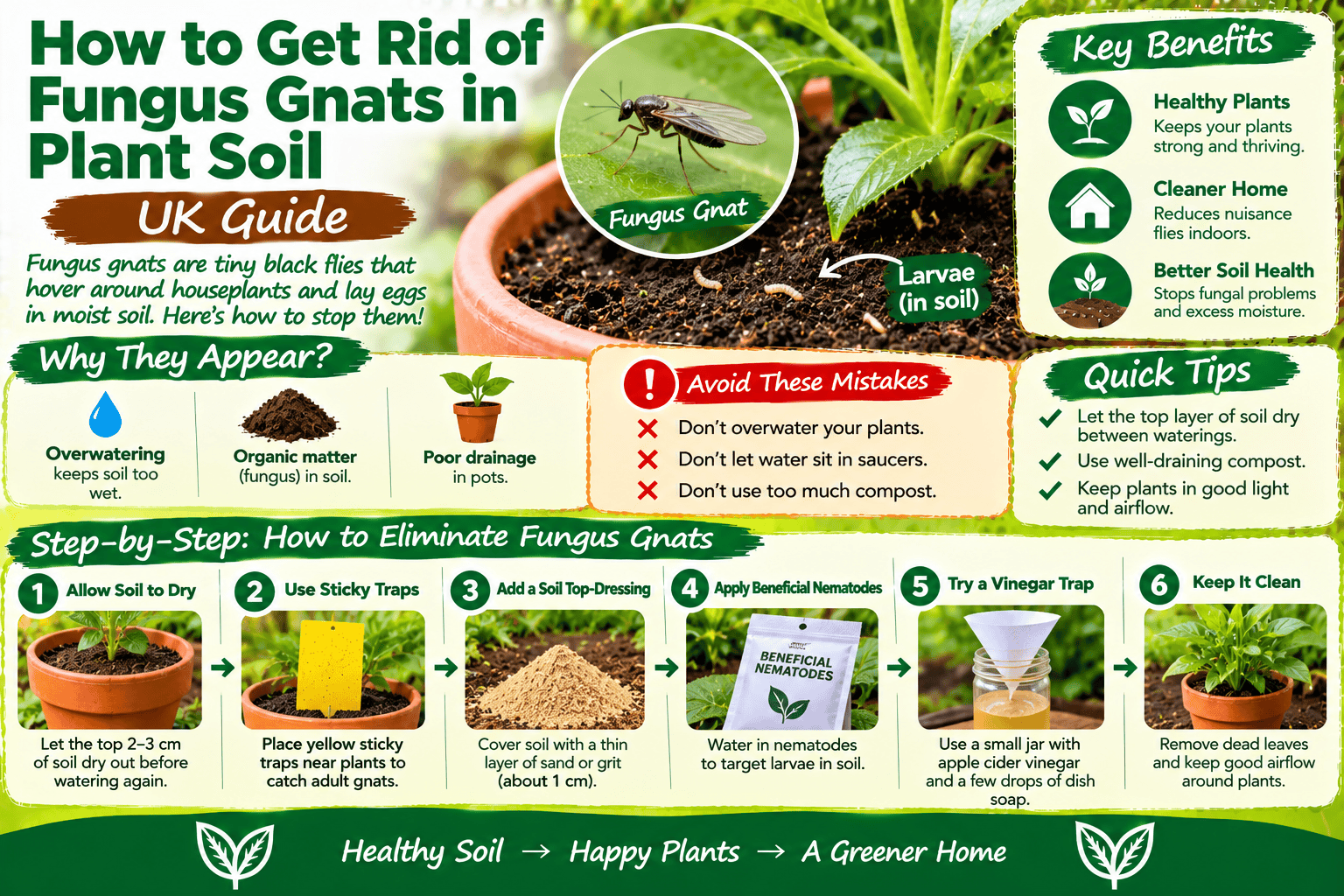
Why Are There Tiny Flies in My Plant Soil? How to Get Rid of Fungus Gnats
You water your plants, move a pot or disturb the compost, and suddenly dozens of tiny black flies appear.
They hover around the soil, crawl across the surface and sometimes fly towards windows.
Where did they come from?
Are they damaging your plants?
And does their presence mean your compost is contaminated?
Tiny black flies around plant soil are often fungus gnats, also called sciarid flies. Their larvae live in moist growing media and feed mainly on fungi and decaying organic material, although they can damage delicate roots in some circumstances.
Fungus gnats are particularly common in houseplants, seed trays and greenhouse containers where compost remains damp.
For gardeners in Glasgow and across Scotland, they may become more noticeable during autumn and winter when houseplants receive less light and their compost dries more slowly.
This guide explains how to identify fungus gnats, why they appear and how to control them without unnecessarily damaging your plants.
Quick Answer: How Do You Get Rid of Fungus Gnats?
The most effective approach is to tackle both the adult flies and the larvae living in the growing medium.
Identify whether the insects are fungus gnats.
Avoid keeping the compost unnecessarily wet.
Check that pots have adequate drainage.
Use yellow sticky traps to monitor and catch adults.
Consider a suitable biological control for larvae where needed.
Remove decaying material from the soil surface.
Monitor plants over several weeks.
Adjust watering practices to reduce recurrence.
Sticky traps alone rarely solve an established infestation, because larvae can continue developing inside the compost.
1. What Are Fungus Gnats?
Fungus gnats are small, dark flies commonly found around moist soil and growing media.
Adults are usually only a few millimetres long.
They often have slender bodies, long legs and delicate wings.
Unlike some other household flies, fungus gnats tend to remain close to plant pots and damp growing areas.
Their larvae are small, pale and worm-like, often with a darker head.
They live in the growing medium, where they feed on fungi, decaying organic material and sometimes plant tissue.
2. Why Are Tiny Black Flies Coming Out of My Soil?
Fungus gnats are attracted to suitable moist growing media.
Their eggs and larvae may already be present in the compost, or adult flies may enter the growing area and lay eggs.
Conditions that encourage infestations include:
Constantly damp compost.
Overwatering.
Poor drainage.
Decaying leaves.
Organic debris.
Crowded plant pots.
Low evaporation during winter.
Damp greenhouse conditions.
The flies don't necessarily mean your compost is defective.
Fungus gnats are common organisms associated with moist organic growing media.
3. Are Fungus Gnats Harmful to Plants?
Adult fungus gnats are usually more of a nuisance than a direct threat to plants.
The larvae are more important.
They feed mainly on fungi and decaying material, but some may also damage fine roots and vulnerable plant tissue.
Healthy, established plants often tolerate small populations.
However, seedlings, cuttings and weakened plants can be more vulnerable.
Severe infestations may contribute to poor growth.
4. How to Identify Fungus Gnats
Look for these signs:
Small black flies hovering near plant pots.
Flies emerging when compost is disturbed.
Adults resting on the soil surface.
Increased activity after watering.
Pale larvae in very moist growing media.
Persistent flies around seed trays.
However, not every tiny fly is a fungus gnat.
Fruit flies, shore flies and other insects may look similar.
Correct identification helps avoid unnecessary treatment.
5. Fungus Gnats vs Fruit Flies
These insects are often confused.
| Feature | Fungus gnats | Fruit flies |
|---|---|---|
| Common location | Plant soil and growing media | Ripening fruit, food waste and fermenting material |
| Appearance | Small, dark and slender | Often more compact |
| Larval habitat | Moist growing media | Fermenting organic material |
| Main concern | Larvae may affect vulnerable roots | Household nuisance and food contamination |
| Common trigger | Persistently damp compost | Exposed fermenting food |
If flies appear mainly when you disturb plant pots, fungus gnats are a likely possibility.
6. Why Are Fungus Gnats Worse in Winter?
Indoor plants often grow more slowly during winter.
Reduced daylight and cooler conditions can mean they use less water.
As a result, compost may stay wet for longer.
This creates favourable conditions for fungus gnat larvae.
A watering routine that works in summer may be excessive in November or December.
Check the growing medium before watering rather than following a fixed daily schedule.
7. How to Get Rid of Fungus Gnats Naturally
Non-chemical management is often effective.
Reduce unnecessary moisture
Allow the upper growing-medium layer to dry appropriately between waterings where the plant tolerates this.
Don't deliberately dry out plants that require consistently moist conditions.
Improve drainage
Ensure pots have suitable drainage holes.
Empty excess water from saucers when appropriate.
Remove decaying debris
Clear dead leaves and other decomposing material from the surface.
Use sticky traps
Yellow sticky traps can catch adult flies and help you monitor activity.
Consider biological controls
Suitable beneficial nematodes or other approved biological controls may help manage larvae.
Follow the supplier's instructions and ensure the treatment is suitable for the growing environment.
8. Do Yellow Sticky Traps Work for Fungus Gnats?
Yes, yellow sticky traps can catch adult fungus gnats.
They are particularly useful for monitoring populations.
Place traps near affected pots without allowing them to touch foliage unnecessarily.
However, they don't directly control larvae living in the compost.
For persistent infestations, combine traps with improved moisture management and an appropriate larval control.
9. How to Kill Fungus Gnat Larvae in Soil
The most effective approach depends on infestation severity and the plants involved.
Options may include:
Adjusting watering to reduce persistently wet conditions.
Improving drainage.
Removing decaying organic debris.
Applying a suitable biological control.
Replacing badly affected growing media where necessary.
Biological controls containing appropriate beneficial nematodes, such as Steinernema feltiae, are commonly used against fungus gnat larvae.
Their effectiveness depends on correct application, moisture and temperature conditions.
Follow the manufacturer's instructions.
10. Can You Use Hydrogen Peroxide for Fungus Gnats?
Hydrogen peroxide is sometimes recommended in online home remedies.
However, inappropriate concentrations or repeated applications can damage plant roots and affect organisms in the growing medium.
It is not a universal or risk-free treatment.
For routine home gardening, start with moisture management, sticky traps and established biological-control methods.
11. Does Cinnamon Kill Fungus Gnats?
Cinnamon is frequently suggested as a homemade fungus gnat treatment.
However, there is limited reliable evidence that sprinkling household cinnamon on compost consistently controls an established infestation.
It should not replace proper identification, moisture management or proven controls.
12. Can You Use Vinegar to Get Rid of Fungus Gnats?
Vinegar traps are more commonly associated with fruit flies.
They are not a reliable primary treatment for fungus gnats.
Pouring vinegar into plant soil can also damage plants and growing conditions.
Avoid using household vinegar as a soil drench.
13. Does Dish Soap Kill Fungus Gnats?
Some homemade treatments involve dishwashing liquid.
However, household detergents are not formulated for plant protection.
They may damage leaves, roots or soil organisms.
Use suitable gardening products according to their labels rather than improvising soil treatments.
14. Should You Repot a Plant With Fungus Gnats?
Repotting isn't always necessary.
A mild infestation may be controlled by correcting watering and using appropriate monitoring or biological controls.
Consider repotting when:
The growing medium is badly degraded.
Drainage is inadequate.
The plant is suffering from root problems.
The infestation remains severe despite suitable management.
The growing medium is unsuitable for the plant.
When repotting, use an appropriate fresh potting medium and a clean container.
Avoid unnecessarily disturbing fragile roots.
15. Are Fungus Gnats a Sign of Bad Compost?
Not automatically.
Fungus gnats are associated with moist organic growing media.
Their presence does not by itself establish that the compost is poor quality.
However, persistently saturated or badly stored growing media may create conditions that favour them.
Check the overall condition of the material rather than judging it solely by the presence of flies.
16. Can Fungus Gnats Live in Organic Compost?
Yes.
Organic growing materials can support fungi and other organisms that fungus gnat larvae feed on.
However, different compost products have different intended uses.
Bulk garden compost used as a soil improver is not necessarily suitable as a direct substitute for specialist houseplant or seed compost.
Choose a growing medium designed for the plants and containers involved.
17. Why Are There Flies in My Seed Trays?
Seed trays often remain consistently moist during germination.
This can create favourable conditions for fungus gnats.
Seedlings are also more vulnerable to root damage than many established plants.
To reduce risk:
Use suitable seed compost.
Maintain appropriate moisture without unnecessary saturation.
Provide suitable ventilation.
Monitor adult flies.
Remove decaying seedlings or debris.
Use an appropriate biological control where necessary.
Avoid allowing the seedbed to dry out if doing so would prevent germination.
18. Why Are Fungus Gnats in My Greenhouse?
Greenhouses can provide favourable conditions for fungus gnats when growing media remain damp.
Common contributing factors include:
Frequent irrigation.
Damp seed trays.
Organic debris.
Poor drainage.
Crowded containers.
Suitable temperatures for insect development.
Greenhouse management should focus on sanitation, monitoring and appropriate moisture control.
For persistent problems, biological controls may be useful.
19. Can Fungus Gnats Damage Vegetable Plants?
Fungus gnat larvae may affect vulnerable seedlings and young plants.
However, adults are generally not significant direct feeders on vegetable foliage.
If vegetables are wilting or growing poorly, investigate other possible causes as well.
These include overwatering, root disease, nutrient problems and unsuitable temperatures.
Don't assume fungus gnats are responsible for every symptom.
20. Do Fungus Gnats Bite Humans?
Fungus gnats generally do not bite people.
They are mainly nuisance flies around plants.
However, not every small dark fly indoors is a fungus gnat.
If insects appear to bite, reconsider the identification.
21. Are Fungus Gnats Dangerous to Pets?
Fungus gnats themselves are generally not regarded as a major direct threat to household pets.
However, traps and plant-treatment products should be kept away from pets where necessary.
Follow the safety instructions of any biological or pest-control product.
22. How Long Does It Take to Get Rid of Fungus Gnats?
The time depends on temperature, growing conditions and infestation severity.
Because eggs and larvae may remain in the growing medium after adult flies are trapped, control often requires continued management over several weeks.
Monitor adult activity and plant condition.
A reduction in visible flies doesn't always mean every larva has disappeared.
23. How to Stop Fungus Gnats Coming Back
Long-term prevention is usually easier than repeatedly treating infestations.
Check moisture before watering
Don't water automatically when the growing medium is already damp.
Use appropriate pots
Ensure drainage suits the plant.
Avoid standing water
Empty excess water from saucers when appropriate.
Remove organic debris
Keep plant pots and growing areas reasonably clean.
Inspect new plants
Look for insects before placing new plants among an established collection.
Monitor with traps
Sticky traps can help detect emerging problems.
Use suitable growing media
Choose materials designed for the intended growing environment.
24. Fungus Gnats in Glasgow and Scottish Gardens
For gardeners in Glasgow, East Kilbride and South Lanarkshire, fungus gnats are most relevant to houseplants, greenhouses, seed trays and container growing.
During winter, reduced light and slower plant growth may cause compost to remain damp for longer.
Adjust watering to the plant's needs and the actual growing conditions.
Outdoor garden beds may also contain small flies, but not every insect around soil is a pest.
For larger landscaping and soil-improvement projects, choose materials according to their intended use.
Kelvin Compost supplies organic compost, topsoil and other bulk garden materials for suitable outdoor projects across Glasgow and surrounding areas.
Common Fungus Gnat Mistakes
Treating only the adult flies
Larvae may remain in the growing medium.
Overwatering after treatment
Persistent moisture can allow the problem to return.
Using vinegar as a soil drench
This may damage plants.
Assuming all compost is defective
Fungus gnats can occur in otherwise suitable growing media.
Repotting every plant immediately
Unnecessary root disturbance may cause additional stress.
Ignoring seedlings
Young plants may be more vulnerable to larval feeding.
Using inappropriate compost
Bulk garden soil improvers and specialist potting compost have different purposes.
Expecting immediate elimination
Effective control may require several weeks.
Frequently Asked Questions About Fungus Gnats
Why are there tiny black flies in my plant soil?
They may be fungus gnats attracted to moist growing media.
How do I get rid of fungus gnats permanently?
Reduce favourable conditions, manage larvae and monitor for reinfestation. Permanent elimination cannot be guaranteed.
What kills fungus gnat larvae?
Suitable biological controls, including certain beneficial nematodes, can help manage larvae when applied correctly.
Do fungus gnats damage plants?
Larvae can damage delicate roots, especially in seedlings and vulnerable plants.
Are fungus gnats caused by overwatering?
Persistently wet growing media can favour fungus gnat development.
Can fungus gnats live in compost?
Yes. Moist organic growing media can support their larvae.
Do sticky traps kill fungus gnats?
Sticky traps catch adults but don't directly kill larvae in the soil.
Can I use cinnamon to kill fungus gnats?
Cinnamon is not a reliably proven standalone treatment.
Does vinegar kill fungus gnats?
Vinegar traps are not a dependable primary control, and vinegar should not be poured into plant soil.
Do fungus gnats bite?
They generally do not bite humans.
How long do fungus gnats live?
Their life cycle varies with temperature and conditions. Populations can continue developing over several weeks.
Should I throw away compost with fungus gnats?
Not automatically. Assess infestation severity and whether the growing medium remains suitable.
Can fungus gnats spread to other plants?
Yes. Adults can move between nearby pots and lay eggs in suitable growing media.
Are fungus gnats common in winter?
They can remain active indoors during winter where temperatures and moisture are suitable.
How do I stop flies in seed trays?
Use appropriate seed compost, avoid unnecessary saturation and monitor for larvae and adults.
Is repotting necessary for fungus gnats?
Not always. Many infestations can be managed without repotting.
Final Thoughts: Control the Larvae and Improve Growing Conditions
Tiny flies around plant soil can be frustrating, but fungus gnats are a common gardening problem.
The key is understanding their life cycle.
Adult flies are easy to notice, but the larvae live inside the growing medium.
Sticky traps can reduce adult numbers.
Appropriate moisture management can make conditions less favourable.
And suitable biological controls may help manage persistent larval populations.
The most reliable approach is to combine correct identification, sensible watering and targeted treatment rather than relying on unproven home remedies.
Improving Your Outdoor Garden Soil in Glasgow?
Kelvin Compost supplies bulk garden materials for homeowners, allotments and landscaping projects across Glasgow, East Kilbride, South Lanarkshire and surrounding areas.
Our products include:
Organic Compost — for adding mature organic matter to suitable outdoor garden soil.
Topsoil — for projects requiring additional soil depth.
Woodchip — for suitable garden mulching and paths.
Manure — for appropriate soil-fertility projects.
Phone: +44 7561 251350
Email: info@kelvincompost.co.uk
Need Garden Supplies Delivered in Glasgow?
Organic compost, topsoil, manure and more across Scotland