


How Much Compost to Add to Soil? UK Guide
Looking for compost, topsoil or garden supplies?
Browse our full product range or get in touch for delivery across Glasgow and Scotland.
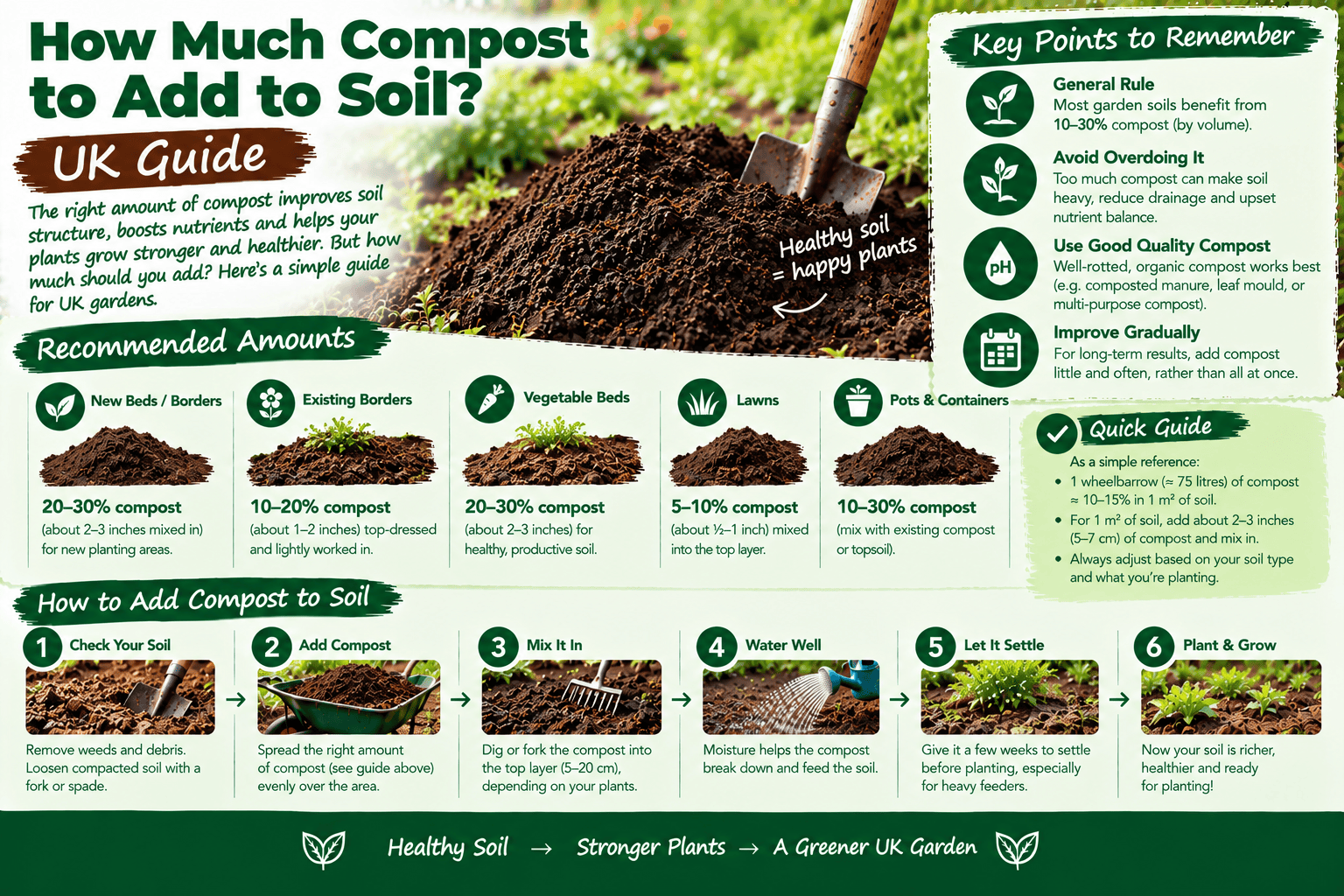
How Much Organic Compost Should You Mix With Soil? A UK Gardener's Guide
You've bought organic compost to improve your garden, but now you're standing beside the flower bed wondering how much to use.
Should you mix one bag of compost with one bag of soil? Spread a thin layer across the surface? Or dig in as much as possible?
It's a common question, and the answer matters more than you might think.
For established garden soil, a modest application of mature organic compost is usually better than replacing large amounts of soil with compost. The right quantity depends on your soil's condition, existing nutrient levels, what you're growing and the compost itself.
Too little may have limited effect. Too much can cause problems with nutrients, drainage or plant growth.
Here's how to work out a sensible quantity for your garden.
Quick Answer: What Is the Best Compost-to-Soil Ratio?
There isn't one universal compost-to-soil ratio.
For improving an ordinary garden bed, it's often more useful to calculate a surface application than to aim for a fixed percentage.
For example, a 2.5cm layer of compost spread across 10m² requires:
10 × 0.025 = 0.25m³, or 250 litres.
That is a quantity calculation, not a recommendation to apply 2.5cm to every bed.
The amount you actually need depends on soil testing, previous compost applications and plant requirements.
A bed that has received compost every year may need little or none this season.
Why Add Organic Compost to Garden Soil?
Mature organic compost is a soil improver.
Its main value is adding organic matter, which supports soil structure and biological processes.
Used appropriately, compost can:
Help clay-rich soils become more workable over time.
Improve moisture retention in sandy soils.
Support soil organisms.
Contribute nutrients.
Help protect the soil when applied as mulch.
However, compost isn't a complete solution to every soil problem.
It won't automatically fix severe compaction, contamination or a garden that regularly floods.
Should You Mix Compost Into Soil or Leave It on Top?
Both approaches can work.
Mixing compost into the soil
In a new planting bed, suitable mature compost may be incorporated into the upper soil when conditions are workable.
Avoid digging wet clay soil, as this can damage its structure.
Applying compost to the surface
In established beds and no-dig gardens, mature compost can be spread over the surface.
Earthworms and other soil organisms gradually incorporate organic matter.
This approach avoids disturbing established roots and soil structure.
If you're improving an existing flower border, surface application may be the simplest option.
How Much Compost Should You Add to Clay Soil?
Clay-rich soil often benefits from appropriate additions of organic matter.
Compost can help improve aggregation and workability over time.
But don't assume that heavy clay requires enormous quantities of compost.
Start by checking whether the ground is compacted, poorly drained or simply naturally clay-rich.
If water regularly stands on the surface, adding compost alone may not solve the underlying problem.
For suitable clay soil, moderate, repeated applications guided by soil condition are generally more sensible than one excessively heavy application.
How Much Compost Should You Add to Sandy Soil?
Sandy soils often drain quickly and retain fewer nutrients than soils with more clay and organic matter.
Mature compost can help improve moisture retention and nutrient cycling.
However, excessive compost can also contribute to nutrient losses, especially where rainfall washes soluble nutrients through the soil.
A balanced programme of soil improvement, mulching and appropriate feeding is better than repeatedly adding large amounts without checking the soil.
Can You Add Too Much Compost to Soil?
Yes.
This is one of the most overlooked aspects of compost use.
Compost is often described as natural, which can create the impression that unlimited amounts are beneficial.
But mature compost contains nutrients, and repeated heavy applications can raise nutrient levels beyond what plants require.
Depending on the material, excessive compost may also increase soluble salts or create an unsuitable growing environment.
If you've been adding compost to the same beds for several years, consider a soil test before ordering another large quantity.
Is a 50/50 Compost-to-Soil Mix Good?
Not automatically.
A 50/50 mix may contain far more compost than an established garden bed needs.
It may also settle substantially as organic matter decomposes.
For many outdoor beds, the goal is to improve the existing mineral soil, not replace half of it with organic material.
A specific engineered growing medium may use a particular blend, but that doesn't mean the same ratio should be applied across an ordinary garden.
How Much Compost Should You Add to a Vegetable Garden?
Vegetable beds can benefit from mature organic matter, but the amount depends on crop requirements and soil fertility.
For example, pumpkins and courgettes often perform well in fertile soil, while other crops may need less nutrient-rich conditions.
If your vegetable garden has received substantial compost or manure in previous years, additional nutrients may not be necessary.
Avoid applying unfinished compost directly around sensitive seedlings.
For edible crops, use compost made from suitable feedstocks and processed appropriately.
How Much Compost Should You Add to Flower Beds?
Established ornamental borders may benefit from a modest layer of mature compost, especially where the soil is low in organic matter.
However, not every flower benefits from rich soil.
Some plants are adapted to relatively low-fertility conditions.
Consider the plants in the border before adding compost automatically.
Keep material away from vulnerable stems and crowns.
How Much Compost Should You Add Before Planting Shrubs?
When planting shrubs, focus on creating suitable conditions across the surrounding soil rather than filling the planting hole with a highly enriched compost mixture.
A sharp difference between the planting-hole material and surrounding soil can sometimes discourage roots from expanding into the wider ground.
The RHS generally advises using the soil removed from the planting hole for backfilling rather than routinely filling the hole with compost.
Where wider soil improvement is needed, address the surrounding bed.
How Much Compost Should You Add to Raised Beds?
Raised beds need a suitable growing medium with appropriate structure and nutrient balance.
Compost can be a valuable ingredient, but a raised bed shouldn't automatically be filled entirely with bulk organic compost.
For beds open to the ground, suitable topsoil can provide mineral soil volume while mature compost contributes organic matter.
For enclosed planters, use an appropriate container-growing medium.
The right blend depends on the bed design and intended crops.
Compost Quantity Calculator
To calculate how much compost you need for a surface layer:
Area (m²) × depth (m) × 1,000 = litres
For a rectangular bed:
Length × width = area
Compost quantities by garden size
| Garden area | 1cm layer | 2.5cm layer | 5cm layer |
|---|---|---|---|
| 5m² | 50L | 125L | 250L |
| 10m² | 100L | 250L | 500L |
| 20m² | 200L | 500L | 1,000L |
| 30m² | 300L | 750L | 1,500L |
| 50m² | 500L | 1,250L | 2,500L |
These figures show volume only. They do not mean that every garden should receive these depths.
A 5cm layer is often associated with substantial surface mulching, but applying that much nutrient-rich compost every year may be unnecessary.
How Many Bulk Bags of Compost Do You Need?
First, confirm the bag's actual capacity.
For example, if a bulk bag contains 850 litres:
A 10m² bed at 2.5cm requires approximately 250 litres.
A 20m² bed at 2.5cm requires approximately 500 litres.
A 30m² bed at 2.5cm requires approximately 750 litres.
An 850-litre bag would theoretically cover about 34m² at a depth of 2.5cm.
However, 850 litres is an example, not a confirmed capacity for every Kelvin Compost product.
Always check the product specification before ordering.
How Do You Mix Compost Into Garden Soil?
If incorporation is appropriate for your project, follow these steps.
Remove weeds and unwanted debris.
Check that the soil isn't saturated.
Spread the intended quantity of mature compost evenly.
Incorporate it gently into the upper soil where appropriate.
Break up large clods without pulverising the soil.
Rake the surface level.
Allow the bed to settle naturally before planting if needed.
Avoid excessive cultivation.
If you're using a no-dig approach, you may instead leave the compost on the surface.
When Is the Best Time to Add Compost to Soil?
Spring and autumn are both useful times.
Spring
Compost can be added while preparing suitable beds for planting.
Autumn
After harvesting vegetables or clearing seasonal plants, gardeners can improve soil and protect exposed areas.
Summer
Mature compost may be applied around established plants where appropriate.
Winter
Avoid working frozen or saturated soil.
In Glasgow and western Scotland, prolonged wet weather can make timing especially important.
Wait until the ground is suitable rather than working to a fixed calendar date.
Is Organic Compost Better Than Manure for Soil Improvement?
Both can contribute organic matter, but their nutrient characteristics and handling requirements differ.
Mature compost is commonly used to improve garden soil and as a surface mulch.
Well-rotted animal manure can also be useful, but its source, maturity and food-safety considerations matter.
Neither should be applied in unlimited quantities.
Choose based on your soil's requirements and the product's characteristics.
Organic Compost vs Topsoil: Which Do You Need?
This distinction is particularly important when buying in bulk.
Topsoil is used to provide mineral soil volume, for example when creating a new garden bed or establishing a lawn.
Organic compost is primarily used to improve suitable existing soil by adding organic matter.
If your garden is missing 10cm of soil depth, you generally need suitable topsoil rather than 10cm of pure compost.
If the existing soil has sufficient depth but needs improvement, mature compost may be appropriate.
For some projects, you'll need both.
Buying Organic Compost in Glasgow
For gardeners in Glasgow, East Kilbride and South Lanarkshire, the amount of compost required can vary considerably.
A small flower border may need only a modest quantity.
A larger allotment or landscaping project may justify bulk delivery.
Before ordering, measure your growing area, decide how the compost will be used and check the product's intended application.
You can view Kelvin Compost's organic compost or contact the team to discuss your project.
Common Mistakes When Adding Compost to Soil
Assuming more compost always means better soil
Excess nutrients and unsuitable growing conditions can result from overapplication.
Using compost to replace missing topsoil
Compost and topsoil serve different purposes.
Applying the same ratio everywhere
Clay soil, sandy soil and established vegetable beds may have different requirements.
Digging saturated ground
Working wet soil can damage its structure.
Filling planting holes with excessive compost
Improve the surrounding soil where necessary rather than creating an isolated pocket of enriched material.
Repeating heavy applications without testing
Soil testing can help identify whether more nutrients are actually needed.
Using unfinished compost
Choose mature material suitable for the intended use.
Frequently Asked Questions
How much compost should I add to soil?
There is no universal amount. Base the application on soil condition, fertility, plant requirements and the compost's characteristics.
What is the best compost-to-soil ratio?
There isn't a single ideal ratio for every garden. A modest surface application is often more useful than aiming for a fixed percentage.
Is 50% compost too much?
For many established garden beds, replacing half the soil volume with compost would be excessive.
Can you plant directly into organic compost?
Not every compost is suitable for standalone growing. Bulk soil improvers are different from formulated potting compost.
Can compost improve clay soil?
Yes, suitable mature compost can support improved structure over time.
Can compost improve sandy soil?
Yes, organic matter can contribute to improved moisture retention and nutrient cycling.
Should compost be mixed into soil?
It can be incorporated into suitable soil, or applied to the surface in established and no-dig beds.
Can you put compost on top of soil?
Yes. Mature compost can be used as a surface mulch where appropriate.
Can too much compost harm plants?
Yes. Excess nutrients, salts or unsuitable physical conditions can affect plant growth.
How much compost do I need for 10m²?
At 2.5cm depth, approximately 250 litres. The appropriate depth depends on your soil and intended use.
Is compost better than manure?
Neither is universally better. They have different characteristics and handling considerations.
Is compost the same as topsoil?
No. Compost primarily adds organic matter, while topsoil provides mineral soil volume.
Final Thoughts: Improve the Soil Without Overdoing It
Organic compost is one of the most useful materials for maintaining garden soil.
But it works best when applied thoughtfully.
Rather than choosing a fixed compost-to-soil ratio, consider the condition of the soil, the plants you're growing and the compost's characteristics.
For many established beds, a modest application is more sensible than replacing large amounts of soil.
And if your garden has received compost regularly, check whether another application is actually needed.
The aim isn't to add as much compost as possible. It's to create the right growing conditions for your plants.
Need Organic Compost in Glasgow?
Kelvin Compost supplies organic compost and other garden materials for soil improvement, allotments, flower beds and landscaping projects across Glasgow, East Kilbride, South Lanarkshire and surrounding areas.
Explore our organic compost product or contact us to discuss quantities and delivery.
Phone: +44 7561 251350
Email: info@kelvincompost.co.uk
Need Garden Supplies Delivered in Glasgow?
Organic compost, topsoil, manure and more across Scotland