


How Deep Should Topsoil Be? UK Garden Guide
Looking for compost, topsoil or garden supplies?
Browse our full product range or get in touch for delivery across Glasgow and Scotland.
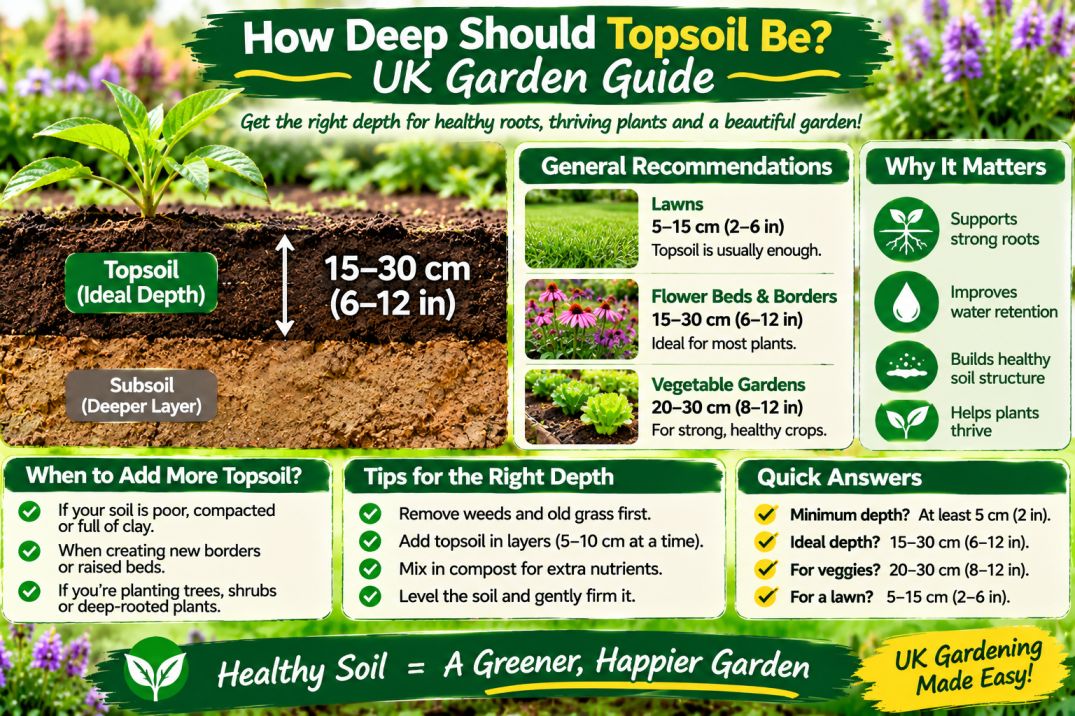
How Deep Should Topsoil Be for Grass, Raised Beds and Garden Borders? A Complete UK Guide
Topsoil depth depends on what you're growing and the condition of the existing ground. A new lawn, vegetable garden and flower border may all need different amounts of suitable soil.
If you're preparing a garden in Glasgow, East Kilbride, South Lanarkshire or elsewhere in Scotland, choosing the correct topsoil depth matters.
Too little suitable soil can restrict root development, while adding more than necessary increases costs and may create problems with ground levels or drainage.
This guide explains recommended starting depths, how to measure existing topsoil and how to calculate the volume you need.
Quick Answer: How Deep Should Topsoil Be?
The following figures are practical planning ranges rather than universal minimum standards.
| Garden project | Indicative suitable soil depth |
|---|---|
| New lawn | Around 10–15cm of suitable topsoil as a common preparation target |
| New turf | Around 10–15cm of suitable topsoil |
| Grass seed | Around 10–15cm of suitable topsoil |
| Flower borders | Often 20–30cm or more of suitable rooting soil, depending on plants |
| Vegetable beds | Often 20–30cm or more of suitable rooting soil, depending on crops |
| Raised beds | Depends on bed construction, crops and underlying soil |
| Established lawn levelling | Usually a thin application rather than a new full-depth layer |
Important: These are guides to suitable growing depth, not instructions to add that much new topsoil on top of every existing garden.
For example, if your garden already has 12cm of good-quality topsoil, you may not need another 12cm before laying turf.
1. What Is Topsoil and Why Does Its Depth Matter?
Topsoil is the upper mineral-soil layer where much of a garden's biological activity and plant-root development occurs.
It typically contains mineral particles, organic matter, water, air and living organisms.
A suitable depth helps provide:
Space for roots to develop.
Access to water and nutrients.
Support for grass and garden plants.
A workable planting environment.
Greater resilience to changing moisture conditions.
However, soil depth is only one consideration.
Soil structure, drainage, compaction, pH and fertility also influence plant growth.
A deep layer of unsuitable soil isn't necessarily better than a shallower layer of well-prepared, appropriate soil.
2. How Deep Should Topsoil Be for a New Lawn?
For many domestic lawn projects, around 10–15cm of suitable topsoil is a useful preparation target.
The exact requirement depends on the existing ground.
If the site already has adequate topsoil, you may only need to prepare and level it.
If the site consists mainly of compacted subsoil or construction fill, additional suitable topsoil may be required.
Example: A 40m² lawn
Suppose your garden requires an additional 10cm layer.
40 × 0.10 = 4m³
That's 4,000 litres.
If the existing ground already has 5cm of suitable topsoil and the target is 10cm, you would need approximately another 5cm, not 10cm.
In that case:
40 × 0.05 = 2m³
Correctly measuring existing soil can make a substantial difference to the quantity you order.
3. How Deep Should Topsoil Be Before Laying Turf?
New turf needs suitable soil for root establishment.
A common domestic preparation target is around 10–15cm of suitable topsoil, provided the underlying conditions are appropriate.
Before laying turf:
Remove unsuitable debris and perennial weeds.
Check drainage.
Investigate compaction.
Assess existing topsoil depth.
Add suitable topsoil only where required.
Prepare a level, firm but not excessively compacted surface.
Lay turf according to appropriate seasonal and supplier guidance.
Avoid laying turf directly over severe compaction without addressing the underlying problem.
Can turf grow on 5cm of topsoil?
Grass may grow with a shallow topsoil layer if the underlying ground provides suitable rooting conditions.
However, a shallow layer over hard, compacted subsoil can restrict roots and increase vulnerability to drought.
Assess the complete rooting environment rather than judging only the visible topsoil layer.
4. How Deep Should Topsoil Be for Grass Seed?
Grass seed requires a suitable seedbed and adequate rooting conditions.
The overall soil-depth considerations are similar to turf.
However, you do not need to bury grass seed under 10–15cm of topsoil.
The 10–15cm figure refers to the prepared soil layer, not the depth at which seeds should be sown.
Grass seed is generally sown shallowly according to the seed supplier's instructions.
Deep burial can prevent successful germination.
5. How Deep Should Topsoil Be for Raised Beds?
Raised-bed requirements depend on the plants and whether roots can extend into suitable ground beneath the bed.
A raised bed placed on healthy, permeable garden soil may allow roots to grow below its sides.
A bed built on paving or another impermeable base has different requirements.
For vegetable growing, a suitable rooting depth of around 20–30cm or more may be a useful starting point, but deeper-rooted crops can need considerably more.
Raised-bed example
A raised bed measures:
2.4m long.
1.2m wide.
30cm deep.
Volume:
2.4 × 1.2 × 0.30 = 0.864m³
That's 864 litres of growing medium.
If you use a suitable combination of topsoil and mature compost, calculate the quantities of each separately.
Avoid assuming that pure compost is an appropriate substitute for all the mineral soil in a raised bed.
6. How Deep Should Topsoil Be for Vegetables?
Vegetable crops vary in their rooting habits.
Shallow-rooted salad crops may have different needs from carrots, parsnips or other deeper-rooted vegetables.
A suitable rooting depth of at least 20–30cm is often a useful planning starting point for many garden beds, but it isn't sufficient for every crop or soil condition.
Consider the following
Existing soil depth.
Underlying soil structure.
Drainage.
Crop requirements.
Soil fertility.
Whether the bed is open to the ground.
Where the existing soil is suitable, improving it may be more appropriate than importing a large quantity of topsoil.
For soil-improvement projects, explore Kelvin Compost Organic Compost.
7. How Deep Should Topsoil Be for Flower Borders?
Flower borders need sufficient soil depth for the plants being grown.
For many herbaceous planting projects, 20–30cm or more of suitable rooting soil can be a useful starting point.
However, shrubs and larger perennials may root much deeper.
The goal should be to create suitable rooting conditions, not simply add a fixed layer of new topsoil.
Example: A new 12m² flower border
If the border needs 15cm of additional topsoil:
12 × 0.15 = 1.8m³
That's 1,800 litres.
Before ordering, confirm whether the existing soil can be retained and improved.
8. How Deep Should Topsoil Be for Trees and Shrubs?
Trees and shrubs need sufficient rooting space.
Their roots can extend well beyond the planting hole.
Simply adding a thick layer of topsoil around an established tree can damage its root environment.
For new planting, assess the surrounding soil and drainage.
Avoid burying the root flare or planting too deeply.
For significant tree planting or difficult ground conditions, follow species-specific horticultural guidance.
9. How to Measure Existing Topsoil Depth
Before buying new topsoil, investigate what is already present.
Step 1: Choose several locations
Check more than one point in the garden.
Step 2: Examine the soil profile
Use an appropriate small inspection hole where safe.
Look for changes in colour, texture and structure.
Step 3: Estimate the topsoil layer
Topsoil is often darker than the underlying subsoil, but colour alone isn't definitive.
Step 4: Check for compaction
Look for dense or difficult-to-penetrate layers.
Step 5: Assess drainage
Observe how the ground behaves after rainfall.
Step 6: Record your findings
Note the approximate depth and conditions in different parts of the garden.
Avoid excavation near underground services or important tree roots.
10. How Much Additional Topsoil Do You Actually Need?
This is where many homeowners overestimate their requirements.
Suppose you want 15cm of suitable topsoil.
Your existing garden already contains approximately 8cm.
The theoretical additional depth is:
15cm − 8cm = 7cm
For a 30m² lawn:
30 × 0.07 = 2.1m³
That's 2,100 litres.
If you had calculated a full 15cm layer instead:
30 × 0.15 = 4.5m³
That's 4,500 litres.
Measuring existing topsoil can prevent you from ordering more than twice the volume actually needed in this example.
The calculation assumes the existing layer is suitable and can be incorporated appropriately into the project.
11. Topsoil Volume Calculator: Area × Depth
Use this formula:
Topsoil volume (m³) = Area (m²) × Additional depth (m)
To convert cubic metres into litres:
Cubic metres × 1,000 = Litres
Example
A 25m² lawn needs an additional 8cm of topsoil.
25 × 0.08 = 2m³
That's 2,000 litres.
Quick calculation table
| Area | Additional 5cm | Additional 10cm | Additional 15cm |
|---|---|---|---|
| 10m² | 500L | 1,000L | 1,500L |
| 20m² | 1,000L | 2,000L | 3,000L |
| 30m² | 1,500L | 3,000L | 4,500L |
| 40m² | 2,000L | 4,000L | 6,000L |
| 50m² | 2,500L | 5,000L | 7,500L |
| 75m² | 3,750L | 7,500L | 11,250L |
| 100m² | 5,000L | 10,000L | 15,000L |
These are theoretical volumes before any project-specific allowance.
12. How Many Bulk Bags of Topsoil Do You Need?
Bulk-bag sizes vary by supplier.
Do not assume every bulk bag contains 850 litres or one cubic metre.
For an example using an 850L bag:
A 20m² garden needs an additional 10cm of topsoil.
20 × 0.10 = 2m³
That's 2,000 litres.
2,000 ÷ 850 = 2.35 bags
If buying only whole 850L bags, you would need three.
Confirm the actual bag volume before ordering.
13. What Happens If Topsoil Is Too Shallow?
Insufficient suitable rooting depth may contribute to:
Restricted root growth.
Increased drought stress.
Poor lawn establishment.
Reduced plant vigour.
Difficulty establishing deeper-rooted plants.
However, the impact depends on the underlying soil.
If roots can penetrate healthy subsoil, a relatively shallow topsoil layer may still support plant growth.
The important consideration is the total rooting environment.
14. Can You Have Too Much Topsoil?
Adding more topsoil than necessary can create problems.
These include:
Raising levels against buildings.
Covering plant stems or root flares.
Altering drainage patterns.
Burying existing lawn grass.
Increasing project costs.
Creating unsuitable transitions between soil layers.
Avoid raising soil levels against damp-proof courses, air bricks or other building features.
Seek professional advice when changing ground levels near structures.
15. Should You Mix Topsoil With Compost?
Suitable mature compost can be used to improve some garden soils.
However, the correct amount depends on the soil, existing fertility and intended planting.
Adding excessive compost may create nutrient imbalances.
For raised beds and borders, use an appropriate growing-medium specification rather than assuming a fixed compost percentage is suitable for every project.
Kelvin Compost supplies both topsoil and organic compost for suitable garden applications.
16. What Topsoil Depth Is Best for Glasgow Gardens?
Glasgow gardens vary considerably.
Some have clay-rich soil.
Others contain shallow topsoil, disturbed ground or compacted subsoil from construction work.
The right depth depends on the existing conditions.
For a new lawn, around 10–15cm of suitable topsoil may be a useful preparation target.
For vegetable beds and flower borders, greater suitable rooting depth may be needed.
But you should calculate the additional depth required, not automatically order an entire new layer.
17. Topsoil Preparation in Scotland During Autumn and Winter
Scottish autumn and winter weather can make soil preparation challenging.
Avoid working saturated ground.
Heavy machinery and repeated foot traffic can compact wet soil.
If your garden is waterlogged, investigate drainage before adding topsoil.
For some projects, waiting until the ground becomes workable will produce a better result.
You can still use winter to measure the garden, assess drainage and calculate materials for spring.
18. Topsoil Delivery in Glasgow: What to Check
Before ordering topsoil, consider:
The area you need to cover.
The existing topsoil depth.
The additional depth required.
The intended use.
The actual volume of each bag or load.
The delivery location.
Vehicle access.
Ground conditions.
Total delivered price.
Whether the soil is suitable for your project.
Kelvin Compost supplies garden materials for suitable projects in Glasgow, East Kilbride, South Lanarkshire and surrounding areas.
Common Mistakes When Calculating Topsoil Depth
Ordering a full new layer without checking existing soil
You may already have enough suitable topsoil.
Confusing seed-sowing depth with soil depth
Grass seed should not be buried under 10–15cm of soil.
Using compost as a complete topsoil replacement
Compost and mineral topsoil serve different purposes.
Ignoring compaction
Adding topsoil over severely compacted ground may not solve rooting or drainage problems.
Assuming all bulk bags are the same size
Bag volumes vary.
Adding soil against buildings
Raising levels can create damp and drainage concerns.
Working soil when saturated
This can damage soil structure.
Frequently Asked Questions About Topsoil Depth
How deep should topsoil be for grass?
Around 10–15cm of suitable topsoil is a common domestic lawn-preparation target, depending on the existing ground.
How deep should topsoil be for turf?
A suitable prepared topsoil layer of around 10–15cm is often used for domestic lawns.
How much topsoil do I need before sowing grass seed?
Calculate the additional suitable soil depth needed after assessing the existing ground.
Is 5cm of topsoil enough for grass?
It depends on the underlying rooting conditions. A shallow layer over compacted subsoil may be inadequate.
Is 10cm of topsoil enough for a lawn?
It can be a suitable preparation depth in many domestic situations, provided drainage and underlying soil conditions are appropriate.
Is 15cm of topsoil enough for a lawn?
It may provide a suitable growing layer for many lawns, but depth alone doesn't guarantee good results.
How deep should topsoil be for vegetables?
Many vegetable beds benefit from 20–30cm or more of suitable rooting soil, depending on crops and underlying conditions.
How deep should a raised bed be?
The required depth depends on the crops, bed construction and whether roots can extend into suitable ground beneath.
How deep should topsoil be for flowers?
Many flower borders benefit from substantial suitable rooting depth, often 20–30cm or more depending on the plants.
Can I put topsoil directly over clay?
Sometimes, but investigate compaction and drainage first.
Can I lay turf directly on subsoil?
Poorly prepared or compacted subsoil may not provide suitable rooting conditions. Assess and prepare the site appropriately.
Should I add compost before topsoil?
The correct approach depends on the existing soil and project. Compost isn't automatically required.
How much topsoil is needed for 20m²?
At an additional depth of 10cm, 20m² requires 2m³ or 2,000 litres.
How many litres are in 1m³ of topsoil?
One cubic metre equals 1,000 litres.
How do I measure topsoil depth?
Inspect several locations and assess the soil profile, structure and underlying conditions.
Can too much topsoil damage plants?
Yes. Burying stems, crowns or tree root flares can damage plants.
Where can I buy topsoil in Glasgow?
Kelvin Compost supplies topsoil for suitable garden and landscaping projects across Glasgow and surrounding areas.
Final Thoughts: Measure First, Then Order Topsoil
The correct topsoil depth depends on what you're growing and what soil already exists.
For new lawns, around 10–15cm of suitable topsoil is a useful starting point.
For raised beds, vegetables and flower borders, rooting requirements may be greater.
But the most important step is to assess the existing ground.
Measure the suitable topsoil you already have, calculate the additional depth required and then work out the volume.
That helps you avoid unnecessary costs and gives your plants a better foundation.
Buy Topsoil in Glasgow From Kelvin Compost
Planning a lawn, raised bed, flower border or landscaping project?
Kelvin Compost supplies topsoil and other garden materials across Glasgow, East Kilbride, South Lanarkshire and surrounding areas.
Explore Compost Delivery in Glasgow
Phone: +44 7561 251350
Email: info@kelvincompost.co.uk
Need Garden Supplies Delivered in Glasgow?
Organic compost, topsoil, manure and more across Scotland