



How Deep Should Topsoil Be? Lawn, Beds & Garden Guide
Looking for compost, topsoil or garden supplies?
Browse our full product range or get in touch for delivery across Glasgow and Scotland.
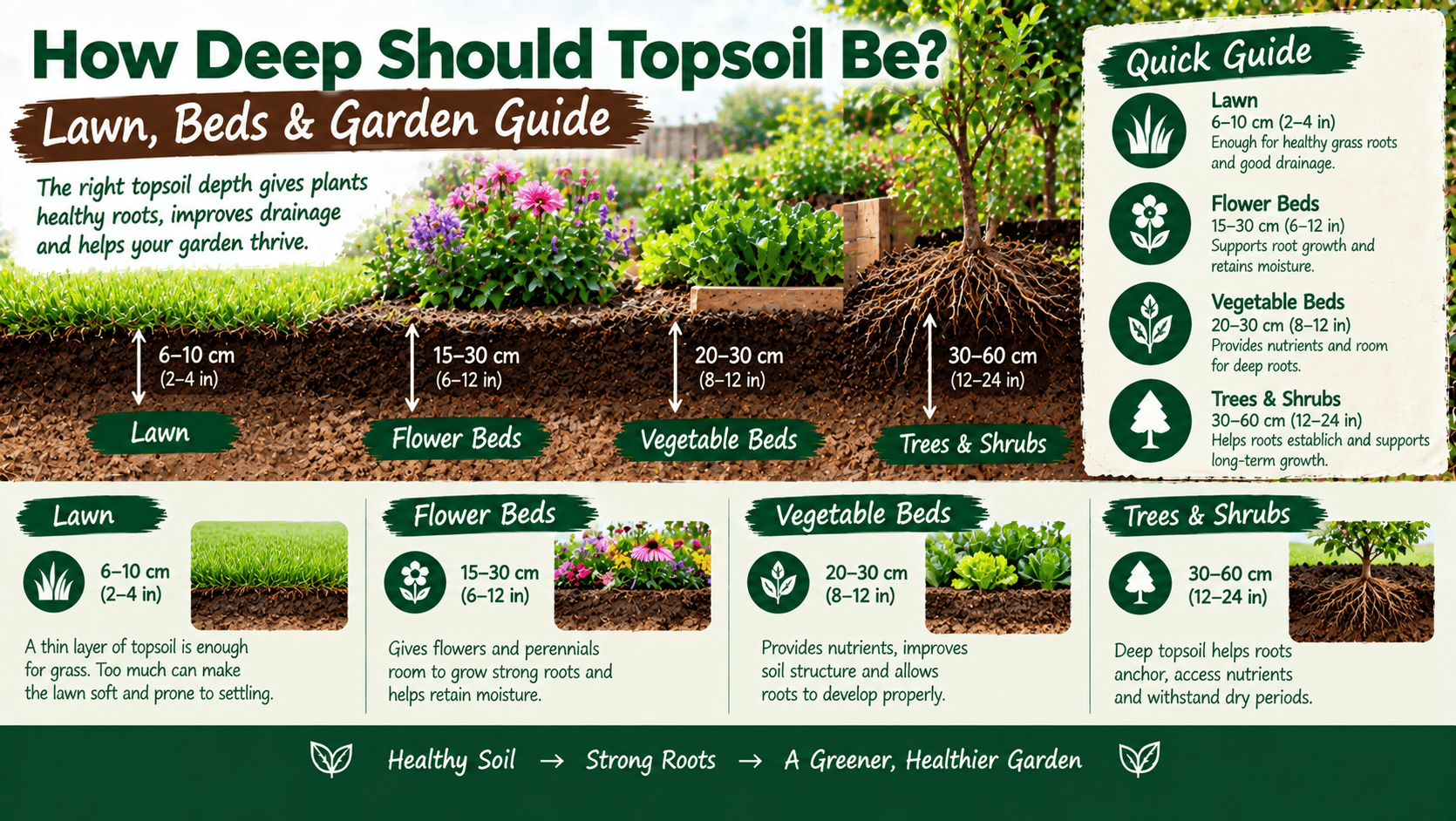
How Deep Should Topsoil Be? Recommended Depths for Lawns, Borders, Raised Beds & Gardens
Ordering the right amount of topsoil starts with one question that is easy to overlook:
How deep should topsoil actually be?
The answer isn't the same for every garden project.
A thin layer may be useful for minor lawn levelling, while creating a new planting area can require considerably more soil depth. Raised beds, vegetable gardens, new lawns and garden borders all have different requirements because plants use the soil in different ways.
Getting the depth wrong can cause two very different problems.
Use too little topsoil and plants may have insufficient good-quality soil for healthy root development. Order far too much and you can spend unnecessary money, raise finished levels too high or create problems around paths, buildings and drainage.
This guide explains how deep topsoil should be for common garden projects, how to measure the depth you already have and how to calculate exactly how much topsoil you need.
Quick Answer: How Deep Should Topsoil Be?
There is no single correct topsoil depth for every project.
As a practical starting point:
| Project | Typical depth to consider |
|---|---|
| Minor lawn levelling/top dressing | 0.5–2cm |
| New lawn over suitable prepared ground | Around 10–15cm of suitable topsoil |
| General flower border | Around 20–30cm+ of suitable growing soil |
| Vegetable growing area | Around 20–30cm+ |
| Shallow raised bed | Around 20–30cm |
| Deeper raised bed | 30–45cm+ depending on design/crops |
| Trees and shrubs | Improve the wider existing soil rather than simply creating a deep pocket of imported topsoil |
These are general starting points, not universal specifications.
The correct depth depends on:
- Existing soil
- Drainage
- Compaction
- What you're growing
- Rooting depth
- Finished ground level
- Whether you're improving existing soil or creating a completely new growing area
Before ordering anything, inspect what is already underneath.
What Is Topsoil?
Topsoil is the upper layer of soil in which much garden plant growth occurs.
It typically contains varying proportions of:
- Mineral particles
- Organic matter
- Water
- Air
- Living organisms
Good garden topsoil provides physical growing volume for plant roots.
This is different from compost.
Topsoil provides soil volume and structure.
Compost is primarily used to add organic matter and improve suitable existing soil.
That distinction becomes extremely important when calculating depth.
If you need to increase the level of a garden by 20cm, filling the entire space with compost is generally not the same as adding suitable topsoil.
Why Does Topsoil Depth Matter?
Plants don't only grow above ground.
Their roots need sufficient suitable soil to:
- Anchor the plant
- Access moisture
- Obtain nutrients
- Exchange gases
- Expand as the plant matures
A very shallow layer of good soil over heavily compacted subsoil can look excellent immediately after landscaping.
But plants eventually encounter the layer underneath.
That's why simply spreading a small amount of topsoil over poor ground doesn't necessarily create a good garden.
The soil profile underneath the topsoil matters too.
How Deep Is Natural Topsoil?
Natural topsoil depth varies enormously.
There isn't a universal depth that applies to every garden.
One property might have a substantial existing soil profile.
Another may have:
- Shallow soil
- Heavy clay
- Compacted ground
- Disturbed construction soil
- Rubble
- Imported fill
- Poor drainage
This is particularly relevant in new-build gardens, where construction activity can leave soil disturbed or compacted.
Before ordering additional topsoil, dig a few inspection holes.
Don't judge the whole garden from one location.
How Do I Measure My Existing Topsoil Depth?
You don't need sophisticated equipment.
Step 1: Choose several locations
Check different parts of the proposed lawn, border or growing area.
Step 2: Dig an inspection hole
Look at the soil profile from the surface downward.
Step 3: Identify changes
You may see changes in:
- Colour
- Texture
- Stone content
- Compaction
- Organic matter
Step 4: Measure the usable soil
Use a tape measure to estimate the depth.
Step 5: Check what's underneath
This is crucial.
Finding 10cm of decent soil over severely compacted material tells you much more than simply knowing you have 10cm of topsoil.
How Deep Should Topsoil Be for a New Lawn?
For a new lawn, a usable topsoil depth around 10–15cm is a common practical target, provided the ground beneath is suitable and drainage is functioning.
But don't interpret this as:
Put exactly 10cm of topsoil over anything and turf will thrive.
The underlying ground still matters.
If the site has:
- Severe compaction
- Rubble
- Poor drainage
- Standing water
- Extremely uneven levels
address those problems first.
Is 5cm of Topsoil Enough for a New Lawn?
Usually, 5cm is relatively shallow if it represents the entire useful growing layer.
Grass roots don't stop neatly at the bottom of your imported topsoil.
A thin layer over compacted or unsuitable material can limit rooting and make the lawn more vulnerable to stress.
If you're simply adding a little suitable soil to an already healthy existing soil profile, that's a different situation.
Always distinguish between:
adding topsoil to good existing ground
and
creating the entire growing layer from scratch.
How Deep Should Topsoil Be Under Turf?
Again, roughly 10–15cm of suitable prepared topsoil is a useful starting point for many new-lawn projects.
Before turfing:
- Correct major drainage problems.
- Remove significant debris.
- Deal with severe compaction.
- Establish appropriate levels.
- Add and prepare suitable topsoil where required.
- Firm and level the surface.
- Lay turf according to appropriate installation guidance.
- Water correctly during establishment.
Don't use extra topsoil as a substitute for solving drainage problems underneath.
How Much Topsoil Do I Need for a Lawn?
Use:
Area × depth = volume
Suppose your lawn is:
50m²
and you need:
10cm (0.10m)
The calculation is:
50 × 0.10 = 5m³
That's approximately:
5,000 litres of topsoil
At 15cm:
50 × 0.15 = 7.5m³
That's approximately:
7,500 litres
A seemingly small change in depth makes a big difference to the quantity you need.
Lawn Topsoil Calculator
| Lawn area | 5cm | 10cm | 15cm |
|---|---|---|---|
| 10m² | 0.5m³ | 1m³ | 1.5m³ |
| 20m² | 1m³ | 2m³ | 3m³ |
| 30m² | 1.5m³ | 3m³ | 4.5m³ |
| 50m² | 2.5m³ | 5m³ | 7.5m³ |
| 75m² | 3.75m³ | 7.5m³ | 11.25m³ |
| 100m² | 5m³ | 10m³ | 15m³ |
This is why you should establish the required depth before ordering.
How Deep Should Topsoil Be for Garden Borders?
For many general garden borders, aim to create a substantial workable growing layer rather than spreading a token covering over poor ground.
Around 20–30cm or more of suitable growing soil can be a useful starting point for many border situations, but the existing soil beneath should also be considered.
Perennials, shrubs and other plants don't restrict all their roots to the imported layer.
Ideally, the transition between imported topsoil and existing ground should allow roots, air and water to move through the profile.
Is 10cm of Topsoil Enough for a Flower Bed?
If 10cm is the only usable soil, it will be too shallow for many permanent border plants.
If you're adding 10cm of good-quality topsoil onto an existing healthy soil profile, that's completely different.
This distinction is essential.
When someone asks:
“Is 10cm enough?”
the first question should be:
“What's underneath it?”
How Deep Should Topsoil Be for Vegetables?
Many vegetables benefit from a substantial depth of workable soil.
For a newly created vegetable growing area, 20–30cm of suitable growing soil is a reasonable starting range, with deeper workable soil advantageous for many crops.
But vegetables vary.
A shallow-rooted salad crop has different requirements from:
- Carrots
- Parsnips
- Potatoes
- Brassicas
- Tomatoes
- Squash
Good vegetable soil should also provide more than depth.
It needs appropriate:
- Structure
- Drainage
- Organic matter
- Fertility
- Moisture retention
Simply creating 30cm of poor-quality soil won't automatically create a productive vegetable bed.
Topsoil or Compost for a Vegetable Garden?
Often, the answer is both—but for different reasons.
Use topsoil where you need:
- Soil depth
- Soil volume
- A new growing layer
Use mature compost where you need:
- Additional organic matter
- Soil conditioning
- Long-term soil improvement
If you already have sufficient suitable soil depth, you may not need additional topsoil at all.
You may simply need to improve the existing soil with organic matter.
How Deep Should Topsoil Be in a Raised Bed?
This depends heavily on the raised-bed design.
A raised bed sitting directly over usable garden soil doesn't necessarily need to contain the plant's entire rooting depth within its wooden or masonry sides.
Roots may continue into the soil underneath.
A bed built over:
- Concrete
- Very poor fill
- Severely compacted ground
- Another impermeable surface
is a completely different situation.
As a general planning guide:
20–30cm
Can work for relatively shallow beds over suitable underlying soil.
30–45cm
Provides substantially more growing volume and flexibility.
45cm+
Can be useful for deeper beds or where additional soil depth/accessibility is part of the design.
But deeper doesn't automatically mean better.
Every extra centimetre requires more material.
Raised Bed Topsoil Calculator
For a raised bed:
Length × width × filling depth = volume
Example:
2.4m × 1.2m × 0.30m = 0.864m³
That's approximately:
864 litres
At 45cm:
2.4 × 1.2 × 0.45 = 1.296m³
Approximately:
1,296 litres
Increasing that same bed from 30cm to 45cm requires roughly 432 additional litres.
Depth matters financially as well as horticulturally.
Should a Raised Bed Be Filled Entirely With Topsoil?
Not necessarily.
A good growing medium should provide suitable structure, drainage, organic matter and fertility for what you're growing.
A combination of suitable topsoil and mature organic matter is often more appropriate than simply filling a deep bed with one material.
Avoid improvised filling methods that leave plants growing above large quantities of unsuitable waste material unless you're deliberately following a proven growing system.
The final mix should suit the crops.
How Deep Should Topsoil Be for Trees?
Trees need much more than a deep pocket of imported topsoil.
Their roots eventually spread far beyond the planting hole.
When planting a tree, focus on:
- Existing soil
- Drainage
- Compaction
- Correct planting depth
- Root flare position
- Width of prepared area
- Appropriate aftercare
Don't create a deep planting hole filled with completely different rich material and assume that this will produce better establishment.
For trees, improving the wider rooting environment is generally more important than creating an isolated container of premium soil underground.
How Deep Should Topsoil Be for Shrubs?
The same principle applies.
Shrubs eventually root beyond the immediate planting hole.
If the surrounding soil is reasonable, improve the broader planting area where appropriate rather than creating an isolated pocket.
Where the entire border is shallow or unsuitable, increasing the usable growing depth may be necessary before planting.
How Deep Should Topsoil Be Over Clay?
There is no magic depth of topsoil that automatically solves clay.
This is particularly important.
Suppose you spread 20cm of beautiful topsoil over heavily compacted clay that holds water.
Rain moves through the upper soil.
Then it reaches the poorly draining compacted layer.
Water may accumulate at that interface.
The garden can still become waterlogged.
Before adding topsoil over clay, determine whether the real problem is:
- Soil texture
- Construction compaction
- Poor site drainage
- Low organic matter
- Surface levels
- Runoff
Topsoil can increase usable growing depth.
It does not automatically repair drainage.
Can You Put Topsoil Directly Over Compacted Ground?
You can physically do it.
That doesn't mean you should.
Severely compacted ground can restrict:
- Root penetration
- Drainage
- Air movement
Adding a good layer on top may simply hide the problem temporarily.
Where appropriate, alleviate serious compaction before establishing the final growing layer.
Avoid working saturated clay aggressively, because this can damage its structure further.
How Deep Should Topsoil Be in a New-Build Garden?
There isn't one answer for every new-build property.
Start by investigating the garden.
Dig multiple test holes and check:
- Existing topsoil depth
- Subsoil
- Rubble
- Compaction
- Drainage
- Finished levels
If the existing soil is shallow but the underlying ground is otherwise suitable, additional topsoil may help.
If the garden has severe construction compaction or drainage problems, simply importing more topsoil can hide rather than solve the underlying issue.
Can You Put New Topsoil Over Old Topsoil?
Yes, where additional suitable soil is actually required.
However, avoid creating a sharp compacted interface between layers.
The existing surface may need appropriate preparation so that water and roots can move through the profile.
If the existing topsoil is already deep and healthy, ask whether additional topsoil is necessary at all.
You may get more benefit from adding organic matter instead.
Topsoil vs Compost: Which Adds Depth?
This is an important purchasing distinction.
Choose topsoil when:
- You need additional soil volume.
- You're establishing a new lawn.
- You're building up levels.
- You're creating a new planting area.
- Existing soil is too shallow.
Choose compost when:
- You already have adequate soil.
- The soil needs more organic matter.
- You're improving structure.
- You're maintaining productive beds.
- You're mulching appropriate established soil.
In some projects, both are appropriate.
But don't calculate a 20cm soil deficit and automatically fill it entirely with compost.
How Much Topsoil Do I Need?
The formula is straightforward:
Length × width × depth = cubic metres
For irregular areas, first estimate the total square metres.
Then:
Area × depth = volume
Example 1: New lawn
80m² × 0.10m = 8m³
Example 2: Border
25m² × 0.20m = 5m³
Example 3: Raised bed
3m × 1.2m × 0.30m = 1.08m³
Always convert centimetres to metres before multiplying.
- 5cm = 0.05m
- 10cm = 0.10m
- 15cm = 0.15m
- 20cm = 0.20m
- 30cm = 0.30m
- 45cm = 0.45m
Topsoil Quantity Table
| Area | 5cm | 10cm | 15cm | 20cm | 30cm |
|---|---|---|---|---|---|
| 5m² | 0.25m³ | 0.5m³ | 0.75m³ | 1m³ | 1.5m³ |
| 10m² | 0.5m³ | 1m³ | 1.5m³ | 2m³ | 3m³ |
| 20m² | 1m³ | 2m³ | 3m³ | 4m³ | 6m³ |
| 30m² | 1.5m³ | 3m³ | 4.5m³ | 6m³ | 9m³ |
| 50m² | 2.5m³ | 5m³ | 7.5m³ | 10m³ | 15m³ |
| 100m² | 5m³ | 10m³ | 15m³ | 20m³ | 30m³ |
This table also shows why measuring accurately matters.
For a 100m² garden:
10cm = 10m³
but:
20cm = 20m³
Doubling the depth doubles the material requirement.
Should You Order Extra Topsoil?
Some allowance may be sensible because loose materials can settle and site measurements are rarely perfect.
But don't automatically add a huge percentage "just in case."
Before ordering:
- Measure carefully.
- Determine the actual depth required.
- Calculate the volume.
- Consider existing soil.
- Confirm how the supplier describes the quantity/product.
- Discuss the project if you're uncertain.
This is especially important for larger jobs where a small calculation error can mean several additional cubic metres.
Does Topsoil Settle After It Is Laid?
Some settlement is normal.
Freshly placed loose soil contains air spaces and may settle after:
- Rain
- Watering
- Light consolidation
- Natural movement
This doesn't mean you should heavily compact the soil.
Plants need pore space for air, water and root growth.
The objective is a reasonably settled growing medium—not soil compressed into a hard mass.
Should You Compact Topsoil?
Avoid excessive compaction.
Heavy compaction can reduce:
- Drainage
- Aeration
- Root penetration
For lawns, the prepared surface generally needs to be firm enough to avoid major settlement while remaining suitable for rooting.
This is different from mechanically compacting a road base.
Garden soil should remain a functional growing environment.
How Do You Know If Topsoil Is Deep Enough?
Don't judge by appearance alone.
Dig into it.
Check:
- Total usable depth
- Root penetration
- Soil underneath
- Drainage
- Compaction
- Moisture behaviour
For an existing garden, plants themselves can also provide clues.
Repeated poor establishment doesn't prove that topsoil is too shallow, but it is a reason to investigate the soil profile.
Does More Topsoil Always Mean Better Plants?
No.
This is an important misconception.
A 50cm layer of poor-quality, waterlogged or compacted soil isn't necessarily better than 25cm of appropriate growing soil over a healthy underlying profile.
Plants need the right soil conditions, not simply the largest possible volume of imported material.
Think about:
depth + quality + drainage + structure + organic matter
rather than depth alone.
What Quality Topsoil Should You Buy?
Depth calculations are only useful if the material itself is appropriate.
Ask what the topsoil is intended for.
Different projects may require different specifications.
Consider:
- Texture
- Stone content
- Organic matter
- Contamination
- Intended landscaping use
- Screening
- Source
- Relevant testing/specification information
Don't choose solely on price per bag.
A cheap material that is unsuitable for the project can become expensive once it has been spread across an entire garden.
Screened Topsoil vs Unscreened Soil
Screening helps remove oversized material such as larger stones and debris and can produce a more consistent product.
That can make spreading and grading easier.
But “screened” doesn't automatically tell you everything about:
- Fertility
- Texture
- Organic matter
- Contamination
- Suitability
Ask about the actual product rather than relying on one descriptive word.
When Do You Need Topsoil Rather Than a Soil Improver?
You probably need topsoil when the problem is:
“There isn't enough soil here.”
You may need compost when the problem is:
“There is enough soil, but it needs more organic matter.”
That simple distinction can prevent expensive ordering mistakes.
Common Topsoil Depth Mistakes
1. Ordering before checking the existing soil
Dig first.
2. Using the same depth for every project
A lawn and a raised vegetable bed aren't the same.
3. Ignoring the soil underneath
Excellent topsoil over severely compacted ground can still cause problems.
4. Trying to fix waterlogging by simply adding soil
Find the cause of the drainage problem.
5. Confusing topsoil with compost
They perform different jobs.
6. Forgetting to convert centimetres to metres
This can create enormous calculation errors.
7. Measuring only one part of the garden
Soil depth can vary considerably across a site.
8. Raising levels against buildings
Finished levels and drainage around structures require careful consideration.
9. Over-compacting the imported soil
Soil needs pore space.
10. Buying based only on price
Suitability and quality matter.
Topsoil Depth Checklist Before Ordering
Before placing an order, answer these questions:
- What am I creating?
- How many square metres is the area?
- How deep is the existing usable soil?
- What is underneath it?
- Is the ground compacted?
- Does the site drain properly?
- What plants will grow there?
- How much additional depth do I actually need?
- What will the final ground level be?
- How many cubic metres does that equal?
- Can the delivery vehicle access the site?
- Where will the material be unloaded?
If you can't answer the first eight questions, you're probably not ready to calculate the order accurately.
Frequently Asked Questions About Topsoil Depth
How deep should topsoil be?
It depends on the project. New lawns often work with roughly 10–15cm of suitable topsoil, while permanent borders and vegetable areas generally benefit from a deeper workable growing layer.
Is 5cm of topsoil enough?
It may be enough for minor levelling or adding material over good existing soil, but it is generally shallow if it represents the entire growing layer.
Is 10cm of topsoil enough for grass?
Around 10cm can be a practical starting point for a new lawn where the underlying ground is suitable, although 10–15cm provides a useful general planning range.
How deep should topsoil be under turf?
Approximately 10–15cm of suitable prepared topsoil is a useful general starting point, subject to existing ground and drainage conditions.
How deep should topsoil be for vegetables?
Around 20–30cm of suitable workable growing soil is a useful starting range, although many crops root considerably deeper.
How deep should topsoil be for a flower bed?
A substantial workable layer around 20–30cm or more can be appropriate for many borders, depending on what is underneath and what you're planting.
How deep should a raised bed be?
Raised beds commonly range from around 20–45cm or considerably deeper. The correct depth depends on the crops, accessibility requirements and whether roots can enter suitable soil underneath.
Can I put topsoil over clay?
Yes, but topsoil alone won't solve severe clay compaction or drainage problems.
Can I put topsoil over grass?
If you're creating a new planting area, first decide what should happen to the existing vegetation and soil profile rather than simply burying established turf under an arbitrary layer.
Can I put topsoil over compacted soil?
Address serious compaction first where appropriate. Otherwise roots and drainage may remain restricted underneath the new layer.
Is deeper topsoil always better?
No. Soil quality, drainage, structure and the underlying profile are just as important.
How do I calculate topsoil quantity?
Multiply area in square metres by required depth in metres. The result is cubic metres.
How many litres are in one cubic metre?
One cubic metre equals 1,000 litres.
Is topsoil the same as compost?
No. Topsoil provides soil volume. Compost is primarily an organic soil improver.
Should I mix compost with topsoil?
For suitable planting projects, adding mature organic matter to topsoil can be beneficial. The appropriate proportion depends on the intended use and the characteristics of both materials.
Get the Depth Right Before You Order
When buying topsoil, the most expensive mistake often happens before the delivery vehicle arrives.
It's ordering based on area without considering depth.
A 50m² garden requiring 5cm of additional soil needs approximately:
2.5m³
The same garden at 20cm requires:
10m³
That's four times as much material.
So don't begin with:
“How many bags should I buy?”
Begin with:
“What soil do I already have, and how much additional usable depth does this project actually need?”
Inspect the existing ground.
Check drainage and compaction.
Determine the finished level.
Choose the appropriate material.
Then calculate the quantity.
That approach gives your lawn, vegetable bed, border or raised bed a much better foundation—and prevents you paying for soil you don't need.
Need Topsoil for a Garden Project in Glasgow?
Kelvin Compost supplies topsoil and other garden materials for domestic, allotment, landscaping and community projects across Glasgow, East Kilbride, South Lanarkshire and surrounding areas.
Whether you're creating a new lawn, improving a garden, filling raised beds or working out how much soil your project requires, calculate your area and required depth before ordering.
Call: +44 7561 251350
Email: info@kelvincompost.co.uk
Need Garden Supplies Delivered in Glasgow?
Organic compost, topsoil, manure and more across Scotland