




Green Manure Guide: What It Is & When to Sow It
Looking for compost, topsoil or garden supplies?
Browse our full product range or get in touch for delivery across Glasgow and Scotland.
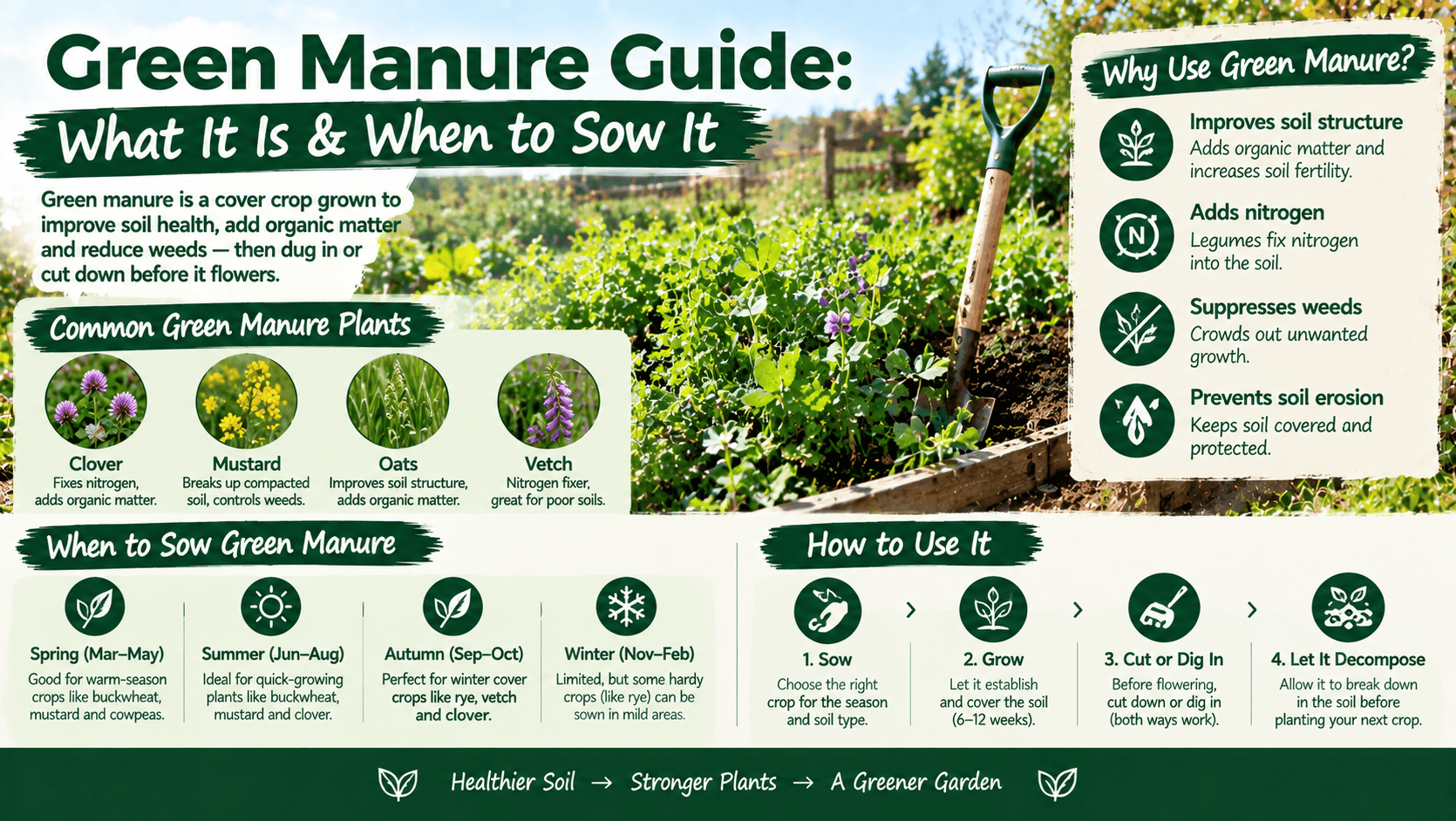
Green Manure Guide: What It Is, When to Sow It & How to Use It
If you have an empty vegetable bed, allotment or growing area sitting bare over autumn and winter, you don't necessarily have to leave the soil exposed.
One option is to grow green manure.
Despite its name, green manure isn't animal manure and it doesn't arrive in a bag. It is a crop grown primarily to benefit the soil rather than to harvest for food.
Plants such as grazing rye, field beans, clover and other suitable green-manure crops can cover otherwise bare ground, suppress weeds, protect the soil and capture nutrients that might otherwise be lost.
Later, the plants are cut down and either incorporated into the soil, left on the surface to decompose, or added to the compost heap depending on the crop and gardening method.
For Scottish gardeners and allotment holders, green manure can be particularly useful during the long period between autumn harvesting and spring planting.
This guide explains what green manure is, what it does, when to sow it, which type to choose, how to remove it and when compost or well-rotted manure may be a better option.
Quick Answer: What Is Green Manure?
Green manure is a crop grown to improve or protect soil rather than to produce a harvest.
It is usually sown on empty ground between main crops.
Depending on the species, green manure can:
Cover bare soil
Reduce erosion
Suppress weeds
Capture nutrients
Add organic matter
Support soil structure
Provide root activity in otherwise empty beds
Fix nitrogen when suitable legumes are used under appropriate conditions
When the ground is needed again, the green manure is normally cut down.
The material can then be incorporated into the soil, left on the surface or composted.
Green manure is particularly useful in vegetable gardens and allotments where beds might otherwise remain empty for several months.
Why Is Bare Soil a Problem?
Bare garden soil isn't automatically disastrous, but leaving productive ground exposed for long periods can create several problems.
In Scotland, autumn and winter often bring substantial rainfall.
When soil has no growing crop or protective covering, rain can:
Erode exposed soil
Wash nutrients deeper through the soil profile
Cause surface deterioration
Encourage some weeds to colonise empty ground
Leave heavy soil vulnerable to poor structure if repeatedly walked on or worked while wet
Growing plants protect the surface while their roots occupy the soil below.
This is one reason green manure can be useful between crops.
Instead of leaving an allotment bed empty after potatoes, beans or another crop has finished, you can establish a temporary crop whose main job is to protect and contribute to the soil.
Why Is It Called Green Manure?
The name can be confusing.
Traditional animal manure adds organic material and nutrients to soil.
Green manure aims to provide some related soil benefits using living plants.
The crop grows, produces roots and foliage, and is eventually returned to the garden system rather than harvested as a conventional crop.
So:
Animal manure = decomposed animal waste and bedding
Green manure = plants deliberately grown for soil improvement
They aren't the same material and aren't always interchangeable.
What Does Green Manure Do?
Different green-manure species provide different benefits.
There is no single plant that does everything perfectly.
1. Covers bare ground
One of the simplest benefits is physical coverage.
Instead of leaving a bed exposed for months, vegetation occupies the surface.
This can be especially useful over autumn and winter.
2. Helps suppress weeds
A dense green-manure crop competes with weeds for:
Light
Space
Water
Nutrients
It won't magically eliminate every perennial weed, but a well-established cover crop can reduce the amount of open ground available for new weeds.
3. Captures nutrients
Plants need nutrients while growing.
A green manure can therefore absorb available nutrients that might otherwise move through the soil during wet weather.
When the plants are later returned to the soil system, some of those nutrients can become available again as the plant material decomposes.
This is particularly relevant during wet winters.
4. Adds organic material
The foliage and roots eventually decompose.
That organic material contributes to the soil system.
5. Keeps roots in the ground
Healthy soil isn't just the material you can see.
Living roots interact with microorganisms and physically occupy the soil.
Instead of having an empty bed for six months, a green manure keeps plants growing through at least part of that period.
6. Can help soil structure
Roots penetrate soil at different depths depending on the crop.
This root growth, followed by decomposition, can contribute to soil structure over time.
However, don't expect a green manure to magically repair severe compaction or drainage problems.
Those issues should be diagnosed separately.
7. Some green manures can fix nitrogen
Plants in the legume family can form relationships with bacteria associated with their roots.
Under suitable conditions, this allows atmospheric nitrogen to be fixed.
Examples of leguminous green manures include certain:
Clovers
Vetches/tares
Field beans
This doesn't mean every legume automatically delivers unlimited nitrogen to the next crop.
The process depends on growing conditions and management.
When Should You Sow Green Manure?
Timing depends on the species and what you plan to grow afterwards.
Green manures can be used at different points throughout the year.
Late summer
When an early vegetable crop finishes, a fast-growing green manure can occupy the bed before winter.
This is useful when there isn't enough time or need for another food crop.
Autumn
Autumn is one of the most useful times for green manure.
Beds become available as crops are harvested, but they may not be needed again until spring.
Hardier green manures can cover these beds over winter.
Spring
A green manure can also be grown during spring if a bed won't be planted until later.
Choose a crop that fits the available time.
Summer
Temporary empty ground can be covered with fast-growing species.
The important consideration is not simply the month.
Ask:
How long will this bed be empty?
Then choose a green manure whose growing period fits that gap.
Is October Too Late to Sow Green Manure in Scotland?
It depends on the species and local conditions.
Some green manures are much better suited to colder conditions than others.
By October, the growing window is narrowing in many Scottish gardens, so species selection becomes particularly important.
Hardier options such as grazing rye and suitable winter field beans can be considered for overwintering.
Tender, fast-growing summer species are less useful once temperatures fall.
Don't choose a seed simply because the packet says "green manure."
Check:
Recommended sowing months
Winter hardiness
Soil requirements
How long the crop needs
How it should be terminated
Whether it could interfere with your crop rotation
The last point is surprisingly important.
Which Green Manure Should You Choose?
There are many possibilities.
Here are some commonly encountered types.
| Green manure | Main characteristics | Typical use |
|---|---|---|
| Grazing rye | Hardy, strong growth | Winter soil cover |
| Winter tares/vetch | Leguminous, winter option | Overwintering beds |
| Field beans | Legume, hardy options available | Winter cover |
| Crimson clover | Leguminous | Soil cover and organic matter |
| Mustard | Fast-growing | Short gaps between crops |
| Phacelia | Fast-growing, not closely related to common veg crops | Temporary cover |
| Buckwheat | Fast-growing in warmer conditions | Short summer gaps |
| Fenugreek | Quick-growing | Summer green manure |
| Alfalfa/Lucerne | Deep-rooting perennial | Longer-term ground improvement |
This is not a planting calendar for every Scottish garden.
Always check the specific variety and seed supplier's instructions.
What Is Grazing Rye?
Grazing rye is one of the better-known overwintering green manures.
It is useful because it can tolerate colder conditions and produce substantial roots and foliage.
That makes it useful for beds that would otherwise sit empty over winter.
It can help:
Cover soil
Capture nutrients
Reduce erosion
Suppress some weeds
Produce organic material
However, grazing rye can develop a substantial root system.
Don't leave termination until the last minute if you intend to plant the bed immediately afterwards.
Plan ahead.
What Are Winter Tares?
Winter tares, also known as vetch, belong to the legume family.
They can be used as an overwintering green manure and are often grown alongside another species such as rye.
A mixture can provide complementary characteristics.
For example, one species may offer dense ground cover while the legume contributes nitrogen-fixing ability.
Again, the precise value depends on conditions and management.
Is Mustard a Good Green Manure?
Mustard grows rapidly and can be useful when you have a relatively short gap between crops.
However, there is an important consideration for vegetable growers:
mustard belongs to the brassica family.
That means it can complicate crop rotation where you're growing:
Cabbage
Broccoli
Cauliflower
Kale
Brussels sprouts
Turnips
Radishes
Other brassicas
If you're carefully rotating crop families, don't casually insert mustard without considering the consequences.
This is a good example of why choosing green manure by name alone isn't enough.
What Is Phacelia?
Phacelia is popular as a green manure partly because it isn't closely related to most common vegetable crops.
That makes it easier to fit into many crop rotations.
It can establish relatively quickly in suitable conditions and also produces flowers attractive to pollinating insects if allowed to flower.
However, allowing a green manure to flower isn't always desirable if your primary objective is to return tender growth to the soil before seed formation.
Management depends on what you want from the crop.
Which Green Manure Is Best for a Vegetable Garden?
There isn't one universal answer.
Choose according to:
Time of year
Length of the empty period
Your next crop
Your crop rotation
Soil conditions
Whether you want winter cover
Whether nitrogen fixation matters
How easily you can remove the crop
For example:
Empty bed from September until March or April
Consider a hardy overwintering option.
Empty bed for only six to eight weeks in warmer weather
A fast-growing temporary green manure may be more appropriate.
Vegetable rotation involving lots of brassicas
Be cautious about using mustard.
Long-term unused ground
A longer-lived green manure may be possible.
The correct choice starts with the gap in your growing plan, not with the seed packet.
How to Sow Green Manure
Green manure is usually straightforward to establish.
Step 1: Clear the bed
Remove finished crops and problem weeds.
You don't need to make the soil immaculate, but deal with serious perennial weeds first.
A green manure will not necessarily eliminate established bindweed, couch grass or ground elder.
Step 2: Prepare the surface
Create reasonable seed-to-soil contact.
Avoid excessive cultivation.
If the ground is compacted, address the underlying problem rather than simply scratching the surface and hoping the green manure fixes everything.
Step 3: Sow the seed
Follow the recommended rate for your chosen species.
Green manure is generally sown relatively densely because you want good ground coverage rather than widely spaced individual plants.
Step 4: Lightly cover where required
Follow the seed instructions.
Some species need only shallow coverage.
Step 5: Water if necessary
Autumn rainfall may do much of the work, but newly sown seed still needs sufficient moisture to germinate.
Step 6: Allow it to establish
Once established, the crop's job is largely to occupy and protect the soil.
Do You Need to Fertilise Green Manure?
Usually the objective is not to produce a prize crop.
You're growing it to benefit the soil system.
Adding large amounts of fertiliser simply to grow a green manure can defeat part of the purpose.
However, extremely poor ground may behave differently.
Assess the soil rather than automatically applying feed.
When Should You Cut Down Green Manure?
This is one of the most important parts of using it successfully.
Don't sow a green manure and forget about it until the morning you want to plant vegetables.
Termination needs planning.
Many green manures are cut before they set seed.
Depending on the species and gardening method, you may:
Cut the foliage
Mow it
Chop it
Dig it into the soil
Leave it on the surface
Add foliage to the compost heap
If incorporating the material into the soil, allow time for decomposition before sowing or planting the next crop.
Exactly how long depends on the material and conditions.
Should You Dig Green Manure Into the Soil?
Traditionally, green manure is cut down and dug into the soil.
That remains one method.
The foliage and roots then decompose and contribute organic matter.
But digging isn't the only approach.
Traditional approach
Cut the crop and incorporate the material into the upper soil.
Avoid burying large masses of fresh material deeply.
Reduced-dig approach
Cut the top growth and disturb the soil as little as necessary.
No-dig approach
Some green manures can be terminated and left on the surface or covered appropriately, allowing plant material to decompose without conventional digging.
The RHS notes that green manures can also be incorporated into no-dig systems—for example, foliage may be composted in place or cut and added to the compost heap while roots remain in the soil.
The correct method depends heavily on the species.
Can Green Manure Be Used in a No-Dig Garden?
Yes.
But choose the crop carefully.
A vigorous green manure that is difficult to terminate may create unnecessary work in a no-dig system.
The basic no-dig strategy can involve:
Grow → cut at ground level → leave roots → compost or surface-manage foliage → cover if appropriate → plant when ready.
Leaving roots in place allows them to decompose naturally.
That avoids unnecessarily turning the soil.
Green Manure vs Compost: What's the Difference?
Both can contribute organic matter, but they work very differently.
| Green manure | Compost |
|---|---|
| Grown directly in the bed | Applied to the bed |
| Requires time to establish | Ready to use when mature |
| Protects soil while growing | Protects soil when used as mulch |
| Living roots occupy soil | No living root system |
| Can capture nutrients while growing | Adds mature organic material |
| Requires seed and growing time | Requires compost material |
| Some species fix nitrogen | Nutrient profile depends on compost |
| Takes up the bed temporarily | Does not require a growing season |
Neither is automatically better.
They can actually complement each other.
For example, you might grow a green manure on one empty allotment bed while applying mature compost to another bed that needs to be planted sooner.
Green Manure vs Well-Rotted Manure
The similar names can cause confusion.
They are completely different materials.
Green manure
A living crop grown specifically to benefit the soil.
Well-rotted manure
Decomposed animal manure, usually mixed with bedding material.
Well-rotted manure can supply substantial organic matter and nutrients.
Green manure instead uses plants to occupy the soil, capture nutrients and eventually return plant material to the ground.
For a vegetable garden, the choice depends on:
Existing soil fertility
Crop requirements
Time available
Crop rotation
How much organic material the soil needs
They can also be used at different stages rather than treated as competing options.
Green Manure vs Mulch
Mulch covers the surface.
Green manure covers the soil using living plants.
Organic mulches include materials such as:
Mature compost
Well-rotted organic material
Woodchip for suitable areas
Leafmould
A mulch can be applied immediately.
A green manure must germinate and establish first.
For a bed that needs instant winter protection, mulch may be more practical.
For an empty bed that can remain planted for several months, green manure may be worthwhile.
Should You Use Green Manure or Compost Over Winter?
This depends mainly on when you need the bed again.
Use green manure when:
The bed will remain empty for months.
You want living soil cover.
You have enough time for establishment.
A suitable hardy crop fits your rotation.
You can manage termination before spring planting.
The bed will remain empty for months.
You want living soil cover.
You have enough time for establishment.
A suitable hardy crop fits your rotation.
You can manage termination before spring planting.
Consider compost when:
You want to add mature organic matter directly.
There isn't enough time to establish a green manure.
The bed needs to be planted relatively soon.
Your soil needs additional organic matter.
You are following a suitable mulching or no-dig strategy.
You want to add mature organic matter directly.
There isn't enough time to establish a green manure.
The bed needs to be planted relatively soon.
Your soil needs additional organic matter.
You are following a suitable mulching or no-dig strategy.
There is no reason every bed must receive the same treatment.
Is Green Manure Good for Clay Soil?
Green manure can contribute to a long-term soil-improvement strategy.
Plant roots penetrate the soil, and the resulting organic material contributes to biological processes.
But it isn't a cure for severely compacted or waterlogged clay.
If water stands on the surface for days, investigate:
Compaction
Drainage
Soil depth
Runoff
Site levels
Organic matter can improve workable clay over time, but don't expect a cover crop to solve a fundamental drainage defect.
For heavy but workable clay soil, mature organic compost can also be extremely useful.
Is Green Manure Good for Sandy Soil?
It can be.
Light sandy soil tends to hold less water and nutrients than soil with a higher proportion of fine particles and organic matter.
Green manure can help by:
Keeping living roots in the ground
Capturing some nutrients
Contributing organic material after termination
Reducing periods of completely bare soil
However, long-term improvement normally requires a broader organic-matter strategy.
Mature compost is particularly valuable where the aim is to increase organic matter and improve moisture retention.
Can Green Manure Stop Nutrients Being Washed Away?
It can help reduce losses.
Instead of leaving soluble nutrients unused in bare ground, actively growing plants can absorb some of them.
This is sometimes described as mopping up nutrients.
The nutrients become part of the plant.
When that plant material later decomposes, nutrients can return to the soil system.
This is one reason overwintering green manure can be useful in wet climates.
It doesn't mean nutrient loss becomes impossible, but it gives otherwise unused nutrients somewhere productive to go.
Green Manure Add Nitrogen?
Some types can.
Leguminous green manures—including certain clovers, tares and field beans—can form relationships with nitrogen-fixing bacteria.
However, don't assume all green manure adds nitrogen.
Non-leguminous crops such as rye mainly capture nutrients already present rather than fixing atmospheric nitrogen.
This distinction matters.
Nutrient capture and nitrogen fixation are not the same thing.
Does Green Manure Replace Compost?
Not completely.
Green manure can produce organic material and provide several valuable soil benefits, but there are situations where adding mature compost remains useful.
For example, suppose you are improving a large vegetable plot with soil that is low in organic matter.
Growing a green manure helps.
But if you want to increase organic matter substantially, a mature soil improver may still be useful.
Think of soil improvement as a system rather than searching for one magic product.
That system can include:
Green manure
Home-made compost
Bulk organic compost
Leafmould
Appropriate well-rotted manure
Surface mulch
Crop residues
Living roots
Can Green Manure Replace Animal Manure?
Again, not necessarily.
Animal manure can provide concentrated organic matter and nutrients.
Green manure has different strengths, particularly its ability to cover soil and maintain living roots.
A productive garden may use both at different times.
The important thing is to avoid adding material simply because "more fertility must be better."
Vegetable crops have different nutrient requirements.
Excessive fertility can be just as unhelpful as deficiency in some situations.
Can You Use Green Manure in Raised Beds?
Yes, provided the bed will be unused long enough.
Raised beds are often intensively cropped, so there may not be a large gap available.
But after an early crop finishes, you might have enough time for a short-duration green manure.
Or a bed can be covered through winter before spring planting.
Consider:
The next crop
Available time
Crop rotation
How you will terminate the green manure
Don't sow a vigorous overwintering crop if you need the raised bed again almost immediately.
Is Green Manure Good for Allotments?
Allotments are one of the best places to use it.
Large vegetable plots often contain empty sections between crops.
Green manure can help keep those areas productive rather than bare.
It is particularly useful when:
You take over an allotment gradually.
A section won't be cropped until next year.
Early potatoes have been harvested.
Summer crops have finished.
Beds will remain empty through winter.
You want to reduce weed opportunities.
But don't use green manure as an excuse to ignore established perennial weeds.
Clear serious weed problems first.
Can Green Manure Help With Weeds?
Yes, mainly through competition.
A dense crop occupies the space and intercepts light.
That can make establishment more difficult for many annual weeds.
However, it won't reliably eliminate deeply rooted perennial weeds.
If your plot contains:
Bindweed
Couch grass
Ground elder
Other persistent perennial weeds
deal with those separately.
Green manure is a soil-management tool, not a universal weed treatment.
Can Green Manure Become a Weed?
Potentially.
Any plant allowed to seed can create unwanted seedlings.
Some green manures can also regrow if terminated incorrectly.
That's why management matters.
Know:
When the crop flowers
Whether it readily self-seeds
Whether it regrows from roots
How it should be terminated
Cutting at the correct stage avoids many problems.
Does Green Manure Fit Into Crop Rotation?
Yes, but you must know the plant family.
This is particularly important in vegetable gardens.
If your green manure belongs to the same family as an important food crop, it may affect your rotation planning or potentially share some pests and diseases.
Mustard is the classic example because it is a brassica.
Phacelia is often convenient because it isn't closely related to most commonly grown vegetables.
Legumes also need consideration if peas and beans form part of your rotation.
Don't view green manure as invisible simply because you don't harvest it.
Botanically, it's still a crop.
Green Manure for Scottish Gardens: What Changes?
The principles are the same throughout the UK, but Scotland's climate affects timing.
For many areas around Glasgow and the Central Belt:
Autumn temperatures decline relatively quickly.
Winter rainfall can be substantial.
Soil can remain wet for long periods.
Spring soil warming may be slower than in southern England.
Tender green manures may stop growing or be killed by frost.
This makes hardiness and timing particularly important.
A seed that performs brilliantly when sown in August may not establish the same way when sown late in October.
Use the seed supplier's regional sowing guidance and adapt it to actual weather and soil conditions.
What Should You Do With Empty Vegetable Beds in October?
You have several options.
Option 1: Sow a suitable hardy green manure
Best where conditions and timing allow establishment.
Option 2: Apply appropriate organic matter
Mature compost can be used where soil improvement is required and timing is appropriate.
Option 3: Leave crop roots in place
Healthy roots from some finished crops can remain and decompose naturally.
Option 4: Cover the soil
A suitable organic mulch can protect exposed ground.
Option 5: Keep growing food
Not every bed needs to become dormant.
Depending on your conditions and growing system, autumn and overwintering crops can continue occupying some areas.
A productive garden can use several of these approaches simultaneously.
A Simple Autumn Allotment Example
Imagine you have four vegetable beds after summer.
Bed 1: Potatoes finished
The bed won't be used until spring.
→ Consider a suitable overwintering green manure.
Bed 2: Brassicas still growing
→ Leave the crop in place.
Bed 3: Poor soil that needs organic matter
→ Consider mature compost or appropriate well-rotted manure according to the next crop and soil needs.
Bed 4: Garlic planned
→ Prepare and plant the garlic rather than sowing a green manure.
This demonstrates an important principle:
You don't need one autumn treatment for the whole garden.
Treat each bed according to what it needs next.
What If Your Soil Needs More Organic Matter Than Green Manure Can Provide?
Green manure produces organic material, but it doesn't instantly create large volumes of mature compost.
If your soil is badly depleted, shallow or low in organic matter, additional material may be appropriate.
For example:
Existing soil with low organic matter
Consider mature organic compost.
Soil requiring additional depth
Consider quality topsoil rather than assuming compost alone will solve the problem.
Productive ground requiring suitable fertility
Well-rotted manure may be appropriate depending on the crop.
Bare paths and suitable areas around established woody plants
Woodchip may be useful as a surface mulch.
This is where understanding the difference between products matters.
Green manure grows in the soil.
Compost improves suitable existing soil.
Topsoil adds soil volume.
Well-rotted manure adds organic matter and nutrients.
Woodchip primarily provides a surface mulch for suitable applications.
Common Green Manure Mistakes
1. Choosing the wrong species
Don't buy seed without checking season, hardiness and crop family.
2. Sowing too late
A crop cannot protect the soil effectively if it never establishes.
3. Forgetting crop rotation
Especially important with mustard and other plants related to vegetable crops.
4. Letting it seed unintentionally
Cut it at the appropriate stage.
5. Leaving termination until planting day
Plan removal in advance.
6. Expecting it to fix severe compaction
Green manure can contribute to soil health but isn't a substitute for diagnosing serious physical problems.
7. Expecting it to eliminate perennial weeds
Deal with persistent weeds separately.
8. Assuming every green manure adds nitrogen
Only suitable nitrogen-fixing plants provide that particular benefit.
9. Digging wet Scottish soil unnecessarily
Avoid heavy cultivation when the soil is saturated.
10. Assuming green manure means you never need compost
The two can perform complementary roles.
Green Manure, Compost or Manure: Quick Decision Table
| Situation | Consider |
|---|---|
| Empty bed for several months | Green manure |
| Bare soil over winter | Hardy green manure or suitable mulch |
| Existing soil low in organic matter | Compost |
| Need more actual soil depth | Topsoil |
| Productive bed needing suitable fertility | Well-rotted manure or compost depending on crop |
| Want living roots over winter | Green manure |
| Need immediate organic matter | Mature compost |
| Need quick ground cover in a short summer gap | Fast-growing green manure |
| New-build garden with shallow soil | Diagnose first; often topsoil + organic matter |
| Severe waterlogging | Fix drainage/compaction issue first |
Frequently Asked Questions About Green Manure
What is green manure?
Green manure is a crop grown mainly to protect or improve soil rather than to produce food. It is later cut down and returned to the soil system.
When should I sow green manure in the UK?
It depends on the species. Many are sown from spring through early autumn, while suitable hardy types can be used for overwintering.
What green manure can I sow in autumn?
Hardy options can include grazing rye, winter tares and suitable field beans. Always check the individual variety and sowing instructions.
Can I sow green manure in October?
Some hardy types may still be suitable depending on your location, soil and weather. In Scotland, establishment becomes increasingly dependent on conditions as autumn progresses.
What is the best green manure for winter?
There isn't one universal best option. Grazing rye and winter tares are commonly used overwintering choices, but crop rotation and your next planting should influence the decision.
Does green manure improve soil?
It can protect soil, maintain living roots, capture nutrients, suppress some weeds and contribute organic material after decomposition.
Does green manure add nitrogen?
Leguminous green manures can fix atmospheric nitrogen under suitable conditions. Non-legumes primarily capture nutrients already present in the soil.
Do I have to dig green manure in?
No. Some gardeners incorporate it, while reduced-dig and no-dig approaches may cut the crop and manage the foliage at the surface or compost it separately.
How long should green manure grow?
That depends entirely on the species. Some are designed for short gaps while others can occupy the ground for many months.
Can I plant vegetables immediately after green manure?
Usually it is sensible to allow time after termination, particularly where substantial fresh material has been incorporated. Follow guidance for the species and your chosen management method.
Is green manure better than compost?
They perform different jobs. Green manure provides living ground cover, while mature compost provides ready-to-use organic material.
Can green manure replace well-rotted manure?
Not necessarily. Their nutrient profiles and effects differ, and the appropriate choice depends on the soil and crops.
Is green manure suitable for raised beds?
Yes, if the bed will be empty long enough and the chosen crop fits your rotation and planting schedule.
Can green manure help clay soil?
Its roots and decomposing material can contribute to long-term soil health, but it will not fix severe compaction or drainage problems by itself.
Is green manure useful in Scotland?
Yes. It can be particularly useful for protecting otherwise bare soil during long periods between crops, but hardy species and appropriate sowing dates are important.
Is Green Manure Worth Using?
For the right garden, absolutely.
It is particularly useful for vegetable growers and allotment holders who regularly have empty ground between crops.
Green manure can turn that empty period into something productive.
Instead of thinking:
“Nothing is growing here until spring.”
think:
“What can grow here now that benefits the soil?”
That change in approach can help you:
Keep soil covered
Maintain living roots
Capture nutrients
Suppress some weeds
Produce organic material
Build a more resilient growing system
But green manure doesn't need to replace compost, manure or mulch.
The strongest soil-management strategy often combines several methods according to what each bed actually needs.
If your soil needs more organic matter than your green manure can provide, Kelvin Compost supplies bulk organic compost, well-rotted manure, topsoil and organic woodchip for gardens, allotments and larger growing projects across Glasgow, East Kilbride, South Lanarkshire and surrounding areas.
Need to Improve Your Soil Before Next Season?
If you've cleared your vegetable beds and discovered that the soil needs more than a cover crop, choose the material according to the problem.
Organic Compost — for adding mature organic matter to suitable existing soil.
Well-Rotted Manure — for suitable productive beds where additional organic matter and fertility are required.
Topsoil — where you need additional actual soil depth or volume.
Organic Woodchip — for suitable paths and mulching applications.
Call Kelvin Compost: +44 7561 251350
Email: info@kelvincompost.co.uk
Need Garden Supplies Delivered in Glasgow?
Organic compost, topsoil, manure and more across Scotland