




Garden Mulch: Types, Benefits & How to Use Mulch | UK Guide
Looking for compost, topsoil or garden supplies?
Browse our full product range or get in touch for delivery across Glasgow and Scotland.
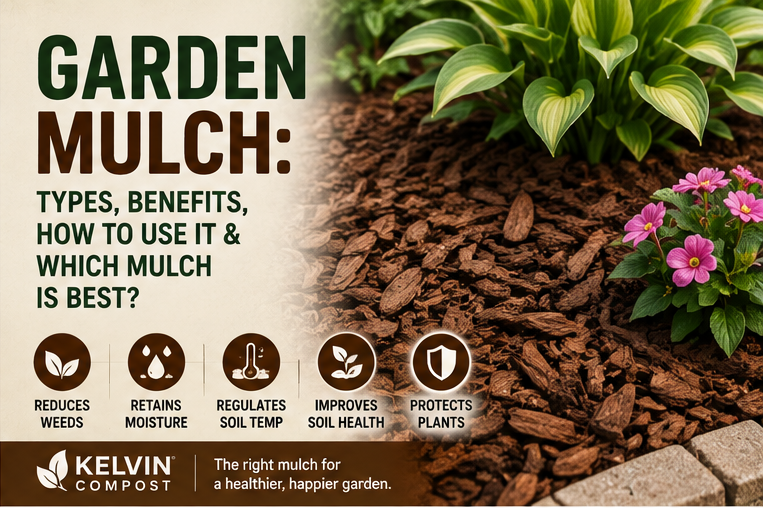
What Is Garden Mulch?
Garden mulch is a layer of material placed over the surface of soil.
Mulch can be used around plants, trees, shrubs, flower beds and vegetable gardens.
Depending on the material, mulch can help:
- Reduce weed growth
- Retain soil moisture
- Protect soil
- Add organic matter
- Improve appearance
- Reduce soil erosion
- Moderate soil conditions
Common garden mulch materials include:
- Woodchip
- Bark
- Garden compost
- Leafmould
- Well-rotted organic matter
- Straw
- Gravel and other decorative mineral materials
Organic mulches gradually break down and contribute organic matter to the soil.
What Does Mulch Do?
Mulch creates a protective layer between the soil surface and the outside environment.
This can provide several benefits.
Reduces Weed Growth
A suitable layer of mulch can make it harder for weed seeds to germinate and establish.
However, mulch is not a guaranteed weed killer.
Perennial weeds should be controlled before mulching.
Helps Retain Moisture
Mulch can reduce direct evaporation from exposed soil.
This means soil can remain moist for longer during dry periods.
This can be particularly helpful around newly planted trees, shrubs and garden borders.
Protects the Soil Surface
Bare soil can be exposed to:
- Heavy rainfall
- Wind
- Temperature changes
- Foot traffic
- Erosion
Mulch provides a protective surface layer.
What Are the Different Types of Garden Mulch?
There is no single best mulch for every garden.
Woodchip Mulch
Woodchip is one of the most versatile organic mulches.
It is particularly suitable for:
- Paths
- Shrub borders
- Trees
- Large planting areas
- Landscaping
- Community gardens
Kelvin Compost already has a dedicated Woodchip Guide: Types, Uses, Prices and How to Buy in Bulk, so this article should link to that page rather than competing with it.
Bark Mulch
Bark is another popular garden mulch.
It can provide an attractive finish around:
- Shrubs
- Trees
- Flower borders
- Decorative beds
Bark tends to be selected where appearance is particularly important.
Compost Mulch
Mature garden compost can also be used as an organic mulch.
It provides the additional benefit of contributing organic matter as it breaks down.
Compost mulch is particularly useful around:
- Flower beds
- Vegetable gardens
- Shrubs
- Perennial plants
Kelvin Compost's existing Organic Compost guides can be linked here.
Leafmould
Leafmould is made from decomposed leaves.
It can be useful for improving soil and as an organic surface material.
It is especially valuable for gardeners who produce their own leaf compost.
Straw Mulch
Straw can be useful in some vegetable-growing applications.
It can provide a protective layer around certain crops and help reduce soil contact.
However, it is not necessarily the best general-purpose mulch for every garden.
Gravel and Decorative Mulch
Not all mulch is organic.
Decorative stone, gravel and other mineral materials can be used in:
- Paths
- Rock gardens
- Drought-tolerant planting
- Decorative beds
Unlike organic mulch, mineral mulch does not break down and add organic matter to the soil.
What Is the Best Garden Mulch?
The best garden mulch depends on what you are trying to achieve.
| Mulch | Best for | Main advantage |
|---|---|---|
| Woodchip | Trees, shrubs, paths | Versatile and long-lasting |
| Bark | Decorative borders | Attractive appearance |
| Compost | Beds and vegetables | Adds organic matter |
| Leafmould | Soil improvement | Organic and lightweight |
| Straw | Some vegetables | Useful protective layer |
| Gravel | Decorative/dry gardens | Long-lasting |
If you want a general-purpose organic mulch, woodchip is a practical option for many landscaping applications.
If improving soil is your priority, mature compost may be more useful.
How Thick Should Garden Mulch Be?
The correct depth depends on the material and application.
A mulch layer should be thick enough to provide protection without creating problems around plants.
As a general approach, use a consistent layer rather than creating a very deep pile.
For woody mulches such as woodchip, a layer of several centimetres is commonly used around established trees and shrubs.
Do not pile mulch against trunks or plant stems.
This is sometimes called a mulch volcano and can create an unnecessarily damp environment around the base of a plant.
How to Apply Garden Mulch
Applying mulch correctly is straightforward.
Step 1: Remove weeds
Control existing weeds before applying mulch.
Step 2: Prepare the soil
Water the area if necessary and make sure the soil is in suitable condition.
Step 3: Spread the mulch
Apply an even layer across the required area.
Step 4: Leave space around stems
Do not bury plant crowns or pile mulch directly against tree trunks.
Step 5: Maintain the layer
Organic mulch gradually decomposes.
Top it up when the layer becomes thin.
When Is the Best Time to Mulch a Garden?
Mulch can be used at different times of year.
Spring
Spring is useful for preparing beds before the main growing season.
Mulch can help retain moisture as temperatures increase.
Summer
Mulching during summer can help reduce moisture loss during dry weather.
Autumn
Autumn is another useful time to mulch, particularly around established trees, shrubs and perennial beds.
It can protect exposed soil during wetter and colder months.
Winter
Avoid working heavily saturated soil.
Mulch can still protect suitable areas, but application should take account of existing soil conditions.
Can You Put Mulch on Wet Soil?
It is better to avoid walking over or heavily disturbing saturated soil.
If the soil is already waterlogged, identify and address the drainage problem rather than simply covering it with a thick layer of mulch.
This is particularly important in parts of Scotland where wet winter conditions can cause persistent soil moisture.
For waterlogged Scottish gardens, link to your existing:
How to Fix Clay and Waterlogged Soil in Scottish Gardens
article.
Can You Put Mulch Over Weeds?
Mulch can suppress some weeds, but simply covering established perennial weeds is unlikely to solve the problem.
Before mulching:
- Remove established weeds.
- Remove roots where appropriate.
- Prepare the soil.
- Apply the mulch evenly.
Mulch works best as part of a wider weed-management strategy.
Does Garden Mulch Improve Soil?
Organic mulch can improve soil over time as it decomposes.
Woodchip, bark, compost and leafmould all behave differently.
As organic mulch breaks down, it contributes organic material to the soil.
However, some woody materials decompose relatively slowly.
If your primary goal is rapid soil improvement, compost or well-rotted organic matter may be more appropriate than fresh woodchip.
Garden Mulch vs Compost
This is an important distinction.
Mulch describes how the material is used.
Compost describes what the material is.
Compost can therefore be used as a mulch.
Woodchip can also be used as mulch.
Bark can be used as mulch.
This means you should choose the material based on the result you want.
Garden Mulch vs Woodchip
Woodchip is one particular type of garden mulch.
So the comparison is not really:
Mulch vs woodchip
It is:
Which mulch material should I use?
Woodchip is particularly useful when you need:
- A durable surface
- Coverage over large areas
- A natural appearance
- Tree and shrub protection
- Path material
Kelvin Compost's existing woodchip article can provide the detailed information on woodchip grades, uses and bulk purchasing.
Is Mulch Good for Vegetable Gardens?
Yes, but choose the material carefully.
Organic mulch can help protect soil and reduce moisture loss around suitable vegetable crops.
Compost is particularly useful where improving soil organic matter is a priority.
Straw can also be useful around certain crops.
Avoid placing unsuitable or very fresh organic materials directly against edible plants.
Is Mulch Good for Flower Beds?
Yes.
Mulch is widely used around flower beds and perennial planting.
It can:
- Reduce weeds
- Improve appearance
- Retain moisture
- Protect soil
- Add organic matter when using organic materials
Bark and woodchip are particularly popular for ornamental beds.
Is Mulch Good Around Trees?
Mulch can be very useful around established trees.
It can help:
- Reduce competition from grass
- Retain soil moisture
- Protect the soil
- Reduce mowing around tree bases
However, keep mulch away from direct contact with the trunk.
A wide, even mulch ring is preferable to a mound piled against the tree.
How Much Mulch Do I Need?
Calculate mulch volume using:
Length × Width × Depth = cubic metres
Example
For an area:
8 m × 4 m
with a:
5 cm layer
the calculation is:
8 × 4 × 0.05 = 1.6 m³
You would therefore need approximately 1.6 cubic metres of mulch.
For large projects, order slightly more if the material will be spread unevenly or if the existing surface is irregular.
Bulk Garden Mulch
Bulk mulch is particularly useful for large areas.
It can be suitable for:
- Large gardens
- Landscapers
- Tree planting
- Paths
- School grounds
- Community gardens
- Commercial landscaping
- Farms
Buying bulk material can be more practical than purchasing many small bags.
Kelvin Compost supplies woodchip and other landscaping materials for larger projects around Glasgow and surrounding areas.
Garden Mulch in Glasgow
If you are searching for garden mulch in Glasgow, the right material depends on the application.
For:
Decorative beds: bark or attractive woodchip
Trees and shrubs: woodchip
Soil improvement: compost
Paths: suitable woodchip
Large landscaping: bulk mulch or woodchip
Kelvin Compost supplies woodchip, compost, manure and topsoil from its South Lanarkshire base for domestic, commercial, community and landscaping projects.
How Often Should You Replace Garden Mulch?
Organic mulch gradually breaks down.
The replacement schedule depends on:
- Material
- Depth
- Weather
- Exposure
- Soil conditions
- Amount of decomposition
Instead of automatically removing all the old mulch, check the existing layer.
If it has become thin, top it up with fresh material.
Common Garden Mulching Mistakes
Piling mulch against trees
Keep mulch away from the trunk.
Using too much mulch
A very thick layer can create problems rather than improving the garden.
Mulching over perennial weeds
Deal with established weeds first.
Using fresh organic material incorrectly
Some materials need to be properly processed or composted before being used around plants.
Ignoring drainage
Mulch does not fix severe waterlogging.
Choosing mulch only by appearance
Consider how long it lasts, how it behaves and what your plants need.
Is Garden Mulch Worth It?
For many gardens, yes.
Mulch is relatively simple to apply and can provide several benefits at once.
A suitable mulch can:
- Improve appearance
- Reduce weeds
- Retain moisture
- Protect soil
- Reduce maintenance
- Add organic matter when using organic materials
The key is choosing the right mulch for the application.
Frequently Asked Questions
What is garden mulch?
Garden mulch is a material placed on top of soil to protect the surface, reduce weeds, retain moisture and, when organic, gradually add organic matter.
What is the best garden mulch?
There is no single best mulch. Woodchip is versatile, bark is attractive, compost is useful for soil improvement and gravel works well for some decorative or dry gardens.
Is woodchip good garden mulch?
Yes. Woodchip is a versatile organic mulch suitable for many trees, shrubs, paths and landscaping applications.
Is compost a mulch?
Compost can be used as a mulch when it is spread over the soil surface around plants.
How thick should garden mulch be?
The ideal depth depends on the material and application. Apply a consistent layer and avoid piling mulch against stems or tree trunks.
When should I mulch my garden?
Spring, summer and autumn can all be suitable depending on the garden and material. Autumn and spring are particularly useful times for preparing beds.
Can mulch stop weeds?
Mulch can suppress many weeds, but it will not reliably eliminate established perennial weeds.
Can I put mulch directly on soil?
Yes. Prepare the area first, remove established weeds and spread the mulch evenly.
Can mulch improve clay soil?
Organic mulch can contribute organic matter as it breaks down, but serious clay and drainage problems require a broader soil-improvement strategy.
Is bark or woodchip better?
Neither is universally better. Bark is often chosen for appearance, while woodchip is versatile for trees, shrubs, paths and larger landscaping areas.
How much mulch do I need?
Multiply the length, width and required depth in metres to calculate cubic metres.
Where can I buy garden mulch in Glasgow?
Kelvin Compost supplies woodchip and other garden and landscaping materials across Glasgow and surrounding areas, subject to delivery location and product availability.
Final Thoughts
Garden mulch is a simple way to protect soil and reduce garden maintenance.
The best material depends on your objective.
Choose woodchip for versatile landscaping and tree or shrub areas.
Choose bark when appearance is important.
Choose compost when improving soil organic matter is the priority.
Choose mineral mulch for suitable decorative or dry-garden applications.
For larger projects, bulk delivery can be considerably more practical than buying small bags.
If you're looking for garden mulch, woodchip, compost or topsoil in Glasgow, Kelvin Compost supplies materials for domestic gardens, allotments, schools, community projects, farms and landscaping.
Need Garden Supplies Delivered in Glasgow?
Organic compost, topsoil, manure and more across Scotland