



Garden Compost: Benefits, Uses & How to Use Compost | UK Guide
Looking for compost, topsoil or garden supplies?
Browse our full product range or get in touch for delivery across Glasgow and Scotland.
What Is Garden Compost?
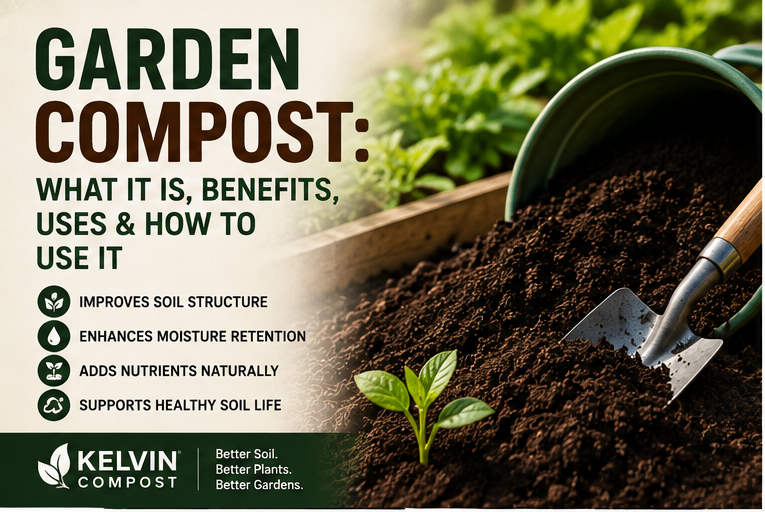
Garden compost is decomposed organic material that is added to soil to improve its structure, fertility and ability to hold moisture.
It can be made from decomposed garden and plant material such as:
- Grass clippings
- Leaves
- Plant material
- Hedge trimmings
- Woodier garden waste
- Other suitable biodegradable material
The RHS describes garden compost as a soil improver made from decomposed plant waste and explains that it can improve soil fertility, structure and water-holding capacity.
Garden compost is different from potting or seed compost.
Garden compost is primarily used to improve soil, while specialist growing composts are formulated for growing plants in containers or establishing seedlings.
What Does Garden Compost Do?
Adding compost to soil can improve the growing environment around plant roots.
The main benefits include:
- Increasing organic matter
- Improving soil structure
- Supporting moisture retention
- Improving aeration
- Supporting soil organisms
- Adding nutrients as organic material breaks down
Compost is particularly useful when soil has become depleted, compacted or low in organic matter.
The RHS recommends using organic matter such as garden compost, well-rotted manure and leafmould as soil improvers.
What Are the Benefits of Garden Compost?
1. Improves Soil Structure
Compost adds organic matter to soil.
In heavy soils, organic matter can help create a better structure and improve the environment for roots.
In lighter soils, organic matter can help improve the soil's ability to retain moisture.
The effect depends on the existing soil, the type of compost and how it is used.
2. Helps Soil Hold Moisture
Organic matter can help soil retain water while still maintaining air spaces.
This can be particularly useful during dry periods.
However, compost should not be viewed as a substitute for good drainage.
If a garden is severely waterlogged, the underlying drainage problem may need to be addressed separately.
3. Adds Organic Matter
Plants continually take nutrients and organic material from the soil.
Adding compost helps return organic matter to the growing area.
This is one reason compost is widely used in vegetable gardens, allotments and planting beds.
4. Supports Soil Life
Healthy soil contains a wide range of microorganisms and other organisms.
Adding mature organic matter provides material that contributes to the soil ecosystem.
Garden Compost vs Topsoil
One of the most common gardening questions is whether you should buy compost or topsoil.
The answer depends on what you are trying to do.
| Garden Compost | Topsoil |
|---|---|
| Improves existing soil | Adds soil volume |
| Adds organic matter | Provides the main soil structure |
| Useful as a soil improver | Useful for creating beds |
| Helps improve soil condition | Useful for lawns and landscaping |
| Usually not used as the sole bulk material | Suitable for larger volumes |
A simple way to remember it:
Topsoil builds the growing area. Compost improves it.
For many garden projects, using both products makes sense.
If you need a detailed comparison, see Kelvin Compost's existing Topsoil vs Compost guide.
Garden Compost vs Manure
Compost and manure are both organic materials, but they are not identical.
Compost is produced through decomposition of organic materials.
Manure comes from livestock waste and must be appropriately managed and well rotted before use.
Both can contribute organic matter to garden soil.
For a detailed comparison, link this section to your existing:
A UK Gardener's Guide to Manure: Types, Timing and Safety
and:
Compost vs Manure vs Topsoil: What's the Difference?
What Is the Best Garden Compost?
There isn't one compost that is best for every garden.
The right choice depends on:
- Intended use
- Source material
- Degree of maturity
- Nutrient content
- Texture
- Quality standards
- Quantity required
For general soil improvement, choose a mature, quality compost suitable for garden use.
For containers, seedlings or specialist plants, use a compost specifically formulated for that purpose.
How Do You Use Garden Compost?
Garden compost can be used in several ways.
Adding Compost to Existing Beds
Spread a suitable layer over the soil surface and incorporate it into the upper soil where appropriate.
This adds organic matter without completely replacing the existing soil.
Preparing New Beds
When creating a new border, compost can be incorporated into suitable topsoil or existing soil.
Vegetable Gardens
Compost can be added before planting and between growing seasons to replenish organic matter.
Around Established Plants
Compost can also be applied around established plants as an organic mulch or soil improver, depending on the product.
Avoid piling compost directly against stems or trunks.
When Should You Put Compost on Your Garden?
Compost can be used at different times of year.
Autumn
Autumn is an excellent time to add organic matter to many garden beds.
The material can begin integrating into the soil over winter.
Spring
Spring is another useful time to prepare vegetable beds, borders and planting areas.
Add compost before planting where appropriate.
During the Growing Season
Compost can also be used around established plants when appropriate.
The important thing is to use mature, suitable compost and apply it according to the needs of the soil and plants.
Kelvin Compost already has a dedicated guide comparing autumn vs spring compost, manure and mulch applications, which would make an excellent internal link here.
How Much Garden Compost Should I Use?
The amount depends on:
- Soil condition
- Type of garden
- Intended use
- Compost specification
- Existing organic matter
For general soil improvement, gardeners often apply a relatively shallow layer and incorporate it into the existing soil.
For larger areas, calculate the volume required using:
Length × Width × Depth = cubic metres
Example
A garden bed measuring:
6 m × 3 m
with a:
5 cm layer
requires:
6 × 3 × 0.05 = 0.9 m³
So approximately 0.9 cubic metres of material would be required.
Always consider the specific application and supplier recommendations before ordering.
Can You Use Too Much Compost?
Yes.
More compost is not automatically better.
Adding excessive quantities can alter soil characteristics and nutrient levels.
It is usually better to use compost as part of a balanced soil-management strategy rather than continually adding very large amounts.
If you are unsure how much to use, consider:
- Existing soil type
- Existing organic matter
- Crop requirements
- Compost specification
Is Garden Compost Good for Vegetable Gardens?
Yes.
Compost is widely used in vegetable gardens and allotments because it adds organic matter to the soil.
It can be used before planting:
- Potatoes
- Carrots
- Beans
- Courgettes
- Brassicas
- Salad crops
- Many other vegetables
However, different crops have different nutrient and soil requirements.
For edible crops, use a suitable compost product and follow the supplier's recommendations.
Is Garden Compost Good for Lawns?
Compost can be useful for improving soil before establishing a lawn.
However, topsoil is generally the main material used when creating a new lawn.
For lawn establishment, a suitable screened topsoil can provide the rooting layer required for grass.
Compost may then be used as part of soil improvement or for specific lawn applications.
Link this section to your existing:
Best Compost and Soil for Lawns: Feeding and Repairing Grass in Glasgow
Can Garden Compost Improve Clay Soil?
Compost can help improve the structure of clay soil by increasing organic matter.
However, severely compacted or waterlogged clay may need more than compost.
A practical soil-improvement strategy can include:
- Avoiding unnecessary compaction.
- Adding suitable organic matter.
- Improving drainage where necessary.
- Maintaining the soil over several seasons.
- Avoiding working wet clay excessively.
Your existing article How to Fix Clay and Waterlogged Soil in Scottish Gardens is a strong internal link here.
Can You Use Garden Compost as Mulch?
Yes, suitable mature compost can be used as an organic mulch.
Apply it around plants while avoiding direct contact with stems.
A compost mulch can:
- Add organic matter
- Help retain moisture
- Suppress some weed growth
- Improve soil condition over time
For a decorative or longer-lasting surface mulch, woodchip may be more appropriate.
Kelvin Compost's Woodchip Guide can be linked here.
Garden Compost for Allotments
Allotment gardens can benefit significantly from regular organic matter additions.
Compost can be used to:
- Improve soil
- Prepare beds
- Replenish organic matter
- Support vegetable production
- Mulch planting areas
For large allotments, buying compost in bulk can be considerably more convenient than transporting numerous small bags.
Bulk Garden Compost
For small gardens, bags can be convenient.
For larger areas, bulk compost can be more practical.
Bulk compost is particularly useful for:
- Large gardens
- Allotments
- Community gardens
- Schools
- Landscapers
- Farms
- Large planting schemes
Before ordering, calculate the required volume and check delivery access.
Garden Compost in Glasgow
If you're looking for garden compost in Glasgow, consider the quantity you need and how it will be delivered.
Kelvin Compost supplies compost and other soil products from its South Lanarkshire base to customers across Glasgow and surrounding areas.
Customers include:
- Home gardeners
- Allotment holders
- Schools
- Community gardens
- Landscapers
- Farms
For large projects, bulk delivery can save considerable time compared with buying and transporting individual bags.
How to Store Garden Compost
If you receive more compost than you need immediately, keep it protected from excessive weather exposure while still allowing appropriate ventilation.
Avoid storing it where contaminated material could mix with the compost.
If you are buying a large quantity, plan where the material will be placed before delivery.
Frequently Asked Questions
What is garden compost?
Garden compost is decomposed organic material used to improve soil structure, fertility, moisture retention and organic matter.
Is garden compost the same as potting compost?
No. Garden compost is generally used as a soil improver, while potting compost is formulated specifically for growing plants in containers.
When should I add compost to my garden?
Autumn and spring are both useful periods for adding compost. It can also be applied during the growing season where appropriate.
How much compost should I put on my garden?
The amount depends on the soil and intended application. Calculate the volume using length × width × depth and follow the compost supplier's recommendations.
Can compost improve clay soil?
Yes. Compost can add organic matter and help improve soil structure, although serious drainage or compaction problems may require additional measures.
Can I use compost in a vegetable garden?
Yes. Suitable garden compost can be used to improve soil in vegetable beds and allotments.
Can compost be used around flowers?
Yes. Mature compost can be used around flower beds as a soil improver or suitable organic mulch.
Can I use compost on a lawn?
Compost can help improve soil, but new lawns normally require suitable topsoil as the main rooting layer.
Is garden compost good for raised beds?
Yes. Compost can be incorporated into raised beds, but topsoil is generally more suitable as the main bulk material for large beds.
Where can I buy garden compost in Glasgow?
Kelvin Compost supplies compost in Glasgow and surrounding areas, with options suitable for gardens, allotments, schools, landscaping and larger projects.
Final Thoughts
Garden compost is one of the simplest ways to add organic matter to soil.
It can help improve soil structure, moisture retention and fertility while supporting a healthier growing environment.
The key is to choose quality compost for the intended application and use the right amount.
For larger projects, bulk compost delivery can also be more practical than buying dozens of bags.
If you're looking for garden compost in Glasgow, South Lanarkshire or surrounding areas, Kelvin Compost supplies compost, topsoil, manure and woodchip for domestic and commercial projects.
Need Garden Supplies Delivered in Glasgow?
Organic compost, topsoil, manure and more across Scotland