




Does Compost Go Off? How Long It Lasts & How to Store It
Looking for compost, topsoil or garden supplies?
Browse our full product range or get in touch for delivery across Glasgow and Scotland.
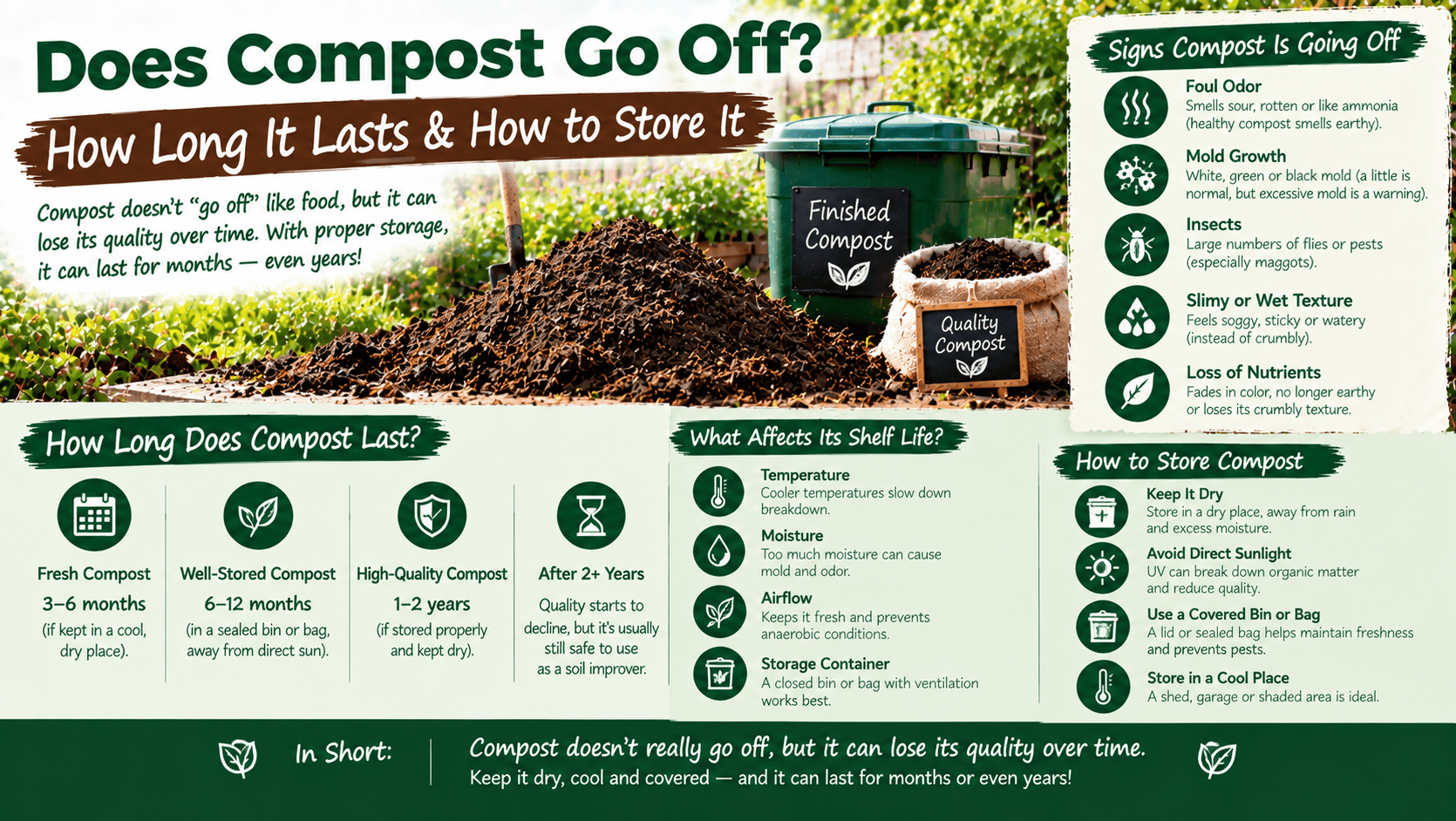
Does Compost Go Off? How Long Compost Lasts & How to Store It Properly
You order compost for a garden project, use what you need and discover there is still half a bag left.
What happens next?
Does compost go off? Can you leave it outside over winter? Does rain ruin it? And can you still use a bag of compost that has been sitting around for a year?
The short answer is that compost doesn't suddenly “expire” in the same way as food, but its condition and usefulness can change during storage.
How much this matters depends on what type of compost you have, how it is stored and what you intend to use it for.
Bulk organic compost used as a soil improver is also different from packaged potting or seed compost designed for growing plants in containers.
This guide explains how long compost can be stored, what happens to it over time and how to protect leftover compost from excessive rain, drying, weeds and contamination.
Quick Answer: Does Compost Go Off?
Mature garden compost doesn't normally become unusable simply because it has been stored for several months.
However, over time it can:
- Become waterlogged
- Dry out
- Become compacted
- Develop weeds
- Lose some readily available nutrients
- Become contaminated by surrounding soil or debris
- Change structurally
- Continue decomposing
If you're storing bulk compost, keep it contained, reasonably covered and protected from excessive rain and contamination.
For specialist bagged growing media, particularly seed or potting compost, follow the manufacturer's storage guidance because its physical and nutritional characteristics may change with age.
First: What Type of Compost Are You Storing?
This distinction matters.
People use the word compost for several very different materials.
Garden compost
This is decomposed organic material produced in a home compost bin or heap.
It is generally used to improve soil.
Bulk organic compost
This is mature organic material supplied in larger quantities for applications such as:
- Garden beds
- Vegetable plots
- Borders
- Raised beds as part of an appropriate mix
- Soil improvement
- Landscaping
Multipurpose compost
This is a manufactured growing medium commonly sold in bags for containers and other specified uses.
Seed compost
This is designed specifically for seed sowing and young seedlings.
Potting compost
This is formulated to provide suitable physical and nutritional conditions for container-grown plants.
The way age affects these materials isn't identical.
A pile of mature organic soil improver stored for six months is a very different situation from an opened bag of specialist seed compost.
How Long Does Compost Last?
There isn't one universal expiry date.
For mature organic compost used as a soil improver, storage for several months is generally possible if the material is managed appropriately.
Its condition may gradually change, but that doesn't automatically make it useless.
The bigger questions are:
How has it been stored?
and:
What do you want to use it for?
Compost left uncovered in a muddy corner for a year may become contaminated and difficult to handle.
The same material stored neatly on a suitable surface and protected from excessive rainfall may remain much more useful.
Does Bagged Compost Expire?
Bagged growing media can deteriorate in quality during long-term storage.
Possible changes include:
- Nutrient balance changing
- Material becoming compacted
- Excessive drying
- Excessive moisture
- Structural deterioration
If a manufacturer provides a storage or use-by recommendation, follow it.
An old bag isn't necessarily automatically unusable, but it may no longer perform exactly as originally intended.
This becomes more important for sensitive uses such as:
- Seed sowing
- Propagation
- Young plants
- Containers
For those applications, consistency matters.
Does Bulk Organic Compost Expire?
Mature bulk organic compost behaves differently.
It has already undergone substantial decomposition.
If stored, biological processes can continue and its characteristics may gradually change.
But properly stored mature compost can still be useful as a soil improver after an extended period.
This is one reason you should think of bulk organic compost as organic matter for soil improvement, rather than treating it like a sealed manufactured product with a simple expiration date.
What Happens to Compost as It Gets Older?
Compost remains biologically active.
Even mature compost isn't completely static.
Several changes may occur.
Continued decomposition
Remaining organic material continues breaking down.
Volume reduction
As decomposition continues, the pile may settle.
A heap that originally appeared one metre high may become noticeably smaller.
Nutrient changes
Some nutrients can be lost or transformed during prolonged storage, particularly where the pile is exposed to heavy rainfall.
Structural changes
The material can become finer or more compacted.
Moisture changes
Uncovered compost can become saturated during wet weather or extremely dry during warm periods.
None of these automatically means the compost must be discarded.
They simply mean stored organic material changes.
Does Compost Lose Nutrients Over Time?
Potentially.
Compost isn't a sealed nutrient vault.
During prolonged storage, nutrients can move or change form through:
- Leaching
- Continued microbial activity
- Volatilisation of certain compounds
- Movement of water through the pile
Heavy rainfall is particularly relevant.
If water repeatedly passes through an uncovered pile, some soluble nutrients may be carried away.
That is one reason sensible storage is worthwhile.
Can Rain Ruin Compost?
Ordinary rainfall doesn't instantly destroy compost.
Compost is routinely exposed to water in gardens.
The problem is prolonged saturation.
If a pile remains excessively wet:
- Air spaces can fill with water.
- Handling becomes difficult.
- Anaerobic conditions may develop.
- Nutrients can be leached.
- The material may become compacted.
For gardeners in Glasgow and western Scotland, this is especially relevant because prolonged wet weather can leave uncovered materials saturated.
The goal isn't to keep compost bone dry.
It is to prevent it sitting permanently waterlogged.
Can Compost Get Too Dry?
Yes.
If stored compost becomes extremely dry, biological activity slows considerably and the material may become dusty or difficult to wet evenly.
Fortunately, dry mature compost isn't necessarily ruined.
It can often be re-moistened gradually before use.
Avoid flooding a completely dry pile with huge amounts of water all at once.
Add moisture progressively and mix where appropriate.
Should You Cover Stored Compost?
For bulk compost that won't be used soon, covering it is generally sensible.
A cover can help reduce:
- Excessive rainfall
- Nutrient leaching
- Weed establishment
- Windblown seeds
- Contamination
- Drying
But don't think you need to hermetically seal a living organic material.
The objective is practical protection rather than turning the pile into an airtight package.
What Should You Cover Compost With?
Options can include:
- A suitable tarpaulin
- A reusable waterproof cover
- A covered storage bay
- An appropriate lidded container for smaller quantities
Secure lightweight covers properly so they don't blow away.
Also ensure water doesn't simply collect in a large depression in the cover and eventually flood the pile.
Can You Leave Compost in a Bulk Bag?
For a relatively short storage period, keeping unused material contained in its bulk bag can be convenient.
But remember that bulk bags are primarily a delivery and handling format.
Long-term outdoor storage can expose the material and bag to:
- Rain
- UV light
- Temperature changes
- Weeds
- Damage
- Contamination
If you know the compost won't be used for months, consider additional protection.
Cover the bag appropriately and keep the area tidy.
Should You Store Compost on Concrete?
A clean hardstanding surface can make bulk-material storage easier because it helps prevent the compost mixing with underlying soil, stones and weeds.
Possible surfaces include:
- Concrete
- Paving
- Another clean stable surface
However, think about drainage.
Don't create a situation where the compost sits in a permanent pool of water.
Can You Store Compost Directly on Soil?
You can, particularly in a working garden environment.
But there are disadvantages.
The compost can become mixed with:
- Existing soil
- Weed roots
- Stones
- Mud
- Other debris
For home-made compost heaps, soil contact can be perfectly normal.
For a delivered pile of finished compost that you're trying to keep clean for later use, a dedicated storage surface can be more convenient.
Can Weeds Grow in Stored Compost?
Yes.
Even good-quality mature compost can eventually develop weeds when left exposed outdoors.
Seeds can arrive from:
- Wind
- Birds
- Nearby plants
- Surrounding soil
This doesn't necessarily mean the original compost contained weed seeds.
An uncovered pile sitting outdoors for six months is continuously exposed to the environment.
Covering stored compost reduces opportunities for new weeds to establish.
Why Are Mushrooms Growing in Stored Compost?
Fungi are normal decomposers of organic matter.
Stored compost may develop:
- Fungal threads
- Mushrooms
- Other visible fungal growth
particularly under moist conditions.
This doesn't automatically mean the compost has gone bad.
Assess the material as a whole.
If it has a normal earthy smell and is being used appropriately as a soil improver, fungal activity alone is not necessarily concerning.
Why Does My Stored Compost Smell Bad?
Mature compost should generally have an earthy smell.
A strong unpleasant or rotten smell can indicate poor conditions.
One possibility is that the pile has become:
too wet + compacted + low in oxygen.
When oxygen becomes limited, anaerobic decomposition can produce unpleasant odours.
If this happens:
- Check whether the material is saturated.
- Prevent additional rain entering.
- Improve drainage.
- Loosen or turn the material where appropriate.
- Allow air back into the pile.
The solution is usually to correct the storage conditions rather than immediately throwing everything away.
Can Compost Be Stored Over Winter?
Yes.
Bulk compost can be stored over winter if necessary.
The main concern in Scotland is often not cold—it is excessive moisture.
Protect the material from prolonged heavy rainfall and contamination.
A covered pile can then be used when gardening resumes.
If you already know you'll need compost in early spring, having material available can be convenient.
However, there is little advantage in ordering substantially more than you need solely for storage.
Calculate the project first.
Does Frost Damage Compost?
Freezing temperatures can slow biological activity, but frost doesn't normally make mature garden compost useless.
Once conditions warm again, biological processes can resume.
The physical material remains organic matter.
This differs from living plants, whose tissues may be damaged by freezing.
So if your stored bulk compost freezes during a Scottish winter, you don't generally need to dispose of it.
Wait until it becomes workable again.
Can Compost Be Stored for a Year?
Mature organic compost may remain usable after a year if it has been stored appropriately.
But expect some change.
Before using old stored compost, check:
Smell
Does it smell reasonably earthy?
Contamination
Has rubbish, oil, chemicals or other unsuitable material entered the pile?
Weeds
Has it become heavily colonised?
Moisture
Is it saturated or extremely dry?
Structure
Has it become unusually compacted?
Intended use
Are you improving garden soil, or trying to sow delicate seedlings?
The final question is particularly important.
Older material may still be perfectly useful for general soil improvement even if you wouldn't choose it for sensitive propagation.
Can You Use Two-Year-Old Compost?
Potentially, depending on the material and how it was stored.
There is no magical point at midnight after twelve months when mature organic compost becomes worthless.
However, the longer it sits, the greater the opportunity for:
- Nutrient changes
- Contamination
- Weed growth
- Compaction
- Waterlogging
- Structural deterioration
Inspect it before use.
For specialist bagged growing media, follow the manufacturer's recommendations.
What Can You Do With Old Compost?
If mature compost is no longer ideal for its original purpose, it may still have several garden uses.
Depending on its condition, you could use it:
- As organic matter on garden beds
- Around established plants
- In vegetable plots
- As part of soil-improvement work
- As a surface application where appropriate
Don't automatically throw away organic material simply because it has been sitting around.
Match the material to a suitable use.
Can You Reuse Compost From Plant Pots?
This is a different question from storing unused compost.
Used container compost has already supported a crop.
Its:
- Nutrients
- Structure
- Root content
- Pest/disease status
may therefore differ substantially from fresh material.
For low-risk situations, old container material may sometimes be incorporated into garden soil or composting systems.
Be more cautious if the previous plants suffered from:
- Serious root disease
- Persistent pests
- Unknown contamination
And don't assume old container compost should automatically be reused for seedlings or demanding container plants.
Can You Mix Old Compost With New Compost?
For appropriate garden soil-improvement applications, older mature organic material can often be combined with newer material.
But don't use mixing as a way to disguise contamination or diseased material.
First confirm that the old compost is suitable.
Then decide whether blending makes sense for the intended application.
Can You Store Manure the Same Way?
Well-rotted manure and compost have similarities as organic soil amendments, but they aren't identical.
If storing well-rotted manure:
- Keep the material contained.
- Avoid excessive runoff.
- Protect it from prolonged heavy rainfall where practical.
- Prevent contamination.
- Consider neighbours and odour.
Fresh manure requires different management and shouldn't simply be treated as finished compost.
For garden use, properly well-rotted manure is generally the relevant material.
Can You Store Topsoil?
Yes, but topsoil has different storage concerns.
A topsoil pile can:
- Become compacted
- Become waterlogged
- Develop weeds
- Become contaminated
- Mix with the surface underneath
For short-term storage, cover it where practical and keep it clean.
If possible, avoid repeatedly driving heavy machinery over the pile.
Remember:
Topsoil is soil. Compost is an organic soil improver.
They shouldn't be treated as interchangeable simply because both arrive in bulk bags.
Can You Store Woodchip?
Yes.
Woodchip is commonly stored outdoors, but decomposition will continue.
Over time it can:
- Develop fungal growth
- Darken
- Heat when freshly piled
- Reduce in volume
- Become finer
If your goal is to use it as garden mulch, some decomposition isn't necessarily undesirable.
However, large piles of fresh woody material require sensible management.
Compost Storage in Scotland: What Matters Most?
Scottish weather makes a few issues particularly important.
Rain
Long periods of rainfall can saturate uncovered compost.
Wind
Secure tarpaulins and lightweight covers.
Frost
Usually less concerning for mature bulk compost than prolonged saturation.
Short winter days
Material can remain damp for long periods because evaporation is slower.
For gardens around Glasgow, East Kilbride and South Lanarkshire, the practical priority is therefore often:
keep stored compost contained and prevent it becoming permanently soaked.
How Much Compost Should You Order?
The easiest way to avoid long-term storage is to calculate your requirement before ordering.
Use:
Area × depth = volume
For example, if your border measures 20m² and you want a 5cm layer:
20 × 0.05 = 1m³
1 cubic metre = 1,000 litres.
Compost Volume Calculator
| Area | 2.5cm depth | 5cm depth | 7.5cm depth |
|---|---|---|---|
| 5m² | 125L | 250L | 375L |
| 10m² | 250L | 500L | 750L |
| 20m² | 500L | 1,000L | 1,500L |
| 30m² | 750L | 1,500L | 2,250L |
| 50m² | 1,250L | 2,500L | 3,750L |
| 100m² | 2,500L | 5,000L | 7,500L |
These are volume calculations rather than recommendations that every garden needs those exact application depths.
Choose the depth appropriate to your soil and project.
Is It Better to Buy Compost as You Need It?
Usually.
If you have a known project, calculate the quantity and order reasonably close to when you'll use it.
This reduces:
- Storage space
- Weather exposure
- Handling
- Contamination
- Weed establishment
There are situations where storing some material makes sense, but buying dramatically more than required simply because you might use it someday isn't always economical.
How Should You Store Leftover Compost?
For most gardeners, this simple process is enough.
Step 1: Choose a clean location
Keep it away from potential contamination.
Step 2: Contain the compost
Leave it in an appropriate bag or create a tidy storage bay.
Step 3: Protect it from excessive rain
Use a suitable cover.
Step 4: Don't make it airtight unnecessarily
You're protecting the material from weather, not preserving food in a vacuum.
Step 5: Check it occasionally
Look for:
- Standing water
- Damaged covers
- Weeds
- Contamination
Step 6: Use older material first
If you later buy additional compost, use the stored material before leaving it for another year.
Common Compost Storage Mistakes
Leaving the pile completely exposed all winter
Heavy rain can saturate the material and contribute to nutrient losses.
Storing it next to chemicals or fuel
Prevent contamination.
Allowing weeds to take over
Cover the pile if it will remain unused.
Assuming wet compost is ruined
It may simply need drainage and aeration.
Assuming dry compost is ruined
It can often be re-moistened.
Treating bulk compost like potting compost
They have different intended uses.
Buying far more than the project requires
Calculate first.
Using old material blindly for seedlings
Sensitive propagation deserves appropriate fresh growing media.
Compost Storage Checklist
Before leaving compost for several months:
- Calculate how much is actually left.
- Put it somewhere clean.
- Prevent contamination.
- Protect it from excessive rain.
- Secure the cover against wind.
- Make sure water isn't pooling around it.
- Check occasionally for weeds.
- Use it when the next suitable project begins.
Frequently Asked Questions
Does compost expire?
Mature garden compost doesn't normally have a simple expiry date, but its properties can change during storage.
How long can you keep compost?
Properly stored mature compost can remain useful for extended periods. Suitability depends on its condition and intended use.
Can I use compost that's been stored for a year?
Potentially yes, particularly as a soil improver. Inspect it for contamination, excessive moisture, weeds and unusual odours first.
Can I leave compost outside?
Yes, but protecting stored material from excessive rain and contamination is sensible.
Should compost be covered?
Covering unused bulk compost is useful when it will be stored for a significant period.
Does rain wash nutrients out of compost?
Repeated water movement through organic material can contribute to leaching of soluble nutrients.
Is wet compost ruined?
Not necessarily. If it is merely excessively wet, improve drainage and aeration.
Can compost freeze?
Yes. Freezing slows biological activity but doesn't automatically make mature compost unusable.
Can compost grow mould?
Fungi naturally participate in decomposition, so fungal growth can occur in organic materials.
Why are mushrooms growing in my compost?
Moist organic material provides suitable conditions for some fungi. Mushrooms don't automatically indicate that compost is spoiled.
Can old compost be used in garden borders?
If it remains uncontaminated and suitable, mature compost may still be useful for improving garden soil.
Can old compost be used for seeds?
For seed sowing, use an appropriate growing medium with reliable structure and characteristics rather than assuming old stored compost is suitable.
Can I mix old and new compost?
For appropriate soil-improvement uses, suitable older material can often be combined with newer organic matter.
How should I store a bulk bag of compost?
Keep it in a clean location and protect it from excessive rainfall and contamination if it won't be used soon.
Does compost lose nutrients if stored?
Some nutrient changes and losses can occur over extended storage, particularly when material is repeatedly exposed to rainfall.
Store Compost Properly — But Calculate Before You Buy
Compost doesn't suddenly become useless because you've kept it for several months.
Mature organic material can remain valuable for garden soil improvement well beyond the day it arrives.
The main enemies of good storage are more practical:
excessive rain, contamination, weeds and neglect.
Keep leftover compost contained.
Protect it from prolonged saturation.
Check it occasionally.
And use it when the next suitable gardening project arrives.
Better still, calculate your requirement before ordering so that you aren't storing significantly more material than necessary.
For larger garden projects, Kelvin Compost supplies organic compost, topsoil, well-rotted manure and organic woodchips across Glasgow, East Kilbride, South Lanarkshire and surrounding areas.
Call: +44 7561 251350
Email: info@kelvincompost.co.uk
Need Garden Supplies Delivered in Glasgow?
Organic compost, topsoil, manure and more across Scotland