



Compost vs Topsoil vs Manure vs Loam: Which Do You Need?
Looking for compost, topsoil or garden supplies?
Browse our full product range or get in touch for delivery across Glasgow and Scotland.
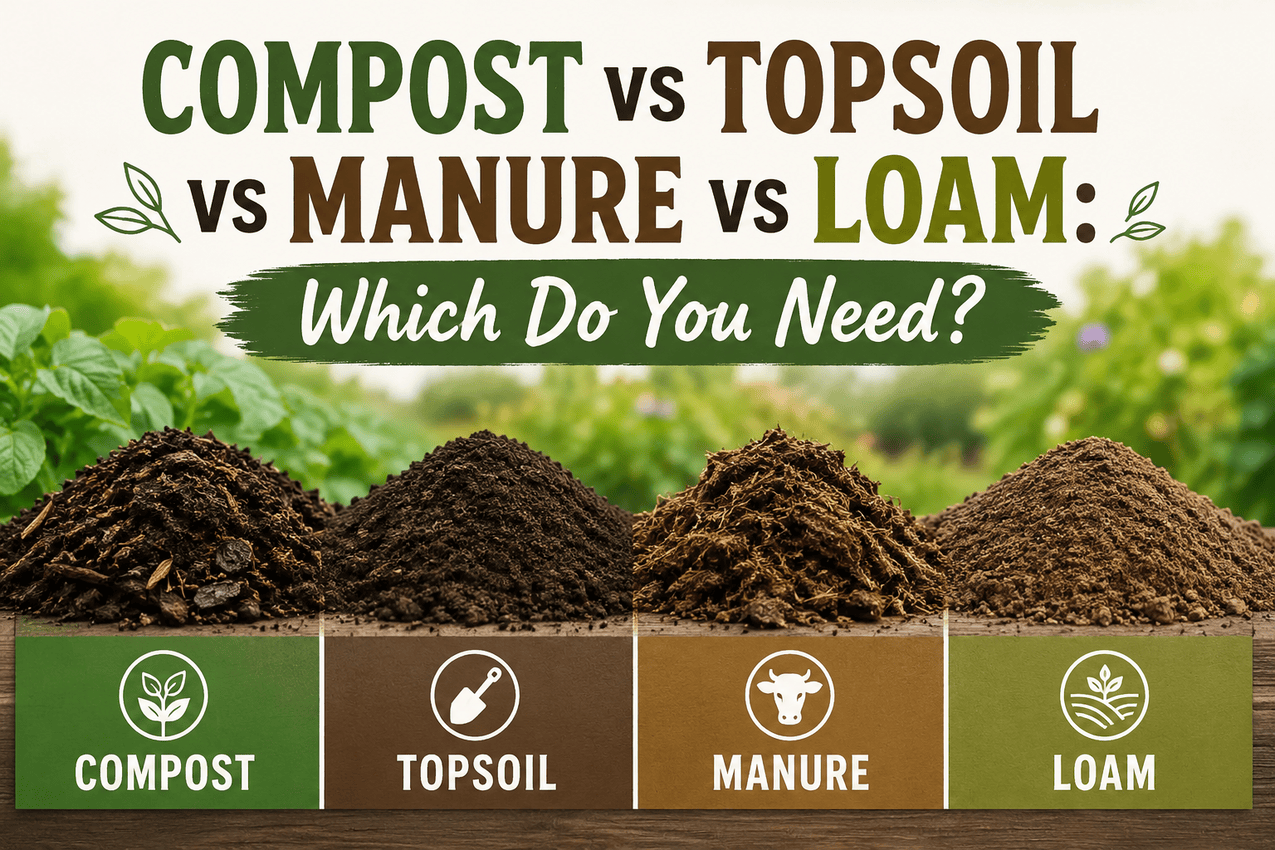
Compost vs Topsoil vs Manure vs Loam: What Does Your Garden Actually Need?
If you are starting a garden, filling raised beds, improving an allotment or preparing ground for a new lawn, choosing between compost, topsoil, manure and loam soil can be confusing.
The simplest answer is:
Organic compost is best for improving existing soil and adding organic matter.
Topsoil is best when you need additional soil volume for lawns, beds and landscaping.
Well-rotted manure is a nutrient-rich soil improver particularly useful for hungry plants and vegetable beds.
Loam soil provides a balanced growing medium with good drainage and moisture retention.
Woodchip is mainly used as a surface mulch rather than a growing soil.
Potash (potassium) is used when plants need additional potassium, particularly during flowering and fruit development.
For many garden projects, the best result comes from using more than one of these materials.
Kelvin Compost supplies compost, topsoil, manure, loam soil, organic woodchip and soil-improving products for gardens, allotments and landscaping projects across Glasgow, South Lanarkshire and surrounding areas of Scotland.
What Is the Difference Between Compost and Topsoil?
Topsoil provides structure and volume. Compost improves the soil.
That is the most important distinction to understand.
Topsoil is the upper layer of soil in which plants establish their roots. It contains mineral particles such as sand, silt and clay alongside varying amounts of organic matter.
Compost is decomposed organic material used primarily to improve soil condition.
Adding good organic compost to existing soil can improve its structure, organic matter content and ability to retain moisture while supporting healthy biological activity.
If you are creating a completely new raised bed, however, filling the entire bed with compost usually isn't necessary. A combination of topsoil and compost generally provides a more practical growing medium.
Quick Guide: Which Garden Product Do I Need?
| Your project | Recommended material |
|---|---|
| Improving tired garden soil | Organic compost |
| Creating new flower beds | Topsoil + compost |
| Filling raised beds | Topsoil + compost |
| Preparing vegetable beds | Compost and/or well-rotted manure |
| Establishing a new lawn | Quality topsoil |
| Improving existing borders | Organic compost |
| Planting shrubs and perennials | Loam soil or topsoil enriched with compost |
| Mulching around trees and shrubs | Organic woodchip |
| Improving moisture retention | Compost or woodchip mulch |
| Feeding fruiting/flowering plants | Potash-potassium where appropriate |
| Levelling garden ground | Topsoil |
| Large landscaping project | Bulk topsoil/soil blends |
The exact combination will depend on your existing soil, what you intend to grow and how much new material the project requires.
What Is Organic Compost Best Used For?
Organic compost is primarily a soil improver.
It is particularly useful when existing soil has become compacted, low in organic matter or difficult to work.
Adding compost can help create a better environment for roots and soil organisms while improving soil structure and moisture management.
Kelvin Compost supplies peat-free, chemical-free BSI PAS 100 certified organic compost produced from matured organic materials.
Organic compost is useful for:
Raised beds
Vegetable gardens
Allotments
Flower borders
Soil improvement
Mulching
Planting areas
Improving tired garden soil
For an established bed, compost can normally be incorporated into the upper soil or applied as a surface mulch and allowed to gradually work into the soil.
Is Compost Good for Raised Beds?
Yes. Organic compost is particularly useful in raised beds, but it is normally better used with soil rather than as the only material filling a deep raised bed.
For example, a new raised vegetable bed may use quality topsoil for structure and compost to increase organic matter.
This creates a growing medium that provides both physical structure and organic material.
When Should You Use Topsoil?
Choose topsoil when your project needs soil depth, structure or additional volume.
If you are laying a lawn, levelling an area, creating a new border or filling a large raised bed, topsoil is generally more appropriate as the main bulk material.
Topsoil is commonly used for:
New lawns
Garden levelling
Raised beds
New borders
Landscaping
Replacing poor existing soil
Increasing soil depth
General planting areas
Topsoil and compost are therefore not competing products.
They perform different jobs.
Topsoil creates the growing base; compost improves it.
Should I Mix Compost With Topsoil?
For many planting projects, yes.
Combining topsoil with organic compost provides the mineral structure of soil together with additional organic matter.
This can be particularly useful for:
Raised vegetable beds
New flower borders
Allotments
Planting areas
Gardens with poor or depleted soil
The appropriate ratio depends on the condition of your existing ground and what you intend to grow, so there isn't one perfect mixture for every garden.
What Is Well-Rotted Manure Used For?
Well-rotted manure is another organic soil improver, but it is particularly valuable where gardeners want to increase organic matter and support nutrient-demanding plants.
The important words are well rotted.
Fresh manure can be too strong for many plants and may damage roots. Properly matured manure has broken down into a darker, more soil-like material that is much easier to incorporate into beds.
Well-rotted manure is commonly used for:
Vegetable plots
Allotments
Established beds
Preparing soil before planting
Improving depleted soils
Nutrient-demanding crops
Vegetable growers often use manure when preparing beds for crops that benefit from fertile, organic-rich soil.
Compost vs Manure: Which Is Better?
Neither is universally better.
They serve slightly different purposes.
Choose organic compost when you want a versatile general-purpose soil improver suitable for a wide range of garden applications.
Choose well-rotted manure when improving beds where additional organic matter and fertility are particularly desirable.
Many experienced gardeners use both products at different points in their growing cycle.
If you're unsure what your Glasgow garden or allotment needs, Kelvin Compost can help you choose the appropriate material for the job.
What Is Loam Soil?
Loam describes soil with a useful balance of sand, silt and clay.
Gardeners value good loam because it combines several desirable characteristics: it can retain moisture and nutrients while still allowing excess water to drain.
That makes loam suitable for a wide range of planting situations.
Loam soil can be useful for:
Flower beds
Shrubs
Trees
Vegetable growing
General planting
Landscaping
Raised beds
Improving poor garden ground
If your project requires an actual growing medium rather than simply an organic soil improver, loam soil can be an excellent option.
Loam Soil vs Topsoil: What's the Difference?
Topsoil describes where soil comes from; loam describes its texture and composition.
Good-quality topsoil may itself have a loamy texture.
When gardeners ask for loam soil, they are generally looking for a balanced soil that doesn't behave like extremely heavy clay or very sandy ground.
For planting beds where soil quality is especially important, loam can therefore be worth considering.
What Are Organic Woodchips Used For?
Woodchips serve a completely different purpose from compost and topsoil.
Rather than filling beds with woodchip, it is normally applied on top of the soil as mulch.
A layer of organic woodchip can help:
Suppress weeds
Reduce moisture evaporation
Protect the soil surface
Cover pathways
Mulch around established trees
Mulch around shrubs
Give beds a natural finished appearance
Over time, organic woodchip gradually breaks down and contributes organic material to the soil surface.
Should I Put Compost Under Woodchips?
This can be a very effective combination.
Apply compost to improve the soil and then place woodchip over the surface as mulch.
The compost improves the soil underneath while the woodchip protects the surface and helps reduce moisture loss and weed growth.
What Is Potash-Potassium Used For in the Garden?
Potassium is one of the major nutrients required by plants.
It plays an important role in several plant processes and is particularly associated with healthy flowering and fruit development.
Potash-based products are therefore often considered for fruiting and flowering plants where additional potassium is required.
However, adding more fertiliser isn't automatically better.
The existing condition of your soil and the plants you are growing should determine whether additional nutrients are necessary.
What Should I Use for Raised Beds?
For most new raised beds, gardeners need both structure and organic matter.
That usually means combining quality topsoil with organic compost.
Topsoil provides the bulk of the growing medium, while compost increases its organic matter.
For vegetable-growing beds, well-rotted manure may also be incorporated where appropriate.
A simple raised-bed approach
For a new raised bed:
Base: quality soil/topsoil
Growing layer: topsoil enriched with organic compost
Optional soil improvement: well-rotted manure where suitable
Surface: compost or organic mulch
The exact quantities should be adjusted according to the depth of the bed, existing soil underneath and crops being grown.
What Should I Use Before Laying a New Lawn?
For a new lawn, quality topsoil is generally more important than filling the area with compost.
Grass needs an adequate depth of structured soil in which to establish its roots.
Topsoil can be used to:
Increase soil depth
Correct uneven areas
Prepare ground before turf
Create a suitable rooting layer
Organic compost may be incorporated where the existing soil needs improvement, but it shouldn't normally replace the structural soil layer.
What Should I Use for a Vegetable Garden?
Vegetables generally perform best in healthy soil containing plenty of organic matter.
For an existing vegetable bed, adding organic compost is a straightforward way to improve the soil.
Well-rotted manure can also be particularly useful for suitable nutrient-demanding crops.
For completely new vegetable beds, consider a combination of:
Topsoil + organic compost + well-rotted organic material where appropriate.
This provides soil structure while increasing organic matter and fertility.
How Much Compost or Topsoil Do I Need?
You can estimate the volume required using:
Area (m²) × Depth (m) = Volume (m³)
For example, a bed measuring:
5 metres × 2 metres = 10 m²
If you want to add material to a depth of 10 cm:
10 m² × 0.10 m = 1 m³
One cubic metre equals approximately 1,000 litres.
Kelvin Compost's standard bulk bags are approximately 850 litres, making them suitable for larger garden, landscaping and allotment projects where buying dozens of small bags would be impractical.
Bulk Bags or Small Garden-Centre Bags?
Small bags can make sense for containers or very small garden jobs.
Once you're filling raised beds, improving an allotment or landscaping a larger garden, bulk bags become much more practical.
Bulk delivery means fewer individual bags to handle and makes it easier to order enough material for the complete project.
For substantially larger requirements, Kelvin Compost can also arrange larger tonne-load deliveries.
Where Can I Buy Compost, Topsoil and Manure in Glasgow?
Kelvin Compost supplies organic compost, topsoil, well-rotted manure, loam soil, organic woodchip and soil-improvement products to gardeners, allotments, landscapers, schools, farms and community projects.
Delivery is available across Glasgow, East Kilbride, South Lanarkshire and surrounding areas, with larger deliveries available by arrangement.
Our organic compost is peat-free, chemical-free and produced to BSI PAS 100 standards.
Which Product Should I Order?
Choose based on what you're trying to achieve:
Improving existing soil?
Choose Organic Compost.
Building beds or adding soil depth?
Choose Topsoil.
Preparing productive vegetable beds?
Consider Well-Rotted Manure.
Looking for a balanced planting soil?
Choose Loam Soil.
Need mulch for paths, trees or borders?
Choose Organic Woodchips.
Need additional potassium for appropriate flowering or fruiting plants?
Consider Potash-Potassium.
For projects requiring both new soil and soil improvement, combining topsoil with organic compost is often the most practical solution.
Frequently Asked Questions
Is compost the same as topsoil?
No. Topsoil provides the physical soil structure and volume plants grow in, while compost is primarily an organic soil improver. Many gardening projects benefit from using both.
Can I fill a raised bed entirely with compost?
Compost can be an important component of a raised-bed mix, but deep beds generally benefit from having quality soil or topsoil for structure rather than being filled entirely with compost.
Is manure better than compost for vegetables?
Well-rotted manure can be particularly useful for nutrient-demanding vegetable beds, while compost is a versatile general soil improver. Which is preferable depends on the crop and existing soil.
What is the best soil for raised beds?
A combination of quality topsoil and organic compost provides both soil structure and organic matter and is suitable for many raised-bed projects.
Can I use topsoil for a new lawn?
Yes. Quality topsoil is commonly used when preparing ground for turf or grass seed because it provides the rooting depth and structure required for lawn establishment.
Is loam soil good for vegetables?
Good loam is well suited to many vegetables because its balanced texture can provide both moisture retention and drainage.
What does PAS 100 compost mean?
PAS 100 is a recognised UK specification for composted materials. Kelvin Compost supplies BSI PAS 100 certified organic compost.
Where can I buy bulk compost near Glasgow?
Kelvin Compost supplies bulk organic compost from South Lanarkshire with delivery across Glasgow, East Kilbride and surrounding areas. Bulk bags and larger loads are available depending on the project.
Do you deliver topsoil and manure as well as compost?
Yes. Kelvin Compost supplies topsoil, well-rotted manure, organic compost, loam soil, organic woodchips and other garden soil products, with delivery options for projects across Glasgow and surrounding areas.
Get the Right Soil Product for Your Garden
Good gardens start below the surface.
Whether you're creating raised beds, improving an allotment, laying a lawn or preparing a larger landscaping project, choosing the right soil product can save both time and money.
Kelvin Compost supplies:
Organic Compost
Topsoil
Well-Rotted Manure
Loam Soil
Organic Woodchips
Potash-Potassium
Need help deciding what to order?
Call Kelvin Compost: +44 7561 251350
Email: info@kelvincompost.co.uk
Order online for compost and soil delivery across Glasgow, South Lanarkshire and surrounding areas of Scotland.
Need Garden Supplies Delivered in Glasgow?
Organic compost, topsoil, manure and more across Scotland