



Compost for Vegetable Gardens: How to Use Compost for Healthier Crops
Looking for compost, topsoil or garden supplies?
Browse our full product range or get in touch for delivery across Glasgow and Scotland.
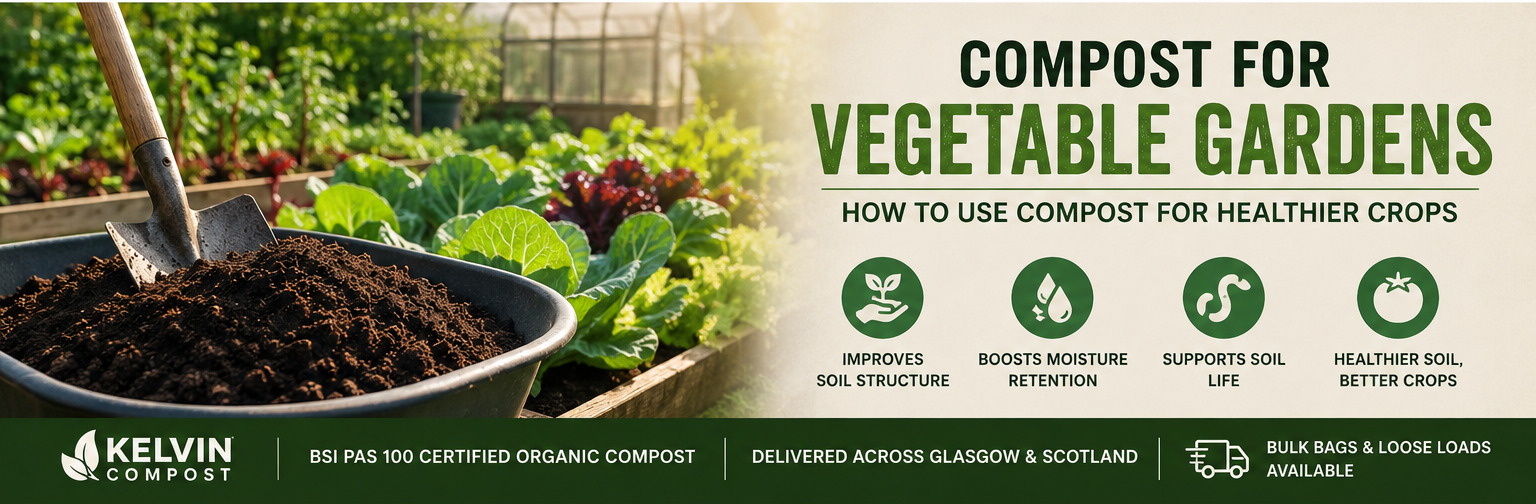
Good vegetable gardening starts with healthy soil.
Whether you are growing vegetables in a traditional garden bed, allotment, raised bed or larger growing area, adding suitable compost can help improve soil structure and increase organic matter.
But how much compost should you use? When should you add it? Should you dig it in or use it as mulch? And is peat-free compost suitable for growing vegetables?
This guide explains how to use compost in a vegetable garden, with practical advice for gardeners in Glasgow and across Scotland.
Quick Answer: Is Compost Good for Vegetable Gardens?
Yes. Quality, mature compost can be an excellent soil improver for vegetable gardens and allotments.
Compost adds organic matter to soil and can help improve structure, moisture management and biological activity.
It can be incorporated into beds before planting, used around established plants where appropriate, or applied as a surface mulch.
For the best results, use mature compost and combine it with good overall soil management.
What Does Compost Do for Vegetable Garden Soil?
Compost does more than simply add nutrients.
Its biggest long-term value is often its contribution of organic matter.
Adding suitable compost can help:
- Improve soil structure
- Increase organic matter
- Support soil organisms
- Improve moisture management
- Make soil easier to cultivate
- Improve the growing environment around plant roots
This is particularly useful when soil has become depleted, compacted or low in organic matter.
However, compost should be regarded as a soil improver rather than a universal replacement for fertiliser.
Different vegetables have different nutritional requirements.
What Is the Best Compost for a Vegetable Garden?
For general soil improvement, choose a mature, quality organic compost suitable for garden use.
Peat-free compost can be an excellent option for gardeners who want to avoid peat.
When buying bulk compost for vegetables, look for:
- Clear product information
- Mature compost
- Consistent texture
- Suitable organic material
- Recognised quality standards
- A product appropriate for soil improvement
For larger vegetable gardens and allotments, certified compost can provide additional confidence in the material being purchased.
Kelvin Compost supplies BSI PAS 100 certified organic compost for gardens and allotments across Glasgow and surrounding areas.
How Much Compost Should I Add to a Vegetable Garden?
There is no single amount that is right for every garden.
A common starting point for general soil improvement is a layer of approximately 5–10 cm of compost across the growing area.
The exact amount depends on:
- Existing soil condition
- Soil type
- What you are growing
- Whether the bed is new or established
- Whether compost has been added previously
- Whether you are using compost as a mulch or soil improver
For a large area, calculate the volume before ordering.
Example
If a vegetable bed is:
5 metres long × 3 metres wide
and you want to add:
0.05 metres (5 cm) of compost
the approximate volume is:
5 × 3 × 0.05 = 0.75 cubic metres
This gives you a useful starting point when deciding whether you need bulk bags or a larger loose load.
Should You Dig Compost Into Vegetable Beds?
For a new bed or when substantially improving existing soil, compost can be incorporated into the upper soil layer.
However, there is no need to aggressively dig the soil every time compost is applied.
In established beds, compost can often be spread over the surface and allowed to work into the soil gradually through natural processes and cultivation.
This approach can help reduce unnecessary disturbance of soil structure.
Avoid working heavy clay soil when it is very wet because this can increase compaction.
When Is the Best Time to Add Compost to a Vegetable Garden?
Compost can be used at different times of year.
Autumn
Autumn is an excellent time to add mature compost to many vegetable beds.
After crops have been harvested, compost can be spread across the soil surface.
This gives organic matter time to integrate into the soil before the following growing season.
Spring
Spring is another useful time to prepare beds.
Add compost before planting when soil conditions are suitable.
Avoid working waterlogged soil.
During the growing season
Compost can also be used as a mulch around suitable established plants.
Apply it carefully around plants without burying stems.
Can You Put Compost on Top of Soil?
Yes.
Compost can be applied as a surface layer or mulch.
This is particularly useful in established beds where you want to add organic matter without extensively disturbing the soil.
A compost mulch can help:
- Add organic matter
- Protect the soil surface
- Support soil organisms
- Reduce exposed bare soil
- Improve moisture management
Not every crop needs the same treatment, so use compost according to the requirements of the plants.
Compost for Raised Vegetable Beds
Raised beds are increasingly popular for vegetable growing because they can provide better control over soil depth and growing conditions.
Compost is particularly useful when preparing raised beds.
However, do not assume that a raised bed should be filled entirely with compost.
For many projects, a mixture of suitable topsoil and compost is more practical.
Topsoil provides the bulk soil volume.
Compost adds organic matter.
This combination can create a productive growing environment while keeping the cost of filling a large bed under control.
Compost for Allotments
Compost is an important soil-improvement material for allotment gardeners.
Large allotments can require substantial quantities, making bulk delivery more practical than purchasing dozens of small retail bags.
Compost can be used to:
- Prepare vegetable beds
- Improve soil structure
- Add organic matter
- Mulch suitable crops
- Prepare new growing areas
- Maintain soil condition between seasons
For gardeners managing multiple beds, calculating the required volume before ordering can save both time and money.
Compost for Specific Vegetables
Different vegetables have different growing requirements.
Potatoes
Potatoes need loose, well-prepared soil that allows tubers to develop.
Compost can be incorporated into the bed as part of overall soil preparation.
Carrots
Carrots prefer soil that is reasonably deep, workable and free from large stones or obstructions.
Avoid creating excessively rich or freshly manured soil immediately before growing carrots, as this can encourage branching and poor root shape.
Brassicas
Cabbage, broccoli, cauliflower and other brassicas are relatively hungry crops.
Good soil preparation and adequate fertility are important for strong growth.
Courgettes
Courgettes and similar productive crops can benefit from fertile soil with good moisture availability.
Compost can form part of the soil preparation.
Onions
Onions prefer well-prepared soil with suitable drainage and fertility.
Avoid excessive nitrogen applications if you want good bulb development and storage.
Leafy vegetables
Lettuce, spinach and other leafy crops can benefit from well-prepared soil with adequate organic matter.
The important point is that compost should support the overall soil-management system rather than being treated as the only input.
Can You Use Peat-Free Compost for Vegetables?
Yes.
Suitable peat-free compost can be used in vegetable gardens and allotments.
For gardeners looking to reduce their environmental impact, choosing peat-free compost avoids the use of extracted peat.
However, always check that the particular compost is suitable for the intended use.
A specialist seed compost is different from bulk compost used for soil improvement.
Compost vs Manure for Vegetable Gardens
Both compost and well-rotted manure can be useful in vegetable gardens.
Compost is generally produced through the decomposition of plant and organic materials.
Manure originates from livestock waste and should be appropriately composted or well rotted before being applied to garden soil.
The right choice depends on the crop, timing and condition of the soil.
For some vegetable beds, compost provides a convenient general-purpose soil improver.
For others, well-rotted manure can be useful as part of a wider soil-fertility strategy.
Never use fresh manure directly around growing crops without understanding the risks and appropriate application timing.
How Does Compost Help Clay Soil in Vegetable Gardens?
Heavy clay soil can be difficult to cultivate.
When wet, it can become sticky and easily compacted. When dry, it can become hard and difficult to work.
Regular applications of suitable organic matter can help improve soil structure over time.
Compost can contribute to this process by increasing organic matter and supporting soil biology.
However, if your vegetable garden is severely waterlogged, investigate the underlying drainage problem rather than relying on compost alone.
Can You Use Compost Every Year?
Yes, many vegetable gardeners regularly add compost to their beds.
The amount and frequency should depend on the condition of the soil and what is being grown.
Regular, moderate additions can help maintain organic matter.
You do not necessarily need to add a huge quantity every year.
Think of compost as part of a long-term soil-management programme.
How to Use Compost Without Wasting It
One of the biggest mistakes gardeners make is applying compost without calculating how much they actually need.
Before ordering, measure:
Length × width × application depth
For example, if your bed is 10 metres by 2 metres and you want a 5 cm layer:
10 × 2 × 0.05 = 1 cubic metre
This makes it much easier to compare bulk bags with loose-load deliveries.
Bulk Compost for Vegetable Gardens in Glasgow
If you are managing a large vegetable garden, allotment or community growing project, buying compost in bulk can be more convenient than purchasing individual bags.
Kelvin Compost supplies organic compost in bulk quantities from its South Lanarkshire base.
Delivery can be arranged for gardens, allotments, schools, farms and landscaping projects across Glasgow and surrounding areas.
For larger requirements, loose-load delivery can also be considered where access and order size make it suitable.
Before ordering, check:
- How much compost you need
- Where the delivery can be placed
- Whether the delivery vehicle can access the property
- Whether a bulk bag or loose load is more appropriate
- The total delivered cost
How to Store Compost
If you order more compost than you immediately need, storage conditions matter.
Keep unused compost protected from excessive contamination and avoid storing it where water can pool around the material.
If you have a bulk bag, place it somewhere accessible but away from areas where it could obstruct paths, drainage or vehicle access.
Try to use compost within a reasonable period rather than leaving it stored indefinitely.
Common Compost Mistakes in Vegetable Gardens
Using immature compost
Fresh or insufficiently composted organic material is not the same as mature compost.
Applying too much
More compost is not always better.
Excessive applications can alter the physical and nutritional characteristics of soil.
Working wet soil
Avoid digging heavily saturated soil, especially clay.
Filling raised beds entirely with compost
Using suitable topsoil alongside compost can often be more practical.
Using garden compost for seedlings
Young seedlings may need specialist seed compost.
Ignoring crop rotation
Good soil management includes crop rotation and broader growing practices, not just compost application.
Frequently Asked Questions
What is the best compost for vegetable gardens?
A mature, quality organic compost suitable for soil improvement is a good choice for many vegetable gardens. Peat-free compost is an option for gardeners who want to avoid peat.
How much compost should I put on my vegetable garden?
A general starting point is around 5–10 cm for soil improvement, but the ideal quantity depends on the soil, crop and application.
Can I put compost directly on soil?
Yes. Suitable mature compost can be spread across the soil surface as a soil improver or mulch.
Should I dig compost into my vegetable garden?
It can be incorporated into soil when preparing or substantially improving a bed, but established beds do not necessarily need deep digging every time compost is applied.
Can I use peat-free compost for vegetables?
Yes, provided the product is suitable for the intended gardening application.
Is compost better than manure for vegetables?
Neither is universally better. Both can have useful roles. Compost is a convenient organic soil improver, while well-rotted manure can also contribute organic matter and nutrients.
Can compost fix clay soil?
Compost can help improve the organic matter and structure of clay soil over time, but severe drainage or waterlogging may require additional solutions.
Where can I buy bulk compost for an allotment in Glasgow?
Kelvin Compost supplies bulk organic compost for allotments, gardens, schools, farms and landscaping projects across Glasgow and surrounding areas.
Final Thoughts
Healthy vegetable gardens start with healthy soil.
Adding suitable mature compost can improve soil structure, increase organic matter and create better conditions for productive vegetable growing.
The best approach is to use compost as part of a wider soil-management programme.
Choose quality material, apply an appropriate amount, avoid cultivating wet soil and select the right compost for the specific job.
For larger vegetable gardens and allotments, bulk compost delivery can also save time and make soil improvement much easier.
Kelvin Compost supplies BSI PAS 100 certified organic compost, topsoil, manure and woodchip from its South Lanarkshire base, with delivery available across Glasgow and surrounding areas.
Need Garden Supplies Delivered in Glasgow?
Organic compost, topsoil, manure and more across Scotland