


Can You Use Compost Instead of Potting Soil?
Looking for compost, topsoil or garden supplies?
Browse our full product range or get in touch for delivery across Glasgow and Scotland.
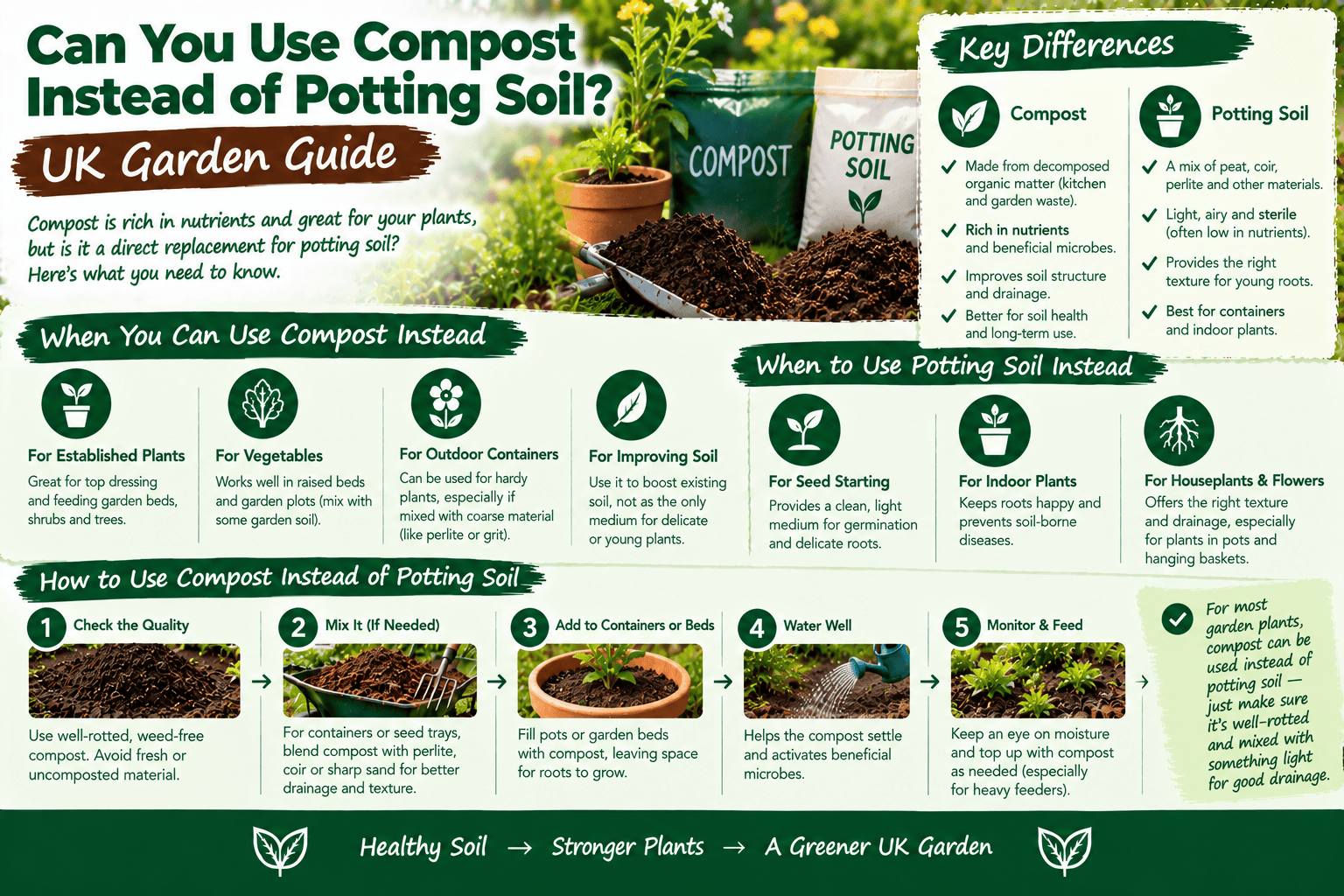
Can You Use Compost Instead of Potting Soil? A UK Guide to Growing in Pots
You've bought a bag of organic compost for your garden. After improving the flower beds, there's some left over, and you have a few empty pots waiting to be planted.
It seems sensible to use what you already have.
After all, compost is good for plants, isn't it?
Yes, but there's an important difference between improving soil in a garden bed and growing a plant in a container.
You shouldn't automatically use ordinary garden compost or bulk soil-improving compost as a complete replacement for potting soil. Some composts are suitable for container growing, while others are intended to be mixed into existing garden soil.
The difference matters because plants in pots depend entirely on a limited volume of growing material for water, air, nutrients and root support.
Here's how to choose the right compost for your pots, containers and planters without wasting money or damaging your plants.
Can You Grow Plants in Compost Only?
It depends on the type of compost.
In the UK, the word compost is used for several different products.
A bag labelled multi-purpose potting compost is generally formulated for growing plants in containers.
A product labelled organic soil improver may be designed primarily for adding organic matter to garden soil.
Those products aren't necessarily interchangeable.
For many container plants, a suitable purpose-made potting compost is the safest starting point.
Using bulk soil-improving compost on its own can create problems with drainage, aeration, nutrient balance or settlement, depending on the material.
What's the Difference Between Compost and Potting Soil?
The terminology can be confusing, particularly when reading gardening advice from different countries.
In the UK, gardeners commonly use the phrase potting compost.
In the United States, similar products are often described as potting soil or potting mix, even when they contain little or no mineral soil.
| Material | Main purpose | Suitable for pots? |
|---|---|---|
| Multi-purpose potting compost | Growing plants in containers | Usually, according to label |
| Seed compost | Seed germination and young seedlings | Yes, for intended use |
| John Innes compost | Soil-based growing medium | Yes, according to formulation |
| Bulk organic soil improver | Improving garden soil | Not automatically on its own |
| Garden topsoil | Adding mineral soil and depth | Usually not ideal alone |
| Homemade garden compost | Adding organic matter | Depends on maturity and formulation |
The name on the bag is only the starting point.
Always check the intended use.
Why Do Pots Need a Different Growing Medium?
Imagine planting a tomato directly into a garden bed.
Its roots can explore a relatively large volume of soil, finding moisture, oxygen and nutrients as they grow.
Now imagine planting the same tomato in a container.
Its roots are restricted to the space inside the pot.
If that material stays saturated for too long, the roots may struggle to obtain oxygen.
If it dries too quickly, the plant can wilt.
If the medium settles excessively, the plant may lose support.
A good container-growing medium needs a suitable balance of:
Water retention.
Drainage.
Air-filled pore space.
Physical stability.
Nutrient availability.
Appropriate pH.
That's why a material that works well in a garden border may not perform the same way inside a pot.
What Happens If You Fill Pots With Pure Organic Compost?
The result depends on the compost.
Some mature composts may perform acceptably as ingredients in container mixes, but a bulk soil improver isn't necessarily formulated for standalone use.
Possible problems include:
Poor aeration
Fine or dense material may retain too much water and leave insufficient air around roots.
Excess nutrients
Some composts contain nutrient levels that are unsuitable for sensitive seedlings or particular plants.
Settlement
Organic material can continue to break down and settle, reducing the level in the container.
Variable water retention
Some mixes dry quickly, while others remain wet for too long.
Unsuitable pH
Plants such as blueberries need specific acidic growing conditions that general-purpose compost may not provide.
These aren't guaranteed problems with every organic compost.
They're reasons to choose a product that has been formulated and tested for the intended growing application.
Is Organic Compost Good for Potted Plants?
Yes, when used appropriately.
Mature organic compost can contribute organic matter and nutrients to suitable growing media.
But that doesn't mean every bulk compost should be used straight from the bag.
If you're making your own container mix, choose ingredients with known characteristics and follow a tested recipe suitable for the plants you're growing.
For most home gardeners, buying an appropriate peat-free potting compost is simpler and more predictable.
Can You Use Garden Soil in Pots?
Garden soil can be used in certain soil-based container mixes, but ordinary garden soil on its own often performs poorly in pots.
It may become compacted, drain inconsistently or contain weed seeds and soil-borne organisms.
Some established growing-media formulations include sterilised or suitably processed loam alongside other ingredients.
That's different from filling a flowerpot with soil dug directly from the garden.
Is Peat-Free Compost Good for Pots?
Yes. Many peat-free potting composts are specifically formulated for container growing.
They may contain ingredients such as:
Composted bark.
Wood fibre.
Coir.
Green compost.
Mineral components.
Suitable fertiliser additions.
The exact formulation varies.
Some peat-free mixes need different watering and feeding practices from older peat-based products.
Read the manufacturer's guidance and monitor moisture rather than watering automatically every day.
What's the Best Compost for Outdoor Pots?
There isn't one universal answer.
The right product depends on the plants.
Bedding plants
Choose a suitable multi-purpose or container compost.
Tomatoes
Use a growing medium intended for productive container crops and provide appropriate feeding as the plants develop.
Herbs
Choose according to the herb. Rosemary and thyme generally need different moisture conditions from mint.
Blueberries
Use an appropriate ericaceous growing medium.
Succulents
Choose a free-draining mix suitable for the species.
Young seedlings
Use an appropriate seed or young-plant compost.
A single bag of bulk soil improver isn't necessarily suitable for all these situations.
Can You Mix Organic Compost With Potting Compost?
Sometimes.
A mature, suitable organic compost may be used as a component of a growing-medium formulation.
However, the correct proportion depends on the compost's characteristics and the plants.
Avoid assuming that a fixed homemade ratio will work for every compost.
Some materials contain relatively high soluble salts or nutrients, while others are too fine or dense for unrestricted container use.
If the supplier doesn't recommend the product for pots, don't assume that adding a little perlite or grit will automatically make it suitable.
Can You Use Organic Compost in Large Outdoor Planters?
Large planters still require an appropriate growing medium.
Their greater size doesn't remove the need for drainage, aeration and nutrient management.
For substantial permanent planters, a specified soil-based growing medium may be appropriate.
For seasonal containers, a suitable container compost is often more convenient.
Before filling a large planter, check:
Drainage holes.
Plant requirements.
Total filled weight.
Access for watering.
Whether the planter sits on paving or a balcony.
The growing medium's intended use.
Wet soil-based media can be heavy, so weight is particularly important on balconies and raised structures.
What About Raised Beds?
Raised beds are different from ordinary plant pots.
A raised bed open to the ground can allow roots to explore the soil underneath.
In that situation, suitable topsoil can provide mineral soil volume, while mature compost may be used to improve organic matter.
A deep, enclosed planter sitting on concrete behaves more like a large container.
Its growing medium needs to be chosen accordingly.
Don't treat every raised bed as though it has the same requirements.
Why Is Drainage So Important in Containers?
Plants need water, but roots also need oxygen.
A container without effective drainage can remain saturated after watering or rainfall.
Even a suitable growing medium may perform badly if excess water cannot escape.
Before planting, make sure the pot has appropriate drainage holes.
Avoid relying on a layer of stones at the bottom as a substitute for a properly draining medium.
The aim is to provide suitable pore space throughout the growing material, not simply a layer of gravel underneath it.
Can Compost Cause Root Rot?
Poorly aerated, persistently wet conditions can contribute to root problems and create favourable conditions for certain root diseases.
But compost itself doesn't automatically cause root rot.
The risk depends on the growing medium, drainage, watering, plant species and environmental conditions.
If plants repeatedly struggle in containers, inspect the roots and growing conditions before assuming they need more fertiliser.
How Do You Know If Your Potting Mix Is Too Wet?
Possible warning signs include:
Water remaining on the surface.
Persistently heavy pots.
Wilting despite wet compost.
Yellowing leaves.
Unpleasant odours.
Poor root development.
These symptoms can have several causes, so investigate the overall conditions.
For many plants, allowing the upper growing medium to dry appropriately between waterings is useful.
However, watering requirements vary considerably by species.
Can You Use Homemade Compost in Pots?
You can use suitable mature homemade compost as an ingredient in some growing mixes, but there are limitations.
Home compost can vary in:
Particle size.
Nutrient content.
Maturity.
Weed-seed content.
Water retention.
It may also contain coarse pieces that are inconvenient for small pots.
For seed sowing and sensitive young plants, a purpose-made seed compost is generally a more reliable choice.
For larger containers, homemade compost may be useful in a suitable tested mix.
Is Organic Compost Good for Houseplants?
Not every organic compost is suitable for houseplants.
Indoor plants often have particular requirements for aeration, moisture and drainage.
For example, an orchid may need a specialist bark-based medium, while a succulent may require a much freer-draining mix than a moisture-loving tropical plant.
Choose a product designed for the plant rather than assuming ordinary garden compost will work.
Can You Use Bulk Compost for Container Gardening?
Bulk compost can be cost-effective when you're improving substantial areas of garden soil.
However, buying a large quantity doesn't automatically make it suitable for container growing.
Before ordering, ask the supplier:
Is this compost intended for soil improvement or potting?
Can it be used on its own in containers?
Is there a recommended blending method?
What are its nutrient and pH characteristics?
Is there relevant product testing or certification?
What plants is it suitable for?
For a large landscaping project, selecting the right material before delivery can prevent considerable waste.
When Should You Choose Organic Soil-Improving Compost?
Bulk organic compost is particularly useful when your project involves improving existing garden soil.
Examples include:
Preparing flower borders.
Improving vegetable beds.
Maintaining allotment soil.
Adding organic matter to suitable clay or sandy soils.
Mulching established planting areas.
Preparing larger landscaping areas.
These are different applications from filling dozens of small plant pots.
If your project needs soil improvement across a substantial area, bulk compost may be the appropriate product.
If your project involves growing plants in containers, choose a suitable potting medium.
Buying Organic Compost in Glasgow
Gardeners across Glasgow, East Kilbride and South Lanarkshire often need different materials for different parts of the same project.
You might be preparing a vegetable bed, filling a few patio containers and creating a new flower border.
Those jobs don't necessarily require the same product.
At Kelvin Compost, we supply organic compost for garden soil improvement and landscaping projects.
If you're ordering material for a specific use, check the product specification before purchasing.
For pots and seed trays, use a suitable growing medium formulated for container growing unless the product information confirms another use.
Common Mistakes When Choosing Compost for Pots
Assuming all compost is the same
Soil improvers, seed composts and potting mixes are different products.
Filling pots with garden topsoil alone
Ordinary garden soil may become dense and poorly aerated in containers.
Ignoring drainage holes
Even a good growing medium can perform poorly without adequate drainage.
Adding too much nutrient-rich compost
More nutrients aren't always beneficial.
Using the same mix for every plant
Blueberries, herbs, tomatoes and succulents have different requirements.
Overwatering peat-free compost
Water according to the plant and the medium's actual moisture condition.
Buying bulk compost without checking its intended use
A bulk soil improver isn't automatically a potting mix.
Frequently Asked Questions
Can you use compost instead of potting soil?
Only if the compost is suitable for container growing. Ordinary bulk soil-improving compost shouldn't automatically replace formulated potting compost.
Can you grow plants in 100% compost?
Some formulated growing media are suitable for standalone use, but pure soil-improving compost may have unsuitable physical or nutritional characteristics.
Is compost the same as potting soil?
No. The word compost can describe both soil improvers and formulated growing media, depending on the product.
Can I use organic compost in flowerpots?
Use it only where the product is suitable for container growing or as part of an appropriate growing-medium formulation.
Is peat-free compost suitable for pots?
Yes, when it's specifically formulated for container use.
Can I mix garden compost with potting compost?
Sometimes, but the proportion and suitability depend on the materials and plants.
Can you use topsoil in plant pots?
Topsoil can be a component of some soil-based growing media, but ordinary garden topsoil alone is often unsuitable.
Can you use compost in raised beds?
Yes. Mature compost can improve suitable raised-bed soil, but it shouldn't automatically be the entire growing medium.
What's the best compost for tomatoes in pots?
Choose a suitable container-growing medium and follow an appropriate feeding and watering programme.
Can you use compost for seedlings?
Choose a suitable seed compost. Bulk soil-improving compost may be too coarse or nutritionally unsuitable for sensitive seedlings.
Why are my plants dying in compost?
Possible causes include overwatering, poor aeration, unsuitable nutrients, incorrect pH, pests or disease. Check the whole growing environment.
Is organic compost better than multi-purpose compost?
Neither is universally better. Organic soil improvers and multi-purpose potting composts serve different purposes.
Final Thoughts: Choose Compost for the Job, Not Just the Name
It's easy to assume that any product called compost will work anywhere in the garden.
But growing plants in pots is different from improving soil in a border.
A good potting medium must provide the right balance of moisture, drainage, air and nutrients within a confined space.
Bulk organic compost is valuable for improving suitable garden soil, but it isn't automatically a replacement for purpose-made potting compost.
For containers, choose a container-growing medium. For improving garden soil, choose a suitable soil improver.
Getting that distinction right can save money, reduce waste and give plants a better start.
Improving Garden Soil in Glasgow?
Kelvin Compost supplies organic compost, topsoil and other garden materials for homeowners, allotments and landscaping projects across Glasgow, East Kilbride, South Lanarkshire and surrounding areas.
Explore our organic compost and topsoil, or contact us to discuss your project.
Phone: +44 7561 251350
Email: info@kelvincompost.co.uk
Need Garden Supplies Delivered in Glasgow?
Organic compost, topsoil, manure and more across Scotland